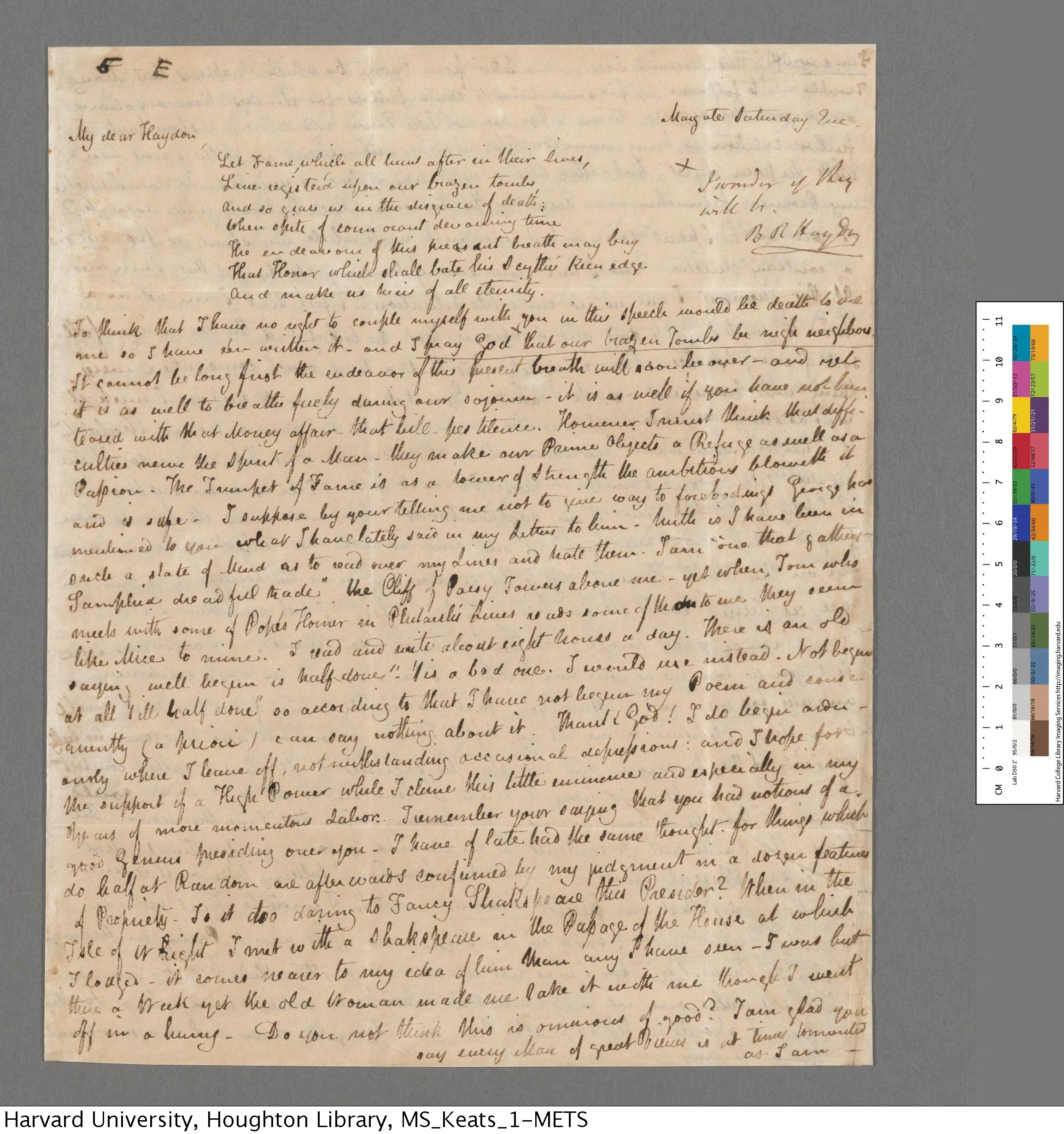
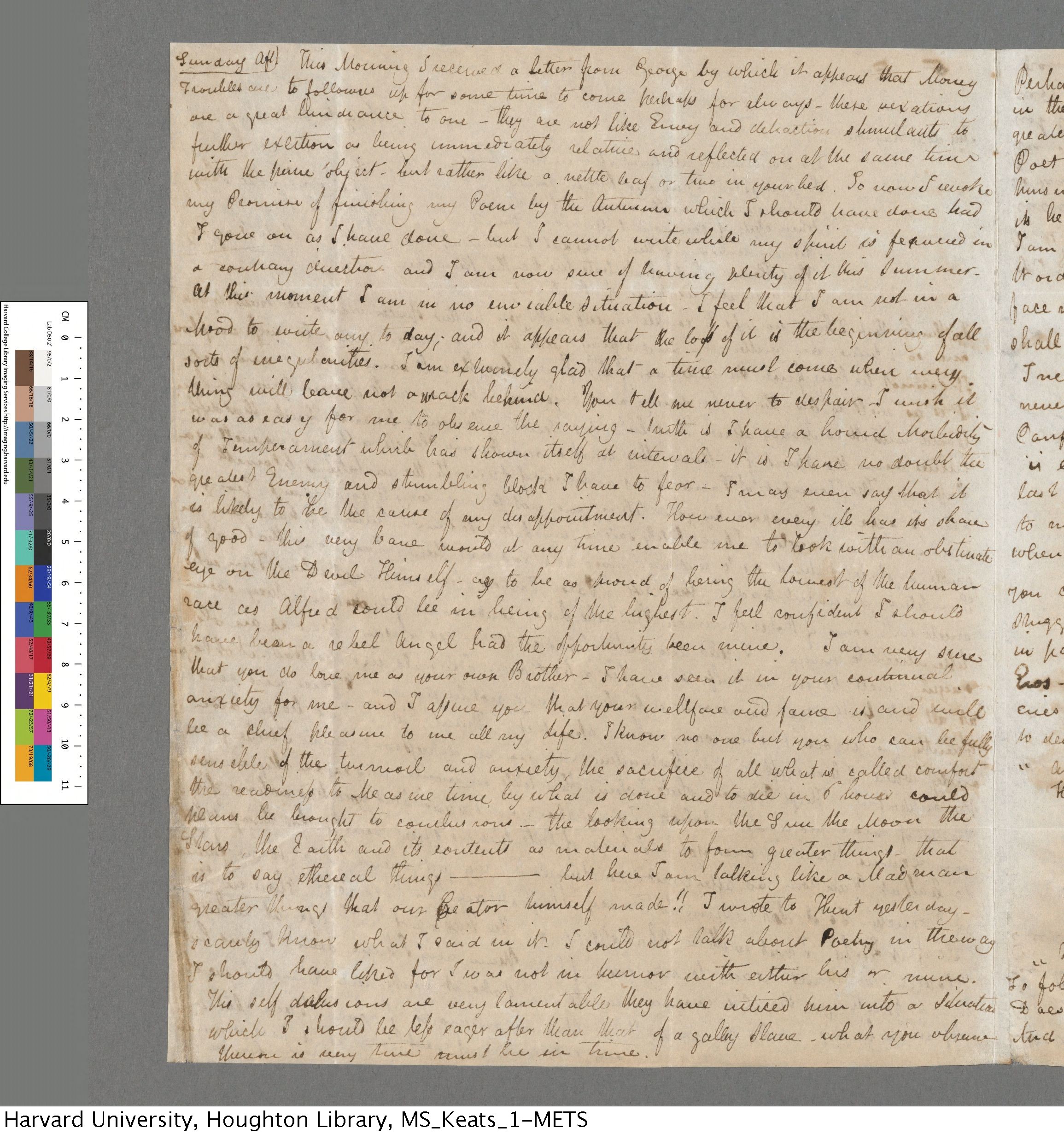
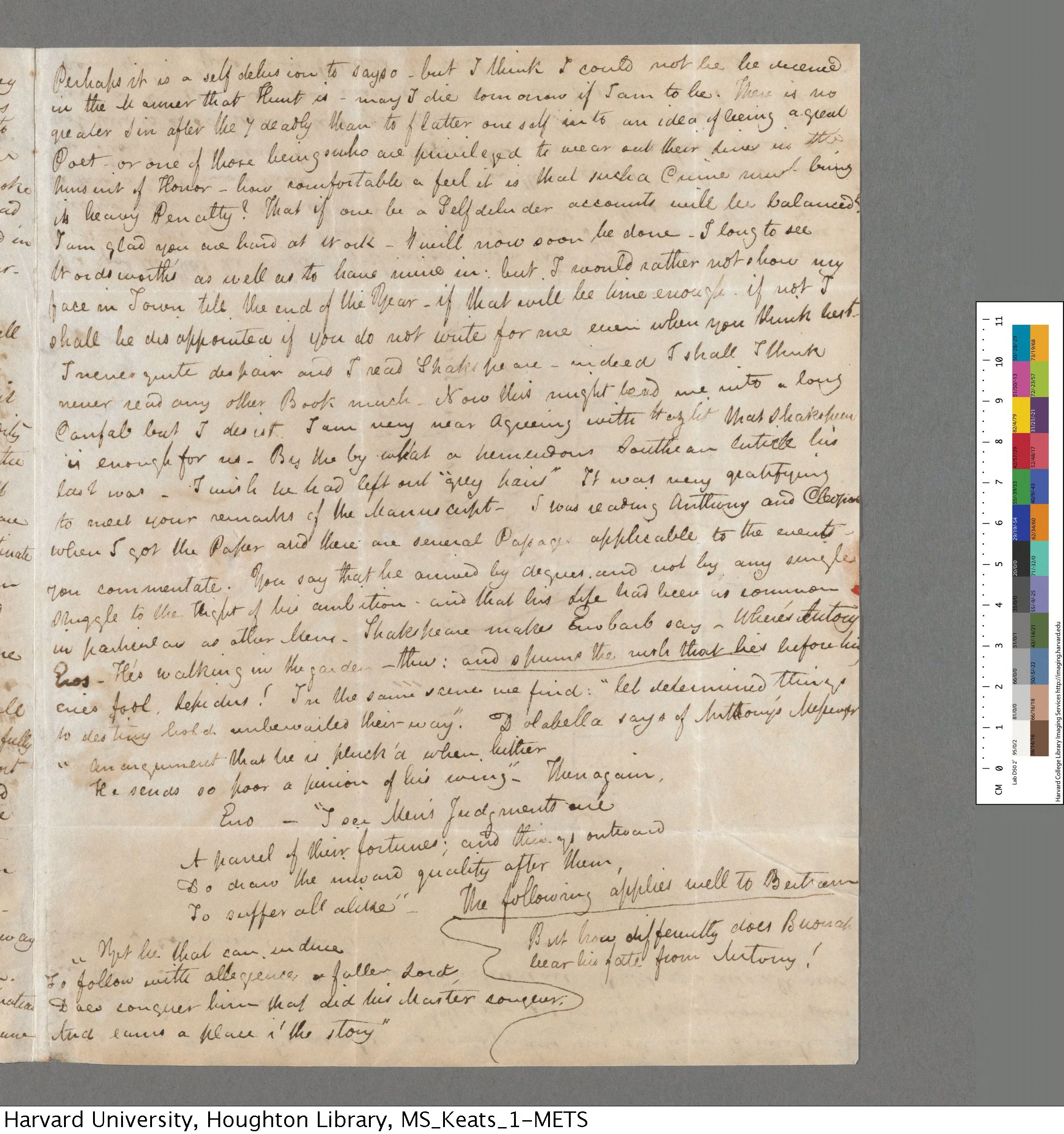
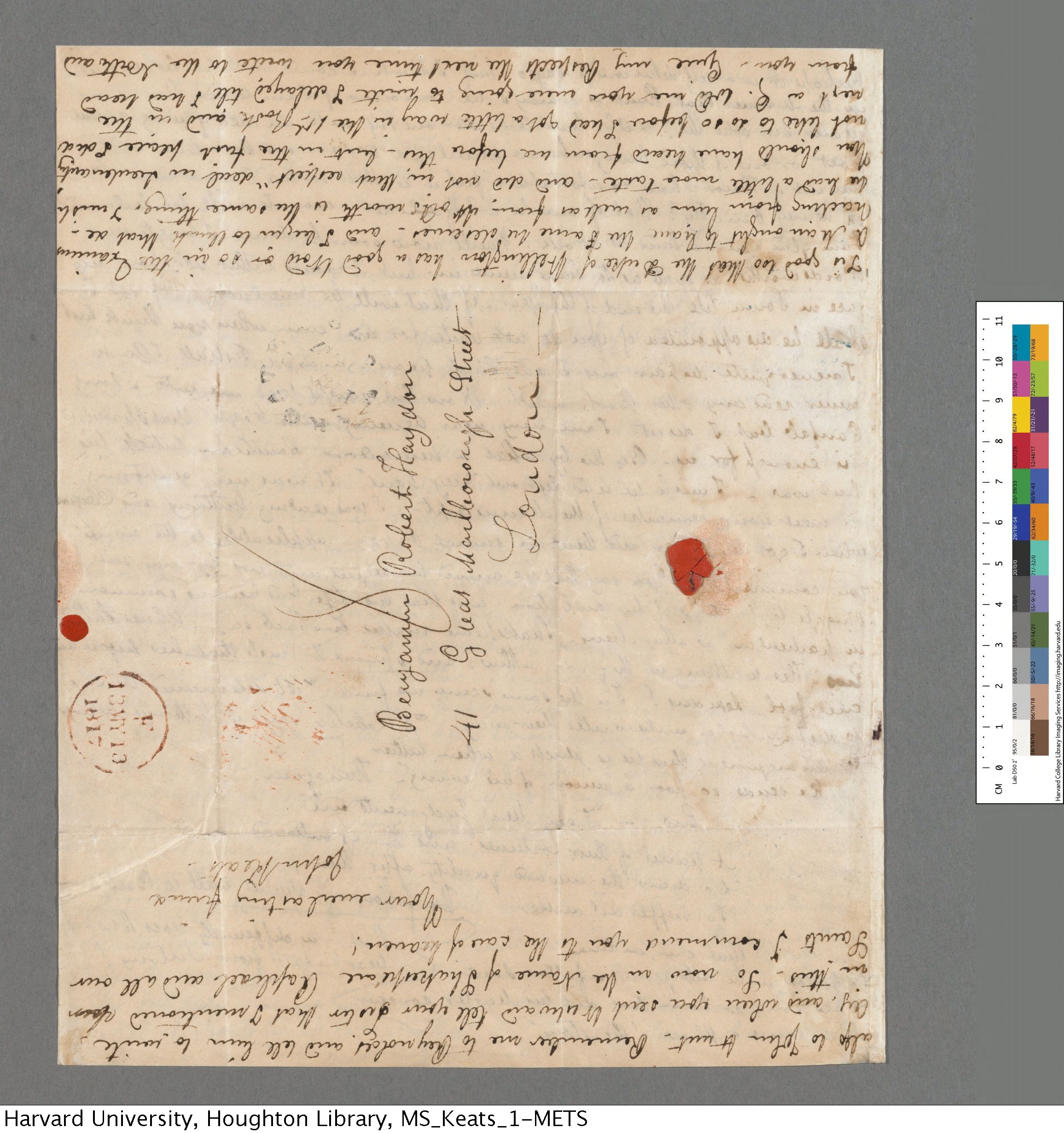
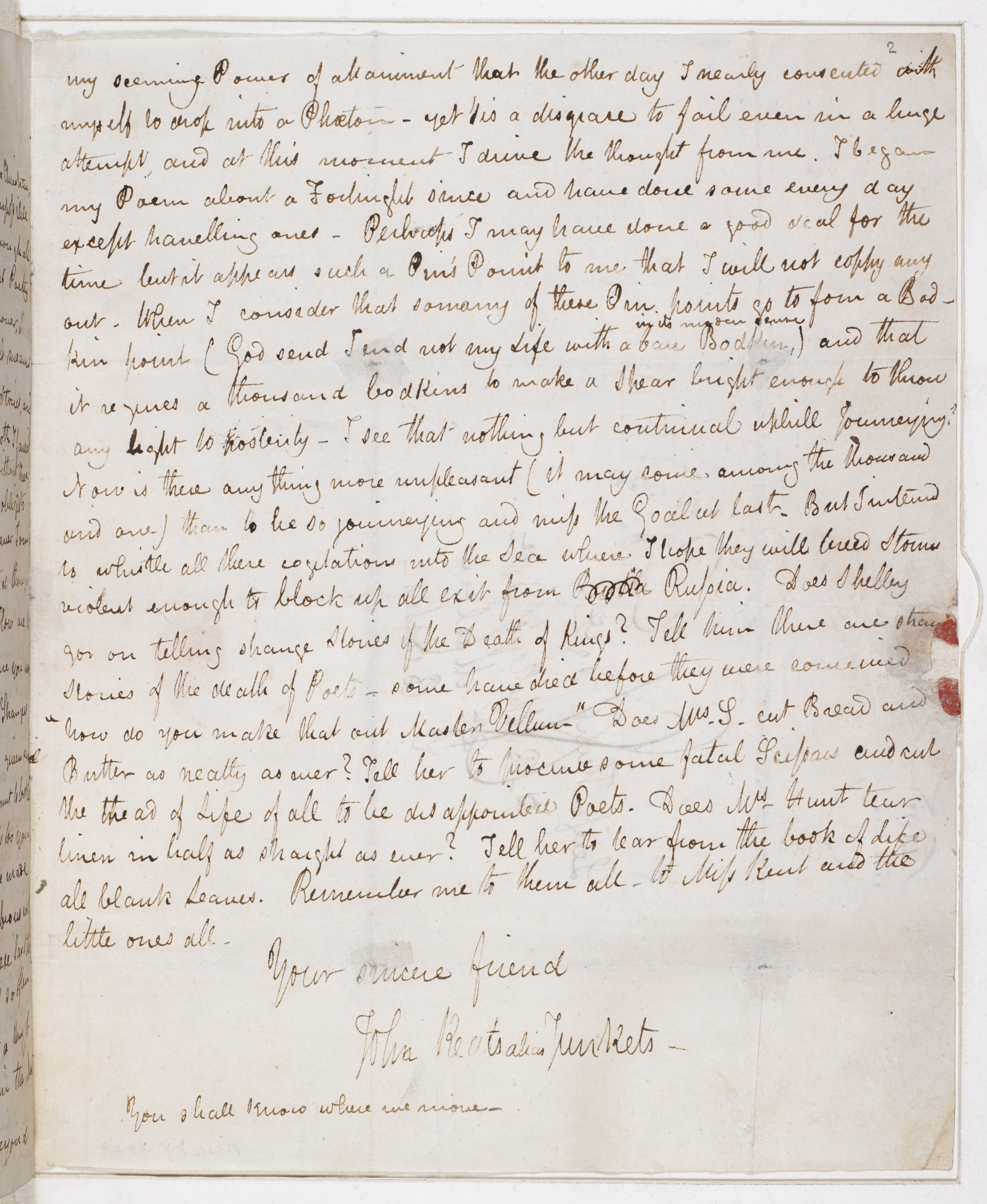
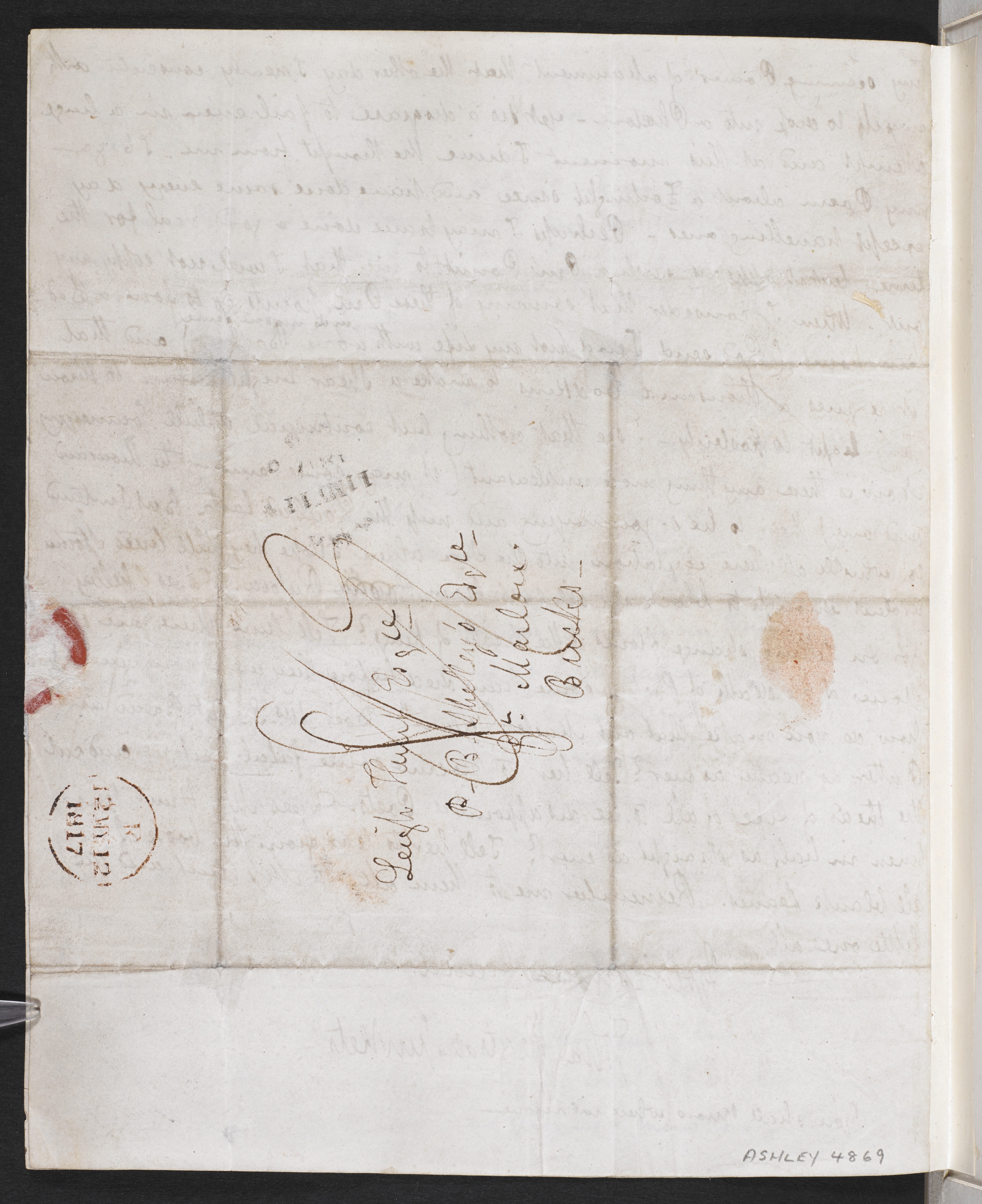
Letter #22: To Benjamin Robert Haydon, August 1817

Alas, it may seem now that warm days will never cease, but summer is indeed on its way out, ready to be replaced by autumn (which, we’re told, has its music too, so there’s that). Here at the KLP we’ve been on a bit of a summer break, thanks to a break in extant letters between June 10 and now. In that interval Keats had been hard at work on Endymion, of which he had completed about 2000 lines at this point. He’ll soon depart for Oxford to visit with Benjamin Bailey. During that time he’ll stay hard at work, proceeding through Book III. And unlike during the summer, we will now have a fairly steady stream of letters to keep us busy this fall!

One thing to note here at the KLP about the contingency of letter-writing and what remains of it for us to digest: there’s no doubt that Keats wrote far more letters than those that have survived in one form or another for 200 years. So although the KLP has been silent for a few months, Keats surely wasn’t in summer 1817. If the sole surviving letter from August gives us any hint, Keats was probably quite socially active while also working steadily on Endymion. So in the spirit of active sociability, for the response to today’s letter, we have for your viewing pleasure a new episode of This Week in Keats! We hope you enjoy the hilarity!

Quick details about this letter–we don’t know the exact date of it, but Hyder Edward Rollins suggests it was likely sent on 21 or 28 August 1817. We’re going with the latter date since we wouldn’t have been able to get the TWiK episode to you earlier (sorry!). In any case, in the spirit of accuracy and full transparency, we really only know for sure that the letter was written on “Thursday morning,” and 21 and 28 August are the best Thursday candidates.

Regarding this letter’s provenance, there are a few mysteries worth noting. First, the vast majority of Keats’s letters to Haydon come to us thanks to Haydon’s diligent habit of placing the letters into his diary, which passed down through his family until the early 20th century, when it was purchased by Maurice Buxton Forman. He then removed the Keats letters and sold them to Arthur Houghton, who presented them en masse to Harvard in 1952. A handful of extant letters to Haydon, however, followed different paths. Today’s letter is one of those. According to the Pierpont Morgan Library catalogue (where the MS still resides), the letter was purchased at auction in 1902, again in 1906, and then passed from Frank T. Sabin (a London-based collector) to J. P. Morgan that same year. The question that remains is what happened to the letter between its one-time place in Haydon’s journal in the 1830s-40s and its sale in 1902. The KLP remains agnostic for now.

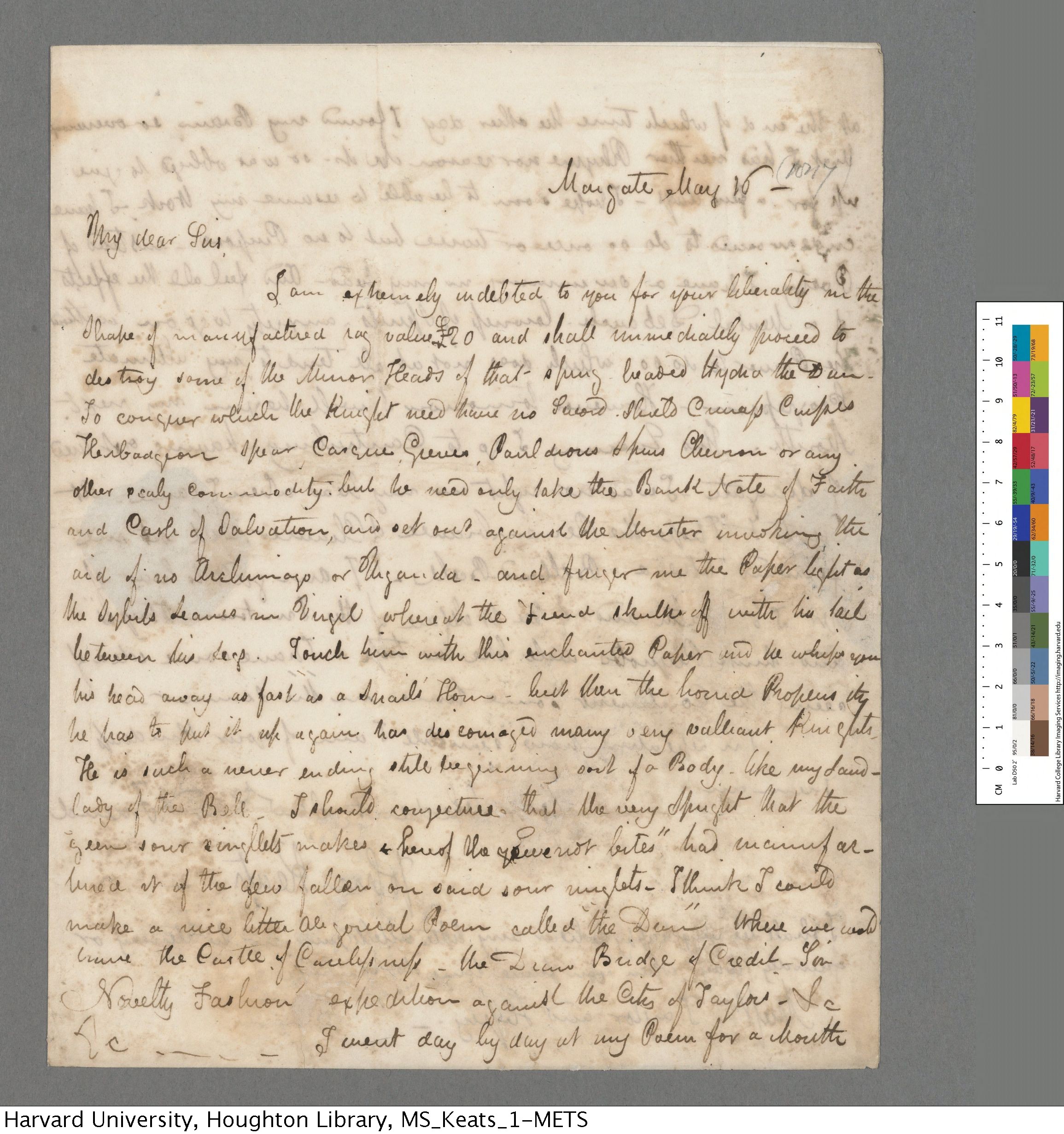
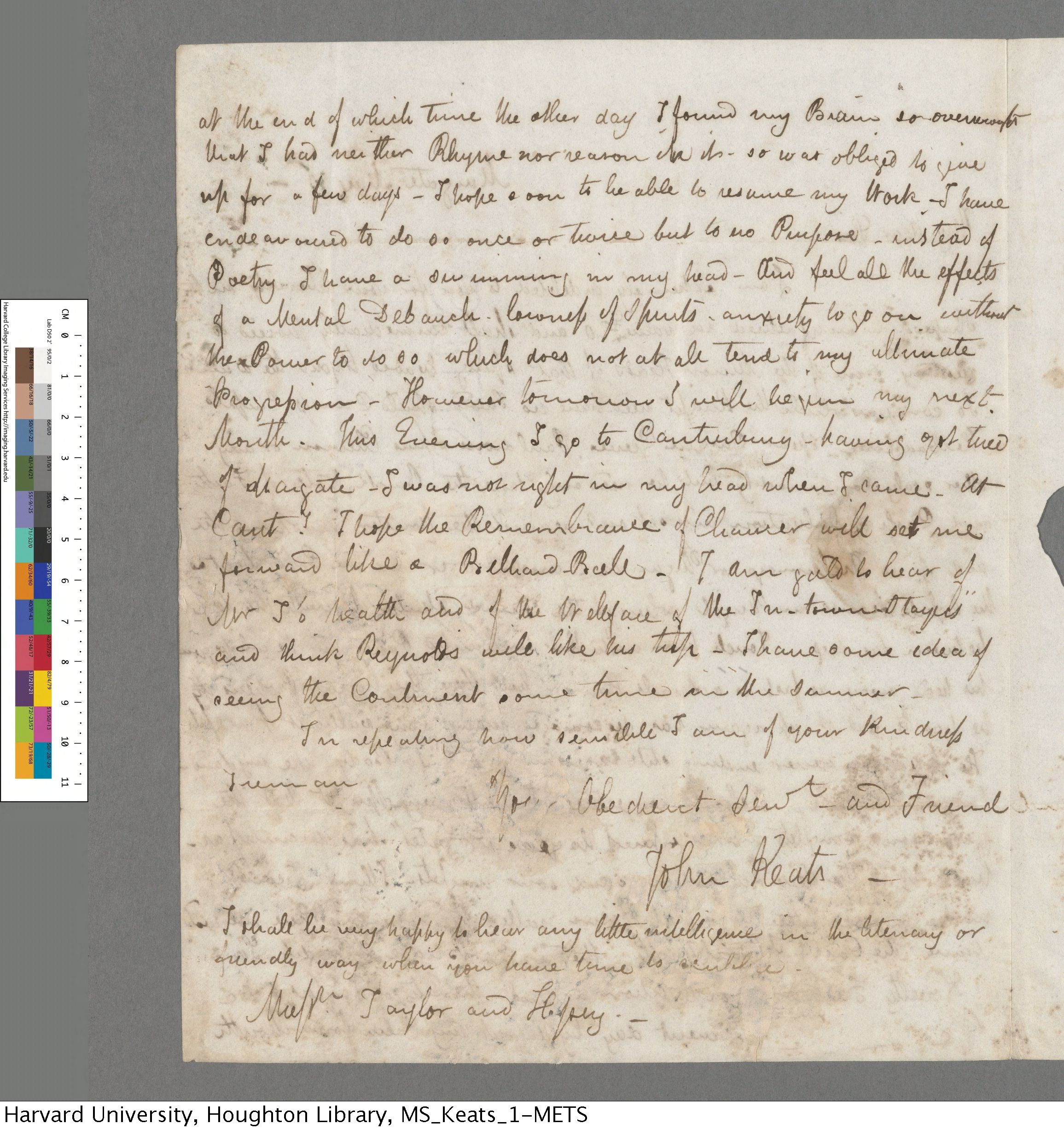
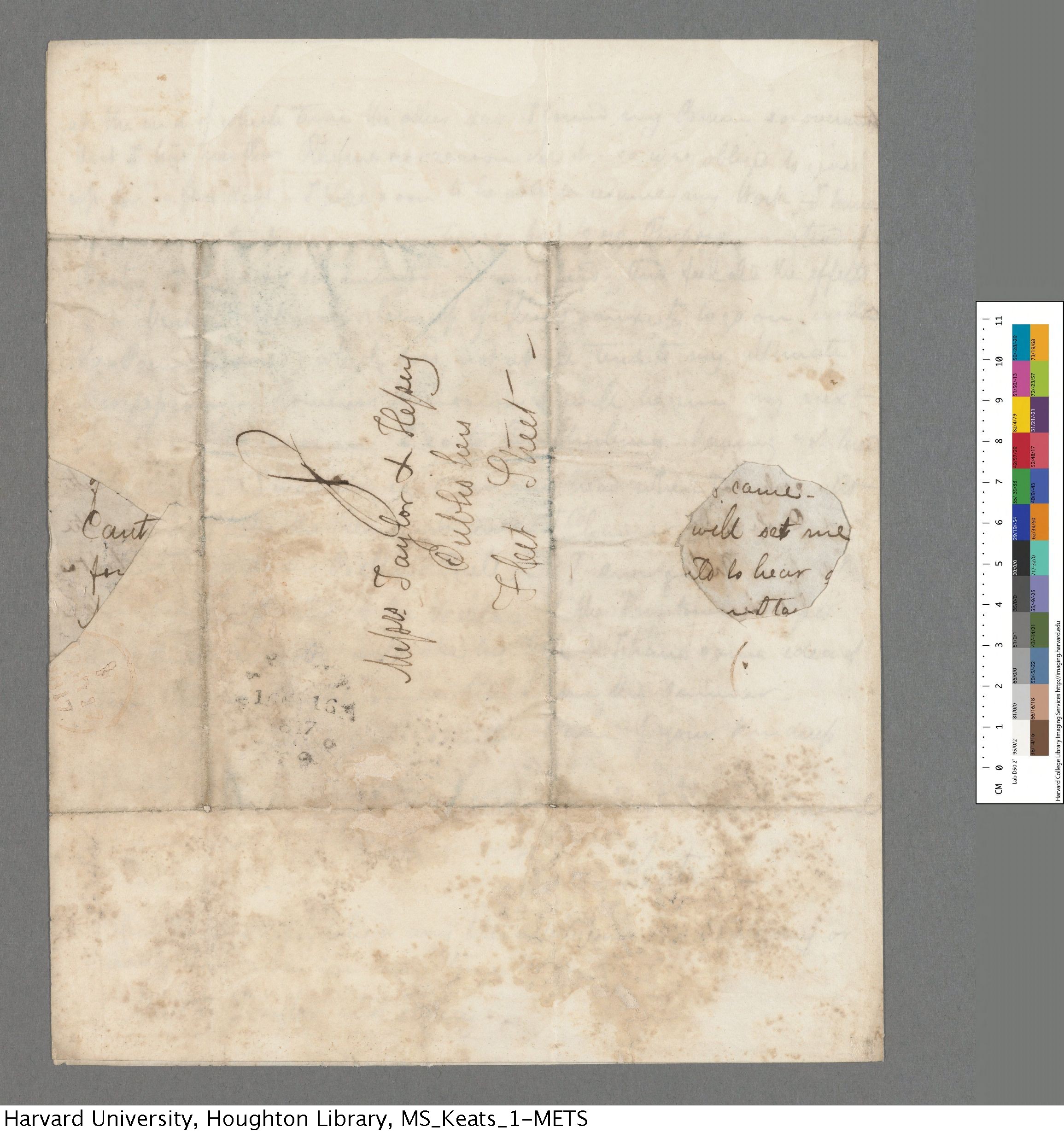
Because the letter did not follow the same path as many other Haydon letters, which made their way into print in the 19th century, it was not first published until 1925, when Amy Lowell published it in her biography of the poet. Copyright laws being what they are (1923 is so close!), that means no public domain editions exist online. If Google is so kind as you provide a preview of the same pages of Rollins’s edition that it currently provides us, you should be able to read the letter by following this link. As an additional measure, here is a screenshot of the letter (the KLP legal team, to the best of its knowledge, believes such sharing to be within the purview of fair use).
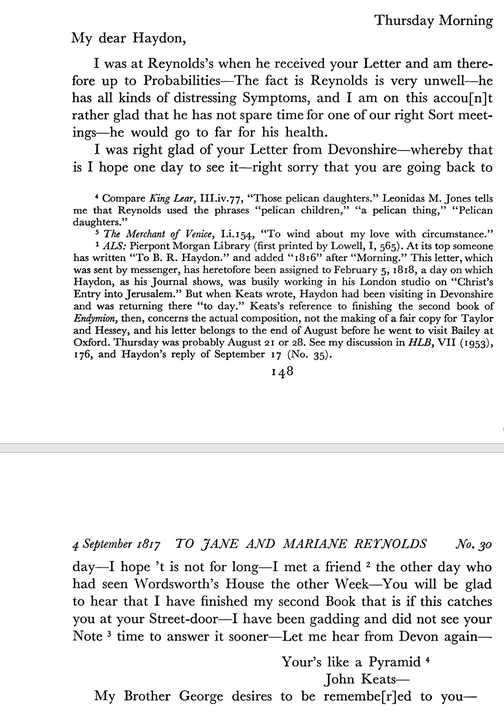
Keats’s letter to Benjamin Robert Haydon, Aug 1817 (probably 21 or 28 Aug)
Letter #21: To John Taylor and James Augustus Hessey, 10 June 1817

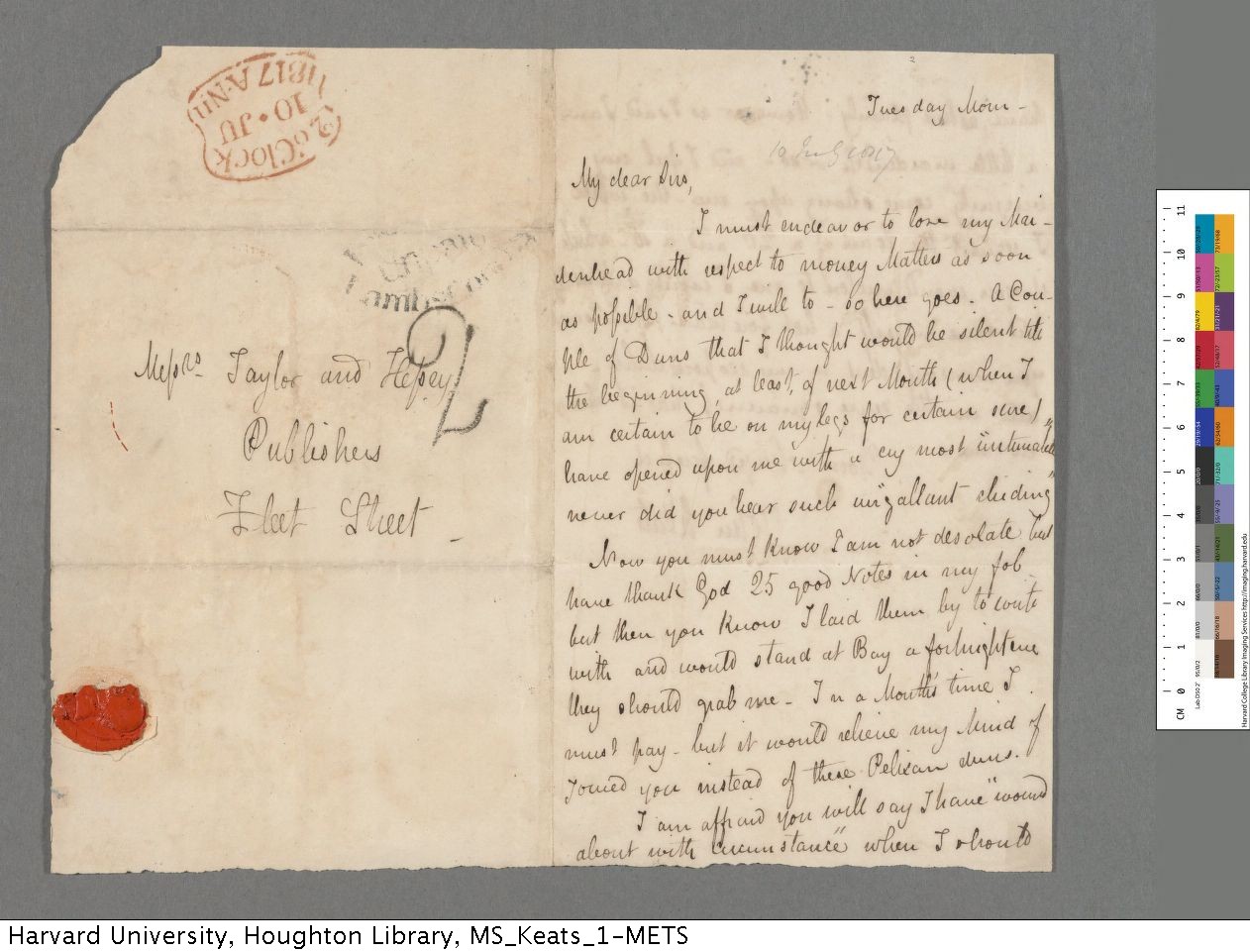
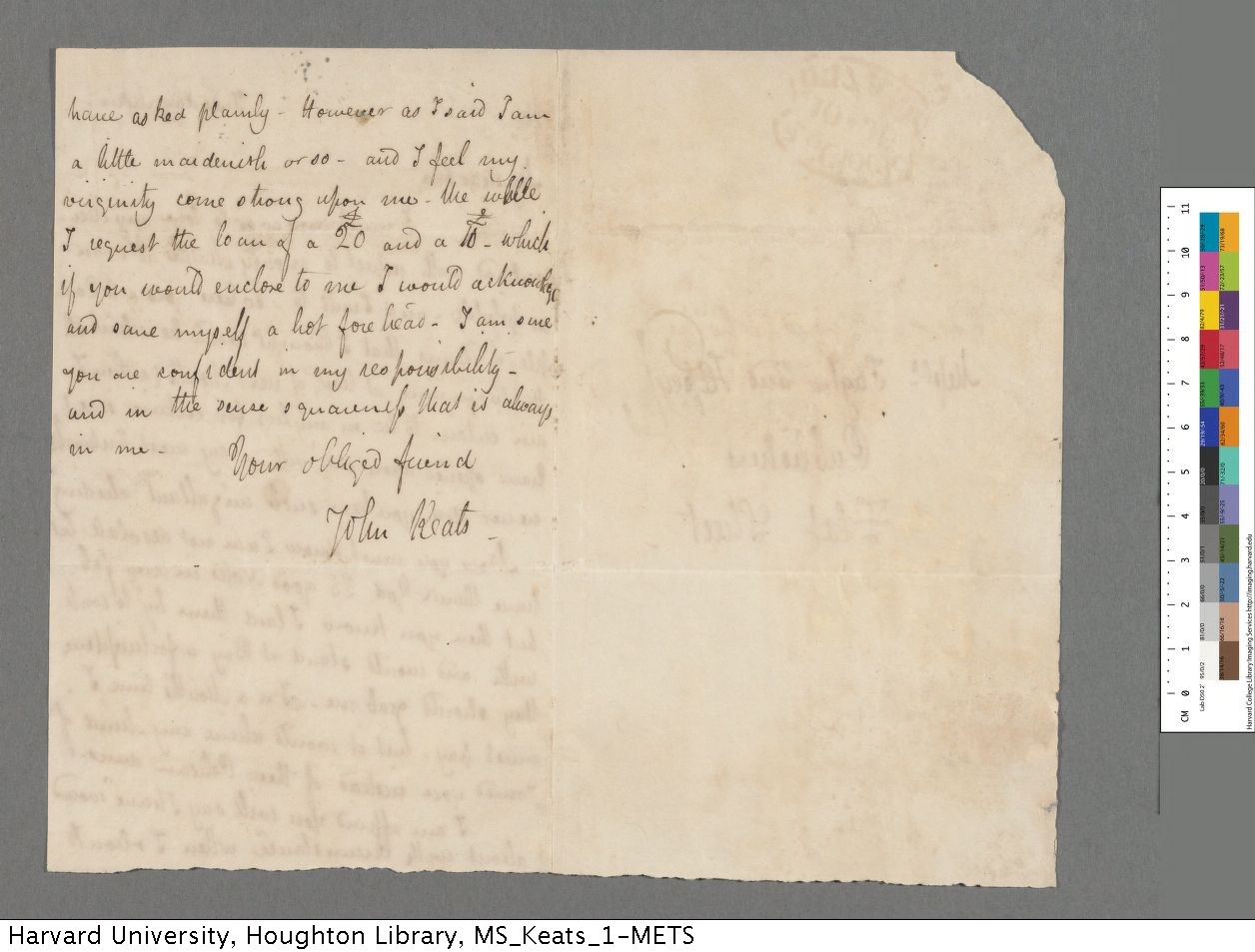
Today we encounter another letter focused on money issues. And just as we saw a month back with Keats’s 16 May letter to Taylor and Hessey, Keats again broaches the topic with some awkward attempts at humor. Really, this 10 June letter is a weird one. The main weirdness springs from Keats’s odd conceit of being a “Maiden” on the topic of money matters, anxious about losing his “virginity” by requesting money from his new publishers. As David Sigler points out in his virtuosic, rollicking response to the letter, it’s perhaps not the most effective way of asking for a loan in these circumstances. If you don’t laugh out loud while following along as Sigler ponders what Keats was thinking in crafting his financial request, then you might just hate laughter. And as is befitting of the author of Sexual Enjoyment in British Romanticism, Sigler examines the structure of Keats’s desire in the letter, and in so doing, he suggests it offers a tantalizing (though disappointing) first draft of The Eve of St. Agnes (with Keats himself in the place of the virginal Madeline). From a short letter concerning anxieties over scarce resources, Sigler creates a wealth of delightful insights for us to enjoy as we read.

In the spirit of commemoration, we thought we should also point out some intriguing details about this letter’s provenance. As remarked upon before, the majority of the letters between Keats and his publishers were sold at auction by Sotheby’s in 1903, and thereafter purchased by Amy Lowell, who bequeathed her Keats collection to Harvard in 1925. Well, since we’re talking about money, you might be interested to know that the Keats letters in Taylor’s possession (29 of them) were sold in one lot, to Bernard Quaritch, for the sum of £1070. Not too shabby! Using the MeasuringWorth calculator (thanks to David Sigler for bringing this tool to our attention in his post), that amount in 1903 would correspond to anywhere between £100,000 and £1,100,000 today (depending on what sort of estimate one uses). Come to think of it, I’d say that lot was a steal! The KLP would gladly pay that much for just one letter, let alone 29…

But what was that about commemoration, you ask? Well, today’s letter was sold on 8 or 9 June 1903, so almost exactly 86 years after it was first written. Another Keats treat did sell through Sotheby’s on 10 June: copies of all three of Keats’s books published in his lifetime. According to the advertisement in the Athenaeum of 6 June 1903, the “valuable Library of a Gentleman living in Yorkshire” went up for auction on 10 June, and it included Poems (1817), Endymion (1818), and Lamia, Isabella, and the Eve of St. Agnes (1820). We’ll forgive the Yorkshire gentleman for Poems and Lamia being still uncut when sold in 1903–even if he never read them, at least the books we’re effectively preserved. The books sold for £38, £30, and £60 respectively. Again, what a deal! Ah, to have been alive and moderately wealthy in 1903.

While the KLP pines away for Keatsiana sold long ago, we encourage you to forget any such troubles by reading Dr. Sigler’s response to cure whatever might ail you. The MS images, once again, come to us from Houghton Library at Harvard. And Forman’s 1883 edition once again supplies a decent public domain printed edition. Careful readers will note, however, that Forman excises the opening line for fear of his reader’s delicate sensibilities. And technically, since Forman didn’t have the MS, it’s really Milnes’s fault, since he made the excision in 1848, and Forman was just following Milnes’s text. No delicate sensibilities here! Keats begins with this opening: “I must endeavor to lose my Maidenhead with respect to money Matters as soon as possible–and I will to–So here goes.”


And one quick programming note before we go: there will be a bit of a letter hiatus after today. No more letters for summer until August! In the interim period, however, be on the lookout for other features, including a report on the Keats conference recently held at the Keats House in Hampstead, more pedagogy features, and another episode of This Week in Keats!


Letter #20: To John Taylor and James Augustus Hessey, 16 May 1817

As we’ve seen in the letters this spring, Keats has been on the move. When he last wrote to Taylor and Hessey (on 12 or 13 April), he had time (and paper) enough for but a “shabby affair” of a letter before leaving town. On 15 April Keats was in Southampton, from which he wrote to George and Tom (Richard Marggraf Turley’s response gives us an excellent account of what that journey from London to Southampton would have been like). For about a week, maybe a bit longer, Keats stayed at Carisbrooke on the Isle of Wight, where he began work on Endymion. While there he wrote to John Hamilton Reynolds, and for that letter we have not one, not two, but three fantastic responses! (Allison Dushane’s, Rosie Whitcombe’s, and Victoria Rego’s). Feeling restless and a bit too solitary, Keats relocated to Margate sometime around the last week of April and was joined there by his brother Tom. They would not remain there for long either, but Keats did write more of Endymion during those weeks, as well as three letters that have survived: to Leigh Hunt on 10 May (response from John Strachan), to Benjamin Haydon on 10 and 11 May (response from Mike Theune), and today’s letter to Taylor and Hessey. And then Keats sets off again! He’ll visit Canterbury and then Hastings (where he first meets Isabella Jones) before arriving back in Hampstead by early June.

In today’s playful letter to Taylor and Hessey, we see Keats addressing a topic that will remain a source of anxiety in future years: “that spring-headed Hydra the Dun.” Debts and other money matters will only get worse for the Keatses going forward. But now we see how funny Keats can be while discussing money. At the same time, one senses the uneasiness in Keats’s inclination to spin a plan for an allegory of debt when intending to simply express his thanks to Taylor and Hessey. We can also see that Keats’s relationship with his new publishers is a fresh one from the simple fact that he fills only two pages in this letter, and even adds a post-script at the bottom of the second page, perhaps after realizing that he ought to at least attempt to fill the whole of that second page. In this case it’s probably fortunate that the third page was blank, since the hastiness with which the letter was opened left a whole the size of the wax that had sealed the letter. One supposes that the busy publishers were trying to get through their correspondence quickly and didn’t realize that they might be eliminating precious words from the epistolary output of John Keats! Come on, Taylor and Hessey! The KLP forgives and forgets, though. And we thank the Taylor family for caring for these papers until they were sold at auction in 1903. Amy Lowell snatched up most of the Keats items from that sale the next year and bequeathed them to Harvard in 1925. We reproduce the MS images here courtesy of the Houghton Library, and we direct you once again to Harry Buxton Forman’s 1883 edition for a printed text (Forman most likely relied on Milnes’s 1848 or 1867 edition for this letter, not having the MS available to him).

For help understanding the broader historical and cultural context for Keats’s comments on debt and money, we have a response from Alex Dick. He expertly sketches that context, demonstrates its significance for writers during the period, and close reads the letter for an articulation of Keats’s thinking on value, monetary and poetic. Enjoy!


Letter #19: To Benjamin Robert Haydon, 10/11 May 1817

One can’t help but feel a bit sorry for Leigh Hunt when reading this letter to Haydon–the very day after Keats sent a friendly letter to Hunt, here he is in the letter to Haydon saying some pretty nasty things about Hunt! It’s Keats at his meanest and gossipyist. Hey, we never said Keats was perfect. However, as Michael Theune points out in his ambitious response for today, Keats does show remarkable self-awareness about his own meanness, his tendency toward a “horrid Morbidity of Temperament.” Theune also makes a compelling argument linking Keats’s negativity here with his more famous negative capability, the letter for which we’re all counting down the months and days until this December! We may be a bit partial since Theune is one of the KLP founders, but we find his response to be quite illuminating. We hope you will too!

On a more somber note, it’s worth pointing out that contrary to Keats’s wish at the beginning of the letter (“I pray God that our brazen Tombs be nigh neighbors”), they’re actually about a thousand miles apart. When Haydon received the letter in 1817, he underlined the phrase and wrote a note above it, “I wonder if they will be.” In November 1845 when Haydon copied the letter to send to Richard Monckton Milnes, he slightly changed the note, reading instead “Perhaps they may be.” On 28 May 1846, Haydon sent along to Milnes the original of the letter as well. And just over three weeks later, on 22 June, Haydon took his own life. Alas, his brazen tomb is in London, at the Church of St. Mary in Paddington. The gravestone has seen better days, the cemetery is not nearly as lovely as the Protestant Cemetery in Rome, and fame may not exactly be registered on the tomb. But Haydon and Keats nonetheless remain linked together as “heirs of all eternity.” Or at least some of eternity.

The MS images come from Harvard’s collection, and the 1883 Forman edition offers a good printed text.


Letter #18: To Leigh Hunt, 10 May 1817

The story of Keats’s early years cannot be told without considering Leigh Hunt, the indefatigable poet, essayist, and editor who, among other things, published Keats’s first poem (in The Examiner, before he and Keats had ever met in person), introduced him to the literary circle gathered around him in London during these years, and continued to champion the poet after his untimely death in Rome in 1821. Curiously enough, however, only two letters from Keats to Hunt still exist: today’s letter and a brief one from late in 1820.

In addition to this letter being the first to Hunt, it has another significant honor: it is, as far as the KLP knows, the first of Keats’s letters to ever appear in print. Thanks here go to Susan Wolfson for pointing out sometime last year to one of the KLP founders, who shall not be named for fear of the opprobrium that would surely be heaped upon him for his egregious oversight, that his assertion that the first Keats letters to appear in print were the two published by James Freeman Clarke in The Western Messenger in 1836 was, in fact, wrong. Hunt beat Clarke to it by 8 years! Ok, we admit–it was that dastardly Brian Rejack who made the mistake. For his crimes against Keats, his status at the KLP is currently under review.

Back to Hunt. It was in his 1828 Lord Byron and Some of His Contemporaries that Hunt published the greater part of Keats’s letter (he excised a few things, most notably Keats’s congratulations for Hunt’s recent Examiner essay, which he described as a “Battering Ram against Christianity”). The chapter on Keats was also one of the more extensive biographical treatments to have appeared by that point. It reinforced some of the elements of the narrative established powerfully by Percy Shelley in Adonais, namely that Keats was a delicate flower rudely cut down in his prime by harsh criticism from the periodicals, a narrative that we now know had more to do with Shelley’s own axes to grind than with the truth of the situation. One delightful detail from Hunt, whether it be true or no, we feel we ought to share here. He claims that Keats, as did Byron and Shelley, had a “head [that] was a puzzle for the phrenologists, being remarkably small in the skull.” Hunt adds of the three small-skulled poets, “none of [their] hats I could get on.” Who knew?

In today’s letter Keats does not discuss skull size, which is a shame. But the letter is a lively one, with Keats ranging across many topics, and with him seeming to be in particularly good cheer, an appropriate mood with which to meet his correspondent, Hunt being the great Cockney champion of cheerfulness. In that same spirit, our response for today comes from John Strachan, who imagines what one of Hunt’s poems from his series written as “Harry Brown’s Letters to His Friends” might have looked like if he had written one to Keats. Strachan certainly captures Hunt’s voice as he responds to Keats’s letter in verse. Enjoy!

Images of the MS come to us courtesy of the British Library. You can read the letter in Hunt’s 1828 book, or if you prefer a fuller text of it, Forman’s 1883 edition is based on the MS without any excisions.

Page 1 of Keats’s 10 May 1817 letter to Leigh Hunt. Courtesy of the British Library. Click for full size image.

Page 2 of Keats’s 10 May 1817 letter to Leigh Hunt. Courtesy of the British Library. Click for full size image.

Page 3 of Keats’s 10 May 1817 letter to Leigh Hunt. Courtesy of the British Library. Click for full size image.

Page 4 of Keats’s 10 May 1817 letter to Leigh Hunt. Courtesy of the British Library. Click for full size image.

Letter #17: To J. H. Reynolds, 17/18 April 1817

Since we last encountered Keats writing to his brothers from Southampton on 15 April, he’s continued on his journey and acquired lodgings at Carisbrooke. Wikipedia will tell you that this village on the Isle of Wight is “best known as the site of Carisbrooke Castle,” but the KLP editors respectfully disagree–it should be remembered for hosting Keats for 10 days 200 years ago! We may be biased. In any case, Keats should at least be mentioned on the Wikipedia page for Carisbrooke! Sad. In Wikipedia’s defense, though, it is a pretty castle.

The gatehouse at Carisbrooke Castle.

Keats claims that he could see the castle from his window, which has led some to speculate on where exactly Keats might have been lodging. Hyder Edward Rollins notes the history of some argument between a Mr. W. H. Wadham, Louis Arthur Holman, and Maurice Buxton Forman; the former two suggest Canterbury House (pictured below via Google’s all-seeing eye) or another building on Castle Road; Forman disagrees with them both; Rollins offers no opinion. Should the KLP settle the matter one day, we shall share the results of our inquiry. For now, here is where Keats might have stayed:


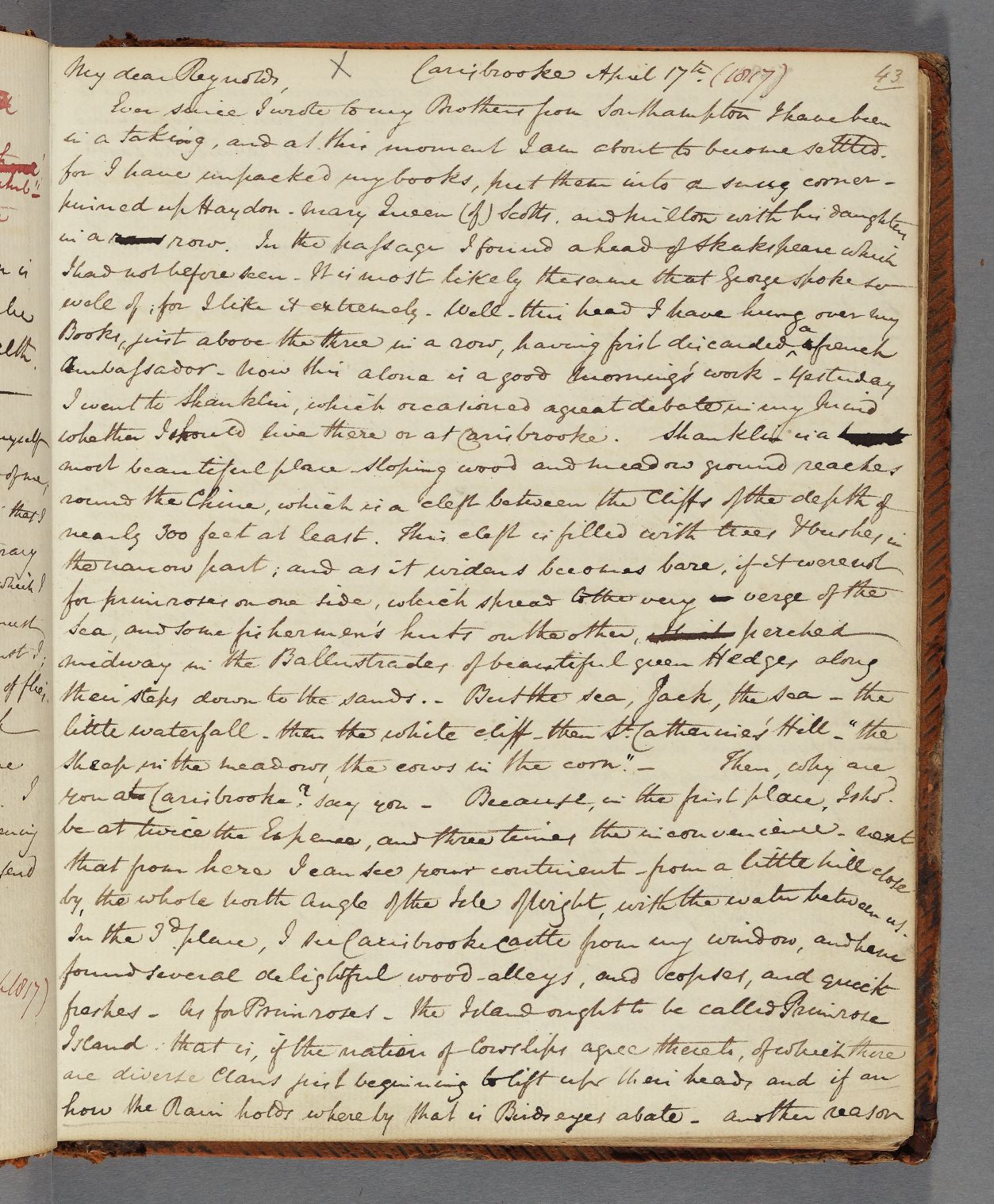
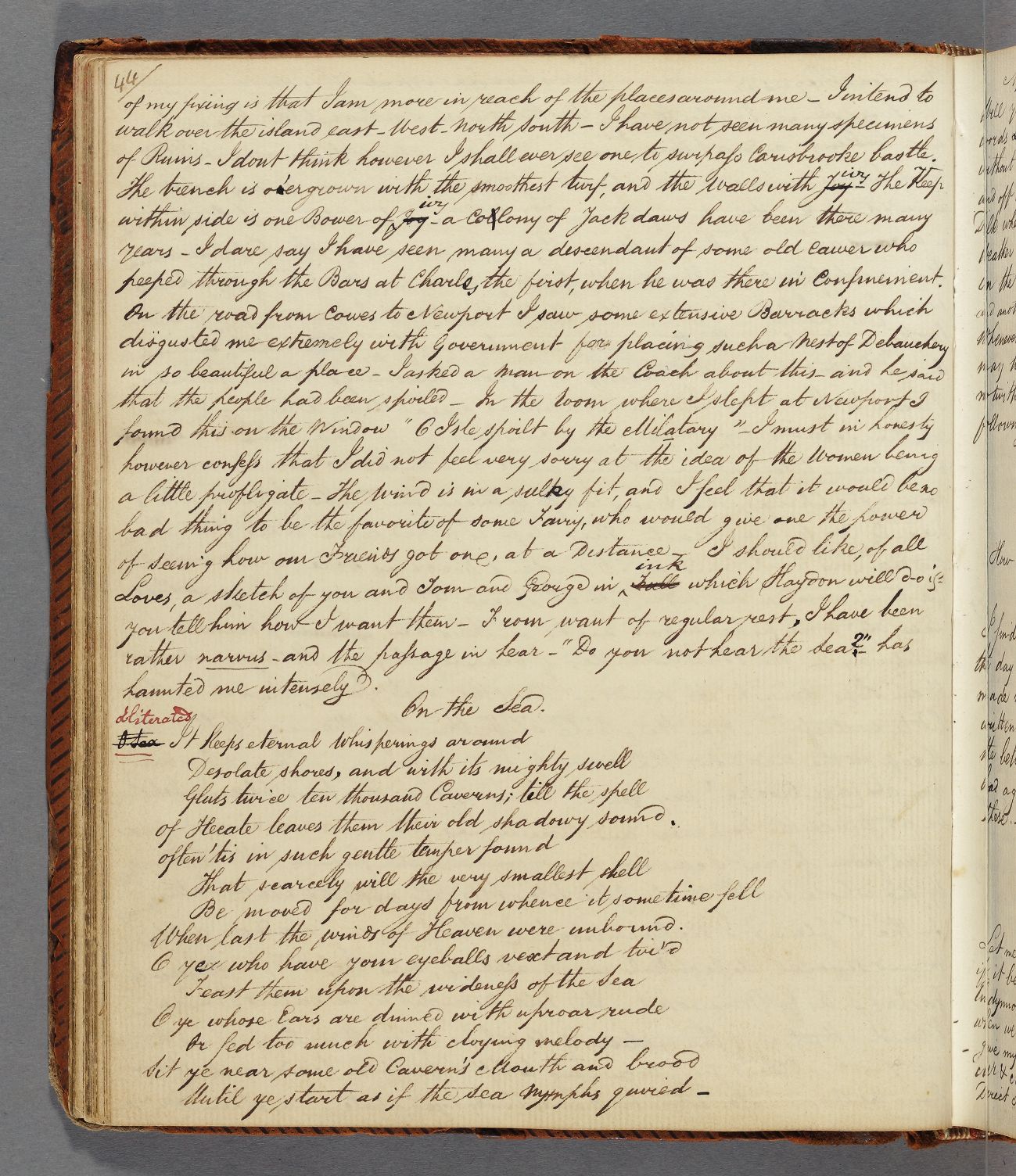
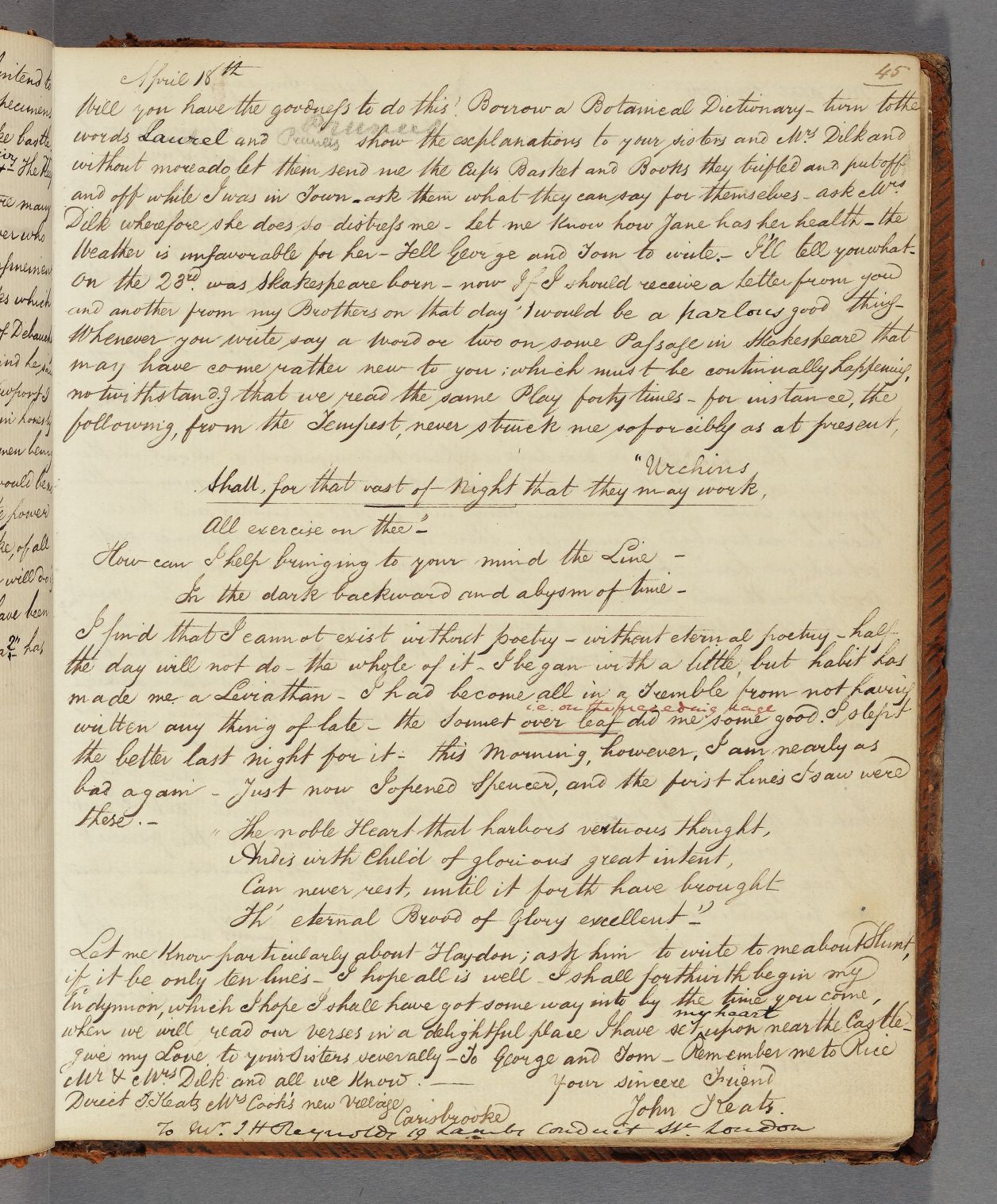
As Keats settled in, at the above building or elsewhere, he wrote a letter to his pal Reynolds in two sittings across two days. It is simply lovely. The proposal that the island ought to be named “Primrose Island,” but only if the “nation of Cowslips agree there to”–pure Keatsian gold! And we encounter in the second section of this two-day letter what could arguably be called the most famous phrase from the letters we’ve read thus far: “I find that I cannot exist without poetry.” We daresay there are some devoted Friends of Keats out there who have that phrase tattooed on their bodies. And, no, to the best of our knowledge, no KLP editors have Keats’s words tattooed on them, but now that we think of it, that really is something we ought to rectify.

Now, as today’s letter spans two days, the KLP has responses for you for today and tomorrow. First up is Allison Dushane (Angelo State University), who wonderfully captures Keats’s narvus state as he arrives in Carisbrooke and gets to the work of writing Endymion. She demonstrates how Keats in this letter poses his relationship to poetry as a bodily one–his narvus-ness is not just about unease, but a more general state of responsiveness to the world around him, including the poetry (and poets) all around him (Shakespeare, Spenser, and Milton in this letter).

Tomorrow we’ll feature a response from Rosie Whitcombe (Birmingham City University). She focuses on a topic that Keats contemplates throughout his correspondence, and particularly in later letters when he’s sending packets across the ocean to his brother George and sister-in-law Georgiana: the limitations of epistolarity. These letters from spring 1817 are the first ones we have of Keats writing at a greater distance than within the bounds of London. As such, he finds himself tasked with how his letters can attempt to bridge that distance, even while reminding that the distance exists. Whitcombe’s response both illuminates these dynamics in this letter to Reynolds and gestures toward later letters in which similar dynamics will become even more pronounced.

And because we have a break in letters until May 10, the KLP will generously share a THIRD response to today’s letter during the interval. That final response (exact date TBA) is a special treat, as it is the first response written by an undergraduate student: Victoria Rego, a student at the College of Charleston in South Carolina. The KLP has several pedagogy-related initiatives in the works, and more broadly we aim to support and promote work by students on the site itself. Rego’s response will be the first entry toward that end. Look for it in late April or early May.

As mentioned back in March with the first letter to Reynolds, the vast majority (18 out of 21) of Keats’s letters to Reynolds come to us via transcripts from Richard Woodhouse. All are available via the Harvard Keats Collection, which we kindly (and with permission) reproduce for you here (click the images for the full size images). And for a readable printed edition, we suggest the same edition mentioned with the previous letter, Harry Buxton Forman’s 1883 volume.

Letter #16: To George and Tom Keats, 15 April 1817

One supposes that at some point we’ll run out of firsts to commemorate, but today is certainly not that day. Keats’s letter sent two hundred years ago today is the first extant letter sent to his brothers George and Tom (we’ve already encountered his epistle to George, but this letter is the first one we have that was addressed to both brothers). Looking forward a bit, the second extant letter to George and Tom comes in December of this year, and… wait for it… it is none other than the negative capability letter! Mark your calendars for December 21-27–the KLP will have plenty of negatively capable action on the docket for that week.

Today’s letter is another breezy one, though much longer than the note to Taylor and Hessey from a few days back. As he was in that letter, Keats is on the move and in a hurry today. He manages a breathless account of the many sites encountered on his journey from London to Southampton, from which he sends his letter before departing on a ferry to the Isle of Wight. Richard Marggraf Turley’s response matches the energy and wit of Keats’s letter point for point. With remarkable detail, precision, and insight, Marggraf Turley reveals a great deal about the landscape Keats traversed on his journey, and also about the rapidity with which Keats was indeed, literally and figuratively, “going places.” We daresay Marggraf Turley’s essay will both instruct and delight!

We present the images of the original MS courtesy of Princeton University Library, which acquired the letter relatively recently: in 1972 as part of the Robert H. Taylor Collection. Taylor amassed a collection of some 7000 items, among which were six of Keats’s letters. A small curious detail which may be of interest only to the most arcane of KLP readers: for his 1958 edition of Keats’s letters, Hyder Edward Rollins printed four of these six letters with the MSS as his copy texts, but not the other two, which included today’s letter to George and Tom, and a March 1820 letter to Fanny Brawne. That is to say, Rollins certainly knew Taylor owned four of the six–did Rollins not know of the other two in Taylor’s possession? Or perhaps Taylor came into possession of today’s letter and the Fanny Brawne letter sometime after the 1958 publication of Rollins’s edition? Perhaps Taylor just wanted to keep two of his letters secret from Rollins?? Hard to say. In any case, today’s letter was printed by Rollins using Harry Buxton Forman’s 1883 edition as the copy text. And it turns out Forman did a solid job of editing–feel free to compare Forman’s edition against the images, which we present for your viewing pleasure below.

**UPDATE**
Of course, we were just kidding about Taylor hiding two of the manuscripts from Rollins. Now we can confirm that Taylor acquired this letter quite late: in late 1976 or early 1977. The Princeton University Library Chronicle for Winter-Spring 1977 features essays dedicated to Robert H. Taylor and the collection named after him. In the issues opening essay, the volume editor Robert J. Wickenheiser informs us that Taylor continues to actively collect. Among the list of his most recent acquisitions (“within the past six months”) is Keats 15 April 1817 letter to George and Tom. The question remains, however: from whom did Taylor acquire it? We know that Rollins in 1958 explained that the MS “was owned by MBF [Maurice Buxton Forman].” For how long and when he owned it is unclear. But the letter was once pasted into Haydon’s diary (likely given to him later in 1817). MBF bought Haydon’s diary in 1932 and removed the Keats letters which were still pasted in it. He seems to have sold some if not all of those. For now, then, that’s all the info we’ve got.


Letter #15: To John Taylor and James Hessey, 12 or 13 April 1817

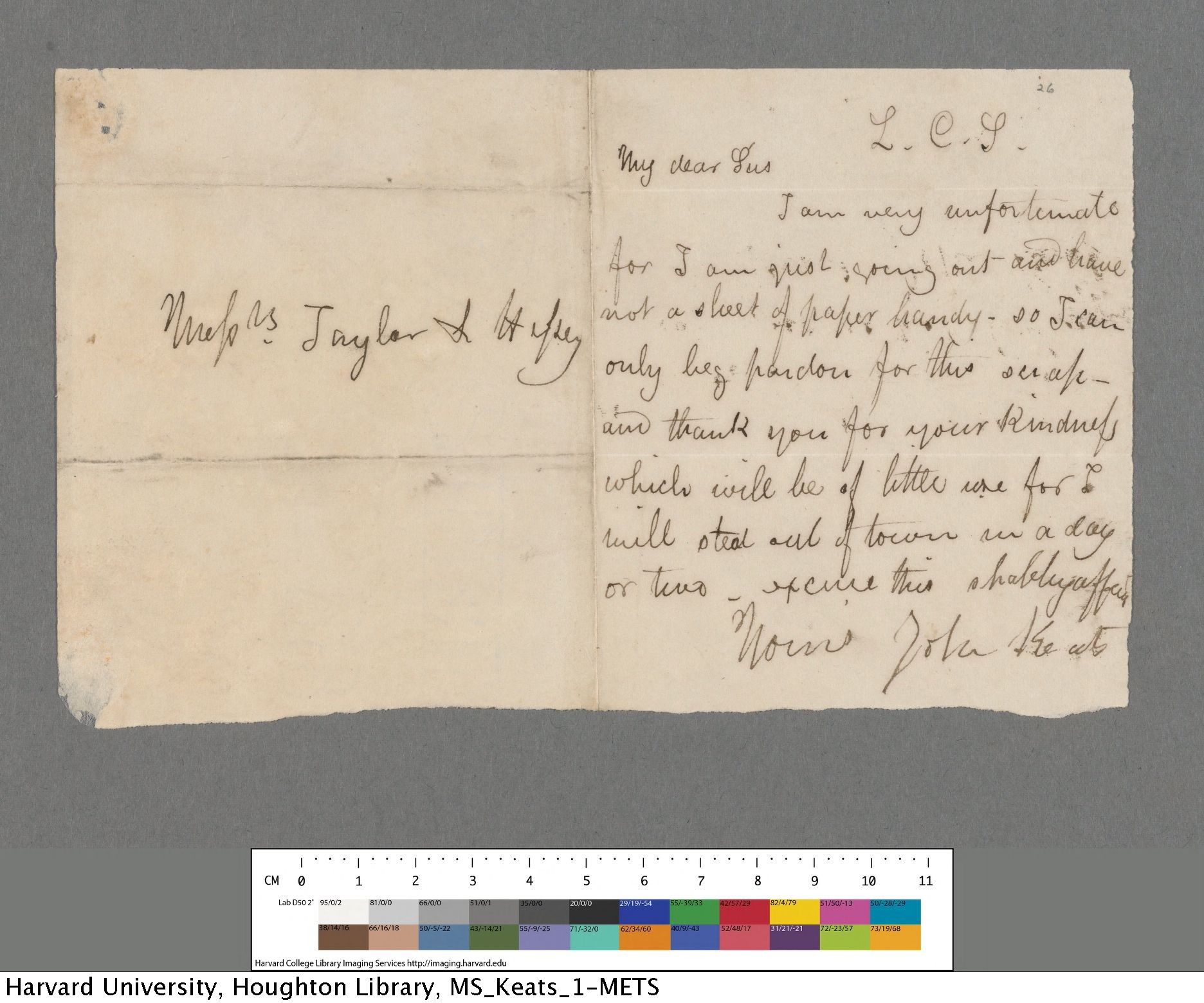
Today’s letter is the first Keats sent to the two men who would become his new publishers, John Taylor and James Augustus Hessey. The brief note is essentially a courtesy hello, in which Keats apologizes for not having more time (or paper) to say more than that. Nonetheless, we sense a bit of his excitement coming off of the recent publication of his first volume, and his eager anticipation for the next project that Taylor and Hessey will help usher into being. That next project is, of course, Endymion, about which we’ll hear much more in coming weeks and months as Keats begins writing it.

Although we’ve had earlier opportunities to do so, today is the first time we’re introducing Amy Lowell into the story of Keats’s letters. Lowell was truly one of the great Friends of Keats. Her 1925 biography certainly put down a hefty deposit in the ledger of friendship toward Keats. But she was also a great collector of Keatsiana. Between 1900 or so and her death in 1925, she acquired many manuscripts of Keats’s letters and poems, and that collection formed the early bulk of Harvard’s Keats Collection. Incidentally, she was not the only Lowell (the illustrious Boston family) who was a friend of Keats. The KLP does not specialize in genealogy, so we’re not sure exactly how to characterize Amy Lowell’s relationship with James Russell Lowell, but we can say with confidence that Amy’s great-grandfather was James’s uncle–so, grandcousins? We’ll learn more about James Russell Lowell in 2018, because in the 1830s he befriended George Keats in Louisville, and through their friendship secured permission to publish two of Keats’s Scotch letters from summer 1818. (Updated on 27 April 2017: See the note below about not trusting us–this brief digression about James Russell Lowell is wrong on one slightly important detail: he was related to Amy Lowell, but he never traveled to Louisville in the 1830s. The KLP confused him with James Freeman Clarke. Forgive us, please. You’ll hear more about him later. James Russell Lowell may one day make another appearance, either in a lie or an actual fact).

But back to Amy Lowell, who acquired today’s letter, along with about two dozen other ones, at a Sotheby’s auction of Taylor family papers in 1903. One pines for those heady days in the late-19th and early-20th centuries when so many Keats manuscripts were coming up for sale. It seems unlikely that anyone anytime soon will acquire dozens of such treasures over the space of just a few years. Alas, the KLP does its best to provide some sense of encountering the objects in other ways than physical possession. And we wholeheartedly thank the great archival institutions like the Houghton Library at Harvard for helping make access possible. Here is an image of Keats’s letter courtesy of Harvard.


For our response to today’s letter, we have a special treat. We don’t mean to boast or anything, but we have for you an exclusive story that we’re breaking here today. It turns out that there is more to the history of this letter’s movements than we previously thought. The KLP is happy to announce that it has learned that Keats’s letter was originally intercepted by another recipient and then passed on to Taylor and Hessey!! And we are reproducing here today the accompanying message that the accidental recipient sent along with Keats’s scrap of a note. So head on to our next post to see our new discovery!

**The KLP adheres to the notion that Beauty is truth, truth beauty. As such, you probably shouldn’t trust us.**

Letter #14: To Charles Cowden Clarke, 25 March 1817

Today we return to the early friend and mentor of Keats, Charles Cowden Clarke, about whom we heard a great deal during the first year of the KLP. Five of the ten letters from 1816 were addressed to Clarke. To the shock of the KLP editors, we realized only upon preparing for today’s letter that it is in fact the last extant letter from Keats to Clarke! The two, of course, remained friends, but certainly after the spring of 1817 they saw less of each other. It seemed like we were just getting to know friend Charles, and now he’s about to disappear from Keats’s epistolary record.

Now, it’s worth reminding our dear readers that for each letter which has survived, there are probably another dozen which have not (caveat: not a mathematically sound or statistically informed estimate). According to Clarke himself, there’s at least one other letter from Keats to him, written in the aftermath of young Tom Keats’s death in early December 1818. In the close of Clarke’s 1878 Recollections of Writers (a work discussed in an earlier post about another Clarke letter), he notes that Keats expressed to him his “firm belief in the immortality of the soul,” a belief he says the recently departed Tom also held. (In other letters Keats’s belief seems less firm.) Surely some other letters were sent and received long after 25 March 1817 as well.

Speaking of lost letters, we’re lucky to have today’s letter! It was not printed until 1932. Long before that, Clarke gave the letter to an Edinburgh collector, bookseller and sometime printer named William Finley (or Findlay) Watson. When exactly remains a mystery. Watson ran his shop (and probably maintained lodgings above it) at 52 Princes Street in Edinburgh–next door to the famous Jenners department store–until at least 1860, and perhaps later. One imagines that at least some of those Victorian shoppers might have wanted to extend their window-shopping route over to Watson’s for a peak at Keats! In any case, after Watson’s death in 1881, he bequeathed his collection of thousands of prints, drawings, manuscripts, paintings, and autograph letters to the National Portrait Gallery of Scotland. The letter to Clarke was found there in 1929 by Louis Arthur Holman, an eccentric Bostonian Keats acolyte (about whom you can read more in Ann Rowland’s excellent essay in her recent collection co-edited with Paul Westover, Transatlantic Literature and Author Love in the Nineteenth Century). 1929-32 may have been a rough time for the global economic system, but it was quite the boom period for newly discovered Keats letters! Regular KLP readers will recall that the 9 October 1816 letter to Clarke was discovered during these years as well, thanks to some dumb luck by a Melville scholar named John Howard Birss–and when he found that letter at the Historical Society of Pennsylvania, the 12 November 1819 letter to George Keats turned up for the first time as well! Holman printed accounts of all three letters’ reentries into the light of day in his short-lived magazine, Within the Compass of a Print Shop. One of the KLP editors may have recently purchased a copy of said magazine. We’ll make sure to update this post if it yields any more intriguing tidbits.

That checkered history out of the way, let’s proceed to the letter! Even though last time we encountered Keats writing to Reynolds about his need for solitude, we know Keats felt some ambivalence about that future prospect. Well, here he is again in the thick of a wine-, music-, poetry-, and friend-filled evening. He tells Clarke to join him, Leigh Hunt, and Vincent Novello the next evening, where they will presumably discuss Hunt’s and Keats’s latest poetic efforts, and, of course, our favorite component, sing “a Hymn of Mr H.’s composing 4 voices.” What an evening it must have been.

Since we don’t yet have Holman’s magazine copy of the letter to share with you, we’ll just go ahead and offer a transcription of our own. And then you can head over to read Christine Woody’s fabulous response! As have many of our earlier correspondents, Woody wonderfully captures the excitement and potential represented by Keats’s sociability during these early years, and what the experiences described and alluded to in the letters must have meant for Keats’s developing notion of himself as a poet. Also be on the lookout for Woody’s article on this topic (specifically on the trope of the “Cockney” author) in the Keats-Shelley Journal later this year.


Hampstead Tuesday Aft

My dear Charles,

When shall we see each other again? In Heaven or in Hell, or in deep Places? In crooked Lane are we to meet or on Salisbury Plain? Or jumbled together at Drury Lane Door? For my part I know not where it is to be except that it may be possible to take place at Mr Novello’s tomorrow evening whither Mr Hunt and myself are going and wher Mr Novello requested Mr Hunt to invite you per Letter the which I offered to do. So we shall meet you there tomorrow evening–Mr H. has got a great way into a Poem on the Nymphs and has said a number of beautiful things I have also written a few Lines and a Sonnet on Rimini which I will copy for you against tomorrow–Mr H. desires to be remembered to you–

Your’s sincerely
John Keats–

 N.B. we shall have a Hymn of Mr H.’s composing 4 Voices–go it!

Letter #13: To J. H. Reynolds, 17 March 1817

As with our last letter, today we find Keats again writing to his pal John Hamilton Reynolds (and again we have the text of the letter thanks only to Richard Woodhouse’s transcription). If you’ve been following This Week in Keats (because who wouldn’t??), you know that Keats’s first volume of poetry came out in early March 1817, and you know that as much as he must have been proud of the accomplishment, he doesn’t waste any time getting started on the next thing. His new project will become Endymion, a poem which is, according to the KLP’s favorite damning praise of it, “at least as full of genius as of absurdity” (so claimed Francis Jeffrey in the Edinburgh Review late in 1820, too, too late to defend Keats against Blackwood’s and the Quarterly–but as is our wont, we do get ahead of ourselves).

Never one to shy away from a grand undertaking, with Endymion Keats sets out to “make 4000 lines of one bare circumstance and fill them with Poetry.” We know this was his intention thanks to Keats’s own act of epistolary transcription. Sometime during the spring of 1817, Keats wrote to his brother George expressing that sentiment as well as other thoughts about his new poetic aspirations. But that letter has been lost. We only know it existed because Keats himself copied extracts from it in a letter to Benjamin Bailey in October 1817 (which has survived). If anyone happens to find that letter to George, let us know! Wouldn’t that be nice?

It may be just after Keats writes to Reynolds on 17 March that he writes the now-lost letter to George, because as we learn from today’s letter to Reynolds, Keats is preparing to leave town. Jacob Risinger’s response for today expertly sketches Keats’s ambivalence about leaving behind his friends (including his brothers) in London. Keats knows the potential value in seeking solitude so that he can work on his poetry in peace. But he also knows the pain his absence will cause his friends (and, though he doesn’t say so explicitly, the pain it will cause him as well). Keats leaves for the Isle of Wight (via Southampton) on 14 April, but stays there only a week or so. He then relocates to Margate, where he will reunite with Tom. As Risinger notes, part of Keats’s reasoning for leaving the Isle of Wight after such a brief stay was his being “too much in Solitude.” What we see today–and what we’ll continue to see throughout the letters from this spring–is Keats sorting out how his different social and personal connections affect his continuing commitment to poetry. So please enjoy this lively letter, and come back to see the several others on the docket over the coming weeks!

Transcript of Keats’s letter to J. H. Reynolds, 17 Mar 1817 (click for full size). From Richard Woodhouse’s letter notebook. John Keats Collection, 1814-1891 (MS Keats 3.3). Houghton Library, Harvard University.