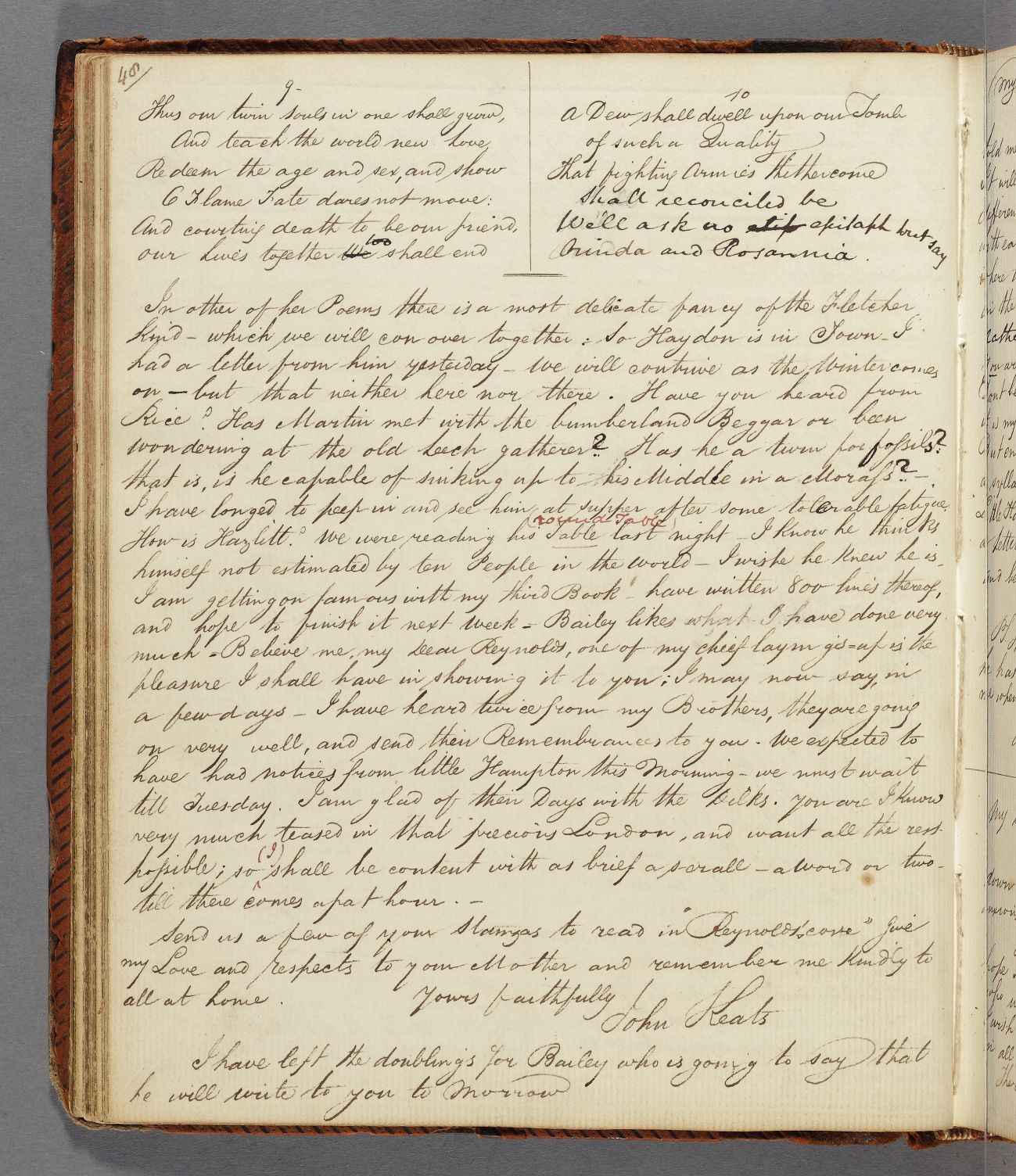
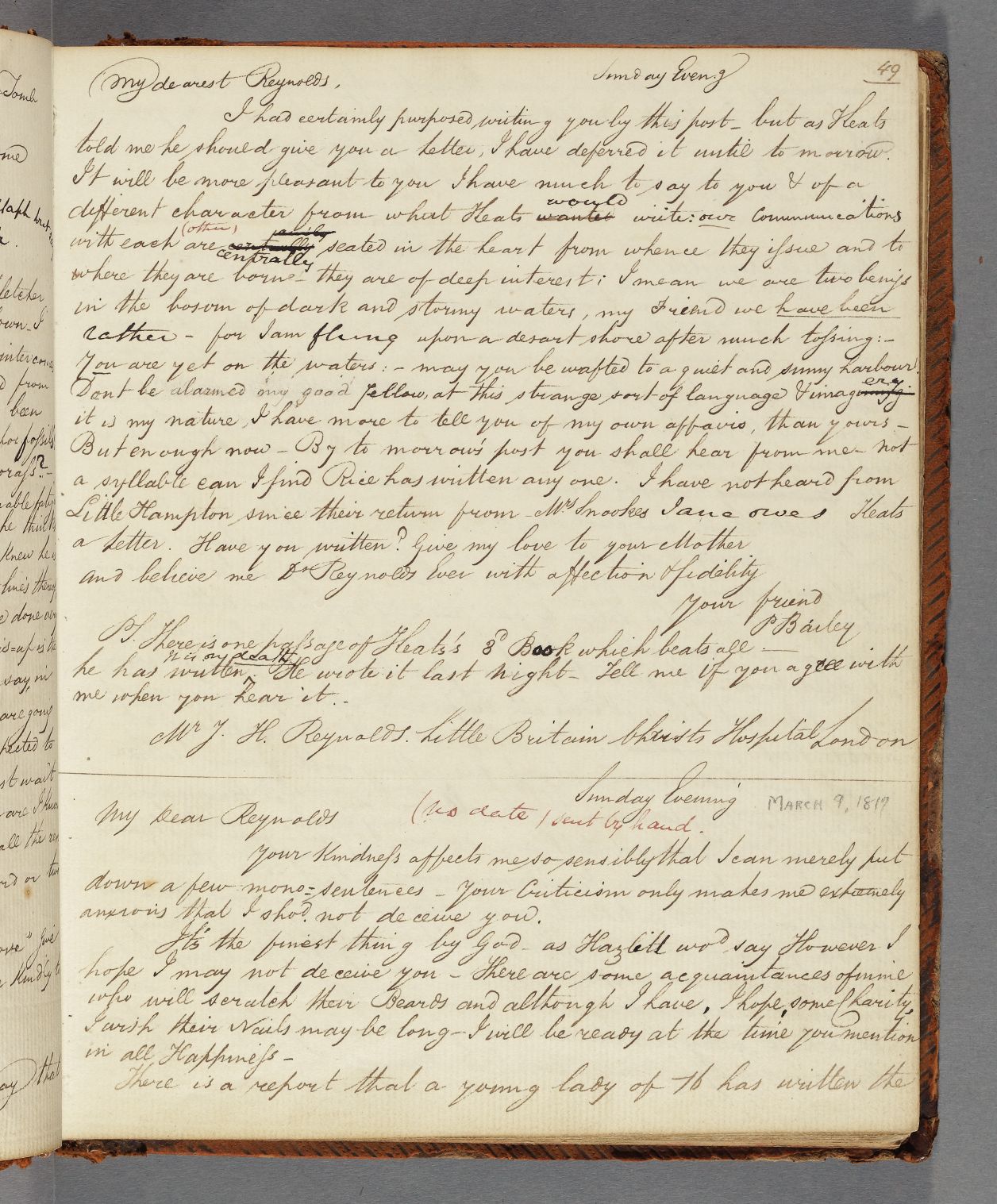
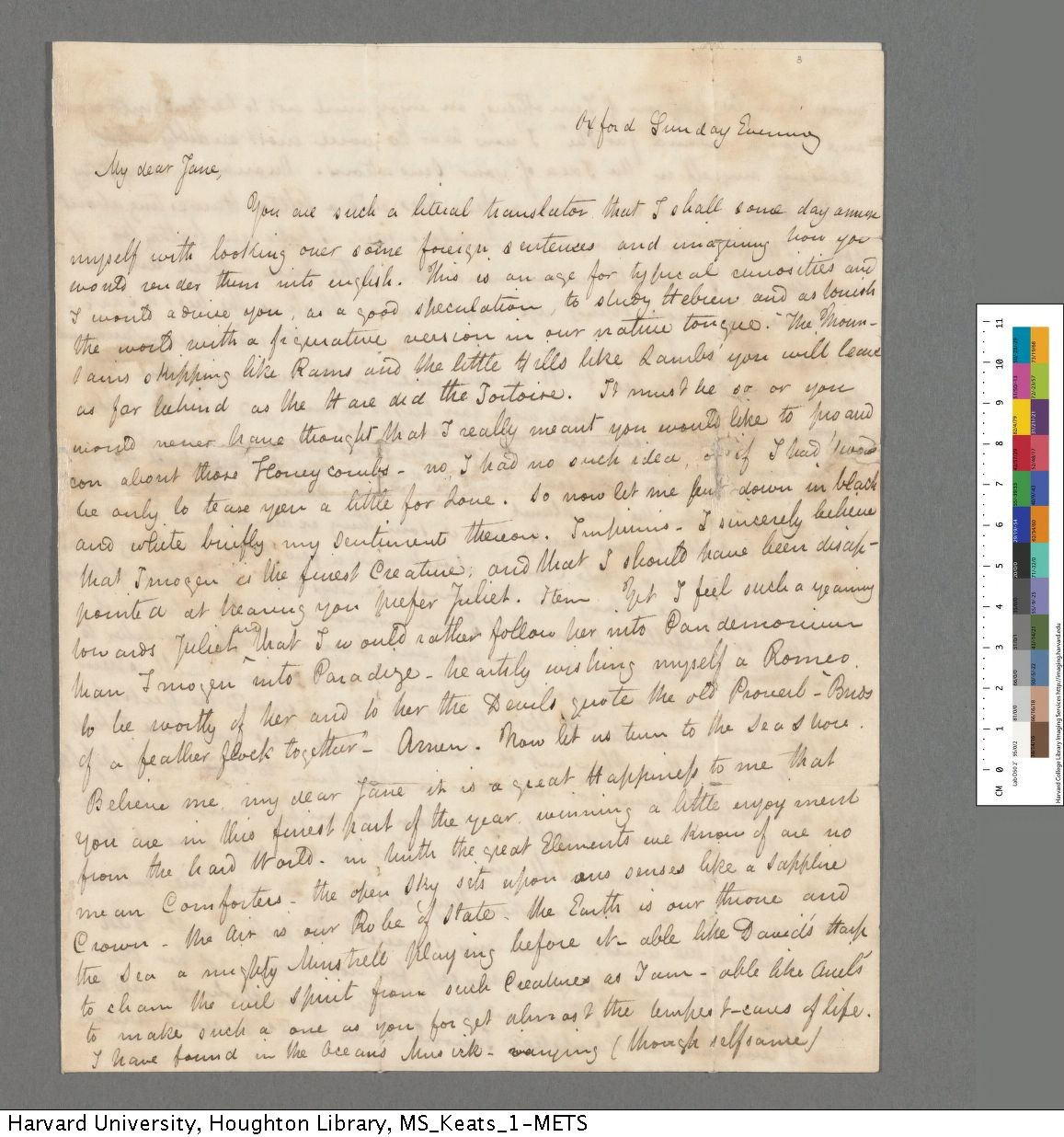
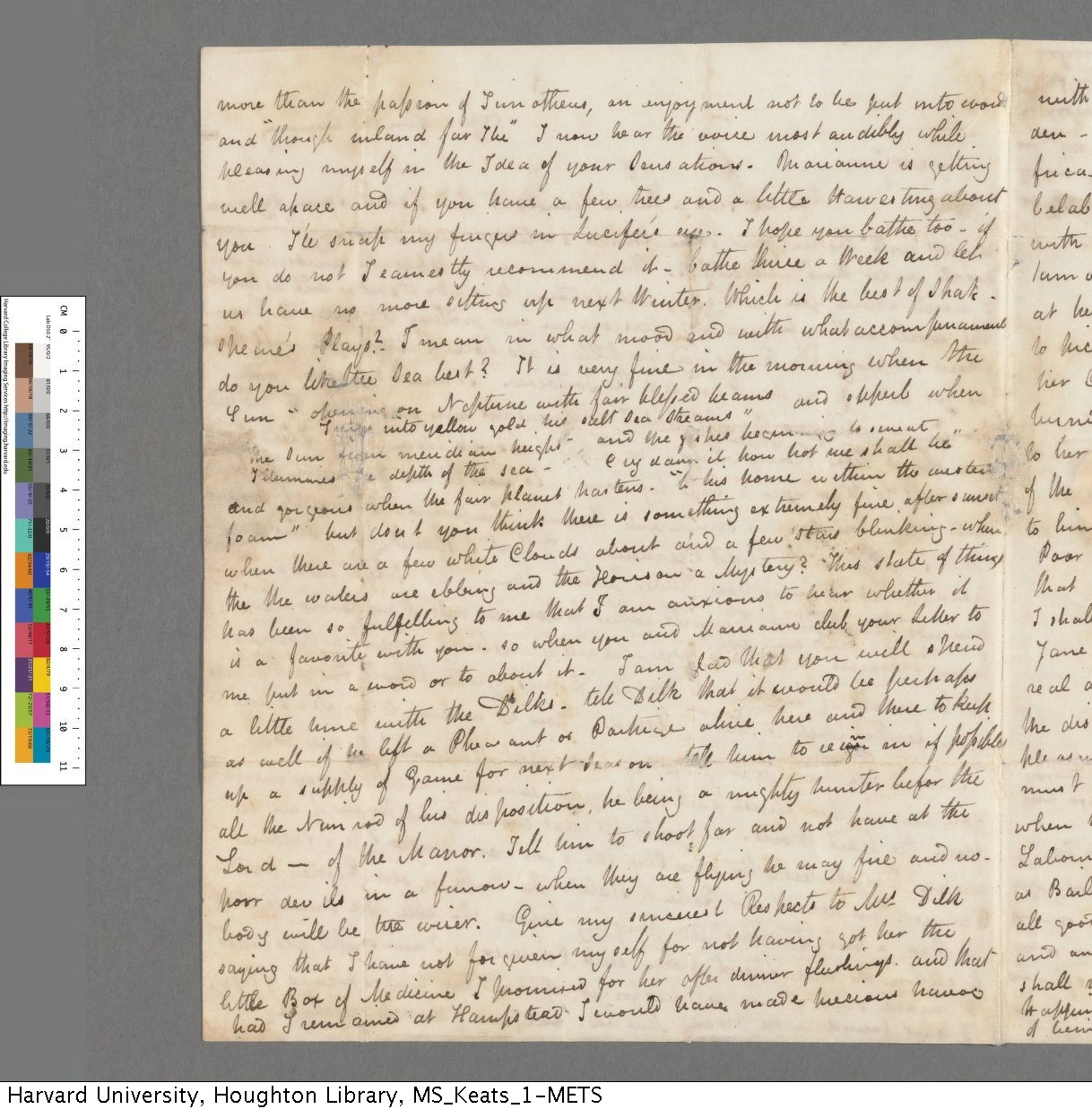
Letter #32: To Jane Reynolds, 31 October 1817

While in the midst of writing his multi-day letter to Bailey, Keats dined with the Reynoldses on 29 October. As he told Bailey when he returned to letter later that evening, he had found Jane a bit under the weather. On 31 October, he decided to send her a bit of his latest from Endymion, with the hope of “helping away for you five Minutes of the day.” What a guy. And he’s doing this on his birthday! Which, by the way, happy birthday, Keats! On completing his 22nd year, Keats had one book of poetry published under his name, and he was only a few hundred lines from completing the poem that would become his second book. Quite the precocious little scamp.

The MS of today’s letter is at Yale’s Beinecke Library, where they have a few Keats letters. Sadly, the KLP has been derelict in its duty of requesting images of said MS. So we can’t share that with you yet, but we shall update this post should we manage to emerge from our indolence.

The letter as first published in Amy Lowell’s biography (1925). She had access to it through Frederick Holland Day, who owned the letter at the time, and who was, like Lowell, one of the Bostonian “Keats lovers” who did so much to preserve and advance Keats’s legacy around the turn of the century. Ann Rowland has been doing fantastic work on Keats’s American reception, and you can find her latest on the topic in the most recent issue of the Keats-Shelley Journal! We’re not sure how the letter ended up at Yale, although Rollins notes that someone named Mitchell Kennerley owned it after Holland Day did. Again, were we not indolent (and pressed for time!), the KLP could tell you more. But for now, that’s it–time to go trick-or-treating!

Keats’s 31 Oct 1817 letter to Jane Reynolds (from The Letters of John Keats, ed. Hyder Edward Rollins, Cambridge: Harvard UP, 1958.)


Letter #31: To Benjamin Bailey, 28-30 October 1817

Keats’s progress on Endymion continues to be steady, as he now heads toward completion of Book IV. In this multi-day letter to Bailey, Keats includes the opening lines of the poem’s final book. He’ll also quote the ‘Ode to Sorrow’– the little song or ’roundelay’ which the Indian Maid sings to Endymion at the opening of Book IV–in his next letter to Jane Reynolds, and then again to Bailey on 3 November. This letter to Bailey also includes some criticism of Wordsworth, via Hazlitt, which hints at the more full-throated criticism to come in spring 1818 (when Keats will decry poetry that has a “palpable design upon us”) and fall 1818 (when Keats will distinguish his notion of the “poetical Character” from that of “the wordsworthian or egotistical sublime”).

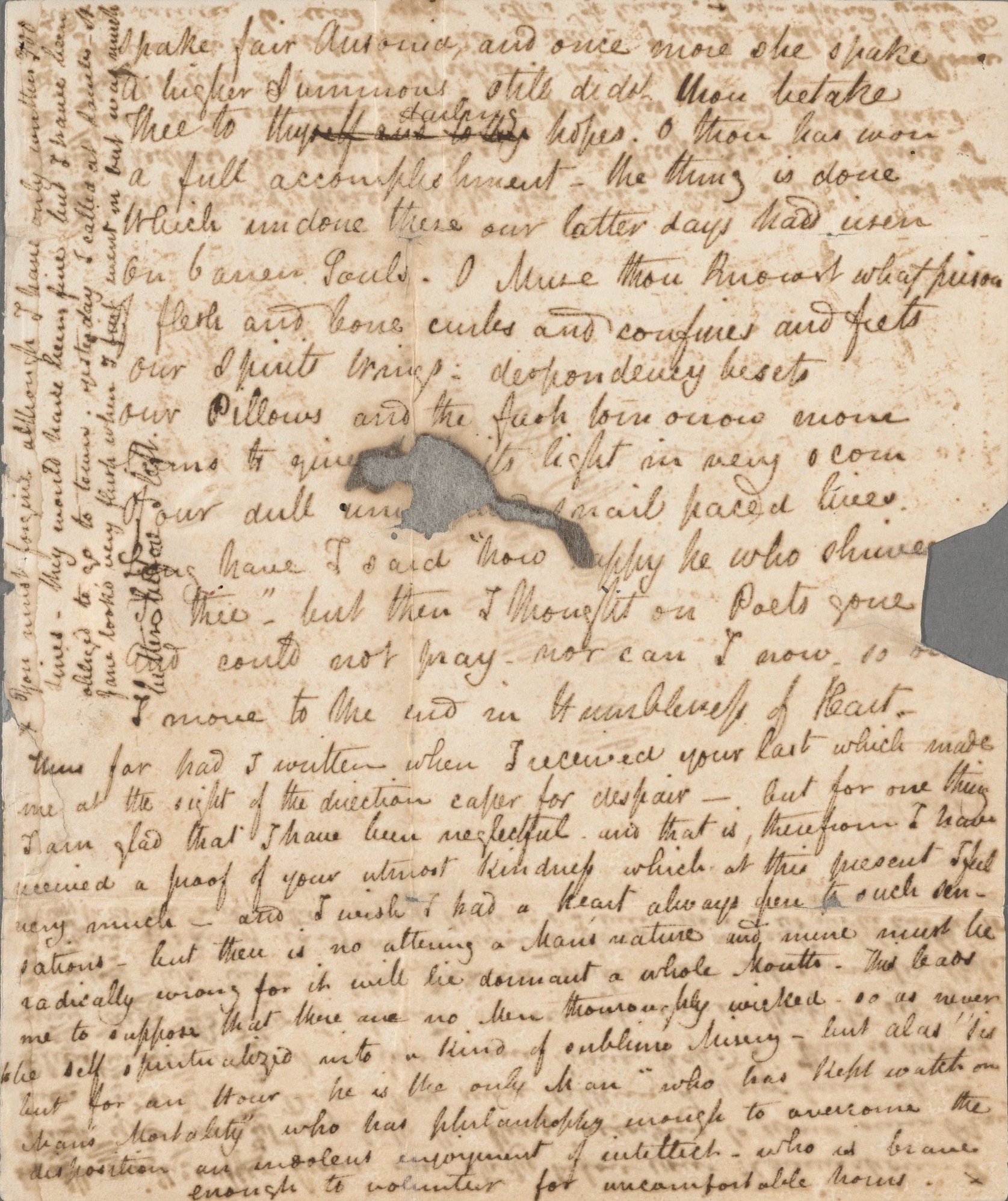
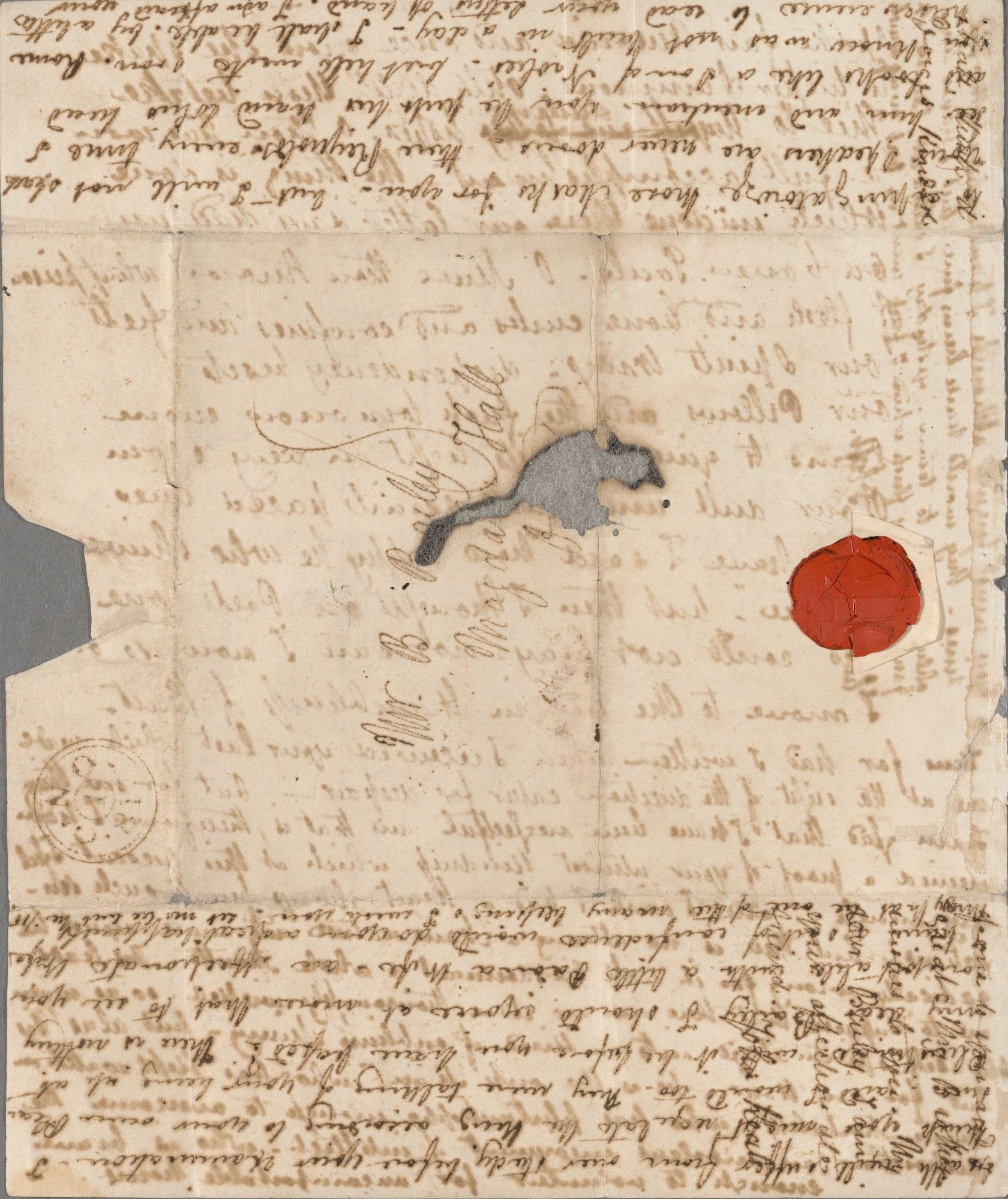
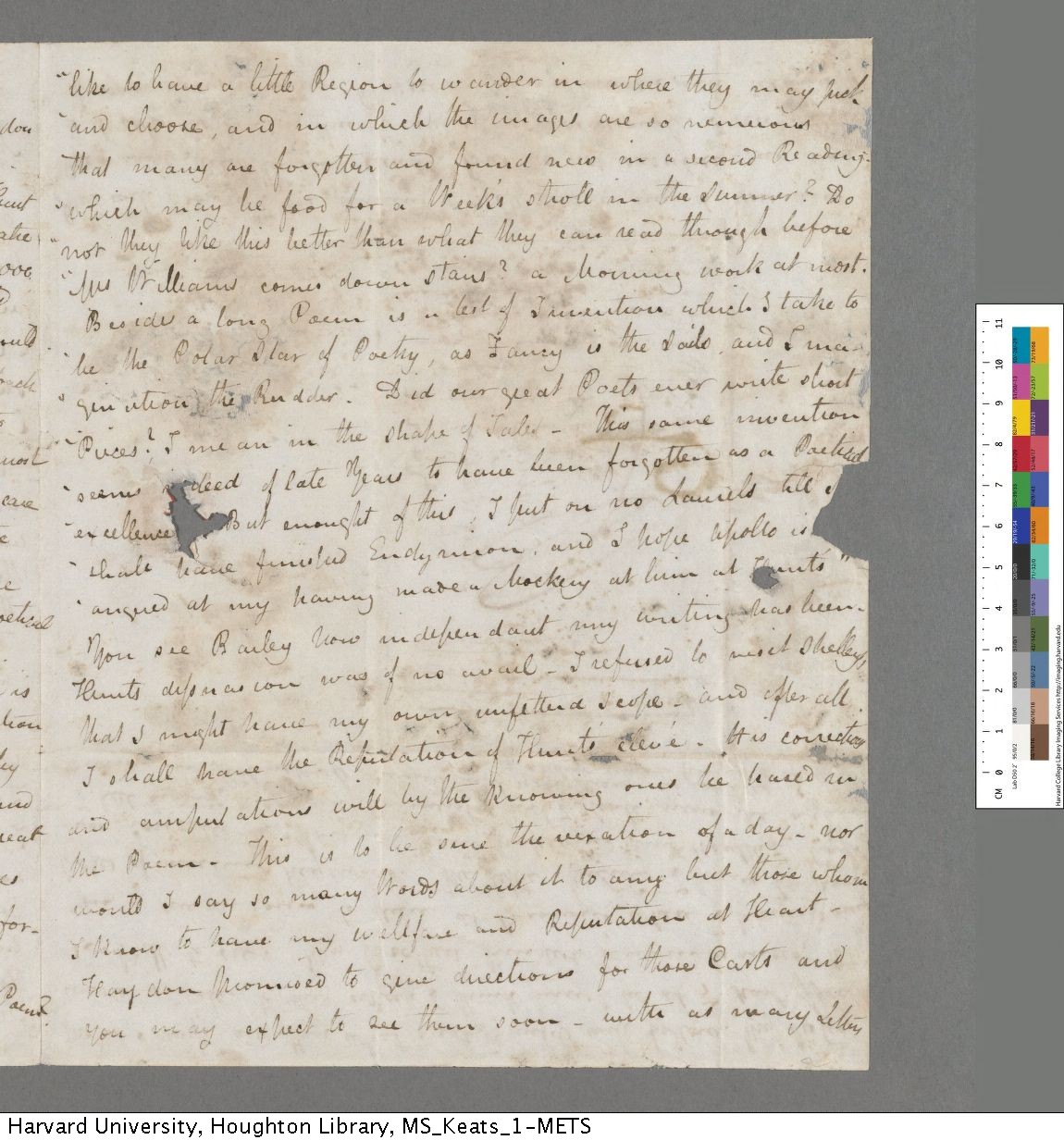
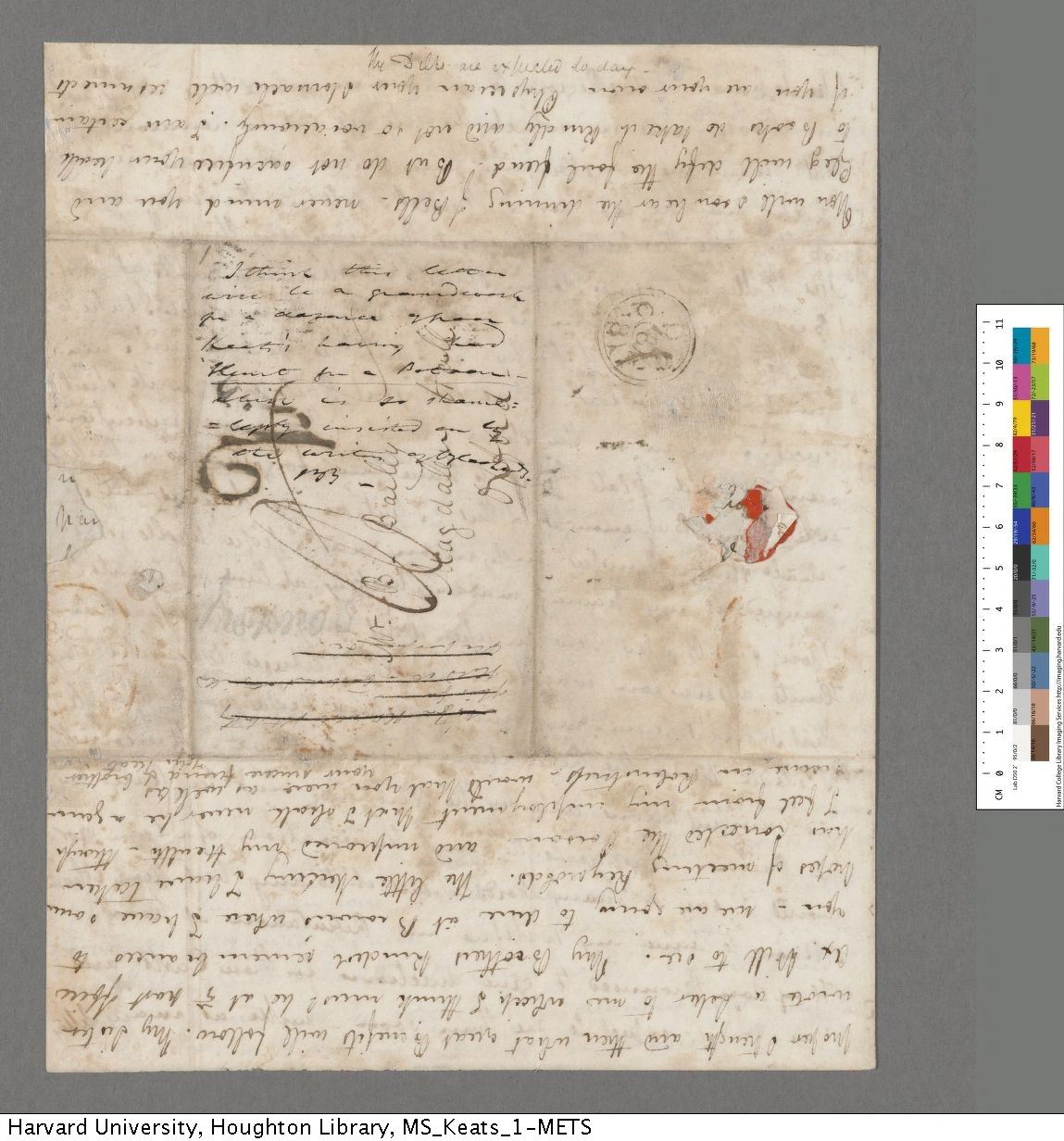
As you can see from the below images, this letter is one of Keats’s more difficult to read letters. The letter is crossed. Although the KLP could have sworn we’d already come across a crossed letter, it appears that today’s letter is the first example of such a thing from Keats. So, let’s explain what a crossed letter is. We have four pages: two leaves formed by folding one sheet. Typically the letter-writer writes on each of the four pages, leaving the proper space on the last page for folding and addressing. After writing on all of those spaces, the letter-writer would go back to page 1, rotate the paper 90 degrees, and write cross-wise over the original writing. It allows the writer to include twice as much writing on the same amount of paper. It also makes it a bit difficult to read!

Keats does some weird stuff, though, that makes it even harder to follow what’s happening in this letter. It appears that Keats wrote only on the first three pages, and then went back to page one, rotated the sheet, and started writing cross-wise. Things get tricky again on page two, because Keats had copied the lines from Book IV of Endymion, and Keats seemed to think that he ought not to write cross-wise over the lines of verse. As such, after writing cross-wise on page one, Keats then went to page 4 (which he had not yet written on at all), where he wrote the remainder of the letter on the wings (the top and bottom spaces which would be folded into the sheet before being addressed and sent).

But wait, there’s more! Keats crossed his writing on the wings, or at least part of the original writing, taking up enough space to get in his parting wishes for Bailey to find marital bliss (“with a little Peona Wife”). Then, not content to leave any blank spaces, Keats goes back to page two, and writes cross-wise in the space left available from the indented lines of verse and over the prose writing from the first go-through on the top half of the page. Then on page three he adds a little “x” at the bottom right corner which points toward another “x” in the blank space on the left side of the page where Keats writes one final little post-script.

All of this is to say, Keats sure is all over the place! One suspects that Bailey found himself a bit lost in this “sea of prose.” He kept the letter for several decades, however, taking it with him to Sri Lanka (then Ceylon), where he became Archdeacon at Colombo. Richard Monckton Milnes, in 1848, incorrectly consigned Bailey to the grave, noting in his Life, Letters, and Literary Remains of John Keats that “Mr Bailey died soon after Keats.” In October of 1848, after having read of his own early demise, Bailey wrote a letter to Milnes explaining that he was in fact still alive and well. With his letter to Milnes, Bailey included the MS of the 28-30 October 1817 letter, and offered to let Milnes print the letter in any future editions of his life of Keats (he did so in the updated edition published in 1867). This particular letter, then, spent many years far from London and Oxford, between which it first traveled back in 1817. The letter remained in Milnes’s family collection and eventually found a home at Harvard’s Houghton Library.

Courtesy of Harvard, here are images of the letter–good luck trying to track all of Keats’s scribblings! A print version of the letter can be found here, via Harry Buxton Forman, who used Milnes 1867 Life as his copy text. He follows Milnes in leaving out the Endymion extract and some other minor parts.

Page 1 of Keats’s 28-30 Oct 1817 letter to Benjamin Bailey. Keats Collection, 1814-1891 (MS Keats 1.14). Houghton Library, Harvard University.

Page 2 of Keats’s 28-30 Oct 1817 letter to Benjamin Bailey. Keats Collection, 1814-1891 (MS Keats 1.14). Houghton Library, Harvard University.

Page 3 of Keats’s 28-30 Oct 1817 letter to Benjamin Bailey. Keats Collection, 1814-1891 (MS Keats 1.14). Houghton Library, Harvard University.

Page 4 of Keats’s 28-30 Oct 1817 letter to Benjamin Bailey. Keats Collection, 1814-1891 (MS Keats 1.14). Houghton Library, Harvard University.

Letter #30: To Benjamin Bailey, 8 October 1817

Keats is now back in London, after his productive stay at Oxford with Benjamin Bailey for all of September 1817. Keats completed Book III of Endymion while there. Over the coming weeks he’d finish the poem, then start getting to the work of copying and revising as he readied the poem for publication with his new publishers, John Taylor and James Augustus Hessey.

One remarkable thing to note about these fall months is how quickly he and Bailey became friends. They had barely just met when Bailey invited Keats to stay with him in Oxford, and after a month together, they were thick as thieves. Bailey becomes a regular interlocutor for the rest of 1817 and well into 1818, after which they seemed to grow apart. But for now, in October and November of 1817, Keats finds in Bailey an indispensable epistolary confidant. At this important moment in Keats’s poetic career (nearing the conclusion of Endymion and starting to contemplate his next steps—no rest for the weary!), Bailey is on the receiving end of some of Keats’s most sustained thinking about poetry, to this point, expressed in epistolary form.

Today’s letter is no exception. Keats opines at length about the thinking behind his undertaking of Endymion. And Deven Parker’s response to the letter for today uses the occasion to explore how in Endymion Keats “casts poetic composition as manual labor and calls attention to the physical and formal constraints that mediate his process, inscribing the poem with the marks of its making.” Before you head over to read her brilliant post, one final thing to note about the letter and its history.

We know that the letters we have are only a small fraction of the letters Keats wrote. Sad but true. In some cases we have some knowledge about those lost letters (we’ll call them the “known unknown” letters). Today’s letter to Bailey includes a long extract from a letter which Keats says he “wrote to George in the Spring.” Back in London with his brothers, Keats clearly had that letter (and others) at hand, ready for him to reread, rethink, and then repeat to Bailey with some new framing and insight. It’s a fascinating piece of evidence testifying to the correspondence’s status, even just weeks or months after the moment of first composition and circulation, as artefacts to be revisited and recirculated. Here at the KLP we’re undertaking a sustained sitting down to read Keats’s letters again, 200 years on, but it’s worth noting with today’s letter that Keats himself was doing a bit of rereading himself. The ongoing lives of the letters seem to, like the poetry of the earth, never die.

Images of the letter courtesy of Harvard, once again. And for a 19-century reading edition, our good pal Harry Buxton Forman, as per usual.

*Programming note: some members of the KLP editorial team were attending the 2017 Romantic Bicentennials Curran Symposium at Fordham University, the topic of which was Keats’s Emergence as a Poet. It was a great day! But that also means internet access while traveling home today is a bit spotty (this post has gone live courtesy of United Airlines wifi—currently providing access somewhere over Ohio maybe?). Deven Parker’s post will go live later today when this editor returns to the surface of the Earth and its more widely available internet connections. And images to the current post will be added later as well. Airline wifi can’t handle much, it seems…

**Ok, the KLP has now left the sky. Here are the images of the letter, as promised.

Page 1 of Keats’s 8 Oct 1817 letter to Benjamin Bailey. Keats Collection, 1814-1891 (MS Keats 1.13). Houghton Library, Harvard University.

Page 2 of Keats’s 8 Oct 1817 letter to Benjamin Bailey. Keats Collection, 1814-1891 (MS Keats 1.13). Houghton Library, Harvard University.

Page 3 of Keats’s 8 Oct 1817 letter to Benjamin Bailey. Keats Collection, 1814-1891 (MS Keats 1.13). Houghton Library, Harvard University.

Page 4 of Keats’s 8 Oct 1817 letter to Benjamin Bailey. Keats Collection, 1814-1891 (MS Keats 1.13). Houghton Library, Harvard University.

Letter #29: To Benjamin Haydon, 28 September 1817

Keats’s Oxford stay is nearing its end, as he’ll be heading back to London in early October. But we have one final letter written during the trip: today’s is to Benjamin Robert Haydon, about whom we last heard back in August (check out the episode of This Week in Keats inspired by that letter). The primary topic of today’s letter is a young man named Charles Cripps. Haydon had asked Keats to inquire about Cripps (who was apparently studying at Magdalen College at the time) and to gauge Cripps’ interest in training as a painter under Haydon’s tutelage. Keats did so, and in this letter he reports back. He also offers some of his own thoughts on Cripps’ potential as a painter (“I have a great Idea that he will be a tolerable neat brush”).

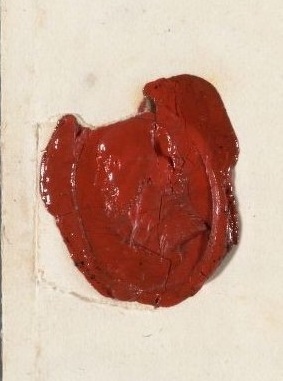
Here at the KLP we often attend to the material details of Keats’s letters. One feature we have not yet discussed, however, is how the letters are sealed. Yes, we’ve discussed how the letters were folded (see here and here, for instance). But what about the wax seals? Well we have a nicely preserved one on today’s letter which gives us an occasion to discuss the matter a bit. It’s still a bit hard to make out in the image from Harvard, but you can sort of see the outlines of a head. That just so happens to be the head of Shakespeare, as designed by James Tassie (or William Tassie, James’s nephew who had taken over the business after his uncle’s death and who set up a fashionable shop on Leicester Square).

The seal from Keats’s 28 Sept 1817 letter to Haydon–an image of Shakespeare.

These “Tassie” gems were incredibly popular, and Keats owned several. In March 1819 he wrote to his sister Fanny about them, noting that he had recently passed through Leicester Square and thought about buying some for her (he did not, for fear of buying any she might already own).

Keats on Tassie gems in a 13 March 1819 letter to Fanny Keats.

Unsurprisingly, Keats enjoyed his Shakespeare seal. But perhaps his other favorite was the one depicting an image of a lyre, with the affixed motto, “Qui me néglige, me désole” (roughly, “whoever neglects me, saddens me”). The broken lyre will become, of course, an image associated with Keats after his death thanks to the gravestone design by Severn. But this particular lyre ought to serve as a reminder of how Keats’s thinking about classical culture was filtered through his own contemporary consumer culture. Psyche may have been “Too, too late for the fond believing lyre,” but Keats had plenty of lyres around him–they just happened to be markers of his own belatedness precisely because of their circulation as products of capitalist enterprise.

That’s all for now, but we’ll have more on Tassie gems in the future–always be on the lookout for those letters that feature well-preserved wax!

Images of the letter are courtesy of Houghton Library at Harvard. For a good reading edition, we direct you again to Forman’s 1895 one-volume edition. Enjoy!

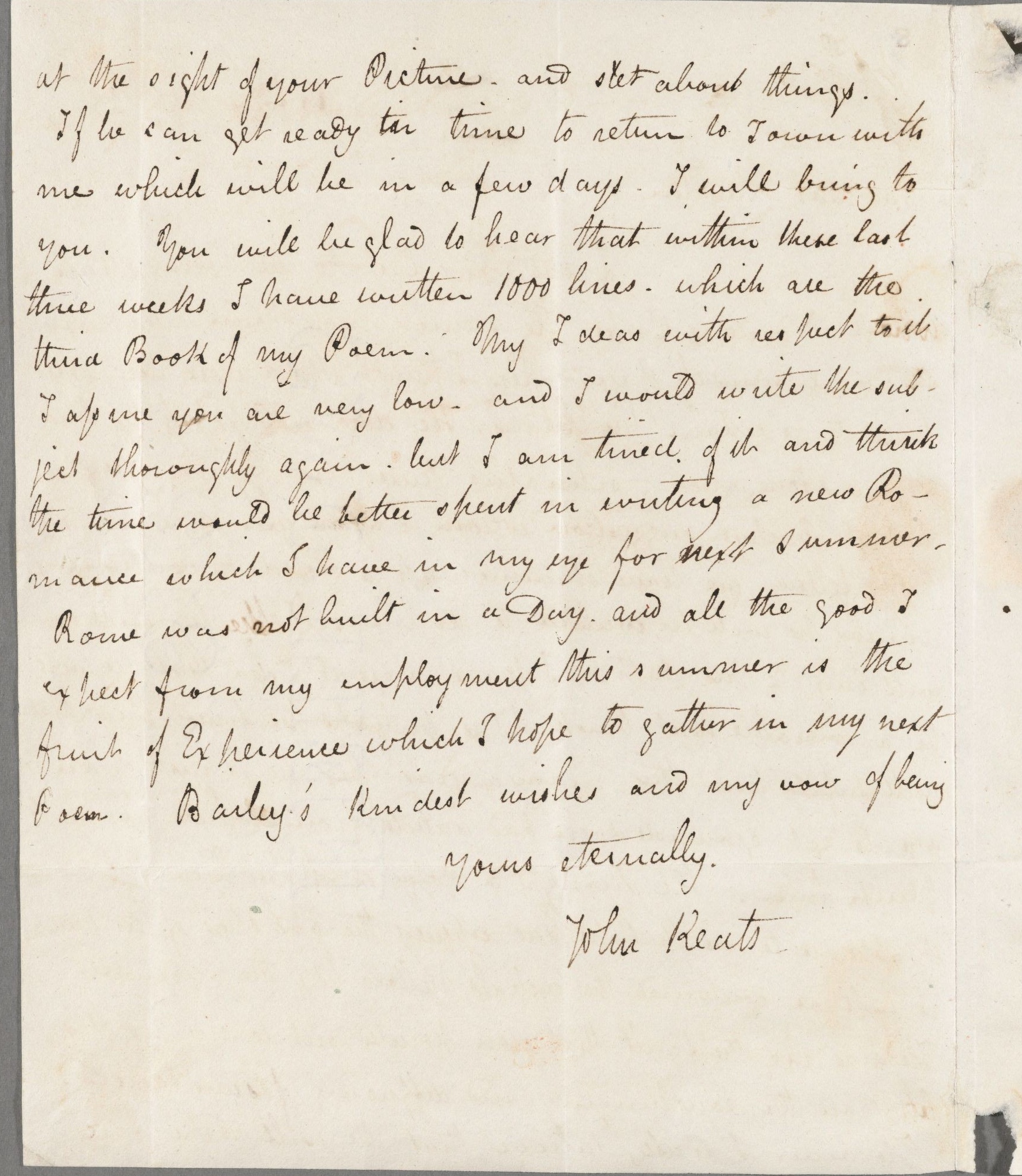
Page 1 of Keats’s 28 Sept 1817 letter to Benjamin Haydon. Keats Collection, 1814-1891 (MS Keats 1.12). Houghton Library, Harvard University.

Page 2 of Keats’s 28 Sept 1817 letter to Benjamin Haydon. Keats Collection, 1814-1891 (MS Keats 1.12). Houghton Library, Harvard University.

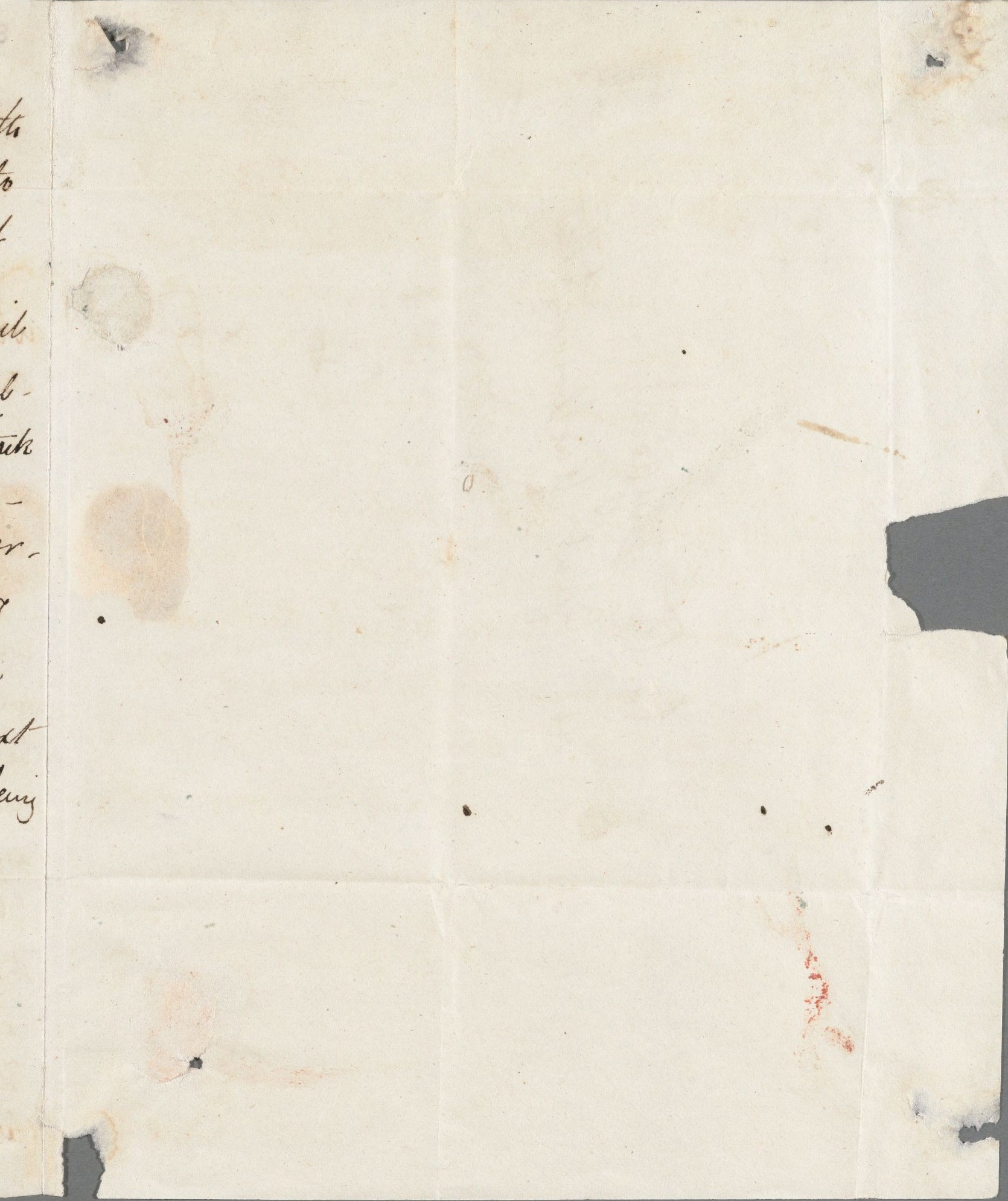
Page 3 of Keats’s 28 Sept 1817 letter to Benjamin Haydon. Keats Collection, 1814-1891 (MS Keats 1.12). Houghton Library, Harvard University. Yeah, it’s blank, but you might be interested in it anyway!

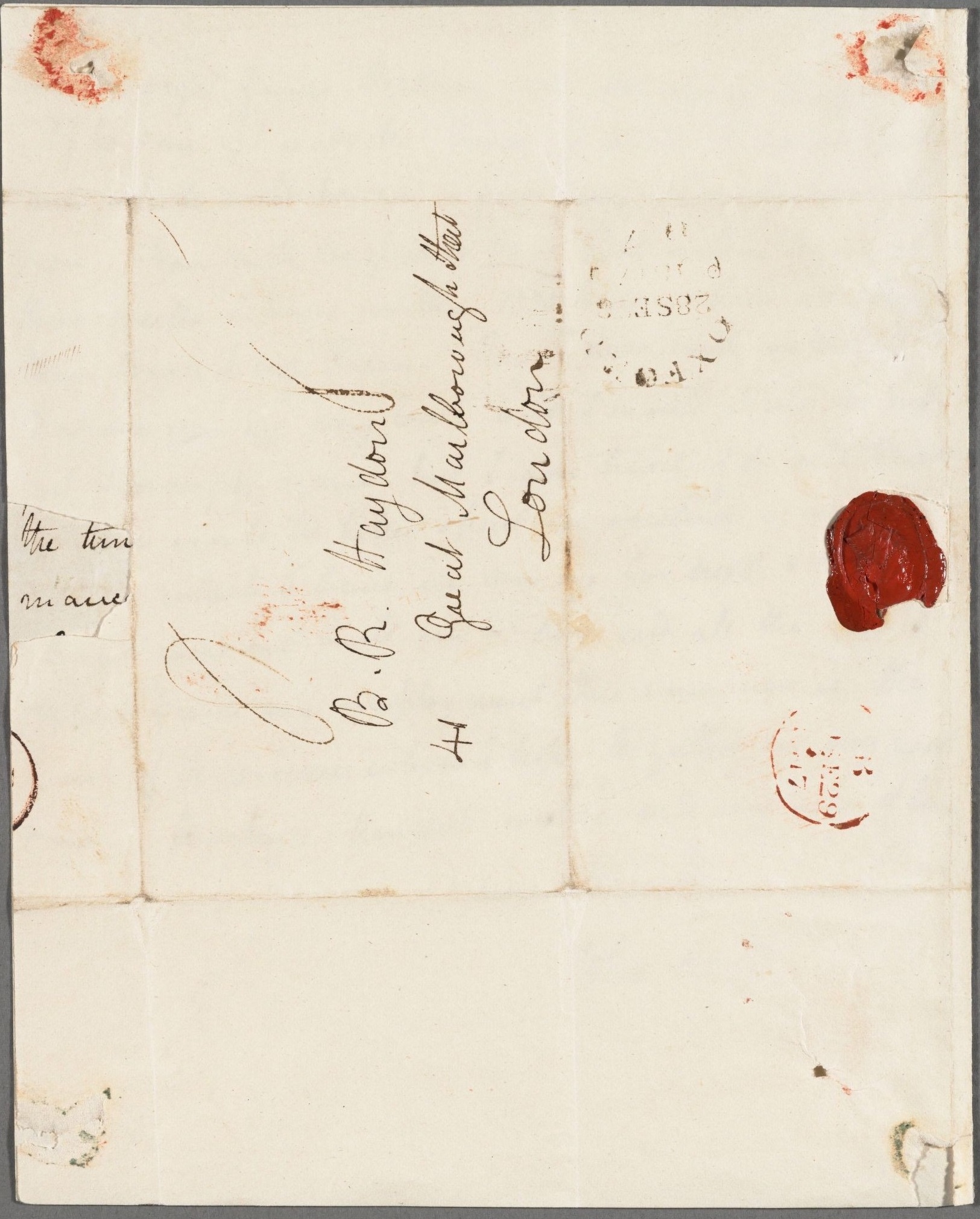
Page 4 of Keats’s 28 Sept 1817 letter to Benjamin Haydon. Keats Collection, 1814-1891 (MS Keats 1.12). Houghton Library, Harvard University.

Letter #28: To John Hamilton Reynolds, 21 September 1817

Lots of things of interest in this letter to Reynolds, all of which has been preserved in a transcript by Richard Woodhouse (unlike the earlier September letter to Reynolds from which we have only his comical verses on Oxford). Keats jokes about one of his favorite topics for comedy: debt. Faithful KLP readers will recall two earlier letters from 1817 which feature a primary focus on money issues: the 16 May letter to Taylor and Hessey, which we had illuminated for us by Alex Dick, and the 10 June letter to Taylor and Hessey, plumbed to its depths by David Sigler. Well, Keats keeps on honing his burgeoning stand-up routine on 19th-century money problems, starting off his letter to Reynolds with gems like “as I say to my Taylor send me Bills and I’ll never employ you more.” And there’s this amazing passage preceding that one-liner, which we feel compelled to quote in full:

So you are determined to be my mortal foe–draw a Sword at me, and I will forgive–Put a Bullet in my Brain, and I will shake it out as a dewdrop from the Lion’s Mane;–put me on a Gridiron and I will fry with great complancency–but, oh horror! to come upon me in the shape of a Dun!

Ah, good times. The KLP generally takes the position that if there is a chance Keats might be making a pun, then he’s definitely making a pun. So although the misspelling of “complacency” as “complancency” might be an error on the part of the transcriber and not Keats’s own, we choose to accept that Keats was indeed making a purposeful misspelling in order to lodge the sound of “complain” in “complacency,” thereby creating a new word, which really ought to exist in English, in order to name the phenomenon when someone claims to feel complacent about a situation while constantly (and perhaps passive aggressively) complaining about the very same situation. Even if you’re not convinced that Keats is punning, the image of frying with great complacency is quite lovely.

All that silly stuff aside, what this letter is perhaps best known for is one of Keats’s most forceful negative comments about women (describing the Bluestockings as “a set of Devils”), followed by his appreciation of the poetry of Katherine Philips. For a response to today’s letter, Rachel Schulkins offers a nuanced reading of Keats’s denouncing of the Bluestockings and the seemingly contradictory move of then expressing appreciation for Philips’s accomplishments. In Schulkins’s treatment, the two moments are less contradictory than they may at first seem.

For a public domain edition in which to read today’s letter, we direct you again to Harry Buxton Forman’s 1895 one-volume collection of the letters. Also below are the images of Woodhouse’s transcript, courtesy once again of Harvard’s Houghton Library. Ah, but one other thing before we go! At the end of Keats’s letter, he writes “I have left the doublings for Bailey.” The “doublings” refer to the spaces on the top and bottom of the back side of the letter’s second leaf, where the paper was folded (creating a doubling) to conceal the text written on it and turn the paper into its own little envelope with blank space (in between the doublings) for writing an address (if that all sounds confusing, just go back and look at the letter to Jane Reynolds from last time). Anyway, the final image below shows what Bailey wrote on the doublings. Thanks to Woodhouse for transcribing that bit too!

Page 1 of Keats’s 21 September 1817 letter to Reynolds. Keats Collection, 1814-1891 (MS Keats 3.3). Houghton Library, Harvard University.

Page 2 of Keats’s 21 September 1817 letter to Reynolds. Keats Collection, 1814-1891 (MS Keats 3.3). Houghton Library, Harvard University.

Page 3 of Keats’s 21 September 1817 letter to Reynolds. Keats Collection, 1814-1891 (MS Keats 3.3). Houghton Library, Harvard University.

Page 4 of Keats’s 21 September 1817 letter to Reynolds (featuring Bailey’s message written on the doublings). Keats Collection, 1814-1891 (MS Keats 3.3). Houghton Library, Harvard University.

Letter #27: To Jane and Mariane Reynolds, 14 September 1817

Wow. What a letter. There is so much in this letter. Despite its amazing features, today’s letter is not particularly well known. The KLP thinks it’s fair to say that the letter is an overlooked one. But it really shouldn’t be! It’s got the funnies; it’s got Shakespeare; it’s got playful teasing; it’s got a letter-within-a-letter delivered by Endymion from the bottom of the sea! In short, it’s got it all. So prepare to be blown away.

As the KLP has been of late obsessing over the possible provenances of the letters Keats wrote to the Reynolds sisters, we ought to say a word or two thereon here. Yesterday we mentioned that today’s letter is the only one (of five) to Jane and/or Mariane which made its way into Milnes’s 1848 collection (although he publishes only excerpts, and without identifying the sisters by name). Milnes had access to the letter via John Taylor, Keats’s publisher, and, after the poet’s death, an effective collector and preserver of Keatsiana. Today’s MS was sold at auction in 1903 along with many other Keats-related materials, and then through Amy Lowell the letter became part of Harvard’s collection in 1925.

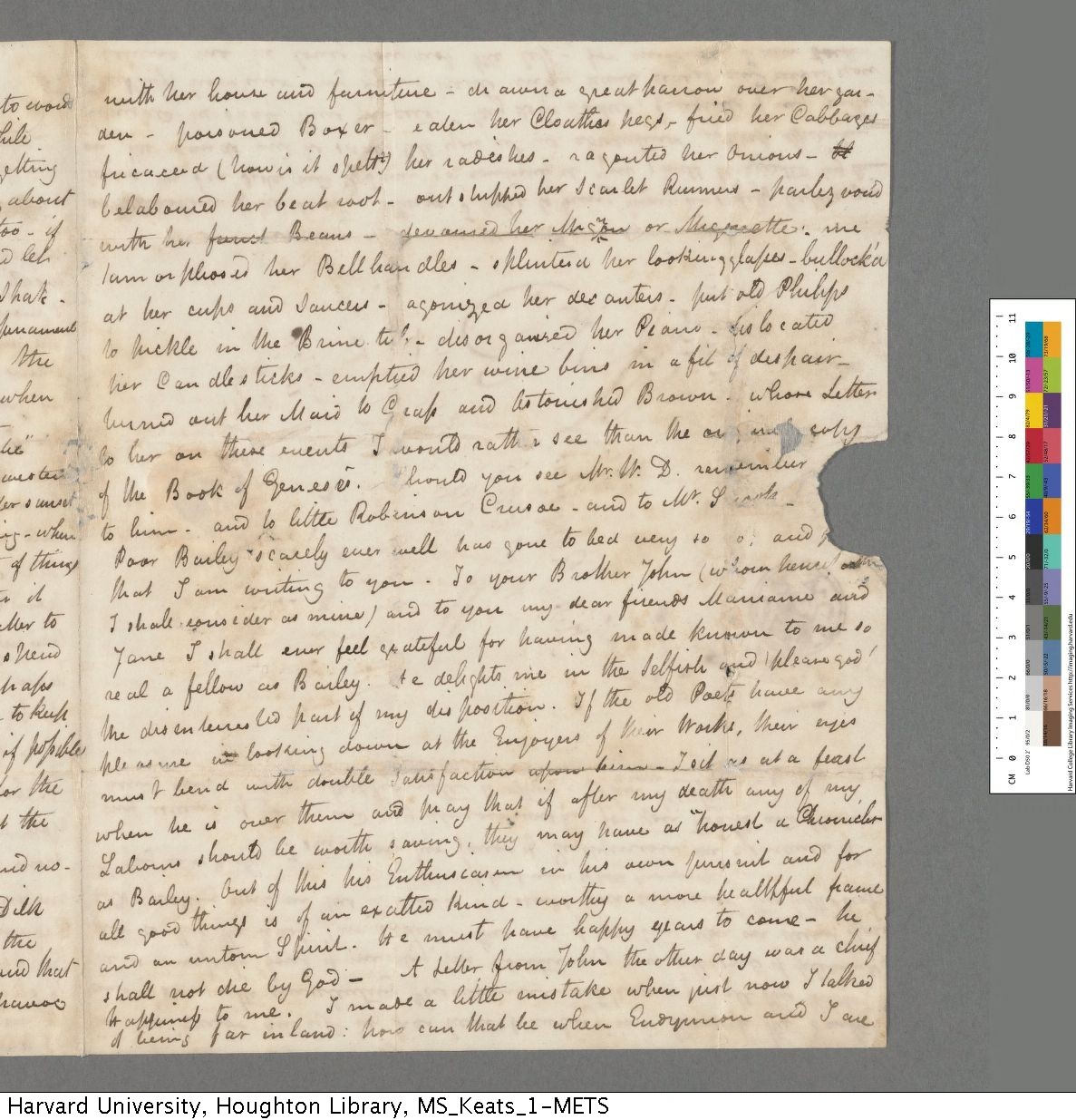
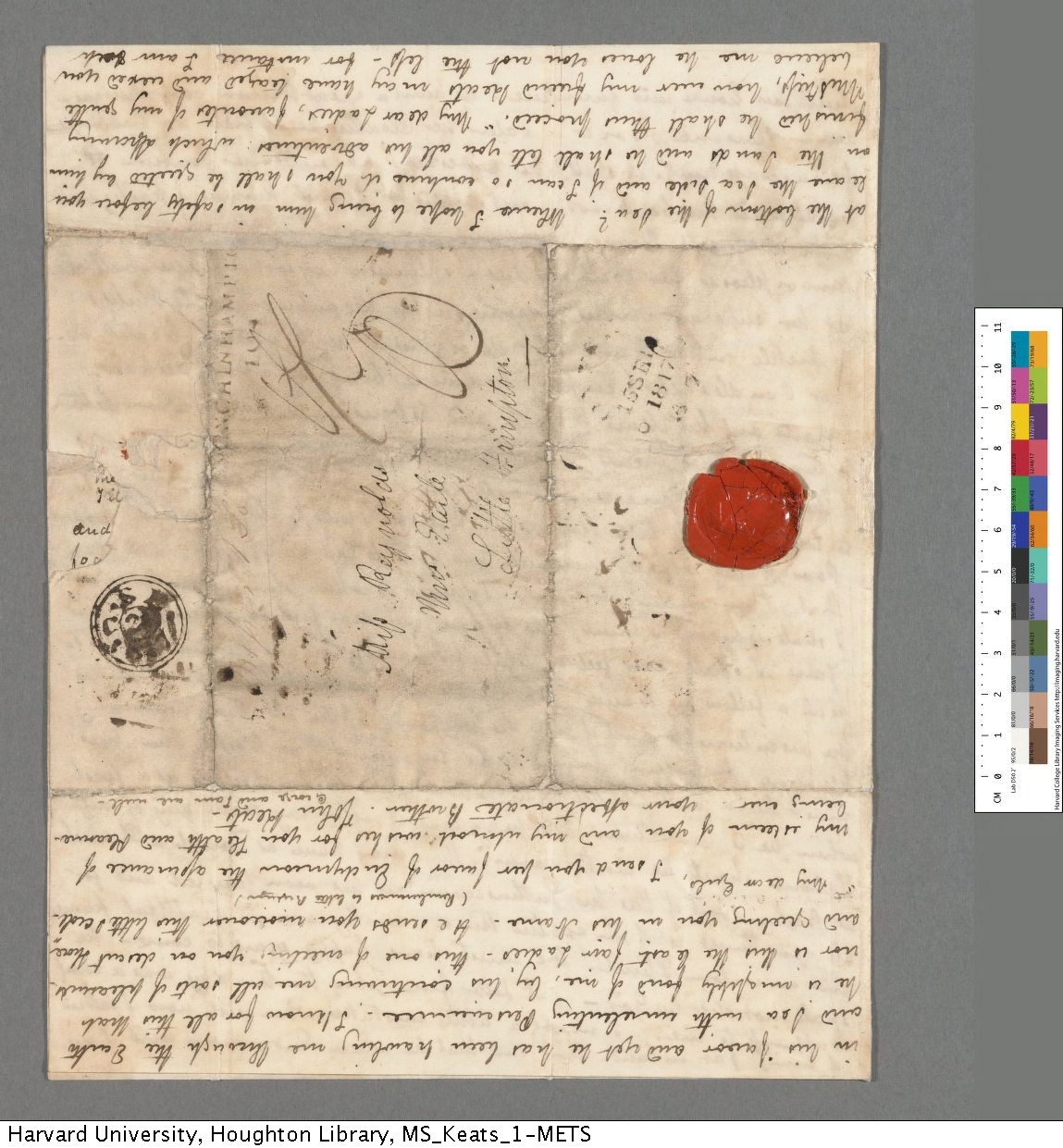
As befits a letter which features a fictional character from Keats’s poem delivering a scroll from Keats to the Reynolds sisters through submarine courier service… the actual MS letter took a circuitous path before finding its recipients. The letter was addressed to Little Hampton but was missent to Minchinhampton! We know this because of the postage marks visible on the fourth image included below. What that means is that the letter first traveled west from Oxford before the mistake was discovered, at which point the letter then traveled south toward Little Hampton. If we here at the KLP knew a bit more about postal routes in 1817 we could tell you more–but alas, we simply have not world enough, nor time, to figure that out right now!

To guide you along the winding mossy ways of today’s wonderful letter, we have a response from Rosie Whitcombe. In it she deftly catalogues Keats’s “epistolary thicket of alternate personae.” After reading the letter, make sure you follow Whitcombe to the bottom of the sea and back as well!

We often guide you to Harry Buxton Forman’s 1883 edition of Keats’s works for a readable and well-edited edition in the public domain, but in this case it appears that Forman had only Milnes’s excerpt of today’s letter as the basis for his text in 1883. However, by 1895, when Forman published a one volume edition of Keats’s letters, he appears to have accessed either the MS or the Woodhouse transcript of the letter (if you’re so inclined to compare Forman’s printed text to both the MS and Woodhouse’s transcript, please do so and let us know your conclusions!). So we direct you to that edition if you have yet to find the pure joy that comes from reading Keats’s letters in his own hand via digital reproductions of them. Otherwise, enjoy these images courtesy of Harvard (click the images for larger sizes, and to download).

Page 1 of Keats’s 14 Sept 1817 letter to Jane and Mariane Reynolds. Keats Collection, 1814-1891 (MS Keats 1.11). Houghton Library, Harvard University.

Page 2 of Keats’s 14 Sept 1817 letter to Jane and Mariane Reynolds. Keats Collection, 1814-1891 (MS Keats 1.11). Houghton Library, Harvard University.

Page 3 of Keats’s 14 Sept 1817 letter to Jane and Mariane Reynolds. Keats Collection, 1814-1891 (MS Keats 1.11). Houghton Library, Harvard University.

Page 4 of Keats’s 14 Sept 1817 letter to Jane and Mariane Reynolds. Keats Collection, 1814-1891 (MS Keats 1.11). Houghton Library, Harvard University.

Letter #26: To Jane Reynolds, September 1817

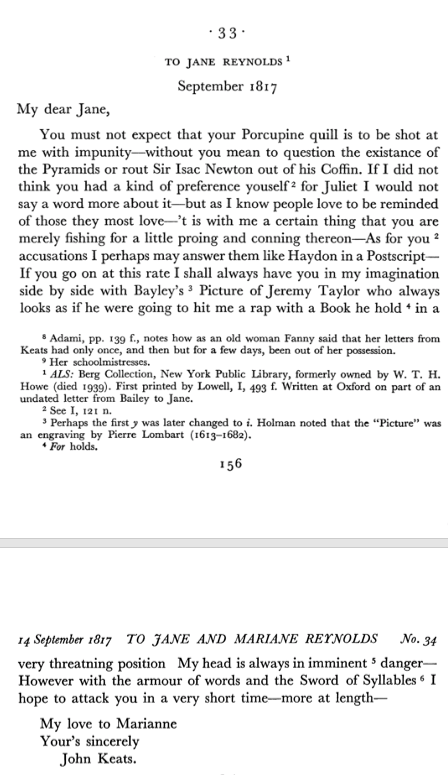
The fragmentary and odd letters just keep on coming as September rolls on! Today we have another letter to Jane Reynolds, and as with the letter from 4 September, this one shares space with Benjamin Bailey. Remember that Keats at this time was staying in Oxford with Bailey, and the two were “lead[ing] very industrious lives,” as Keats wrote to Fanny on 10 September. The nature of their industry seemed to include Bailey engaging in his studies (especially reading his beloved Jeremy Taylor), Keats making progress with Endymion, and both writing plenty of correspondence. Today’s fragment again demonstrates Keats’s playfulness, and it also points toward the extent to which he at times falls into a regular back-and-forth with his correspondents. Most of what Keats writes in this letter is either in response to something Jane had written previously, or it anticipates future responses from her. Keats also promises that he will write a longer letter soon (“I hope to attack you in a very short time–more at length–“), which we know he does on 14 September. More on that one on Thursday.

The provenance of today’s letter reveals relatively little. However, the KLP never hesitates to entertain a bit of wild surmise! Here’s what we know: the letter was owned by William Thomas Hildrup Howe, an American collector active in the early-20th century. After he died in 1939, his collection of manuscripts and books was acquired by Albert Berg (in 1940), who would go on to donate thousands of items to the New York Public Library (where today’s letter still resides). What we don’t know is how, um, Howe came into possession of it, nor do we know when he did, nor where he did. It had to have been before 1925, because the letter was first published in Amy Lowell’s biography of Keats published that year.

What sort of surmises might we make, wild or otherwise? As we learned from the 4 Sept letter, after Bailey’s courting of Mariane Reynolds went south, he asked for her to return the correspondence Bailey had had with her. Since today’s letter was addressed solely to Jane, it seems uncertain if it would have been among those returned letters. If it had been, it may have followed a similar path of sale as that we saw with the 4 Sept letter. It seems more likely, however, that today’s letter remained in Jane’s possession. Of the five extant letters to Jane Reynolds (one of which is also addressed to Mariane Reynolds), only one of them makes it into publication in Milnes’s 1848 volume. It did so because the letter was in the possession of John Taylor, and remained in his family until the early-20th century, when it and many other Keats papers were auctioned. The other four letters seem to have moved through private sellers in the mid-to-late-19th and early-20th centuries.

One final thought about the possibilities for how this letter might have circulated before arriving at its permanent home in the New York Public Library. In 1825 Jane Reynolds married Thomas Hood. The two were active in literary circles in London, and it seems plausible that at some point during their next two decades (Hood died in 1845, and Jane the year after) they would have shared with friends the letters sent to Jane by Keats, whose reputation during that period steadily grew and expanded beyond the bounds of his own circle of friends and supports. Perhaps at some point they gave the letters away as gifts. However it happened, the letters eventually passed on to other owners (either through sale or otherwise). And that’s all the KLP can say on the matter!

So end the wild surmises. But the fun continues with a special treat. For a response to this letter, the co-hosts of This Week in Keats (Brian Rejack and Mike Theune) are debuting a shorter-format video, appropriately titled “This Day in Keats.” Enjoy!

Keats’s letter to Jane Reynolds, courtesy Google Books.

Letter #25: To Fanny Keats, 10 September 1817

Another significant first for today: Keats’s first of many lovely letters written to his sister Fanny. Readers of the letters tend to agree that the Keats we see on display in his letters to his sister is one of the most caring and kind versions of the poet. Fanny was just 14 years old when Keats wrote her this first letter. His solicitude as the eldest of the Keats siblings looking out for his young sister clearly comes across. We daresay that Keats behaves in this letter (and later ones to Fanny) “in a way befitting a brother.”

In addition to his kindness, Keats’s playfulness shines through with great frequency in his letters to Fanny. Towards the end of this letter he bemoans the tendency in English education to privilege instruction in the French language (“perhaps the poorest one ever spoken since the jabbering in the Tower of Babel”) over that in Italian (a language “full of real Poetry and Romance”). Keats concludes with an image of youngsters having instruction in French “cramm’d down our Mouths, as if we were young Jack daws at the mercy of an overfeeding Schoolboy.” Maybe not Keats at his funniest (and the KLP begs to differ about the poetry and musicality of the French language), but it’s a good taste of the kind of jocular tone he tends to adopt when corresponding with Fanny.

Keats concludes this letter by suggesting that he and Fanny each save all their correspondence for posterity’s sake (“You will preserve all my Letters and I will secure yours”). Turns out Fanny took this advice. In 1826 she married Valentin Maria Llanos y Gutierrez. After living for a few years in England, she left England in 1833 and lived the rest of her life in Spain. During that time she kept her letters safe, and, after corresponding with Harry Buxton Forman regularly in the late 1870s and early 1880s, arranged for publication of the letters for the first time in Forman’s 1883 edition of Keats’s collected writings. After Fanny died in 1889, her daughter Rosa Keats de Llanos provided the letters (through the care of Forman) to the British Museum. Today they remain at the British Library–in all, 42 letters.

So here we are at letter number 1 to Fanny Keats! We’ll have many more over the next few years, in large part thanks to Fanny’s life-long impulse to preserve the letters and eventually ensure that they make their way into literary history. They now form one of the most significant parts of Keats’s epistolary legacy.

Letter #24: To John Hamilton Reynolds, September 1817

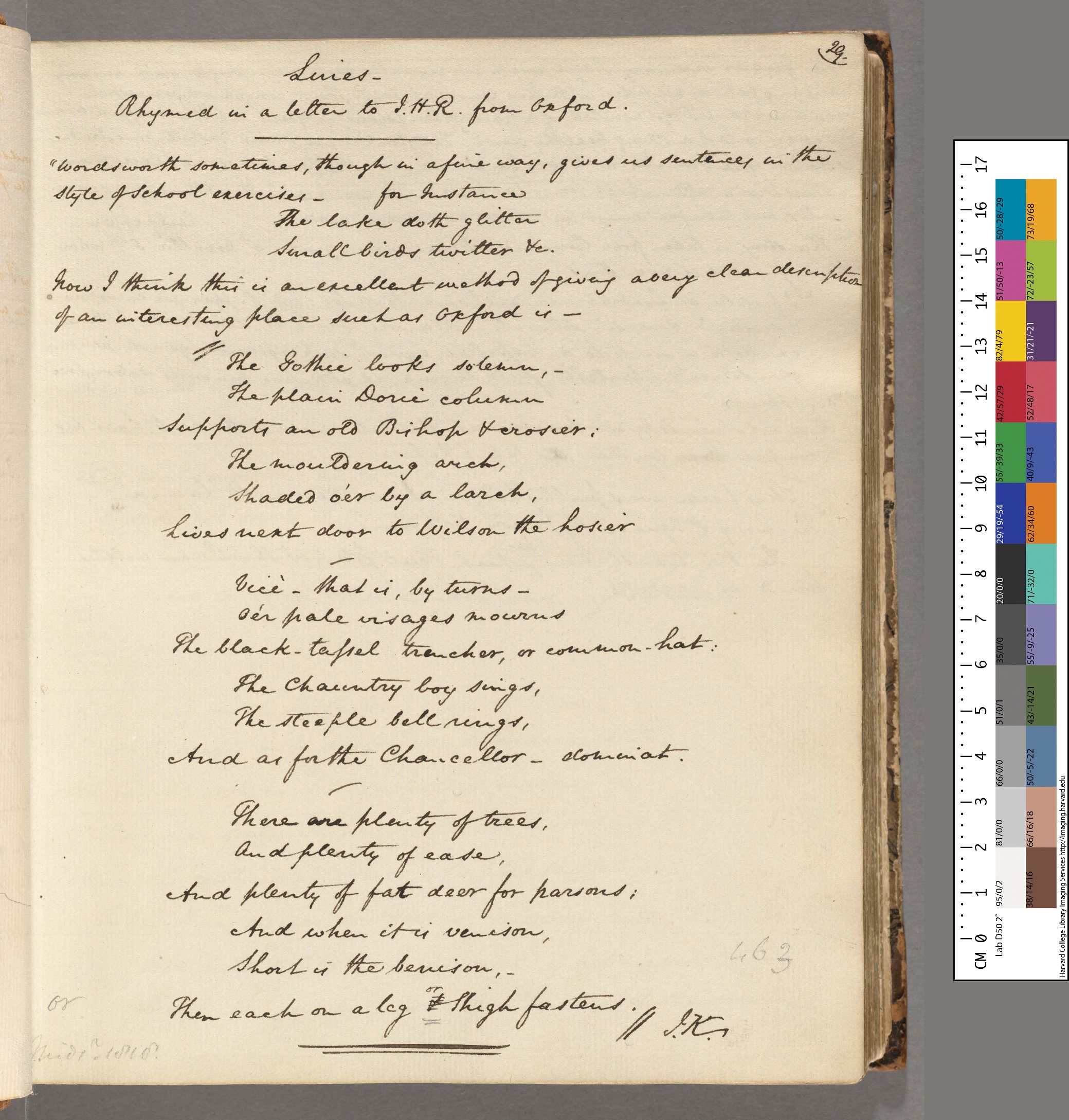
Today’s letter exists only in a fragmentary form. Presumably during one of the first few days of Keats’s visit to Benjamin Bailey at Oxford, Keats wrote to Reynolds to inform him of his arrival. In that letter he included these playful verses offering some initial observations on the place.

Keats’s verses on Oxford, from his letter to Reynolds.

This particular copy of the poem comes from Harry Buxton Forman’s 1883 edition of Keats’s complete writings. Forman got the text from a letter written by Charles Brown to his friend Henry Snook in March 1820. As you can see from the bit of the letter above the poem, Brown says he had just come across the lines for the first time in spring 1820, almost three years after they were first written. Brown may have seen them from the letter itself, probably then still in Reynolds’s possession, but to the KLP it seems more likely that he encountered another copy of the verses. Brown says nothing about the context on the poem provided in the letter.

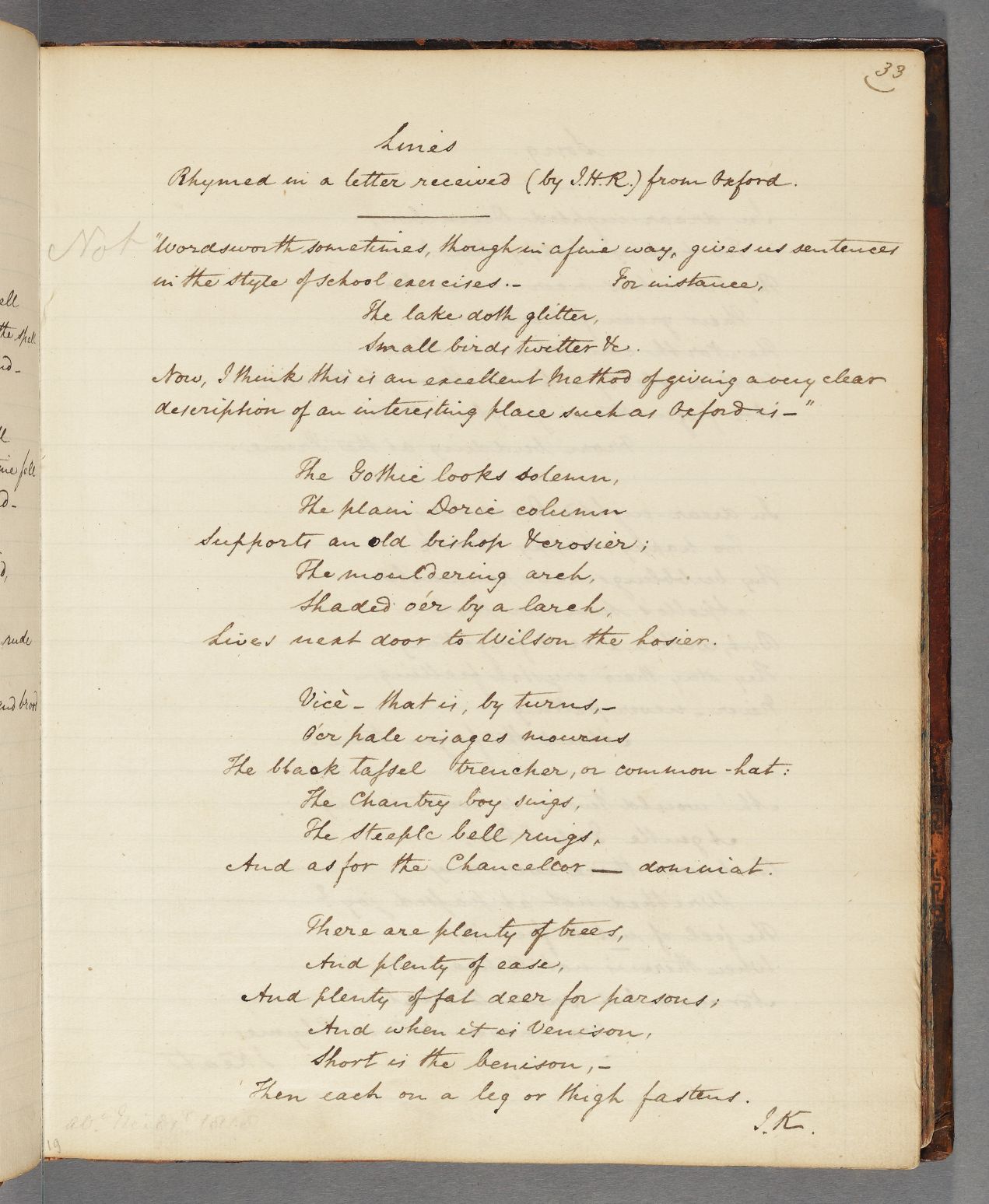
So how do we know about this letter? Well, our indefatigable Keats-chronicler, Richard Woodhouse, made two transcriptions of the poem, and in his copies, he added Keats’s setup for the verses: “Wordsworth sometimes, though in a fine way, gives us sentences in the style of school exercises–for instance ‘The lake doth glitter / Small birds twitter’ &c. Now I think this is an excellent method of giving a very clear description of an interesting place such as Oxford is–”

One of Woodhouse’s two transcriptions, with the two-sentence setup for Keats’s poem.

Sadly for us, Woodhouse did not copy the entire letter. His transcripts are found not among his other copies of Keats’s letters, but in the two notebooks he used for Keats’s poems. Alas. At least we have these two sentences preserved from the letter. If we had only Brown’s letter as the source for the poem, the KLP would likely not be talking about the text as a letter.

Below you’ll find the two images of Woodhouse’s transcripts, courtesy of Harvard. For a response to this fragment of this letter, the co-hosts of This Week in Keats (Brian Rejack and Mike Theune) have been co-writing a poem in imitation of Keats’s imitation of Wordsworth, chronicling Rejack and Theune’s adventures in Oxford during a visit in summer 2015. The poem (and pictures!) will be forthcoming next week. Since the date of the letter is uncertain (and *not* because Brian and Mike are slow composers of poetry), we feel justified in delaying the response until next week. More soon!

Keats’s poem, as copied by Richard Woodhouse. Keats Collection, 1814-1891 (MS Keats 3.1). Houghton Library, Harvard University.

Keats’s poem, as copied again by Richard Woodhouse. Keats Collection, 1814-1891 (MS Keats 3.2). Houghton Library, Harvard University.

Letter #23: To Jane and Mariane Reynolds, 4 September 1817

Today marks the beginning of a series of letters written by Keats during his stay at Oxford with Benjamin Bailey. Many of these letters are sent to members of the Reynolds family, including today’s letter, the first extent letter to Jane and Mariane Reynolds, two of the sisters of John Hamilton Reynolds (the recipient of several letters we’ve encountered previously–see here, and here, and here). During the summer Keats had spent significant time with the Reynoldses, as he indicated in last week’s letter, and including a dinner engagement with them just a day or two before heading to Oxford. As Keats departed for Oxford, the Reynolds sisters also embarked on a journey: they would be doing a bit of late-summer seaside vacationing at Littlehampton.

As we at the KLP are wont to draw attention to firsts of various kinds, we should note that today’s letter is the first of Keats’s sent to female correspondents. Keats himself will regularly note his anxiety about women, as in a letter to Bailey in July 1818 where he writes, “I am certain I have not a right feeling towards Women.” Some of that “not right feeling” is on display in the letter to Jane and Mariane, which is at times affectionate and playful, but at others condescending and mean. That Keats condescends in a self-conscious, slightly self-deprecatory way, however, only highlights his own awareness of his anxiety. So at least he knows he’s being a jerk?? But come on–be nice, JK!

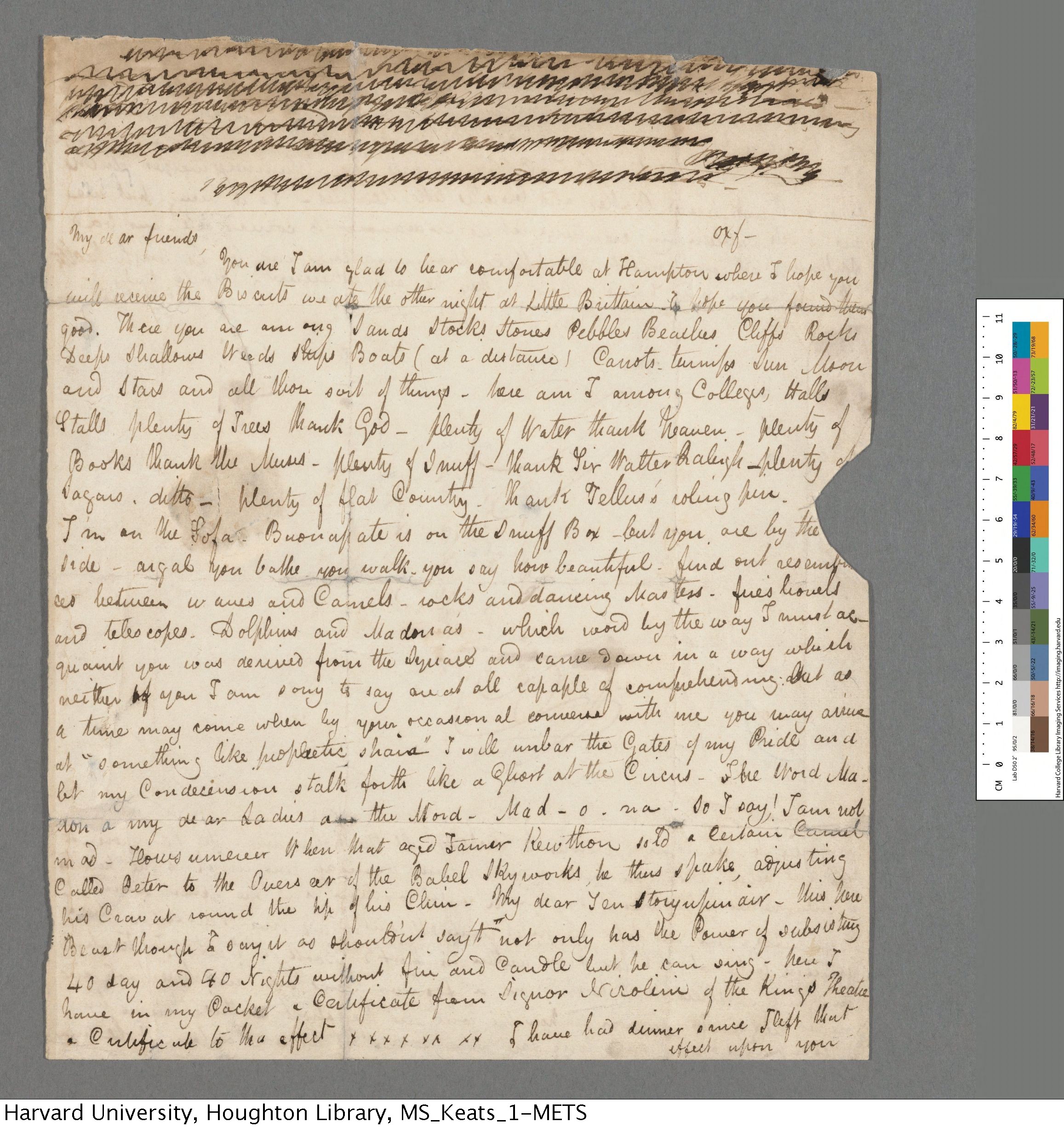
Now, one other factor that may influence his anxiety: Keats has a co-correspondent here. At the top of this letter are several lines written by Benjamin Bailey, and later crossed out rather rigorously. Bailey was at this time courting Mariane, although it seems Keats did not know as much just yet. One wonders what Bailey had to say in his opening half of the letter, and how it might have affected Keats’s own part in the correspondence.

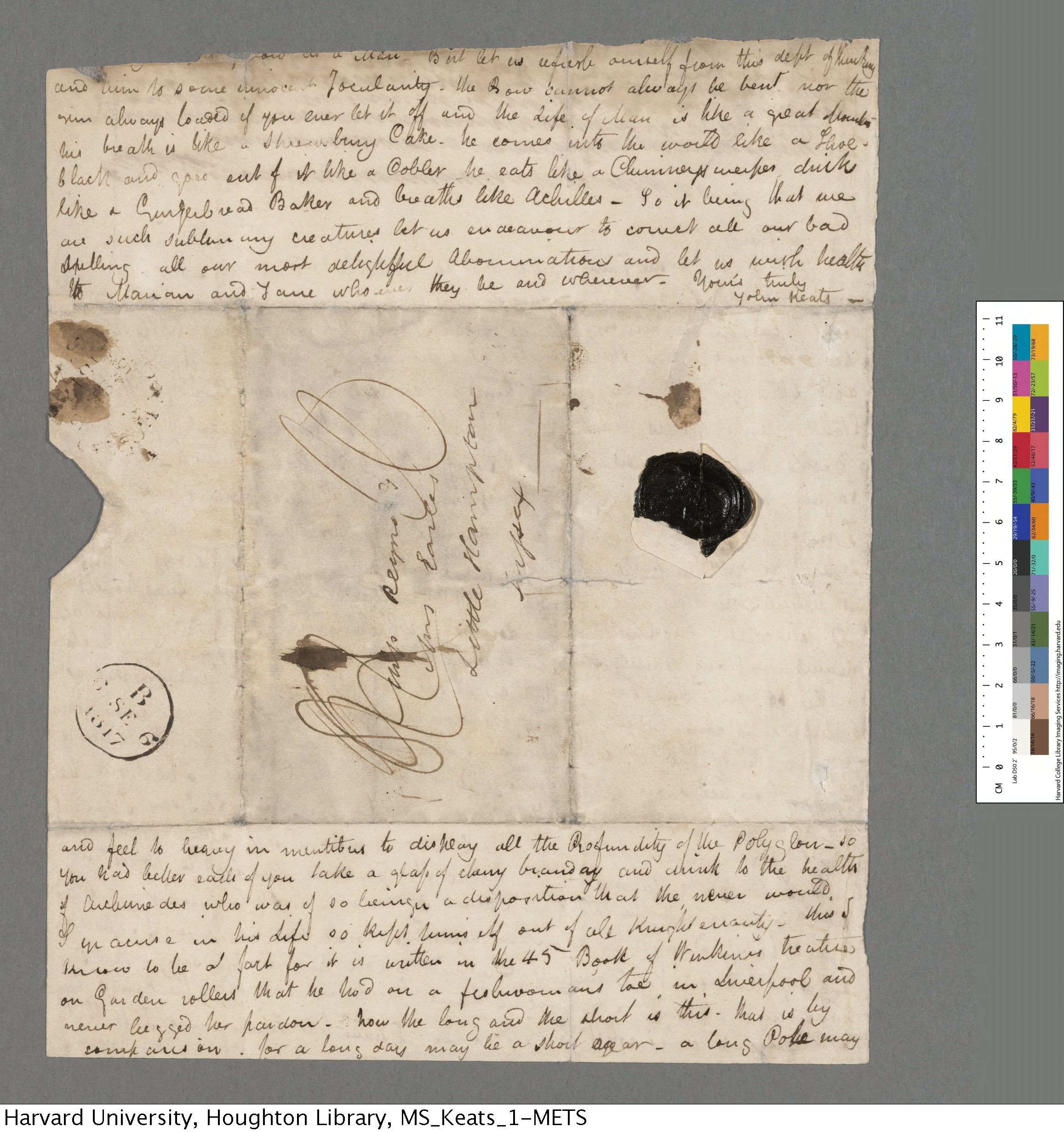
As can be seen from the images of the letter, it’s likely that Bailey wrote not only the few lines at the top of the page which remains, but also filled the first two pages of an adjoining leaf. Recall that Keats’s letters (as would have been true of other letters during this period) were typically written on four sides of two conjugate leaves of paper (or think of it as one sheet folded in half to make a mini-booklet of four pages and two leaves). So, Bailey would have begun the letter, filled the front and back of the first leaf completely, and then finished his message on the top of the second leaf. Although the crossed out lines are almost completely illegible, it seems to the KLP that after Bailey’s struck-through signature, we have a brief post-script that concludes with “Keats.” Thus, Bailey probably wrote something like, “and now I’ll turn things over to Keats.”

The KLP’s educated guess: Bailey’s signature, then just below it to the left, “Keats,” and then Keats’s part of the letter clearly begins below.

“Ah!” you ask, “but what happened to that other leaf??” Well, here’s the KLP’s best guess on that one. In a letter to George and Georgiana in early 1819, Keats explains how the Bailey-Mariane Reynolds drama unfolded: Mariane had rejected a proposal from Bailey sometime in late 1817 or early 1818, but Bailey asked her to give it more thought and reconsider. Meanwhile, having left London after obtaining a curacy at Carlisle, Bailey proceeded to fall in love with a Miss Hamilton Gleig, the sister of one of Bailey’s Oxford classmates. He thereby withdrew his proposal to Mariane, returned her letters and asked for his from her. (Incidentally, Bailey’s conduct in this matter led to the end of his friendship with most of the circle around the Reynoldses. Way to go, Bailey.) Presumably this letter was one of those which Mariane did indeed return to Bailey. After Keats’s death, when Bailey provided much of his correspondence with Keats to John Taylor, he presumably removed the first leaf, crossed out the few lines on the top of the remaining leaf, and sent it on its way. Most of the papers in Taylor’s possession remained in the family until they were sold at auction in 1903 to Bernard Quaritch, soon thereafter purchased by Amy Lowell, and then ultimately bequeathed to Harvard. This letter, however, took a slightly different route, having entered into the possession of a Boston-based collector named William E. Benjamin sometime before March 1886, when he sold it to James R. Osgood. After a few more sales, it eventually wound up with Arthur Houghton, who presented the letter to Harvard.

A final intriguing tidbit: Hyder Edward Rollins notes in his edition of the letters that Bailey’s crossed out lines “fail to reveal their secret to ultra-violet photography.” First, how cool that he (or someone) tried to do so. Second, what additional tools exist now that might be brought to bear on revealing the secret to us? If any DH practitioners want to take a stab at it, please be our guest!

Ok, now comes our admission of guilt… the KLP is a bit “behind hand” with our correspondence right now, as Keats would be at various times. If Keats can fall behind, then we figure we’re allowed some wiggle room too. But fear not, an excellent response from Lauren Neefe is on the way! Once the KLP editorial team catches up again, we’ll have it posted for your reading pleasure. For now, see if you can figure out what Bailey crossed out! Here are the images, courtesy of Houghton Library at Harvard.

Page 1 of Keats’s 4 Sept 1817 letter to Jane and Mariane Reynolds. Keats Collection, 1814-1891 (MS Keats 1.10). Houghton Library, Harvard University.

Page 2 of Keats’s 4 Sept 1817 letter to Jane and Mariane Reynolds. Keats Collection, 1814-1891 (MS Keats 1.10). Houghton Library, Harvard University.