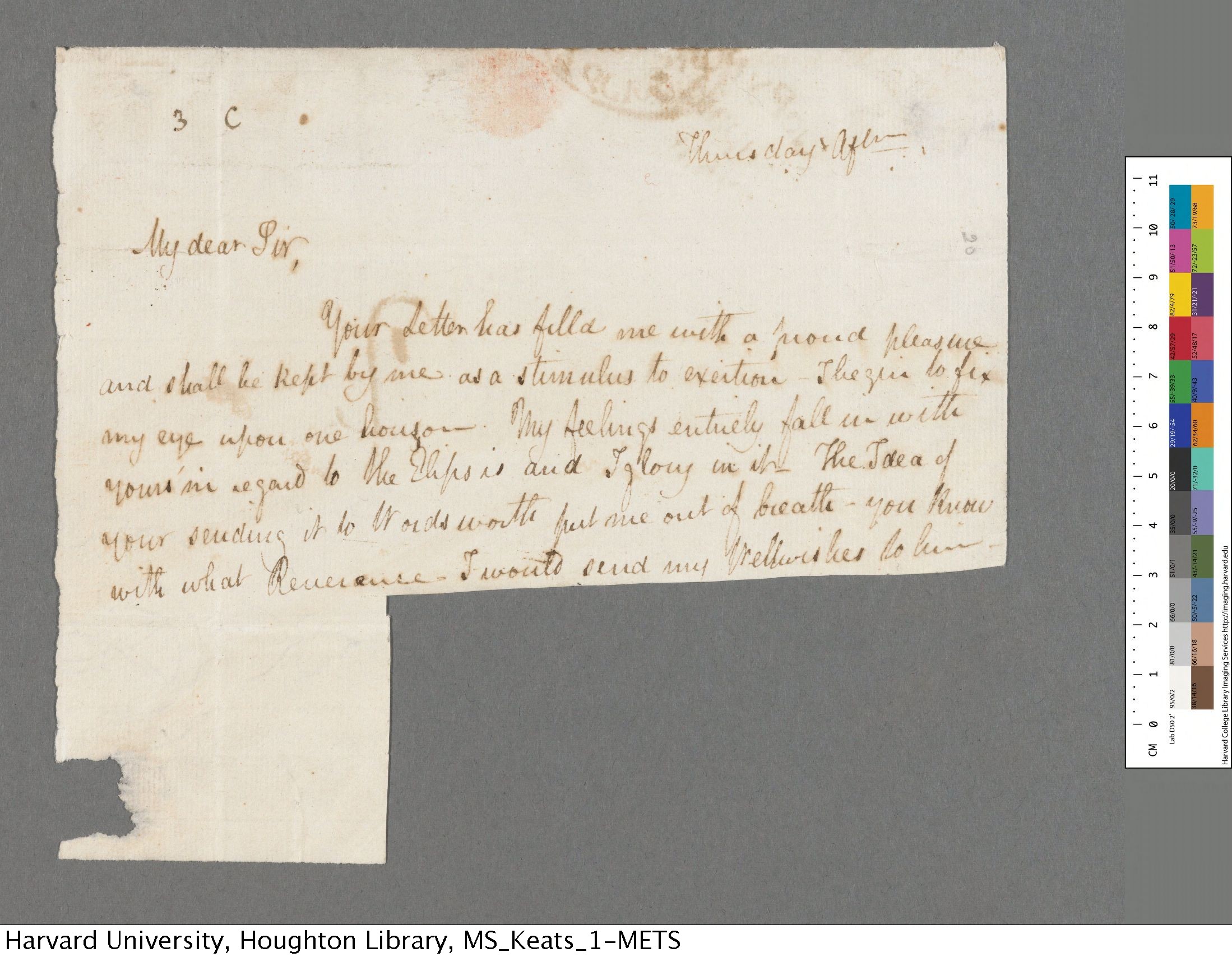
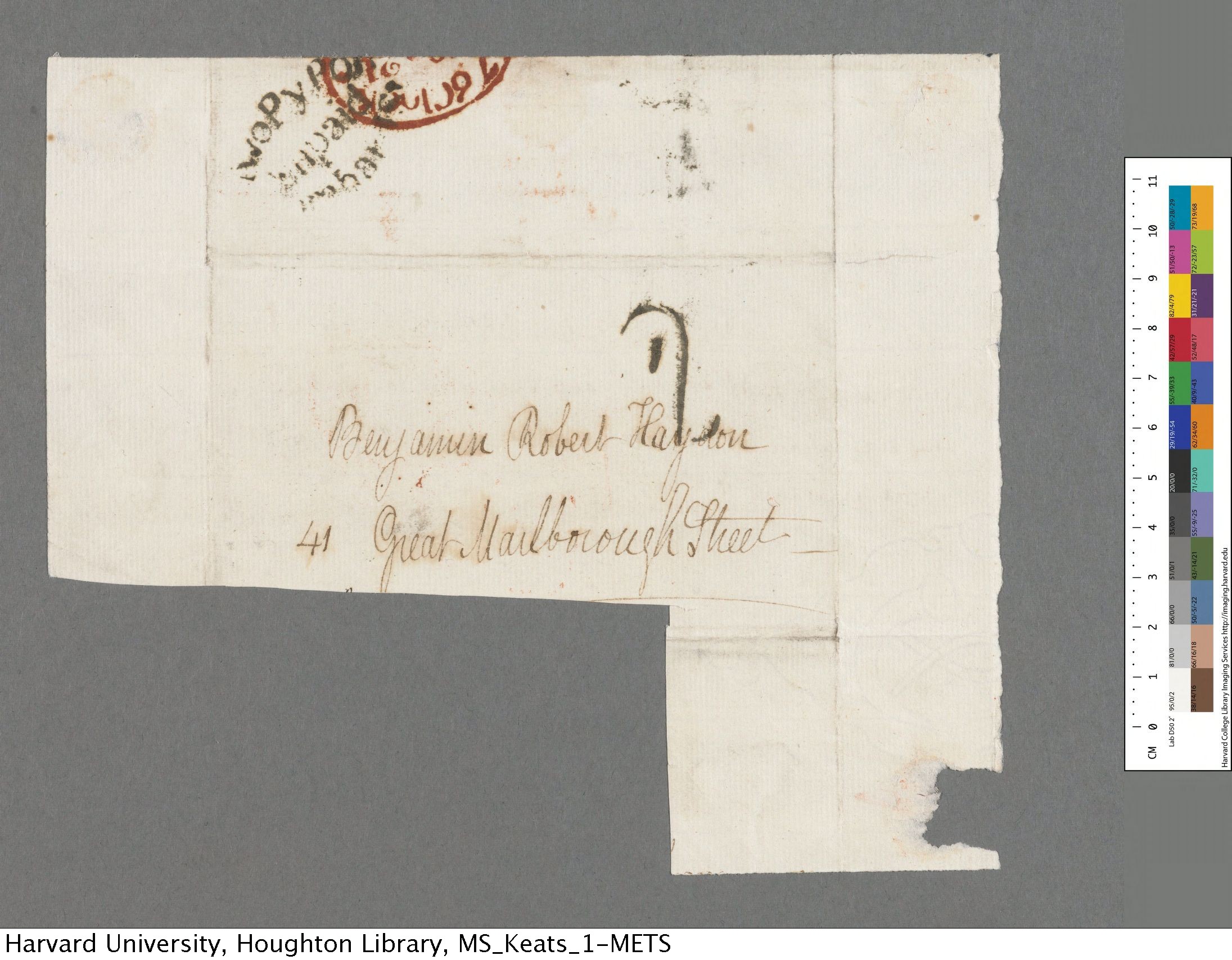
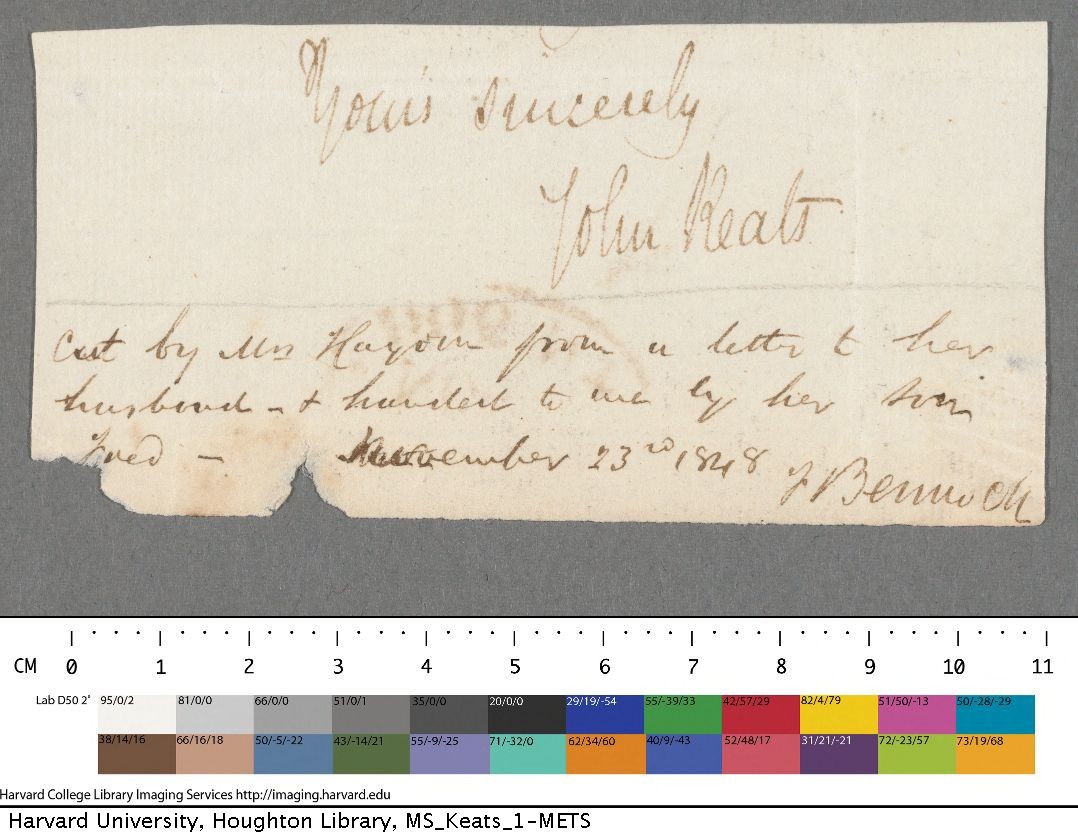
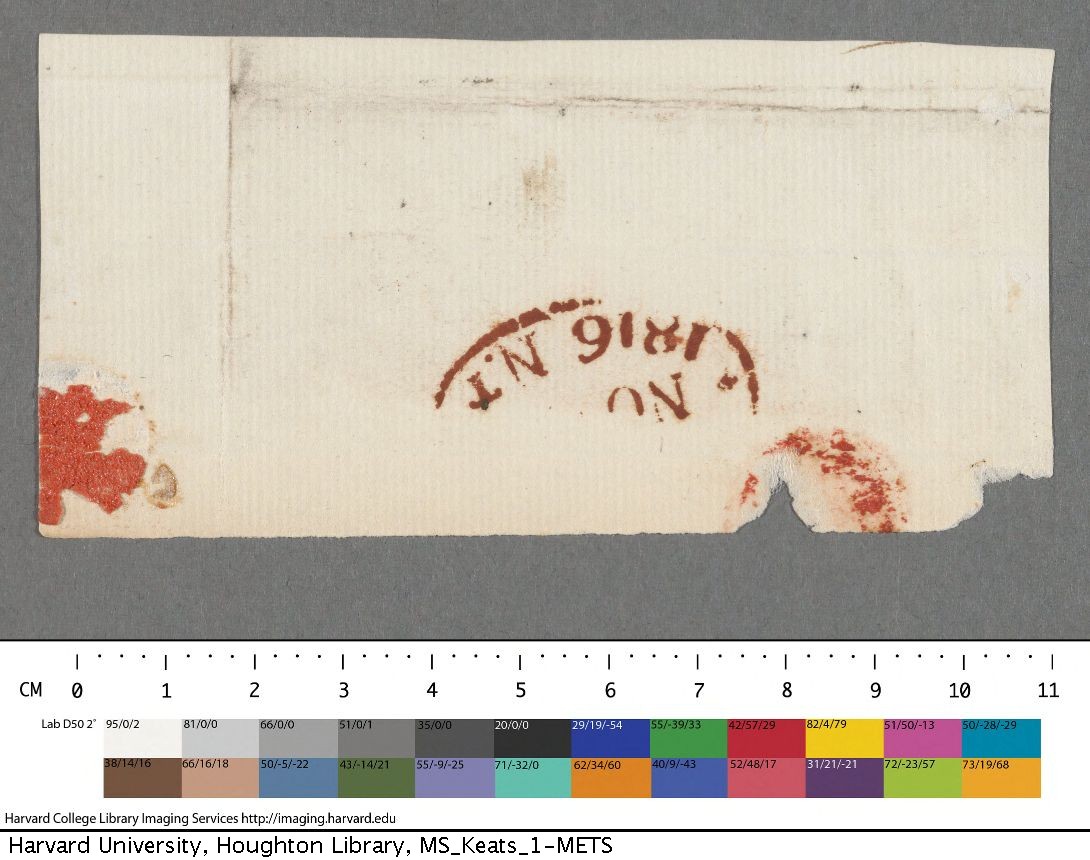
Letter #12: To J. H. Reynolds, 9 March 1817

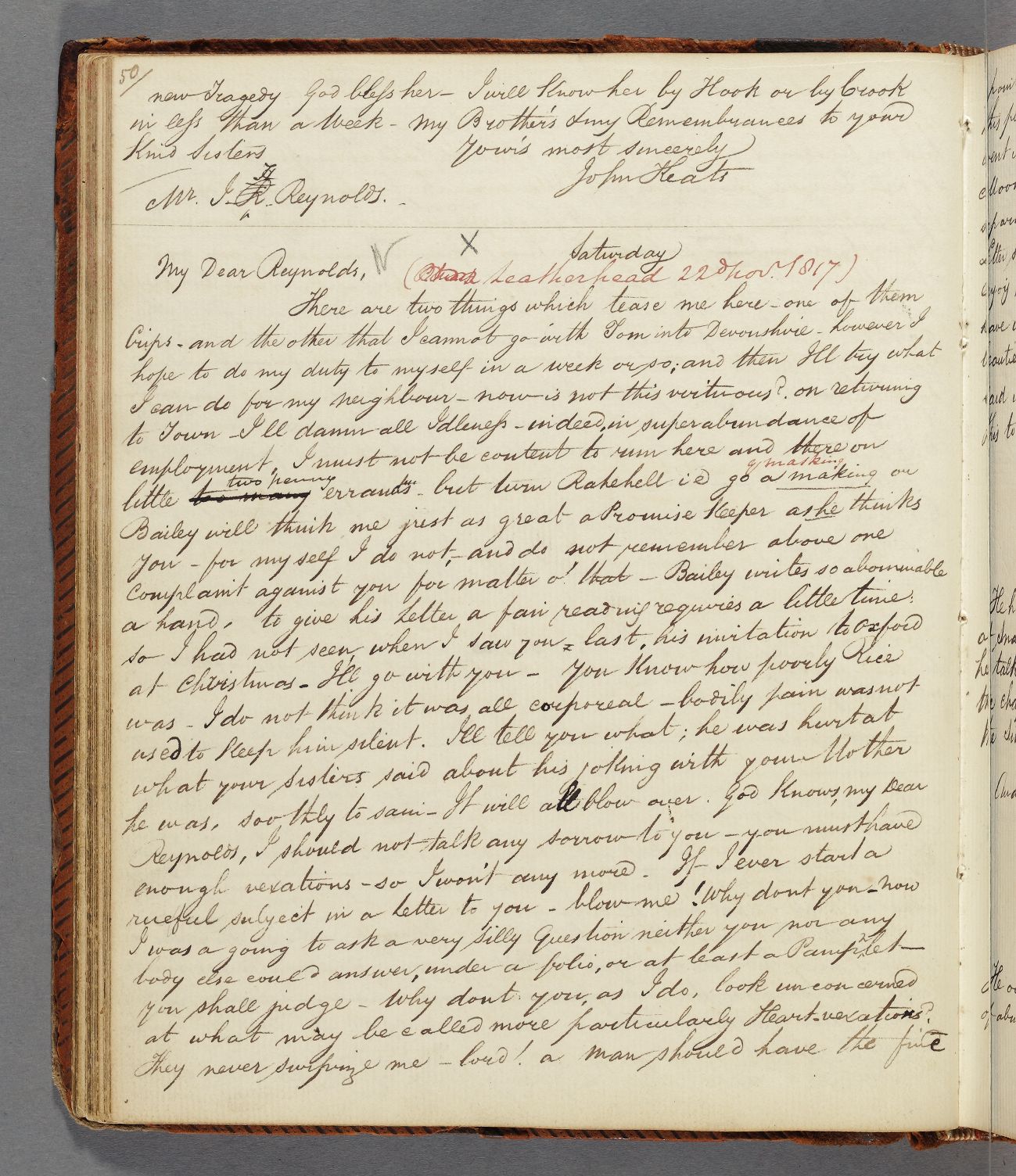
Today at the KLP we encounter for the first time two heroic figures in the story of Keats: John Hamilton Reynolds and Richard Woodhouse. The former is one of Keats’s great epistolary partners. The latter is one of Keats’s great preservationists, of both his poetry and his prose. Today’s letter we have thanks to them both. Of Keats’s 21 letters to Reynolds which still exist in whole or in part, only three exist via the original MS (19 Feb 1818 at Princeton, 24 Aug 1819 at the New York Public Library, and 28 Feb 1820 at the University of Texas). The other 18 exist via transcripts made by Woodhouse. He copied 57 of Keats’s letters (and many of his poems). Out of those 57 letters, 20 exist in no other source. For all you math fans out there, that means all but two of the letters for which Woodhouse’s transcripts are the sole source are letters to Reynolds. And what a loss it would have been had Woodhouse not copied these letters to Reynolds! The KLP editorial board might disagree on this assessment, but one or two of us subscribe to the argument that after Keats’s brothers, sisters (counting his sister-in-law), and Fanny Brawne, Reynolds is the most significant correspondent for Keats across his epistolary career.

Admittedly, however, the 9 Mar 1817 letter to Reynolds is not one of the most consequential sent to him by Keats. But as we’ve seen before at the KLP, even some of these short, seemingly throwaway letters still have moments of brilliance and fascination that our correspondents’ responses help to shine through. Tristram Wolff’s response for today’s letter is no exception in this regard. From this brief note in which Keats thanks Reynolds for the favorable review the latter had just published on the former’s recently published book (see This Week in Keats, Episode 2 for more on Keats’s first book!), Wolff helps us see flickers of William Hazlitt’s brilliance and the influence it will have on Keats. This letter marks the first recorded reference to Hazlitt by Keats, but as Wolff demonstrates, it testifies to a connection between the two that was by this point in 1817 already well established and firmly ingrained (at least in Keats’s mind). Wolff also shows us that at this early stage in Keats’s poetic career, the young poet is keenly attuned to the realm of literary reviewing, long before he becomes embroiled in it in more significant ways. So you should really go read his post–the KLP may be a bit biased in the matter, but we think it’s a pretty fantastic piece. Enjoy!


From Richard Woodhouse’s letter-book. John Keats Collection, 1814-1891 (MS Keats 3.3). Houghton Library, Harvard University.


From Richard Woodhouse’s letter-book. John Keats Collection, 1814-1891 (MS Keats 3.3). Houghton Library, Harvard University.

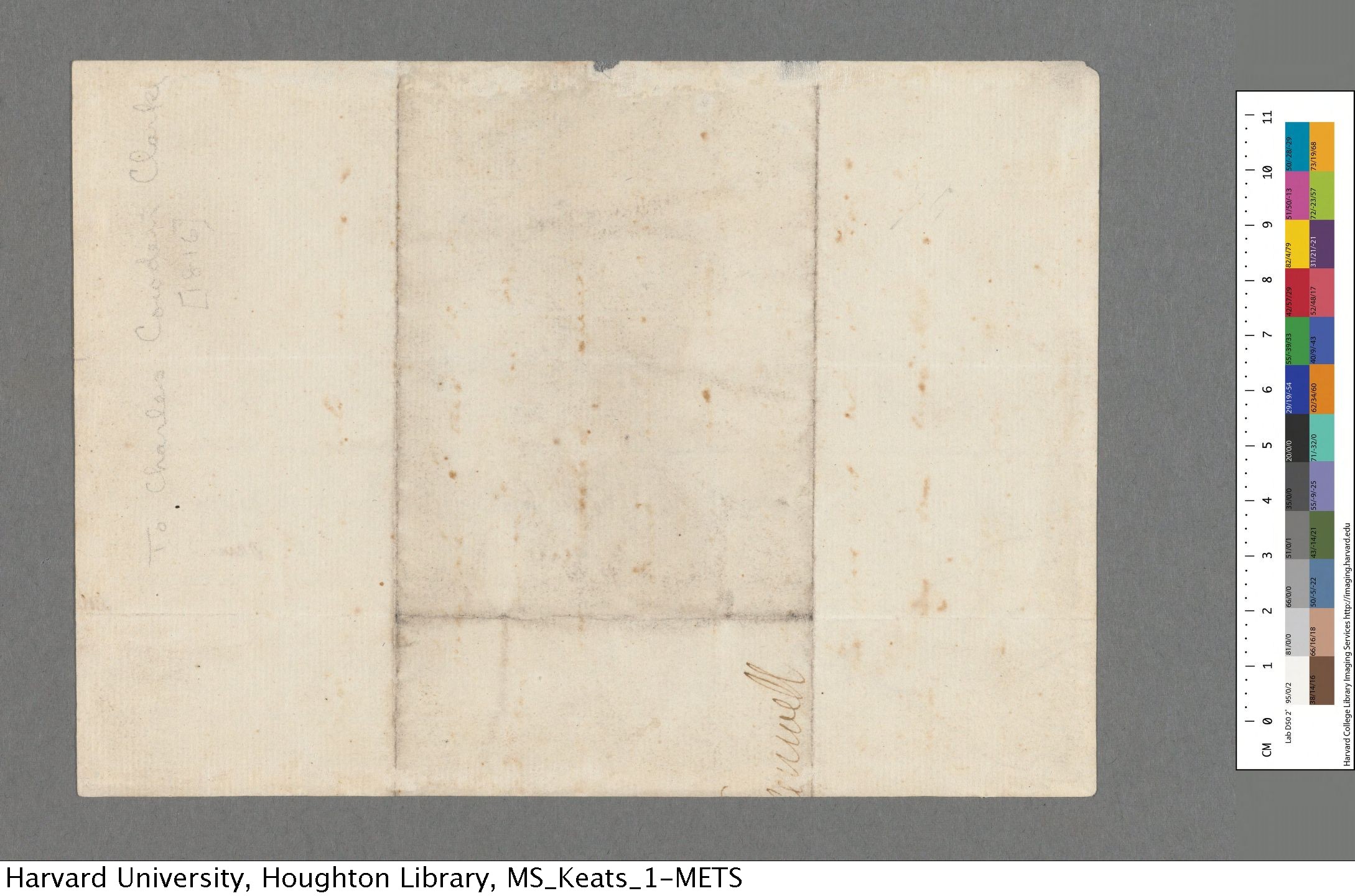
Letter #11: To Charles Cowden Clarke, 17 December 1816

And so we come to the end of the first full year in which Keats leaves behind a significant textual record, and during which he develops so quickly and impressively as a writer. He’s now attracted not just one but two established cultural figures as potential mentors—or rather, those two figures (Hunt and Haydon) have both actively worked to claim Keats as their own. On 1 Dec 1816, Hunt made a case for his ownership stake by featuring Keats as the third and final featured poet in his ‘Young Poets’ essay in The Examiner. And not to be outdone, Haydon has made plans to include Keats’s ‘awful visage’ in his massive painting, Christ’s Entry into Jerusalem (which Susan Wolfson discussed in her response to Keats’s late-November letters to Haydon). Haydon sketched Keats in the famous profile that eventually makes its way into the painting at its completion in 1820. And now, probably just a few days before the 17 December letter to Clarke, Haydon has also made a life mask of the budding poet (perhaps to help with his depiction of Keats in the painting, but also certainly as a preliminary gesture toward preserving Keats’s legacy).

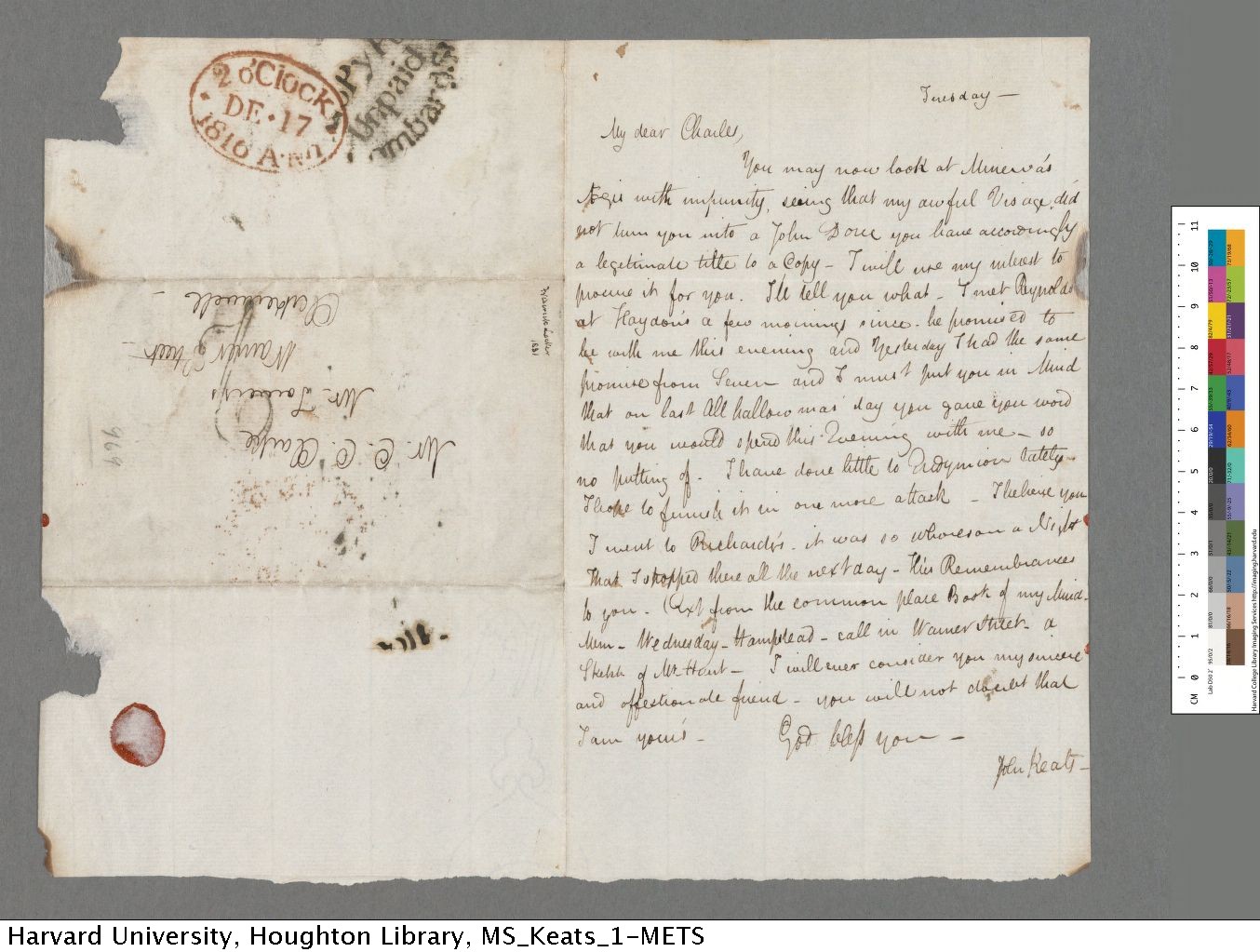
At the beginning of the letter for today, we see Keats playfully referring to that life mask—he reasons that since his awful visage has not yet turned Clarke into a John Doree, his friend will be safe owning a ‘legetimate copy’ (our response to this letter features some lively debate about Keats’s punny spelling!). But the main purpose of this letter seems to be to remind Clarke that he had promised, way back on 1 November, to spend the evening of 17 December with Keats. And to seal the deal, Keats tells Clarke that Severn and Reynolds are both down to hang out, so he better not bail on them!

Why schedule this meeting so long in advance? Well, according to Nick Roe in his recent biography of Keats, this gathering was essentially a coming out party for Keats the Poet. Roe speculates that Keats hit on this particular date in part because it coincides with the Saturnalia (this won’t be the last time we see Keats appreciating the old gods). And he needed to plan it far in advance since, lest we forget, young Keats is still serving as a surgeon’s dresser at Guy’s Hospital! Not only does that mean he’s in a sort of perpetual “busy time.” It also means that he’s spending many of his days and nights during these last months of 1816 amid human suffering of a sort that’s probably hard for most of us to imagine. And yet on some days and nights, like this one on the occasion of the Saturnalia, there must also be such joy, such pleasure, such giddy anticipation at the prospect of a life lived “overwhelm[ed] … / in Poesy.”

What a fine way, then, to end 2016 with Keats. We do not forget the pains and sorrows of those around us. We do not shirk our responsibility to strive always to alleviate and eliminate suffering. Amidst those recognitions we also revel in the joy of conviviality, and we gratefully gather with friends and loved ones for evenings filled with food, wine, and poetry.

Keats’s 17 Dec 1816 letter to Charles Cowden Clarke. Harvard Keats Collection, Houghton Library. Page 1. (click image for full size)

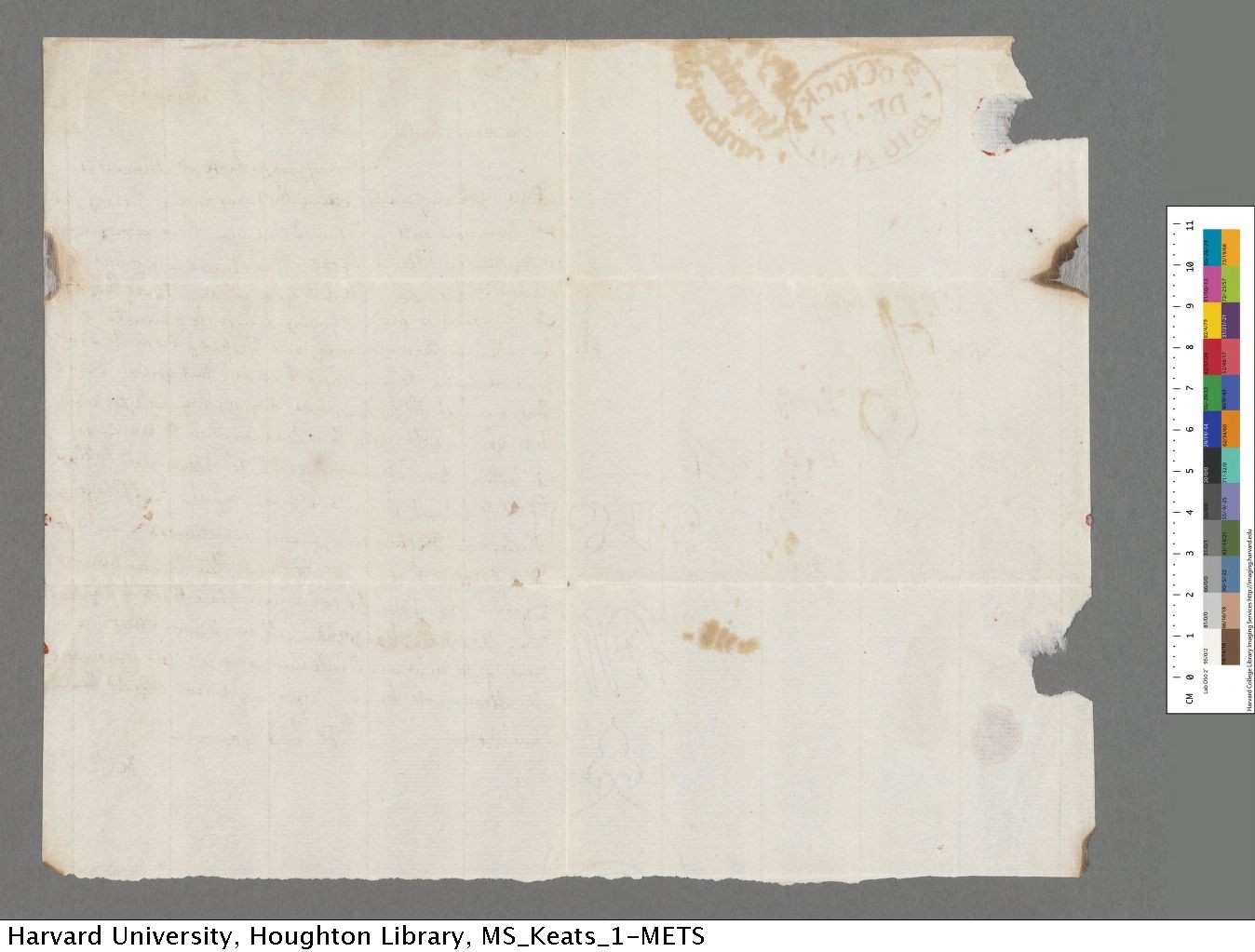
Keats’s 17 Dec 1816 letter to Charles Cowden Clarke. Harvard Keats Collection, Houghton Library. Page 2. (click image for full size)

Letter #10: To Benjamin Robert Haydon, 21 November 1816

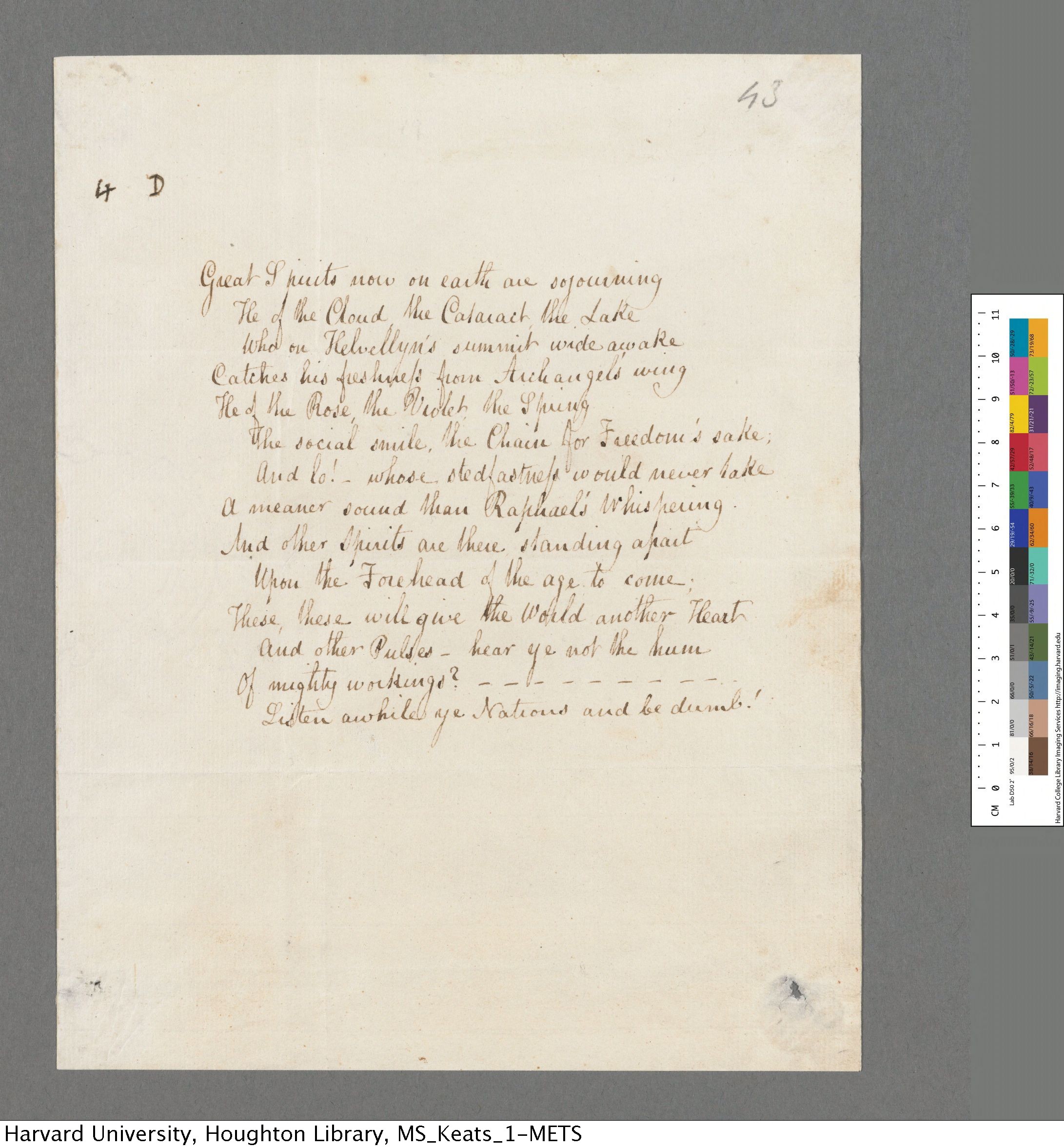
As we saw yesterday, Keats sent Haydon his “Great Spirits” sonnet on 20 November 1816, the morning after the two spent an evening together talking poems and making puns while Haydon sketched Keats’s profile for his eventual inclusion in Christ’s Entry into Jerusalem. Pretty remarkable how quickly Haydon took to Keats–they meet for the first time and then a couple weeks later, he’s like, “hey Keats, how ’bout I put you in my painting right behind Wordsworth?” The KLP is struck again and again in these early, heady days at the rapidity of Keats’s emergence as a poet in 1816. Back in September Keats was anxiously sharing his poetry with Charles Cowden Clarke for the first time–now in November Haydon is promising to forward Keats’s sonnet along to Wordsworth. No biggie.

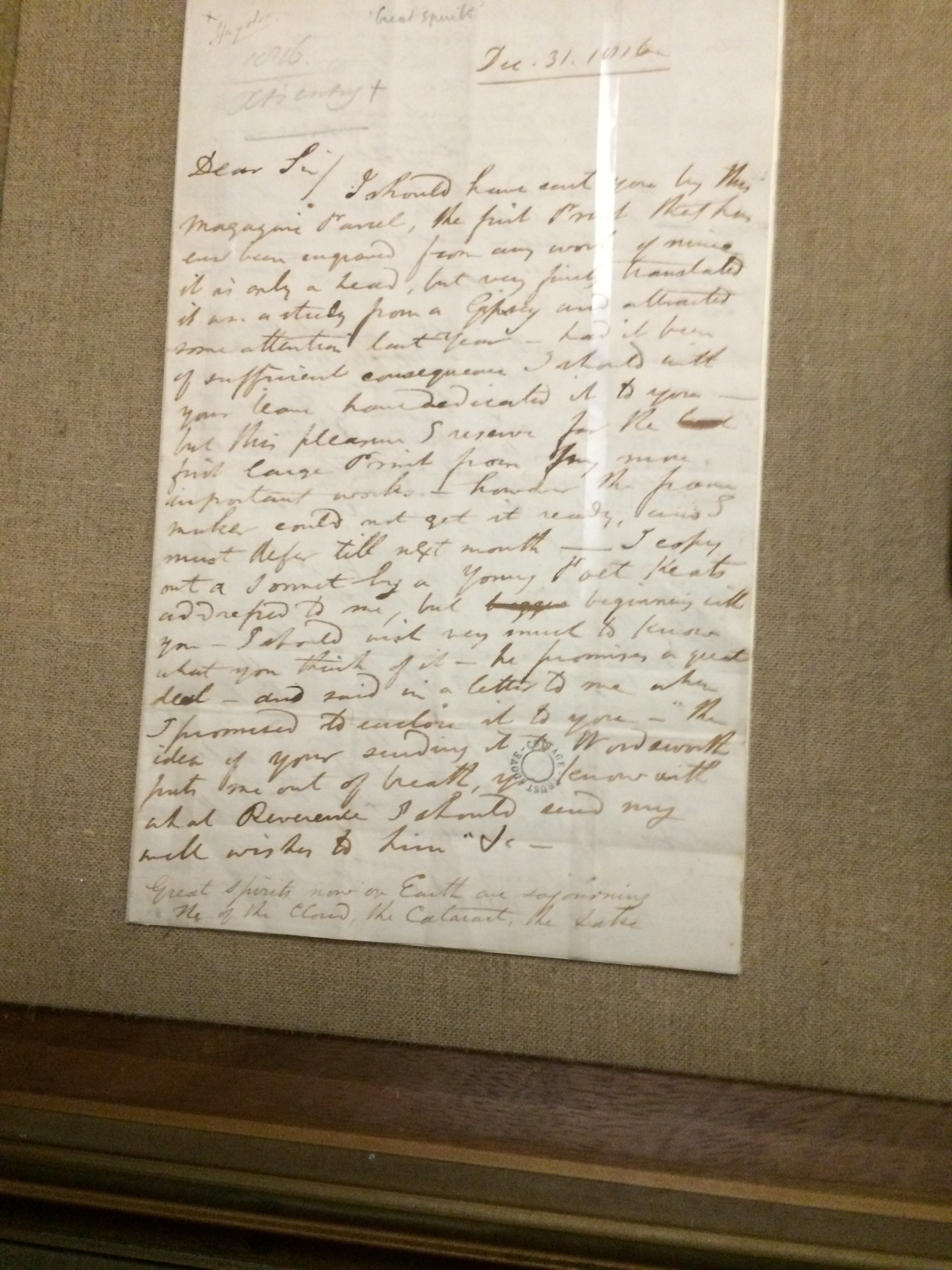
In this second letter to Haydon, then, Keats praises the artist’s suggested revision to the poem (the ellipsis in line 13, about which Keats says, “I glory in it”). And he admits to being put “out of breath” at the thought of his poem making its way north to Wordsworth, “He of the Cloud, the Cataract, the Lake.” One can see the care with which Keats prepared this fair copy of the poem, on a sheet separate from and enclosed within his letter to Haydon. As Susan Wolfson noted yesterday, Haydon did not send the fair copy itself, choosing instead to keep that one for himself, and to send a transcript to Wordsworth (after delaying for a month or so). It now resides at the Wordsworth Museum in Grasmere. Haydon did not present the sonnet with near as much care, as you can see here from this photograph taken by KLP editor Brian Rejack, when he, along with another KLP editor, Mike Theune, visited in July 2015.

Haydon's letter to Wordsworth, including a transcript of the 'Great Spirits' sonnet. Getting the first two lines and then having to turn over the page--not exactly the best reading experience. Come on, Haydon!

Haydon’s letter to Wordsworth, including a transcript of the ‘Great Spirits’ sonnet. Getting the first two lines and then having to turn over the page–not exactly the best reading experience. Come on, Haydon!

In any case, Wordsworth seemed to like the sonnet well enough, although, as Austin Smith writes today, one begins to sense a bit of condescension from His Eminence, who by 1816 had been ensconsced for a few years in the, ahem, slightly-more-regal-than-Dove-Cottage setting of Rydal Mount. But Keats was not yet to lose any faith in Wordsworth. Surely he remained in November 1816 absolutely overjoyed at the thought of any connection with his poet-hero.

Keats also remained at that point firmly convinced that he himself had a shot at becoming another Great Spirit then on Earth sojourning. Austin Smith offers us a valuable suggestion for these early years of Keats’s bicentenary memorials–we would do well to momentarily put aside our knowledge of late Keats, with all the self-annihilating pessimism it brings. Smith writes that, to get there, Keats first “had to work through the desire to be known”; he had to revel in his hope that the sacred springs of Mount Helicon might deign to “spout a little streamlet o’er” his “sorry pages.” Did they ever, Keats. Did they ever.

All MS images from John Keats Collection, (MS Keats 1.4). Houghton Library, Harvard University. Click on each to see full size images.

Letter #9: To Benjamin Robert Haydon, 20 November 1816

More exciting stuff for Keats today. During early November 1816 he began to cultivate a friendship with Benjamin Robert Haydon, an older man and an already established artist, one who happened to be friends with Wordsworth. It’s hard to imagine what Keats must have felt like as he moved into circles that brought him into direct contact with his literary heroes. He had recently also met Leigh Hunt, who in about ten days’ time would publish his “Young Poets” essay in The Examiner naming Keats (along with John Hamilton Reynolds and Percy Bysshe Shelley) as one of three promising writers poised to change the poetry world. Meeting Haydon was another important step in developing Keats’s literary and artistic network.

On 19 November 1816, Keats and Haydon spent the evening together. That evening gave at least two significant gifts to posterity: Haydon’s sketch of Keats in profile (one of the rotating title images for the KLP front page), and Keats’s “Great Spirits” sonnet. The latter Keats sent to Haydon on 20 November, along with a brief note indicating how the previous evening “wrought [him] up,” the topic explored in Susan Wolfson’s response to the letter. The sonnet persists as a testament to Keats’s belief in the social significance of poetry, and to his ability to compose rapidly and animatedly on the occasion of a seemingly great event, or at least one that seemed to mark an era in his existence.

Haydon proved a receptive audience for Keats’s sonnet, and how could he not, given that Haydon had been named as one of those “great spirits”? The interchange between the two on 20 November led to a revision and a second letter from Keats to Haydon the next day. But more on that tomorrow! For now, enjoy Keats’s sonnet and Susan Wolfson’s exquisitely wrought response to it.

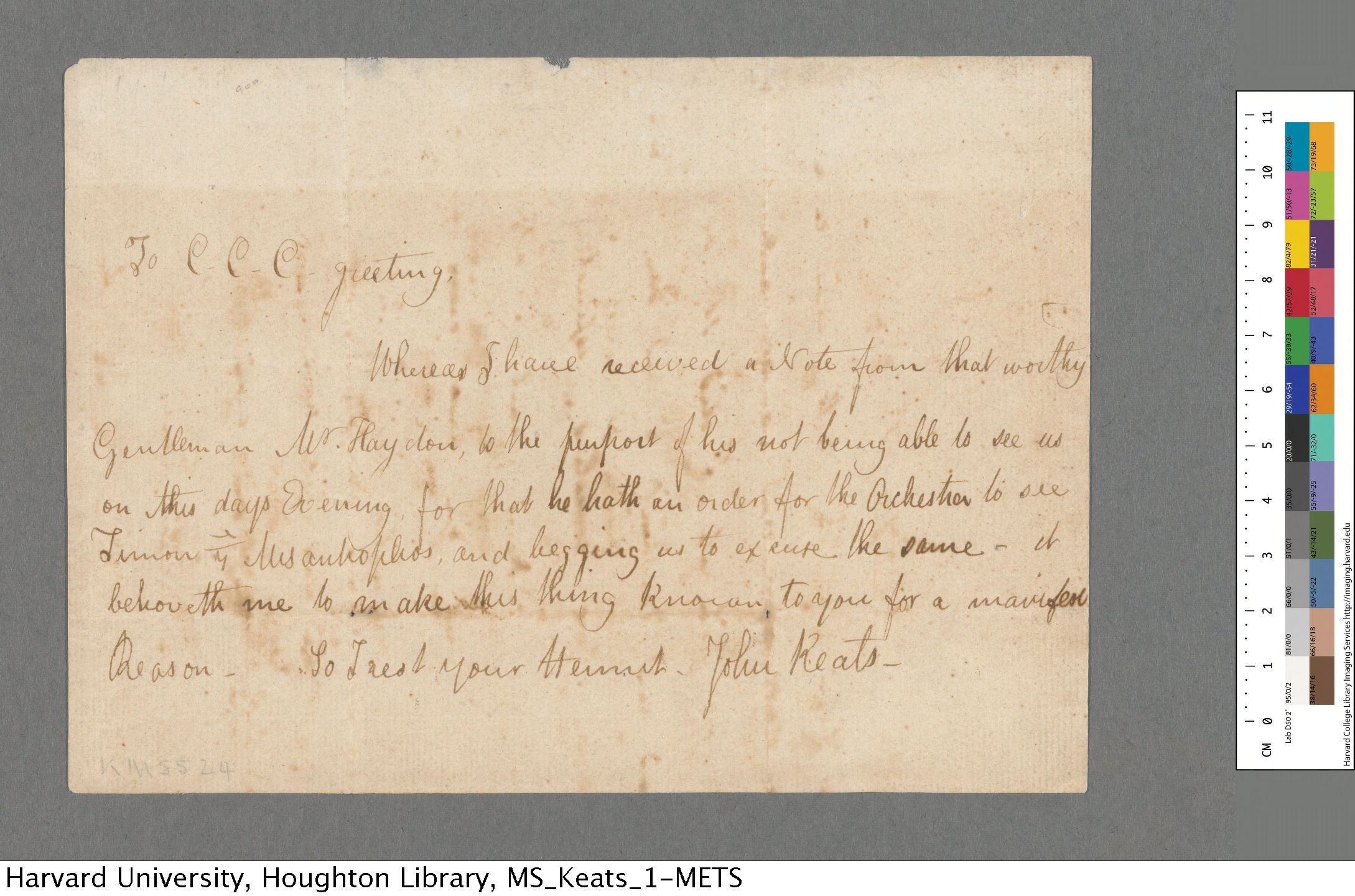
Letter #8: To Charles Cowden Clarke, 8 or 11 November 1816

The esteemed editor of Keats’s letters, Hyder Edward Rollins, offers an estimate of this letter’s date based on the mention of Timon of Athens (or, as Keats has it, “Timon ye Misantrophos”), which was performed at Drury Lane several times in early November 1816. Eliminating a few other options based on information we have about Keats’s activities during this period, Rollins settles on the two remaining possibilities, 8 or 11 November 1816.

As in the 1 November 1816 letter to Severn, here we see Keats again in the heady rush of “urban time,” as Matthew Sangster described it in his response to that letter. The difference here is that Keats’s new friend Benjamin Haydon is the one in a hurry. Haydon apparently had to break an engagement to visit with Keats and Clarke in order to attend a performance of the aforementioned Timon of Athens. Keats dashes off this letter to let Clarke know that the plans are off and that Keats will “rest your hermit.”

Keats also shows off one of his typical modes of humor: the mock-formal, or as he’ll describe it in a much later letter, writing “hoity-toityishly.” Of course, Keats’s letters are well-known for their seriousness of thought, but they ought to be just as highly regarded for their levity. He regularly adopts the language of legal documents or other formal modes, and he appears to get a kick out of hamming it up by so doing. Good on you, Keats.

Since we don’t know the date for certain, we’ll take Rollins’s guesses as our guides for this letter. For your enjoyment on this election day in the US, we hope that Keats’s brief note will provide a moment of respite from the ennui, anxiety, terror, despair, or whatever other feelings (maybe even some good ones!) brought on by today’s events.

And be on the lookout for a response to the letter this Friday, November 11–the KLP figures why not cover both dates!

John Keats Collection, 1814-1891 (MS Keats 1.2.1). Houghton Library, Harvard University.

John Keats Collection, 1814-1891 (MS Keats 1.2.1). Houghton Library, Harvard University.

John Keats Collection, 1814-1891 (MS Keats 1.2.1). Houghton Library, Harvard University.

John Keats Collection, 1814-1891 (MS Keats 1.2.1). Houghton Library, Harvard University.

Letter #7: To Joseph Severn, 1 November 1816

Here at the KLP, especially in the early years of our endeavor, we like to keep Keats alive as long as possible. It’s all too easy to dwell on the poet’s tragic end in Italy in 1821. And now, with the first letter to Joseph Severn, the sensitive and caring companion who would spend several grueling months watching Keats die, we have to work particularly hard to go not to Lethe, to resist the allure of wolf’s-bane’s poisonous wine.

Alas. Sorry, Keats, but we’re going to try a different tack than glutting our sorrow. Instead, as Matthew Sangster suggests in his response to this brief letter to Severn, let us invoke “other kinds of temporalities” than the melancholic “slow Time” so often associated with Keats’s poetry. As Sangster writes, this letter shows “something closer to the quick email apology that harried twenty-first century correspondents might dash off than the worked epistles that he would later use to lay out his ideas about poetry.” In other words, here we see Keats traveling in the fast lane of modern urban life. Let’s do what we can to keep him like that in our minds.

Another harried moment marks the life of this letter as well. Severn outlived Keats by 58 years, and yet, he seems to have kept the poet always lively in his mind during that long period. In 1878, he wrote to Charles Dilke of Keats’s poetry, “I begin to live on them [!!!]” (emphasis, and exclamation marks, added). Even at that late date, Severn seemed able to still call up a new beginning, a new liveliness associated with his old friend. A few months after that, on 27 May 1879, the ailing Severn slowly but surely made his way through a different urban environment than the London of his youth, and arrived at the British embassy in Rome. He brought with him the remaining Keats letters and manuscripts still in his possession. The British vice-consul, Alexander Roesler Franz, attested to the letters’ authenticity, and marked them with his diplomatic seal, alongside Severn’s shaky but insistent signature. It was an act that marked a new beginning for this letter from November 1816. Across a gap of nearly 63 years, Keats’s rushed epistle made its way through slow time and back into another brief but lively moment, when his aging friend added some of his last vital traces to the history of Keats’s letters.

So here’s to you, Severn! The KLP hopes to do our part in helping others “begin to live” on your and Keats’s correspondence.

Letter #6: To Charles Cowden Clarke, 31 October 1816

Happy 221st birthday, Keats! As he was never one to know the day of the month, it’s no surprise that Keats doesn’t mention this fact in his letter to Charles Cowden Clarke. Let’s hope that they nonetheless celebrated with a glass or two of claret.

We at least know that Keats wrote this short letter to Clarke on 31 October 1816, in which he affectionately addresses his pal as, “My daintie Davie.” Keats’s circle of friends at this time was rapidly expanding. We’ve heard already from Noah Comet and Greg Kucich about Keats’s excitement at meeting Leigh Hunt. The painter Benjamin Robert Haydon was the next star in the firmament of Keats’s budding literary and artistic coterie. In this letter, Keats demonstrates his pleasure at visiting with Haydon, whom he refers to as “this glorious Haydon.” Their relationship would prove a fruitful one for both over the next few years. Among the many benefits their friendship bestowed on us is the life mask of Keats that Haydon would make later in 1816 (more on that to come on the KLP in December!). The KLP humbly admits that more than one copy of said life mask is owned by the editorial team.

For the text of this letter, the MS of which now resides in the Berg Collection at the New York Public Library (digitized images to come at a later date, we hope), we refer you to the KLP’s favored late-19th-century edition of Keats’s letters, Harry Buxton Forman’s one-volume edition from 1895, published by Reeves and Turner in London. That publishing firm had realized the value of mimicking the visual design of private presses like William Morris’s Kelmscott Press or Charles Ricketts’s Vale Press, and as such, this particular book looks rather pretty. Also following in the spirit of commemoration on which the KLP is founded, Forman’s 1895 edition was published with the recognition that “On the 31st of October 1895, the hundredth year since his birth will be completed; and it may be fairly asked whether in the literary annals of the century a more significant date can be named” (xiii). The KLP avers that it may indeed be fairly asked. We hold that date near and dear to our collective hearts. So, happy 221st birthday, Keats!

To help celebrate this joyous occasion, the KLP invites you to read Hannah Dow’s poem inspired by this letter. We dare say it burns with a Keatsian intensity–a worthy tribute to Keats, to Haydon, and to Keats’s glorying in the gusto of Haydon’s art.

CCC31oct1816


Letter #5: To Charles Cowden Clarke, 9 October 1816

Here Keats ponders his first meeting with Leigh Hunt, which would indeed become “an era in [his] existence,” as he recognized then. Noah Comet’s response to the letter captures with gusto the attitude of the young poet as he began to make his way toward being “among the English Poets.”


Thanks to the Historical Society of Pennsylvania for digitizing the manuscript of the letter, and for giving us permission to reproduce it here. And thanks to Ferdinand J. Dreer (1812-1902) for collecting over 15,000 autograph letters during his lifetime, and donating them all to the HSP! Keats’s letter was one of them. Good work, Ferdinand! The letter remained in the museum without making its way into print until 1932, however. If you have access (or want to pay), you can read about the re-discovery of the letter in this article by J. H. Birss, in Notes and Queries from 5 November 1932. Birss was at the time researching Herman Melville, and when looking through a bibliography in Widener Library, he just so happened to open the book to the Ks instead of the Ms. The 9 October letter was listed there, and when Birss realized no such letter had ever been printed, he undertook the search that would eventually lead him to find it at the Historical Society of Pennsylvania. So we can also say thanks to Melville, and to the alphabetical proximity of K and M! Lots of thanks to go around.

The KLP would also like to take this opportunity to confess that we fantasize on a semi-daily basis about discovering a new Keats letter in a manner such as this. Some day… some day.

Letter #4: To Charles Cowden Clarke, September 1816

Charles Cowden Clarke died in March 1877, and the next year his widow, Mary Cowden Clarke (née Novello) would publish their co-written Recollections of Writers. Friends of Keats likely know this text for the extended memoir of the poet which Charles had written and published in a shorter form in the Atlantic Monthly in 1861. But Mary’s contributions are valuable too, particularly for the poignancy of her autobiographical “General Recollections” which open the volume, and which can’t but be read in light of her husband’s recent death. The book’s preface features this heart-breaking conclusion:

Charles and Mary Cowden Clarke may with truth be held in tender remembrance by their readers as among the happiest of married lovers for more than forty-eight years, writing together, reading together, working together, enjoying together the perfection of loving, literary consociation; and kindly sympathy may well be felt for her who is left singly to subscribe herself,

Her readers’ faithful servant,

MARY COWDEN CLARKE.

One example of their “loving, literary consociation” can be found in Mary’s recollection of their honeymoon in Enfield in July 1828, where two decades before, Keats and Charles began their own affectionate relationship rooted in reading and writing together. As the newlyweds Mary and Charles make their way from Edmonton to Enfield, strolling in post-nuptial bliss, they pass the spot where Keats “used to lean over the rail of the foot-bridge, looking at the water and watching ‘Where swarms of minnows show their little heads, / Staying their wavy bodies ‘gainst the streams, / To taste the luxury of sunny beams / Temper’d with coolness.” Next they come upon “the exact spot recorded in Keats’ Epistle to C. C. C., where the friends used to part.” After again quoting some lines from Keats, this time from the epistle from September 1816, Mary remembers that she and Charles “loitered under a range of young oak-trees, now grown into more than stout saplings, that were the result of some of those carefully dropped acorns planted by Charles and his father.” One wonders if they then thought of the poet who had been outlived by those young trees.

But we do rush ahead of ourselves, dwelling as we are in 1828, when a newlywed couple celebrated their union by remembering the departed Keats, and in 1878 when the recently widowed Mary published a book that was the product of a life-long literary partnership between her and Charles. In 1816 we see a different sort of partnership, but one based as deeply in the bonds of “loving, literary consociation.” Keats’s “Epistle to C. C. C.” is a moving tribute to the poet’s friend and the experience of poetry they shared together. And as Jayme Peacock shows in her response to the epistle, Keats uses that relationship with Clarke to think through his own emerging sense of himself as a poet. From the beginning, Keats expressed a deep commitment to poetry as a social endeavor, and we certainly see that on display here.

_______________________________________

“To Charles Cowden Clarke”

Oft have you seen a swan superbly frowning,
And with proud breast his own white shadow crowning;
He slants his neck beneath the waters bright
So silently, it seems a beam of light
Come from the galaxy: anon he sports,—
With outspread wings the Naiad Zephyr courts,
Or ruffles all the surface of the lake
In striving from its crystal face to take
Some diamond water drops, and them to treasure
In milky nest, and sip them off at leisure.
But not a moment can he there insure them,
Nor to such downy rest can he allure them;
For down they rush as though they would be free,
And drop like hours into eternity.
Just like that bird am I in loss of time,
Whene’er I venture on the stream of rhyme;
With shatter’d boat, oar snapt, and canvass rent,
I slowly sail, scarce knowing my intent;
Still scooping up the water with my fingers,
In which a trembling diamond never lingers.

By this, friend Charles, you may full plainly see
Why I have never penn’d a line to thee:
Because my thoughts were never free, and clear,
And little fit to please a classic ear;
Because my wine was of too poor a savour
For one whose palate gladdens in the flavour
Of sparkling Helicon:—small good it were
To take him to a desert rude, and bare,
Who had on Baiae’s shore reclin’d at ease,
While Tasso’s page was floating in a breeze
That gave soft music from Armida’s bowers,
Mingled with fragrance from her rarest flowers:
Small good to one who had by Mulla’s stream
Fondled the maidens with the breasts of cream;
Who had beheld Belphoebe in a brook,
And lovely Una in a leafy nook,
And Archimago leaning o’er his book:
Who had of all that’s sweet tasted, and seen,
From silv’ry ripple, up to beauty’s queen;
From the sequester’d haunts of gay Titania,
To the blue dwelling of divine Urania:
One, who, of late, had ta’en sweet forest walks
With him who elegantly chats, and talks—
The wrong’d Libertas,—who has told you stories
Of laurel chaplets, and Apollo’s glories;
Of troops chivalrous prancing through a city,
And tearful ladies made for love, and pity:
With many else which I have never known.
Thus have I thought; and days on days have flown
Slowly, or rapidly—unwilling still
For you to try my dull, unlearned quill.
Nor should I now, but that I’ve known you long;
That you first taught me all the sweets of song:
The grand, the sweet, the terse, the free, the fine;
What swell’d with pathos, and what right divine:
Spenserian vowels that elope with ease,
And float along like birds o’er summer seas;
Miltonian storms, and more, Miltonian tenderness;
Michael in arms, and more, meek Eve’s fair slenderness.
Who read for me the sonnet swelling loudly
Up to its climax and then dying proudly?
Who found for me the grandeur of the ode,
Growing, like Atlas, stronger from its load?
Who let me taste that more than cordial dram,
The sharp, the rapier-pointed epigram?
Shew’d me that epic was of all the king,
Round, vast, and spanning all like Saturn’s ring?
You too upheld the veil from Clio’s beauty,
And pointed out the patriot’s stern duty;
The might of Alfred, and the shaft of Tell;
The hand of Brutus, that so grandly fell
Upon a tyrant’s head. Ah! had I never seen,
Or known your kindness, what might I have been?
What my enjoyments in my youthful years,
Bereft of all that now my life endears?
And can I e’er these benefits forget?
And can I e’er repay the friendly debt?
No, doubly no;—yet should these rhymings please,
I shall roll on the grass with two-fold ease:
For I have long time been my fancy feeding
With hopes that you would one day think the reading
Of my rough verses not an hour mispent;
Should it e’er be so, what a rich content!
Some weeks have pass’d since last I saw the spires
In lucent Thames reflected:—warm desires
To see the sun o’er peep the eastern dimness,
And morning shadows streaking into slimness
Across the lawny fields, and pebbly water;
To mark the time as they grow broad, and shorter;
To feel the air that plays about the hills,
And sips its freshness from the little rills;
To see high, golden corn wave in the light
When Cynthia smiles upon a summer’s night,
And peers among the cloudlet’s jet and white,
As though she were reclining in a bed
Of bean blossoms, in heaven freshly shed.
No sooner had I stepp’d into these pleasures
Than I began to think of rhymes and measures:
The air that floated by me seem’d to say
“Write! thou wilt never have a better day.”
And so I did. When many lines I’d written,
Though with their grace I was not oversmitten,
Yet, as my hand was warm, I thought I’d better
Trust to my feelings, and write you a letter.
Such an attempt required an inspiration
Of a peculiar sort,—a consummation;—
Which, had I felt, these scribblings might have been
Verses from which the soul would never wean:
But many days have past since last my heart
Was warm’d luxuriously by divine Mozart;
By Arne delighted, or by Handel madden’d;
Or by the song of Erin pierc’d and sadden’d:
What time you were before the music sitting,
And the rich notes to each sensation fitting.
Since I have walk’d with you through shady lanes
That freshly terminate in open plains,
And revel’d in a chat that ceased not
When at night-fall among your books we got:
No, nor when supper came, nor after that,—
Nor when reluctantly I took my hat;
No, nor till cordially you shook my hand
Mid-way between our homes:—your accents bland
Still sounded in my ears, when I no more
Could hear your footsteps touch the grav’ly floor.
Sometimes I lost them, and then found again;
You chang’d the footpath for the grassy plain.
In those still moments I have wish’d you joys
That well you know to honour:—“Life’s very toys
“With him,” said I, “will take a pleasant charm;
“It cannot be that ought will work him harm.”
These thoughts now come o’er me with all their might:—
Again I shake your hand,—friend Charles, good night.

September, 1816.

Letter #3: To George Keats, August 1816

Here we have the earliest letter written by Keats for which we have an extant manuscript (you can read the text of the poem here, and also read more about that particular digital copy here). Like so many of the Keats manuscripts (both letters and poems), this one resides at the Houghton Library as part of the Harvard Keats Collection. Their wonderful website offers digitized images of dozens of manuscripts (some of the transcripts from Richard Woodhouse and John Jeffrey, as well as those in Keats’s autograph). For the Keats scholar and Keats lover alike, the Harvard Collection is indispensable, and we here at the KLP are grateful for their embrace of the spirit of open access and free use. We will frequently direct our readers to the Harvard site, and if you don’t already have it bookmarked, you ought to!

[slideshow_deploy id=’487′]


So it’s August 1816, and Keats and his brother Tom are staying at Margate for a several week visit. During this time Keats writes two verse epistles, this one to George, and another to Charles Cowden Clarke in September (be on the lookout for a response to the Clarke epistle soon!). Although we have the manuscript of the poem (and the few words Keats writes by way of preface and conclusion), we also know that part of the letter is missing. To understand about that missing piece, it’s important to recognize that during this period letters were not sent in envelopes–instead, writers folded the letter in such a way as to seal itself (here’s a handy guide on how to fold nineteenth-century style, from the Iowa State University library). In order to keep his poetry manuscript protected from any damage in transit, Keats took another sheet of paper and used it to enclose the poem. Sadly that enclosing sheet, along with Keats’s few words of “downright prose” for George included on it, has disappeared. Perhaps it still lingers in an old attic somewhere in Louisville, Kentucky, since we know George took the existing manuscript with him to America in 1818, and perhaps at that time still had the enclosing sheet as well. The man who married Georgiana Keats after George’s death, John Jeffrey, when he made copies of several letters to send to Richard Monckton Milnes in 1845 (who was then preparing his biography of the poet), neglected to transcribe the verse epistle because it had been previously published–at the top of the first page of the manuscript Jeffrey wrote, “(published).” As Jeffrey was by no means a careful textual scholar, it wouldn’t be unreasonable to assume that if the enclosing sheet was still there, he found the words of “downright prose” not worth his time either. In any case, with or without that enclosing sheet, the poetry manuscript at some point made its way into the collection of William Arnold Harris, an American book collector who owned a handful of Keats manuscripts at the time of his death in 1923 (including one of the most haunting of Keats’s manuscripts, that containing the blood-chilling fragment, “This living hand”). At the auction of Arnold’s collection held in New York on 10-11 November 1924, Amy Lowell purchased the verse epistle to George (and “This living hand,” although a few other items were claimed by other collectors, presumably to Lowell’s extreme disappointment). Thanks to the work of assiduous collectors and that of equally–if not more–assiduous librarians and archivists, this letter to George can be glimpsed in digital form alongside a wealth of other Keats manuscripts. Enjoy! And also enjoy Michael Theune’s deft exploration of the poem’s dolphin-like leaps and turns!