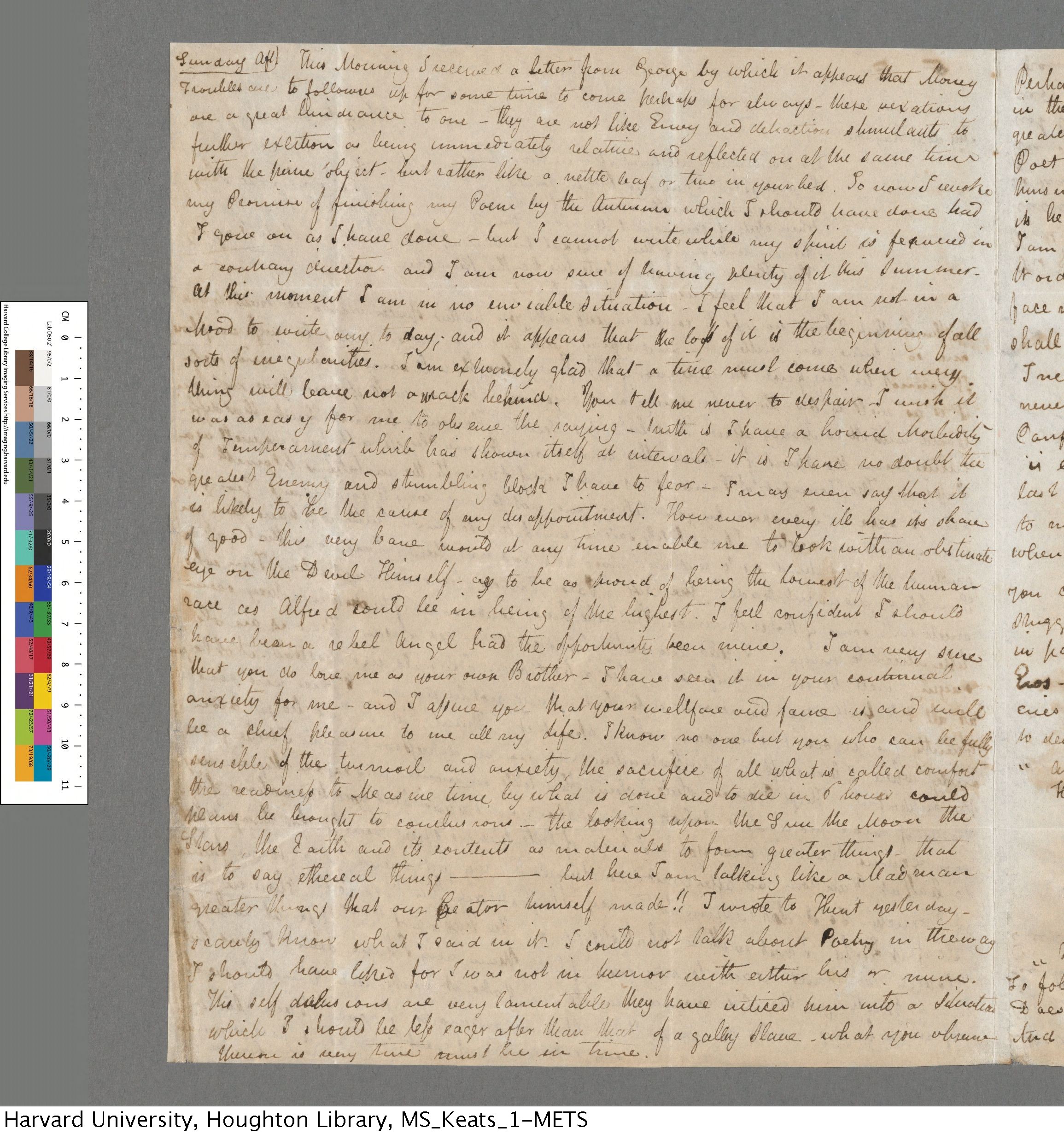
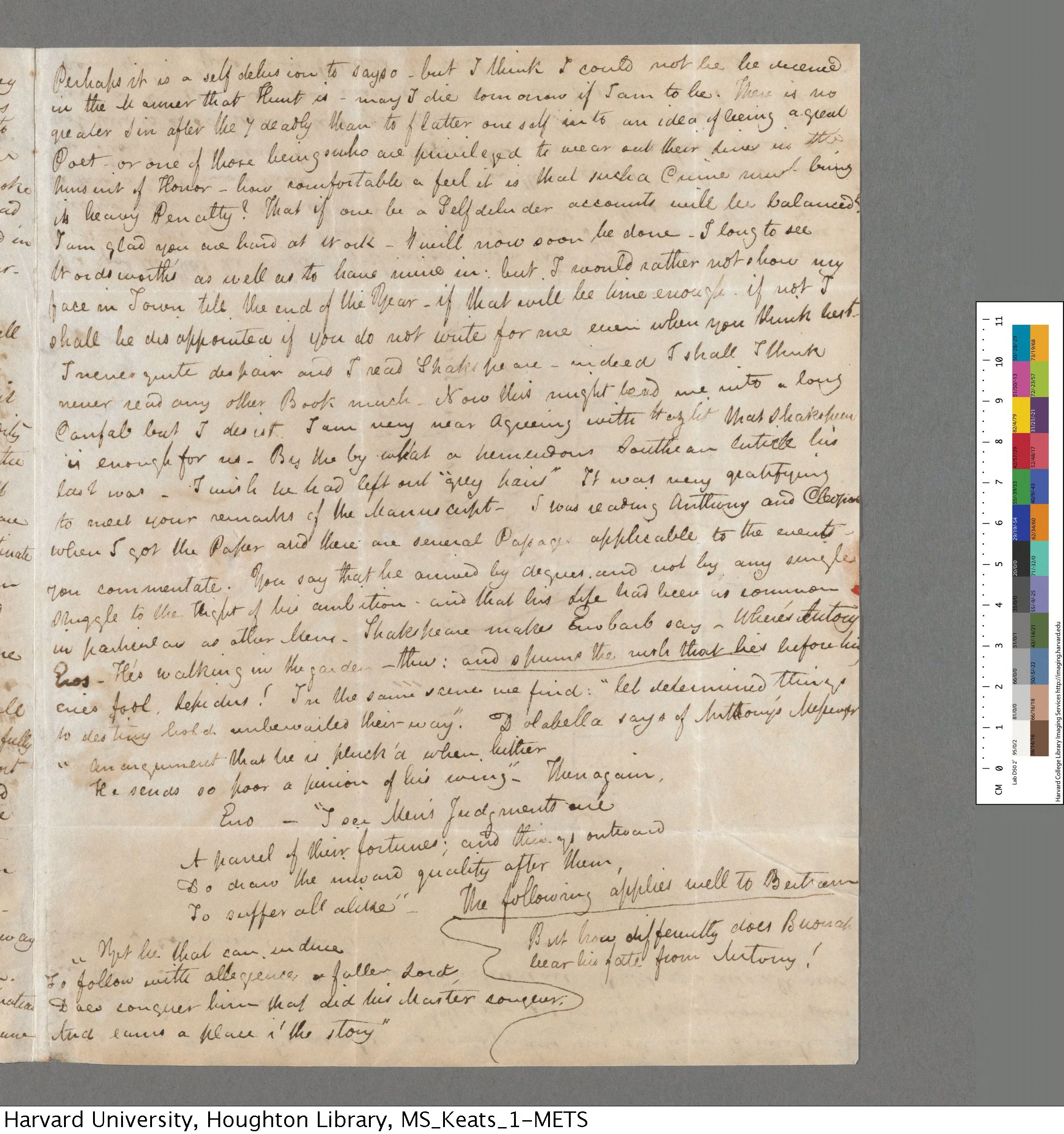
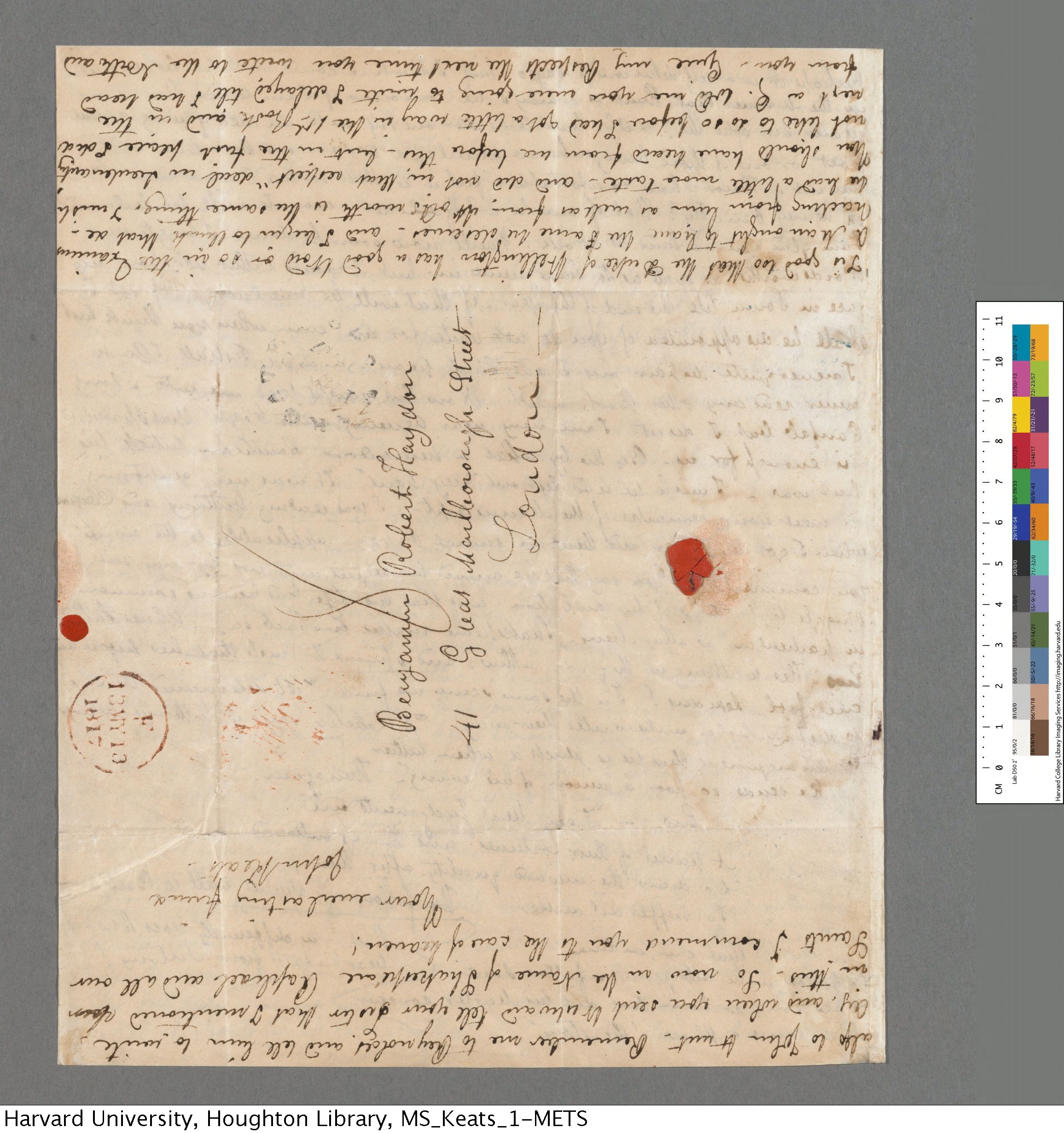
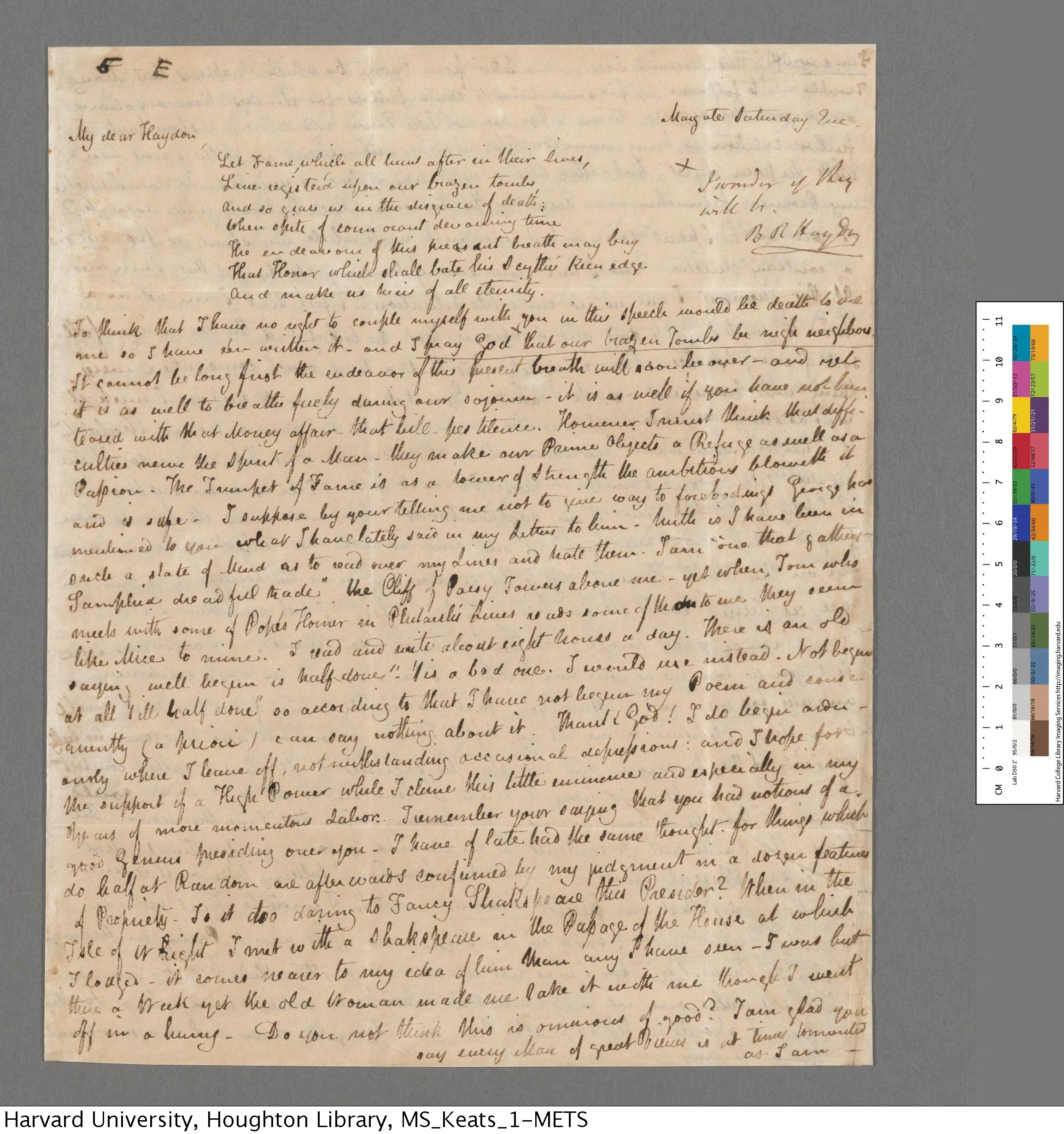
Letter #19: To Benjamin Robert Haydon, 10/11 May 1817

One can’t help but feel a bit sorry for Leigh Hunt when reading this letter to Haydon–the very day after Keats sent a friendly letter to Hunt, here he is in the letter to Haydon saying some pretty nasty things about Hunt! It’s Keats at his meanest and gossipyist. Hey, we never said Keats was perfect. However, as Michael Theune points out in his ambitious response for today, Keats does show remarkable self-awareness about his own meanness, his tendency toward a “horrid Morbidity of Temperament.” Theune also makes a compelling argument linking Keats’s negativity here with his more famous negative capability, the letter for which we’re all counting down the months and days until this December! We may be a bit partial since Theune is one of the KLP founders, but we find his response to be quite illuminating. We hope you will too!

On a more somber note, it’s worth pointing out that contrary to Keats’s wish at the beginning of the letter (“I pray God that our brazen Tombs be nigh neighbors”), they’re actually about a thousand miles apart. When Haydon received the letter in 1817, he underlined the phrase and wrote a note above it, “I wonder if they will be.” In November 1845 when Haydon copied the letter to send to Richard Monckton Milnes, he slightly changed the note, reading instead “Perhaps they may be.” On 28 May 1846, Haydon sent along to Milnes the original of the letter as well. And just over three weeks later, on 22 June, Haydon took his own life. Alas, his brazen tomb is in London, at the Church of St. Mary in Paddington. The gravestone has seen better days, the cemetery is not nearly as lovely as the Protestant Cemetery in Rome, and fame may not exactly be registered on the tomb. But Haydon and Keats nonetheless remain linked together as “heirs of all eternity.” Or at least some of eternity.

The MS images come from Harvard’s collection, and the 1883 Forman edition offers a good printed text.


Harry Brown’s Letters to his Friends: To J. K.

John Strachan
Bath Spa University

Re: Keats’s 10 May 1817 letter to Leigh Hunt

Leigh Hunt, as is well known, was one of Keats’s earliest patrons, and his first publisher (the younger poet’s sonnet ‘O Solitude, if I must with thee dwell’ appeared in the Examiner on 5 May 1816). Under the pen name ‘Harry Brown’, Hunt wrote a series of conversational verse epistles to his poetic and political allies, gossipy yet profound in their own way, which were published in the Examiner in 1816. These included tributes to like-minded friends, including William Hazlitt, Charles Lamb and Thomas Moore. He never wrote one to John Keats …

‘Harry Brown’s Letters to his Friends. Letter VIII.
To J. K.’

Today your letter, sent up from Margate.
A pleasure to read, and a change from the duns:
The midget, the gossip, and why you were late
In replying.  Your wit, your style, your puns,
Why my Junkets, if I might be so bold —
I’d not be lying to say that it stuns
Me to think it — but yes — the realms of gold
Await you, for the gifts that you’re sent.

But seize the day — for we don’t all grow old;
Your gift’s for so much more than the lament
Of Castlereagh and Prinny — and me in the gaol.
Your righteous rage at them — yes, it must be spent,
But there’s vintage as well as town ale.

Whate’er I write and whatever I say,
In Apollo’s assizes I’m bound to fail.
But you’re worth much more than mere today,
And when my wits the Tories bedraggle,
And when politics presses in, then I can say
That now of new poets there’s a gaggle —
Those young poets, of whom I can tell,
So with Apollo I’ll not haggle.

Why thank you, all the nymphs are well,
Oceanid, nereid, naiad, dryad,
The ones that came to me in my cell
Wafted me wheresoe’er — from the bad,
Beyond the motes of Bigotry’s sick eye.
They thought that they could make me mad,
That what I stood for — that would die
But liberty’s a thing that will not fall,
I’ll not submit to an empty lie.
You fight in your own way, against all
Who seek to deny a place in the sun
For peasant, for poet, for great and for small.

What little time we have, then we are gone
And utterance leaves us. — But you’ll live on,
A Poet more than other Men, dear John.


Bibliography

Leigh Hunt, Poetical Works, ed. John Strachan, vols 5 and 6 of Robert Morrison and Michael Eberle-Sinatra, general editors, The Selected Writings of Leigh Hunt, 6 vols (London: Pickering and Chatto, 2003).

Letter #18: To Leigh Hunt, 10 May 1817

The story of Keats’s early years cannot be told without considering Leigh Hunt, the indefatigable poet, essayist, and editor who, among other things, published Keats’s first poem (in The Examiner, before he and Keats had ever met in person), introduced him to the literary circle gathered around him in London during these years, and continued to champion the poet after his untimely death in Rome in 1821. Curiously enough, however, only two letters from Keats to Hunt still exist: today’s letter and a brief one from late in 1820.

In addition to this letter being the first to Hunt, it has another significant honor: it is, as far as the KLP knows, the first of Keats’s letters to ever appear in print. Thanks here go to Susan Wolfson for pointing out sometime last year to one of the KLP founders, who shall not be named for fear of the opprobrium that would surely be heaped upon him for his egregious oversight, that his assertion that the first Keats letters to appear in print were the two published by James Freeman Clarke in The Western Messenger in 1836 was, in fact, wrong. Hunt beat Clarke to it by 8 years! Ok, we admit–it was that dastardly Brian Rejack who made the mistake. For his crimes against Keats, his status at the KLP is currently under review.

Back to Hunt. It was in his 1828 Lord Byron and Some of His Contemporaries that Hunt published the greater part of Keats’s letter (he excised a few things, most notably Keats’s congratulations for Hunt’s recent Examiner essay, which he described as a “Battering Ram against Christianity”). The chapter on Keats was also one of the more extensive biographical treatments to have appeared by that point. It reinforced some of the elements of the narrative established powerfully by Percy Shelley in Adonais, namely that Keats was a delicate flower rudely cut down in his prime by harsh criticism from the periodicals, a narrative that we now know had more to do with Shelley’s own axes to grind than with the truth of the situation. One delightful detail from Hunt, whether it be true or no, we feel we ought to share here. He claims that Keats, as did Byron and Shelley, had a “head [that] was a puzzle for the phrenologists, being remarkably small in the skull.” Hunt adds of the three small-skulled poets, “none of [their] hats I could get on.” Who knew?

In today’s letter Keats does not discuss skull size, which is a shame. But the letter is a lively one, with Keats ranging across many topics, and with him seeming to be in particularly good cheer, an appropriate mood with which to meet his correspondent, Hunt being the great Cockney champion of cheerfulness. In that same spirit, our response for today comes from John Strachan, who imagines what one of Hunt’s poems from his series written as “Harry Brown’s Letters to His Friends” might have looked like if he had written one to Keats. Strachan certainly captures Hunt’s voice as he responds to Keats’s letter in verse. Enjoy!

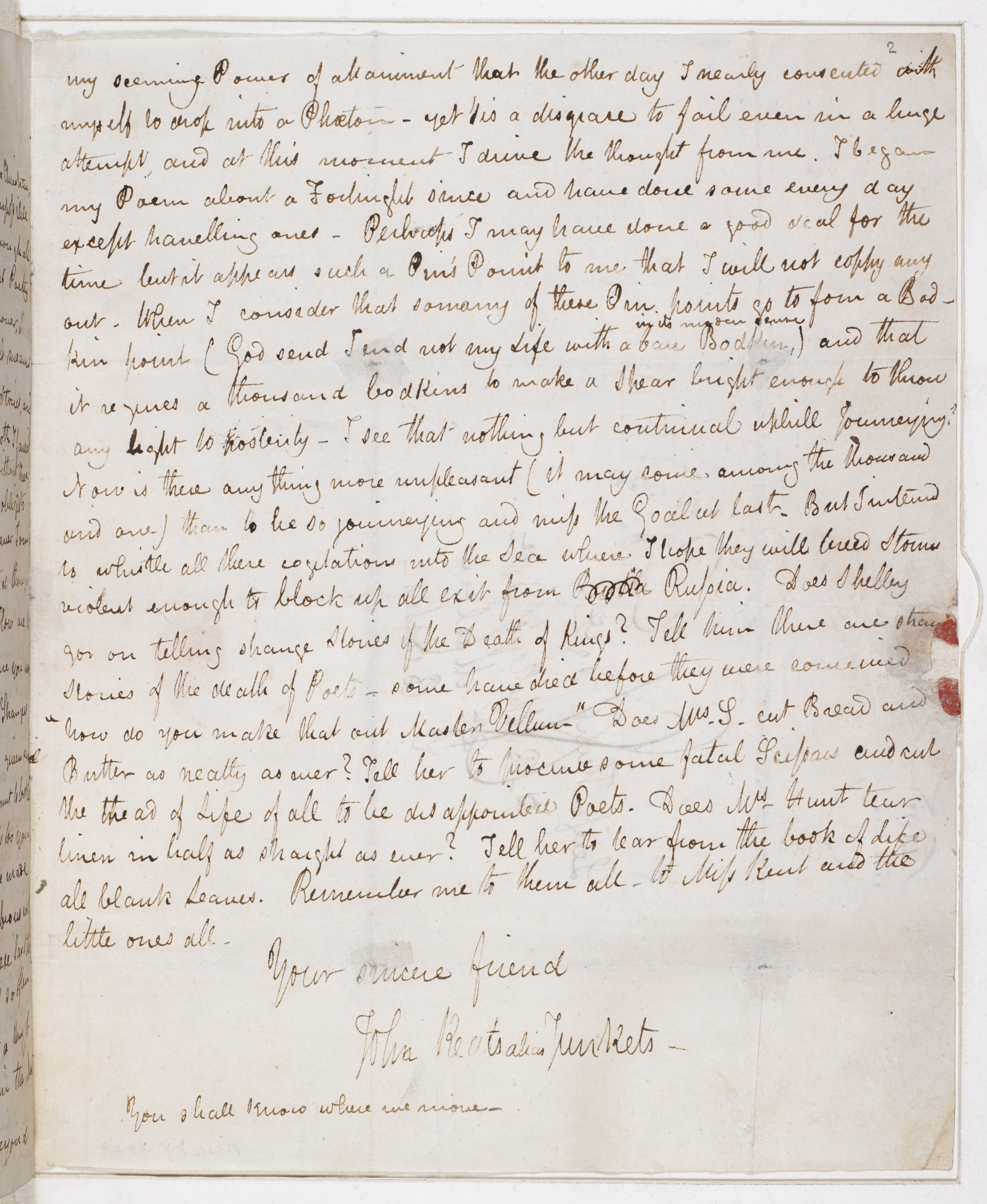
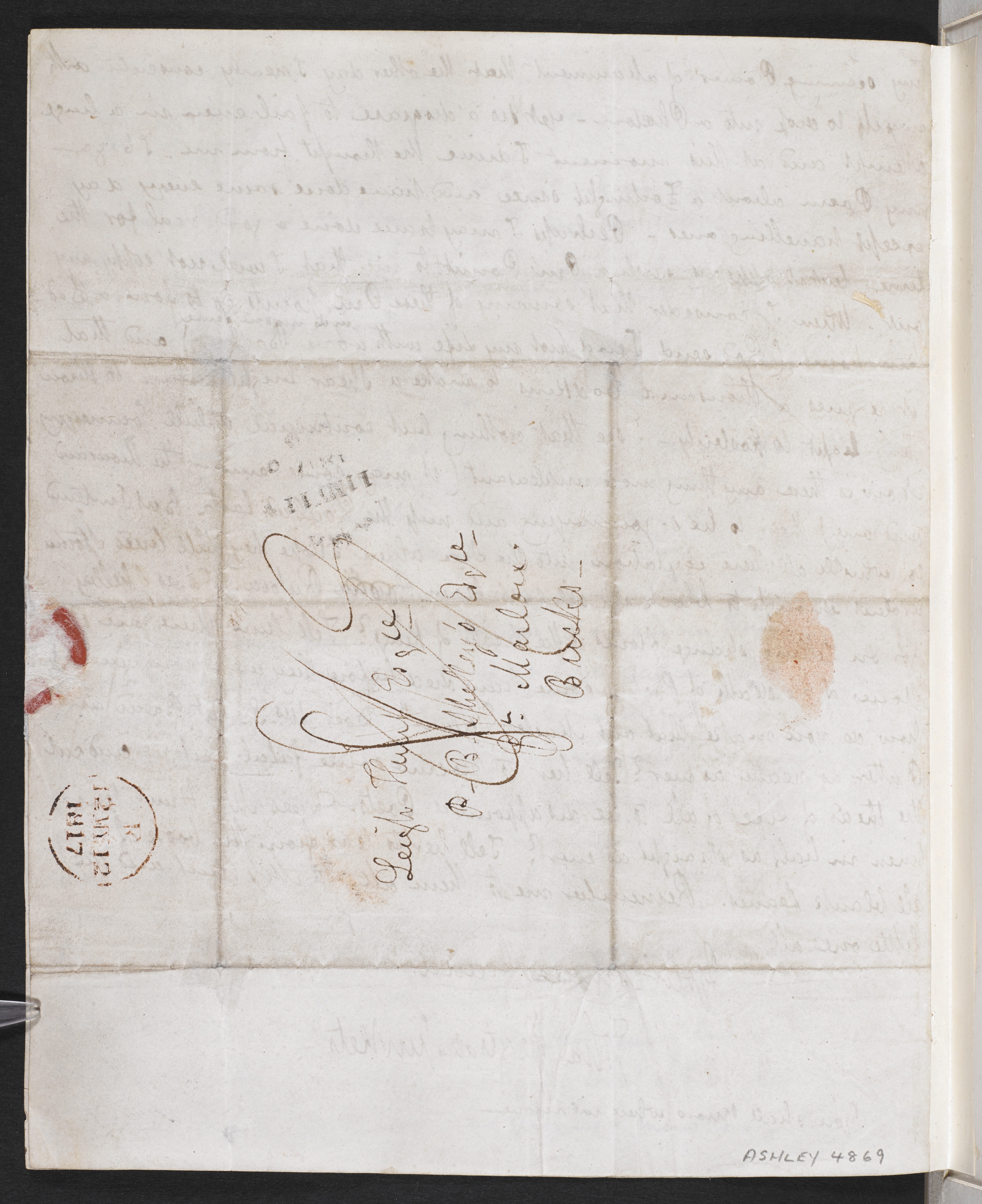
Images of the MS come to us courtesy of the British Library. You can read the letter in Hunt’s 1828 book, or if you prefer a fuller text of it, Forman’s 1883 edition is based on the MS without any excisions.

Page 1 of Keats’s 10 May 1817 letter to Leigh Hunt. Courtesy of the British Library. Click for full size image.

Page 2 of Keats’s 10 May 1817 letter to Leigh Hunt. Courtesy of the British Library. Click for full size image.

Page 3 of Keats’s 10 May 1817 letter to Leigh Hunt. Courtesy of the British Library. Click for full size image.

Page 4 of Keats’s 10 May 1817 letter to Leigh Hunt. Courtesy of the British Library. Click for full size image.

The KLP Pedagogy Series Presents: Keats, Travel, and Aesthetics

[Today’s post is the first installment of the KLP Pedagogy Series, in which we feature student work, work about pedagogy, and other Keats-related things that intersect with some of the vibrant teaching happening in and around romanticism today. Our first author in the series, Victoria Rego, is an undergraduate student studying English and Creative Writing at the College of Charleston, where she also works as a writing lab consultant and has completed grant funded research on the intersection of Victorian Literature and Popular Tourism. Her short fiction has been featured in Bully, from KY Story, with more of her fiction forthcoming.

Read more about this series on our Pedagogy page, and contact us with pedagogy related ideas as you have them!]

Victoria Rego
College of Charleston

Re: Keats’s 17/18 April 1817 letter to J. H. Reynolds

Keats was twenty-one when he wrote a letter to J.H. Reynolds in the spring of 1817. It was the seventeenth of April and he was settling into his lodgings, newly arrived from London to the Isle of Wight, in hopes of making progress on his first grand-scale poem: Endymion. This poetic pilgrimage was, in part, an escape from the bleakness of London, that “jumbled heap of murky buildings,” as Keats refers to it in “O Solitude,” written only a few months earlier (line 1). True poetic inspiration, Keats believed, would require a different sort of setting. Rosemary Hill writes that William Gilpin’s idea of the picturesque was one catalyst that sent Keats to the Isle of Wight: “no matter how he might grumble about the Picturesque … Keats was following the routes prescribed” in Gilpin’s works (122). Gilpin’s essays on the Picturesque, published mostly in the latter half of the 18th century, distinguished between an everyday notion of beauty, and beauty that “please[s] from some quality, capable of being illustrated by painting” (3). Picturesque beauty stands, in many significant ways, in opposition to the philosopher Edmund Burke’s Beautiful, which was smooth, neat, and clearly composed. The Picturesque, in Gilpin’s view, was defined by roughness, crooked edges, and a look of untidiness. While Palladian architecture is undoubtedly beautiful, Gilpin argues, “should we give it picturesque beauty, we must use the mallet instead of the chisel: we must beat one half of it, deface the other, and throw the mutilated members around in heaps” (7). The Picturesque, originally affiliated with landscape paintings by Thomas Gainsborough, John Constable, and JMW Turner, soon spread to many facets of English culture, such as landscape gardening. David Lowenthal and Hugh C. Prince, in “English Landscape Tastes” wrote that “landscapes are formed by landscape tastes. People in any country see their terrain through preferred and accustomed spectacles, and tend to make it over as they see it” (186). While landscapes can seem like something objective—it’s easy to assume that geography and the physical things that make up the natural landscape just are what they are, irrespective of human intention—what the Romantics knew best was that the human imagination is capable of reshaping any and everything. For this reason, popular writers of the time began to infuse picturesque sentiments into their poems and narratives. These writers soon found that this movement, inspired by the imagination, was readily transferable to linguistic mediums: “the picturesque tends always towards narrative, while the Beautiful and the Sublime depend on stasis” (Hill 124). The conflict between motion and stasis, imagination and reality, sublimity and narrative, is a central one to Keats’ poetry, one that relies on the aesthetic impulse, always, for its realization.

I was twenty-one when I made my first trip abroad to study at the University of Nottingham in the English midlands. For me, travel was a thing of novels: a place of escape in the imagination, not an actualization. Up to that point, much like Keats, I had never left my home country—had never even traveled to the West Coast—and had spent the vast majority of my days in the same tristate area. After my arrival in the Manchester airport, I took a public bus to Nottingham. It took over three sleep-deprived hours to arrive at the place that would become my home for the next five months. Amid bouts of exhausted delirium, I was in awe.

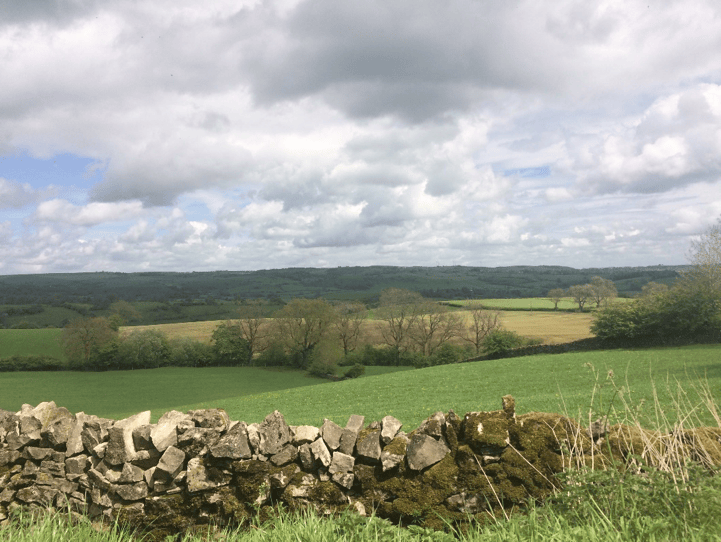
A view of the Midlands scenery. Photo by the author.

The midlands seemed to me a post card: the grass so green it seemed impossible, the effortless hills divided by low-lying stone walls that had compartmentalized the land for centuries and were here and there falling into a crumpled heap, weather-beaten sheep huddled in loose clusters, the sky a smoky blue that seeped into everything. It was both something I felt I knew intimately, but had never seen before—“Was it a vision, or a waking Dream? Do I wake or sleep?”

It seems that Keats felt a similar sentiment while on his journeys across the Isle of Wight. In his letter to Reynolds, Keats writes of a walk he took the previous day to Shanklin:

Shanklin is a most beautiful place—sloping wood and meadow ground reaches around the Chine, which is a cleft between the Cliffs of the depth of nearly 300 feet at least. This cleft is filled with trees & bushes in the narrow part; and as it widens becomes bare, if it were not for primroses on one side, which spread to the very verge of the Sea, and some fishermen’s huts on the other, perched midway in the Ballustrades of beautiful green hedges along their steps down the sands. (130)

Keats’s depiction of the Picturesque starts with nature: the “Chine” filled with trees and bushes” lined with primroses. His depiction ends with the modest human footprint: the fishermen’s huts and “beautiful green hedges.” Rosemary Hill writes that while nature in its pure state may be Sublime, “it could not be Picturesque: the Picturesque [is] a contingent state, secondary to the Sublime and the Beautiful” (124). While the Sublime is revealed in natural scenes which are unable to be fully conceptualized, thereby shoving mankind’s mortality back in the viewer’s face, the Picturesque opens up as something warm, inviting, and rich, exactly because of human presence. The Picturesque delights in human history and the stamp of human activity, although limited. Picturesque scenes, while primarily arising in the bucolic setting, no matter how “their creators strive to conceal their handiwork,” are always “inherently artificial” (Lowenthal 195). The Picturesque setting was just as contrived—whether through actual handiwork, or through the imagination of the spectator—as any landscape painting or pastoral poem.

On one of my weekend journeys in Spring, I visited Dartmoor, a place with a rich literary history. Among the desolate, mist-covered moors, it is simple to see why those from Devon might see themselves as a particularly superstitious people; their landscape has more than enough spaces which seem well fit for ghostly inhabitants. My guide took me to Buckfastleigh Church, a catalyst for Devonshire superstitions for decades.

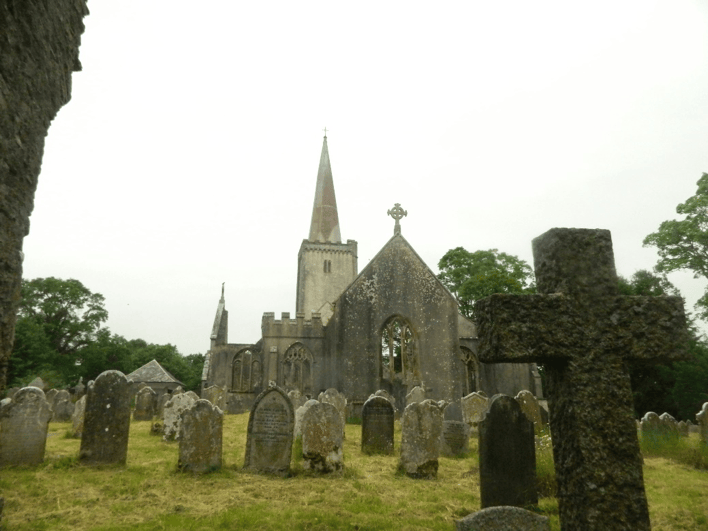
Buckfastleigh Church. Photo by the author.

The church has been rebuilt and burnt down multiple times over the centuries, with the latest disaster completely destroying the church’s roof. On my visit, I wasn’t the only one there to admire the ruin: I saw locals wandering amidst the grave stones, gazing up at the church tower which seemed to me solid and formidable against the skeleton of the nave. I watched a magpie balance himself on an empty window tucked into a disembodied wall standing at the end of the grounds and separating the church from the thick forest around it. The walls were engulfed in a miasma of vines and lichens. The irregular heads of moss marbled tombstones poked out of weed infested grass. The place was eerie, but it had a beauty. Could this be called Picturesque? My guide told me that the place was popular for photoshoots, for weddings, special occasions, and films.

In his letter to Reynolds, Keats praises the beauty of Carisbrooke Castle. He writes: “I have not seen many specimens of Ruins—I don’t think however I shall ever see one to surpass Carisbrooke Castle” (131). Lowenthal and Prince note that “the ruin was a landscape feature especially favored by lovers of the picturesque” (196). The ruin unites the Picturesque with the Antiquarian, another sentiment favored by the English Romantics. When Gilpin wrote of ruins, he argued that they were, although not necessarily more beautiful than complete specimens of architectural master work, favored subjects by painters. The rough surfaces of ruins diffused light in a way that was easier to replicate in paint. While this could be part of the Picturesque fascination with ruins, even Gilpin knew it was far from the whole story. The Picturesque love of ruins can be understood in light of the movement’s philosophy as a whole. The Picturesque “proposed a reciprocal relationship between material reality and subjective experience;” between the physical world and the imagination of the perceiver. (Hill 121) The ruin is a physical manifestation of this reciprocal relationship—an object built by a past peoples, no longer serving its original purpose (whether secular, religious, or political) and having been at least partially taken over by the natural landscape. In his letter, Keats praises the beauty of the ruinous castle:

The trench is o’ergrown with the smoothest turf, and the walls with ivy—the keep within side is one Bower of ivy—a colony of Jackdaws have been there many years—I dare say I have seen many a descendant of some old cawer who peeped through the Bars at Charles the first, when he was there in Confinement. (131)

Keats admires the melding of the natural world with the world of human activity; he delights in seeing the Jackdaws overtaking the castle, and the ivy claiming its walls. Hill argues that the Picturesque relies on a “greeting of the spirit’ in which self and spectacle meet” (Hill 125). It is in the ruin that the human self and the natural spectacle meet and find aesthetic harmony.

For all of Keats’s ruminations on the landscape, one aspect seems to unabashedly steal his attention. When he gets to the waterfront, the poet seems to lose his words: “but the sea, Jack, the sea” (131). Although sometimes depicted in picturesque landscape paintings, the sea rests largely within the Burkeian Sublime. The attempt to capture the Sublime in language is a defining feature of Keats’ works, such as the Elgin Marbles Sonnets, his Hyperion poems, and Endymion. Throughout his short writing career, Keats struggled to find a balance between the impulse to capture the Sublime and a recognition of the impossibility of the task. However, rather than give up his mission to capture that which defies language, Keats struggles on, as in the sonnet, “On the Sea” that concludes his letter to Reynolds:

It keeps eternal Whisperings around
Desolate shores, and with its mighty swell
Gluts twice ten thousand Caverns; till the spell
Of Hecate leaves them their old shadowy sound.
often ’tis in such gentle temper found
That scarcely will the very smallest shell
Be moved for days from where it sometime fell,
When last the winds of Heaven were unbound.
Oh ye who have your eye-balls vex’d and tir’d,
Feast them upon the wideness of the Sea
Oh ye whose ears are dinned with uproar rude,
Or fed too much with cloying melody—
Sit ye near some old Cavern’s Mouth, and brood
Until ye start, as if the sea-nymphs quir’d— (132)

In the sonnet, Keats prescribes the ocean as a soothe for those who are “vex’d and tir’d,” writing that a look at the sea will help one’s soul to “start,” will possibly reawaken the spectator. In his Guide to the Lakes, Wordsworth argues for a new category of aesthetic achievement, the “Tranquil Sublime.” Wordsworth believed that the Tranquil Sublime could be seen in the English Lake District. He argued that the Sublime had become synonymous with “enormity,” and so sought to recategorize aesthetic distinctions in a way more suiting to aesthetic merit. For Wordsworth, neither the Sublime nor the Picturesque were satisfying aesthetic tendencies; the Tranquil Sublime was his way of mediating between these two, collapsing the soothing elements of the Picturesque with the awe-inspiring grandeur of the Sublime. Keats was as skeptical as Wordsworth towards the Picturesque movement, and as Rosemary Hill notes, was vocal about his dislike of Picturesque tourism (122). However, regardless of Keats’ disdain for the Popular Picturesque movement, it is this same inclination to seek out picturesque locations that goes on to fuel some of his poetry. But his treatment of the Sublime element, the ocean, complicates the Picturesque. While the Picturesque is an aesthetic that revels in the traces of human agency in a beautiful scene, Keats’ treatment of the ocean in his sonnet is something contrary to this. In the sonnet, Keats writes that a person feeling the pressures of the world should “sit ye near some old Cavern’s Mouth, and brood / Until ye start” (line 13 132). Keats isn’t suggesting that one can either tame the ocean, or leave one’s mark on it; rather, he suggests that aesthetic pleasure comes from the contemplation of the object in its natural state. As in his Elgin Marbles sonnets, there is an underlying anxiety that something so beautiful can only reduce one to passivity. This possibility seems, at times, to haunt Keats. However, this letter and its sonnet reveal a reconciliation between the fear and awe inspired by the sublime and his tranquil appreciation of the Picturesque. Here, at least temporarily, Keats seems to find a kind of aesthetic equilibrium.

Endymion, the epic poem he starts on the Isle of Wight, begins: “A thing of beauty is a joy forever.” In his private correspondence, one can see clearly the joy he takes in beauty, whether it be Sublime, Picturesque, or somewhere in between. Perhaps this is something that made Keats, so scorned by the critics of his time, charming to many readers; his affection for the Beautiful seems at first so simple and genuine. However, it would be wrong to say his aesthetic impulse is simple. Keats is able to straddle these different aesthetic tendencies, recognizing their merit and pointing to their inadequacies, but eternally believing in the transformative powers of beauty in all its forms.


***This response was written for a class taught by Kathleen Beres Rogers at the College of Charleston. Below, she reflects on how the essay emerged from that context.***

One of the joys of my teaching career has been reading John Keats’s letters with my undergraduate students at the College of Charleston; often, our students work two jobs, struggle with young adult angst, and want their writing to “mean something”: in other words, Keats is a natural fit.

In the fall, I taught my usual Keats course with an emphasis on sympathy and the sublime; although I did give them some ideas for paper topics, I read their responses to our readings and suggested research based on their own areas of interest. In order to promote interest in Keats’s letters, I showed them some essays on the KLP page and suggested they attempt something similar. Tori, a philosophy minor with interests in creative writing, aesthetics and literary tourism, gravitated toward this particular letter and submitted this essay as her final paper for the course. It is undergraduate work, but that’s what (to me) makes it a compelling response to a young man attempting to find his own place in the world.


Works Cited

Cox, Jeffrey N., editor. Keats’s Poetry and Prose. W.W. Norton & Company, 2009.

Gilpin. William. Three Essays on Picturesque Beauty; On Picturesque Travel; and on Sketching Landscape. Cadell and W. Davies, 1808.

Hill, Rosemary. “Keats, Antiquarianism, and the Picturesque.” Essays in Criticism, vol. 64, no. 2, 2014, pp. 119-137.

Keats, John. The Letters of John Keats: 1814-1821. Edited by Hyder Edward Rollins, Harvard University Press, 1958, pp. 130-132.

Lowenthal, David and Hugh C. Prince. “English Landscape Tastes.” Geographical Review , vol. 55, no. 2, 1965, pp. 186-222.

Ottum, Lisa. “Discriminating Vision: Rereading Place in Wordsworth’s Guide to the Lakes.” Prose Studies, vol. 34, no. 3, 2012, pp. 167-184.


Bridging the Distance

Rosie Whitcombe
Birmingham City University

Re: Keats’s 17/18 April 1817 letter to J. H. Reynolds

Following the death of his brother Tom and the new, transatlantic distance between himself and his brother George, letter writing becomes an increasingly anxious task for Keats. Fearful of the effects of long term or permanent separation, Keats experiments with the letter to ‘overcome this distance’ (Barnard 129) between himself and his recipients; yet even his earlier, more playful letters underpin a similar vexation with distance and an impatience with the letter as a form of communication. Keats’s letter to J. H. Reynolds of 17 and and 18 April 1817, is a fast-paced and forceful piece of writing which moves from bright, intense description to dark brooding. Keats toes the line between descriptive exploration and resentful longing, revealing the conflict of letter writing as both an essential means of communication and a delayed conversation in which the recipient is dependent on a cycle of constant reciprocation. Writing from his room in Carisbrooke, on the Isle of Wight, Keats begins by decorating his letter with cosy artifice: “I have unpacked my books, put them in a snug corner – pinned up Haydon – Mary Queen of Scotts, and Milton with his daughters in a row.” With Shakespeare’s head hanging “over my Books,” Keats opens his letter with an inviting warmth, settling himself, and his literary idols, into his lodgings. Keats’s good humour is soothing, his tone both charming in its attention to detail and fluid in movement from one topic to the next. Swiftly, he changes the scene of the letter, carefully describing the countryside “filled with trees & bushes in the narrow part; and as it widens becomes bare, if it were not for primroses on one side, which spread to the very verge of the sea, and some fisherman’s huts on the other”(I: 130). Keats directs the mind’s eye like a periscope, moving from the trees, emerging on to a wider plain decorated with flowers and fisherman’s huts; his insistence on fine detail provides clear visual communication for his recipient. For Keats, it is paramount to “convey the physical traces of touch on the paper” and communicate himself and his environment through the “beautifully captured … physical scrutiny” of the letter (Thomson 168). Not only does he want to communicate information to his recipient, but through his careful and artful attention to detail, he seeks to preserve a physical representation of himself, and his experiences, in his correspondence.

Fluid and fast, this letter slips from a woodland scene to a commentary about “the sea, Jack, the sea” (I: 131). Keats “attempt[s] to bridge physical separation” (Thomson 165) and overcome the tenseness he associates with distance by speaking not only for himself, but for Reynolds: “why are you at Carisbrooke? say you– Because… from here I can see your continent – from a little hill close by, the whole North Angle of the Isle of Wight, with the water between us” (I: 131). By dictating Reynold’s side of this extended conversation, Keats can cut out the distance between them and direct the course of his letter to reflect his feelings of separateness. Remaining in Carisbrooke, Keats can maintain a physical connection with home; he can see England, can look towards his recipients, but is nonetheless aware of the vast straight of water which divides them. His wistful ruminations on the sea, which has “haunted me intensely” (I: 132) during this trip, are compounded both with awe and fear, predicated on the longing and loss fostered by distance. Not only the sea, but the weather echoes his resentment towards separation: “The Wind is in a sulky fit, and I feel that it would be no bad thing to be the favourite of some Fairy, who would give one the power of seeing how our Friends got on, at a Distance” (I: 132). Keats exaggerates natural elements to convey his preoccupation with distance, personifying the wind to reflect his own agitation. He cultivates a fantastical reality in which a fairy might extend his communicative powers from the written word to a visual representation of his recipients, broaching the boundaries of the letter and closing the distance between himself and home. Keats inscribes a magical discourse in the letter which helps to romance the distance he faces as he looks out over the sea. He admits he would “like, of all Loves, a sketch of you and Tom and George” (I: 132) to be sent to him, underpinning his need for visual connection; the letter alone does not satisfy Keats’s desire to communicate intimately with his recipients. He moves closely and quickly through a succession of artfully devised scenes, from the cosy room to the haunting sea, illustrating both his imaginative breadth and his acute sense of distance.

Keats closes the first half of his letter with the poem ‘On the Sea.’ This sonnet presents the changeable nature of the sea, one moment in “gentle temper,” the next in a “mighty swell” (I: 132). After identifying its inherently opposing and contradictory characteristics, Keats implores his reader to “Feast … upon the wideness of the Sea,” and “Sit ye near some old Cavern’s Mouth and brood” (I: 132). This sonnet does not seek to resolve the conflicting elements of the sea, rather encouraging its reader to embrace and indulge in its chaos. This reflects the unresolved conflict of the letter and Keats’s inability to bridge the distance between himself and his recipients. “On the Sea” concludes with a figure sitting brooding, feasting transfixed on something which potentially holds no answers and cannot be reconciled or controlled. This serious, thoughtful tone replaces the cheer found in the first half of the letter and provides direction for the second half: while Keats cannot control the chaos of the sea, his dogmatic approach to the rest of the letter is an attempt to resolve the conflict of distance by controlling the boundaries of communication. Keats is instructive, not descriptive: his imperative rhetoric demands Reynolds “ask them what they can say for themselves – ask Mrs Dilke wherefore she does so distress me – Let me know how Jane has her health… Tell George and Tom to write” (I: 133). From an inviting trail of varied and provoking imagery, this letter evolves into a solid list of requests. Keats’s desires are no longer presented under the guise of fairies and floral imagery, but explicitly announced: he must “receive a Letter from you and another from my Brothers” (I: 133) on a specific date, his direction reflecting his growing agitation with the fragility and uncertainties of long distance communication.

In the following paragraph, Keats’s curtness softens as he makes a sudden admission: “I find that I cannot exist without poetry – without eternal poetry – half the day will not do – the whole of it – … I had become all in a Tremble from not having written anything of late – the Sonnet [‘On the Sea’] over leaf did me some good. I slept better last night for it – this Morning, however, I am nearly as bad again” (I: 133). Once more, Keats entirely alters the focus of the letter, his abrupt instruction mellowing into tense insecurity. His syntax is jarring, broken in more places as he broods on his relationship to poetry. Not only is it impossible to live without poetry, but his very existence depends upon it; poetry is not something he does, but something he is. It is a life force, a marker of health, and a means of healing the self: Keats can sleep better for writing, and becomes nervous for neglecting his work. Yet poetry’s restorative powers only provide a temporary cure; for Keats, poetry is a constant necessity, without which he experiences intolerable changes to his physical and mental health. His anxiety cresting, this admission is a far reach from the jovial, inviting tone which began the letter, cementing Keats’s nervousness about distance and poetry side by side.

With a final slither of hope that he might bridge that distance between himself and home, Keats dreams of a future time when Reynolds will visit him, and “we will read our verses in a delightful place I have set my heart upon near the Castle.” However, Rollins’s footnote reveals “Reynolds did not make the visit” (I: 134). Keats has returned to the dreamy, detailed description of the letter’s opening, which curtails his anxiety with hope. Yet with hindsight the idyllic vision he set his “heart upon” is to remain a vision, the geographical distance between himself and Reynolds left unbridged. His “random, indeterminate motions of mind” (Wolfson 45) and the speed at which his descriptions transform over the course in this letter reveals the troubling nature of the distance between Keats and his life back home. As Robert Gittings observes, during this trip Keats “had hardly been able to bear the hundred miles distance between” (217) himself and his loved ones, and this anguish seeps into the foundations of the letter. Repeated requests for responses underline a thirst for communication as well as a need for physical, visual connection, and his anxieties about poetry and distance culminate in a final instruction to Reynolds which was never to be realised. This letter demonstrates the relationship between Keats’s imaginative force and his developing anxiety: using the letter as an outlet for both reveals Keats’s conflict towards writing. To write is both his life force, an intrinsic part of his identity; but it is also an unreliable, unsatisfying means of communication, and, ultimately, a reminder that he remains at a distance.


Works cited

Barnard, John, ‘Keats’s Letters: “Remembrancing and enchaining”’ in The Cambridge Companion to Keats, ed. by Susan J. Wolfson (Cambridge: Cambridge University Press, 2001).

Gittings, Robert, John Keats (London: Penguin, 2001).

The Letters of John Keats, ed. by Hyder Edward Rollins, 2 vols. (Cambridge: Cambridge University Press, 2011).

Thomson, Heidi, ‘Keats’s Letters: ‘A Wilful and Dramatic Exercise of Our Minds Towards Each Other’’, The Keats-Shelley Review, vol. 25 (2011).

Wolfson, Susan J., ‘Keats the Letter-Writer: Epistolary Poetics’, Romanticism Past and Present, vol. 6 (1982).

Narvus States and Eternal Poetry

Allison Dushane
Angelo State University

Re: Keats’s April 17-18 letter to J. H. Reynolds

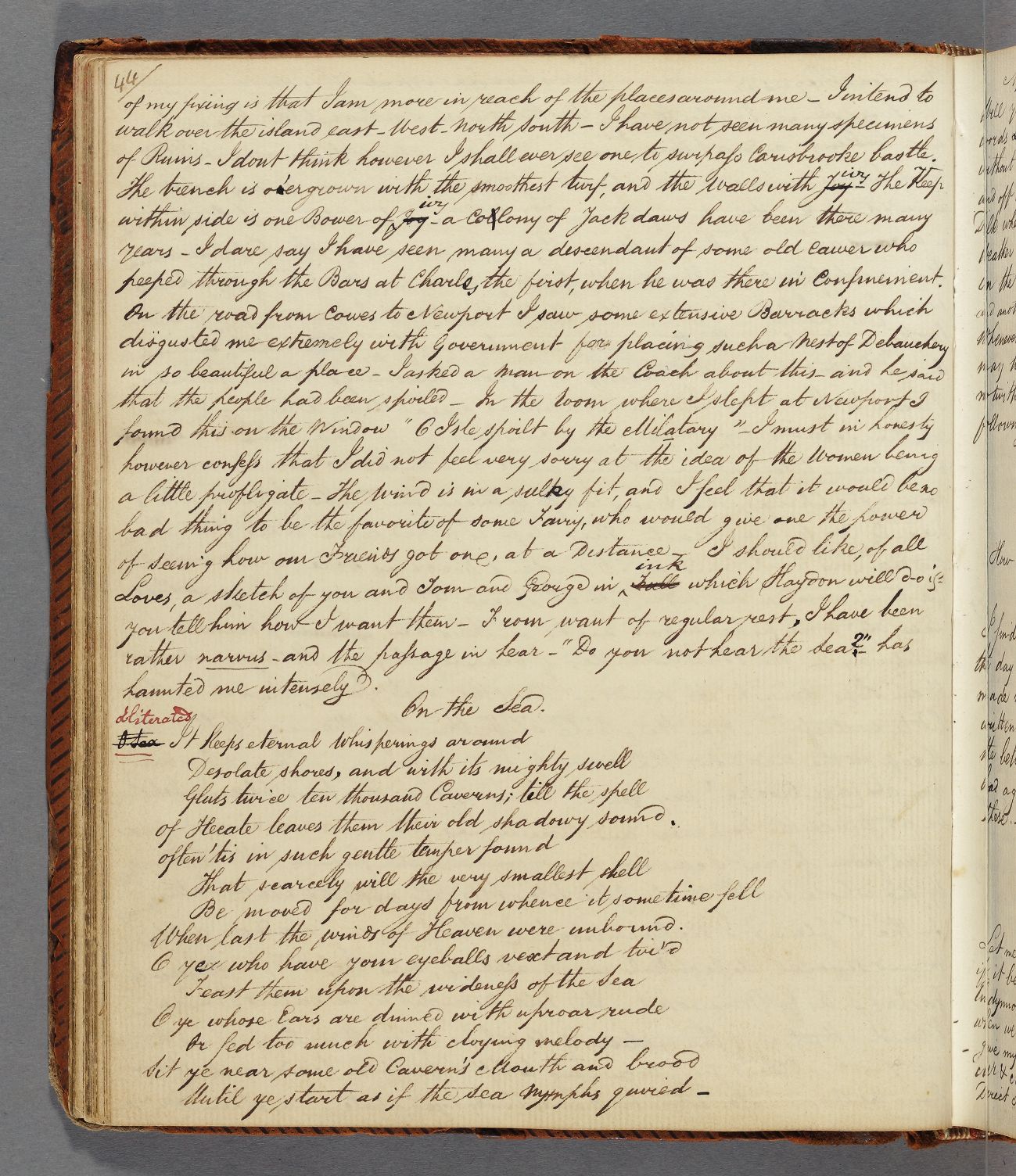
As Keats began to settle into his temporary home on the Isle of Wight to begin work on Endymion, he composed a letter to J.H. Reynolds over the course of two days. The anticipation that Jacob Risinger describes in Keats’s 17 March letter to Reynolds is magnified; at long last surrounded by the solitude he sought, Keats reports at the closing of the letter’s April 17 section: “I have been rather narvus” (I: 132).

Nicholas Roe points to the materialist dimensions of Keats’s neologism in his autobiography:

Keats’s word ‘narvus’ was a reminder of Astley Cooper’s lecture on ‘nerves’ at Guy’s, and also echoes a word heard long ago at Keates’s Livery Stables. A ‘narve’ was taut animal sinew used to tension a saddle-tree or to make bowstring—’the nerve of Phoebus’ golden bow.’  (Roe 163)

During his clinical residency at Guy’s hospital from 1815-1816, Keats engaged at length with Romantic-era discussions about the origins and nature of life, particularly the physician John Hunter’s claims that animal life was driven by a vital principle, a “superadded” feature to matter. In the lectures Keats attended at Guy’s, the nervous system was presented as a center that communicated the vital principle throughout the body.  Astley Cooper’s lectures linked the involuntary response of the nerves to stimulation, irritability, to the aesthetic and intellectual capacities of living beings. As Hermione de Almeida points out in Romantic Medicine and John Keats, “irritability was the measurable and latent mark of life in both muscular and nervous tissue; sympathy or the response of living creation to the stimulation of this irritability, likewise, was characteristic of muscles and nerves, senses and will” (99). She also cites Keats’s notes on these lectures: “Mr. C believes that the power of parts are supported neither by [the] Brain nor the M.S. [muscular system?] but by their particular Nerves. Sympathy. By this the Vital Principle is chiefly supported” (98-99).

Prior to remarking on his “narvus” state, Keats writes about the features of his location in Carisbrooke, remarking on ecologies that surround him: “As for Primroses–the Island ought to be called Primrose Island: that is, if the nation of Cowslips agree thereto, of which there are diverse Clans just beginning to lift up their heads and if an how the Rain holds whereby that is Birds eyes abate⎯” (I: 131). In these letters, traces of Keats’s botanical expertise are visible alongside the evidence of his recent medical training.  He returns to the letter to Reynolds on April 18 and begins with a request:

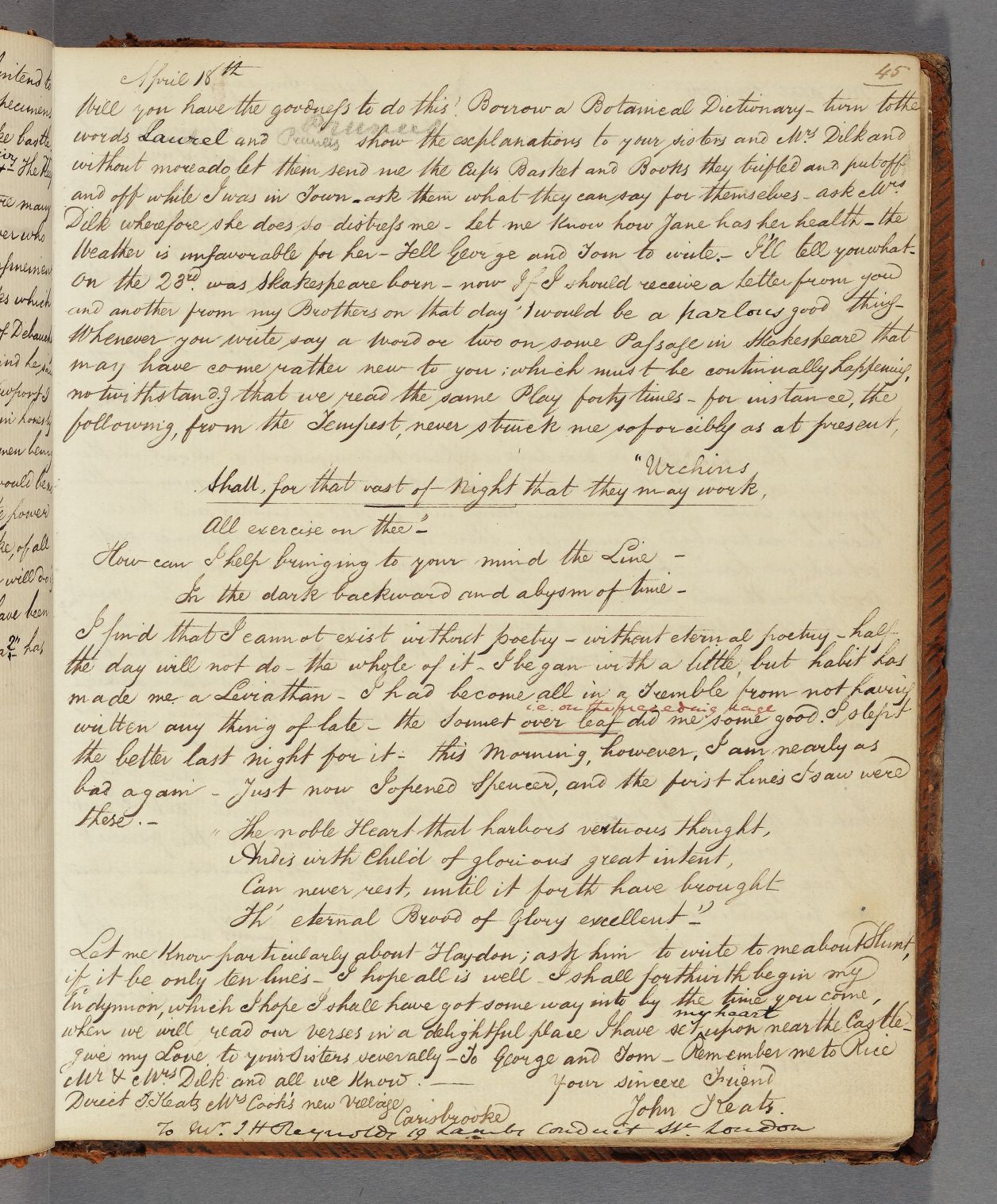
Will you have the goodness to do this? Borrow a Botanical Dictionary⎯turn to the words Laurel and Prunus show the explanations to your sisters and Mrs Dilk and without more ado let them send me the Cups Basket and Books they trifled and put off and off while I was in Town⎯ask them what they can say for themselves⎯…. (I: 133).

Donald Goellnicht unpacks this passage in The Poet-Physician: Keats and Medical Science:  “Keats’s mock argumentative joke is based on dictionary descriptions of the flowers of these trees as having no cups, which puts them in the same situation as himself” (94).  Keats’s extensive knowledge of the natural world is so intrinsic to his mode of expressing himself that it surfaces in references ranging from the idiosyncratic description of his physical and mental state to botanical puns.   The central natural figure of these letters, however, is the sea.  Keats arrives at his destination full of “narvus” energy, an excess of built up irritability.  He expends it by composing a sonnet that he includes with the letter:

On  the  Sea.

It keeps eternal Whisperings around
__Desolate shores, and with its mighty swell
__Gluts twice ten thousand caverns; till the spell
Of Hecate leaves them their old shadowy sound.
Often ’tis in such gentle temper found
__That scarcely will the very smallest shell
__Be moved for days from whence it sometime fell
When last the winds of Heaven were unbound.
O ye who have your eyeballs vext and tir’d
__Feast them upon the wideness of the Sea
O ye whose Ears are dinned with uproar rude
__Or fed too much with cloying melody⎯
Sit ye near some old Cavern’s Mouth and brood
__Until ye start as if the Sea Nymphs quired!  (I: 132).

In addition to the vital forces of his chosen environment, Keats draws inspiration for his immersion in poetic composition with virtual literary company. When he first arrives in his lodging, reports that he first “unpacked [his] books, put them into a snug corner,” and put up various pictures that brought with him, including Benjamin Haydon’s rendition of “Milton with his daughters in a row.” and, of course “a head of Shakespeare,” which he hangs just above his books.  In anticipation of Shakespeare’s upcoming birthday, Keats asks Reynolds, “write or say a Word or two on some Passage in Shakespeare that may have come rather new to you ” (78).  The first selections that he cites, from The Tempest, which he claims “never struck me so forcibly as at present,” might be read as an expression of the excess of nervous energy that Keats has built up in anticipation of his ambitious poetic project:

____________________________“Urchins
Shall, for that vast of Night that they may work,
All exercise on thee⎯”
[…]
In the dark backward and abysm of time⎯

He later cites these lines from Spenser’s Faerie Queene that reflect similarly on the restlessness of the creative faculties:

“The noble Heart that harbours vertuous thought,
And is with Child of glorious great intent,
Can never rest, until it forth have brought
Th’ eternal Brood of Glory excellent⎯”

The urge to create is bound up in Keats’s conception of the intrinsic relationship between his physical body and the rest of the material universe. Between the quotations from Shakespeare and Spenser, he glosses that relationship as such:

I find that I cannot exist without poetry⎯without eternal poetry⎯half the day will not do⎯the whole of it⎯I began with a little, but habit has made me a Leviathan⎯I had become all in a Tremble from not having written any thing of late⎯the Sonnet over leaf did me some good. (I: 133)

To write poetry, for Keats, is as much a biological drive as it is a professional ambition; it is an insatiable desire to absorb the strange vitalities of the landscape and the sea and to communicate their energies in aesthetic form. Through the process of writing Endymion, he will “watch the abysm-birth of elements,” in an extended meditation on the sympathies shared between the human mind and nonhuman nature over the vast expanse of time (Book III, line 28).


Works Cited

De Almeida, Hermione. Romantic Medicine and John Keats. Oxford University Press, 1991.

Goellnicht, Donald. The Poet Physician: Keats and Medical Science. University of Pittsburgh Press, 1984).

Keats, John. The Letters of John Keats 1814-1821. 2 vols. Ed. Hyder Edward Rollins. Cambridge: Cambridge UP, 1958.

Roe, Nicholas. John Keats: A New Life. Yale University Press, 2012.


Letter #17: To J. H. Reynolds, 17/18 April 1817

Since we last encountered Keats writing to his brothers from Southampton on 15 April, he’s continued on his journey and acquired lodgings at Carisbrooke. Wikipedia will tell you that this village on the Isle of Wight is “best known as the site of Carisbrooke Castle,” but the KLP editors respectfully disagree–it should be remembered for hosting Keats for 10 days 200 years ago! We may be biased. In any case, Keats should at least be mentioned on the Wikipedia page for Carisbrooke! Sad. In Wikipedia’s defense, though, it is a pretty castle.

The gatehouse at Carisbrooke Castle.

Keats claims that he could see the castle from his window, which has led some to speculate on where exactly Keats might have been lodging. Hyder Edward Rollins notes the history of some argument between a Mr. W. H. Wadham, Louis Arthur Holman, and Maurice Buxton Forman; the former two suggest Canterbury House (pictured below via Google’s all-seeing eye) or another building on Castle Road; Forman disagrees with them both; Rollins offers no opinion. Should the KLP settle the matter one day, we shall share the results of our inquiry. For now, here is where Keats might have stayed:


As Keats settled in, at the above building or elsewhere, he wrote a letter to his pal Reynolds in two sittings across two days. It is simply lovely. The proposal that the island ought to be named “Primrose Island,” but only if the “nation of Cowslips agree there to”–pure Keatsian gold! And we encounter in the second section of this two-day letter what could arguably be called the most famous phrase from the letters we’ve read thus far: “I find that I cannot exist without poetry.” We daresay there are some devoted Friends of Keats out there who have that phrase tattooed on their bodies. And, no, to the best of our knowledge, no KLP editors have Keats’s words tattooed on them, but now that we think of it, that really is something we ought to rectify.

Now, as today’s letter spans two days, the KLP has responses for you for today and tomorrow. First up is Allison Dushane (Angelo State University), who wonderfully captures Keats’s narvus state as he arrives in Carisbrooke and gets to the work of writing Endymion. She demonstrates how Keats in this letter poses his relationship to poetry as a bodily one–his narvus-ness is not just about unease, but a more general state of responsiveness to the world around him, including the poetry (and poets) all around him (Shakespeare, Spenser, and Milton in this letter).

Tomorrow we’ll feature a response from Rosie Whitcombe (Birmingham City University). She focuses on a topic that Keats contemplates throughout his correspondence, and particularly in later letters when he’s sending packets across the ocean to his brother George and sister-in-law Georgiana: the limitations of epistolarity. These letters from spring 1817 are the first ones we have of Keats writing at a greater distance than within the bounds of London. As such, he finds himself tasked with how his letters can attempt to bridge that distance, even while reminding that the distance exists. Whitcombe’s response both illuminates these dynamics in this letter to Reynolds and gestures toward later letters in which similar dynamics will become even more pronounced.

And because we have a break in letters until May 10, the KLP will generously share a THIRD response to today’s letter during the interval. That final response (exact date TBA) is a special treat, as it is the first response written by an undergraduate student: Victoria Rego, a student at the College of Charleston in South Carolina. The KLP has several pedagogy-related initiatives in the works, and more broadly we aim to support and promote work by students on the site itself. Rego’s response will be the first entry toward that end. Look for it in late April or early May.

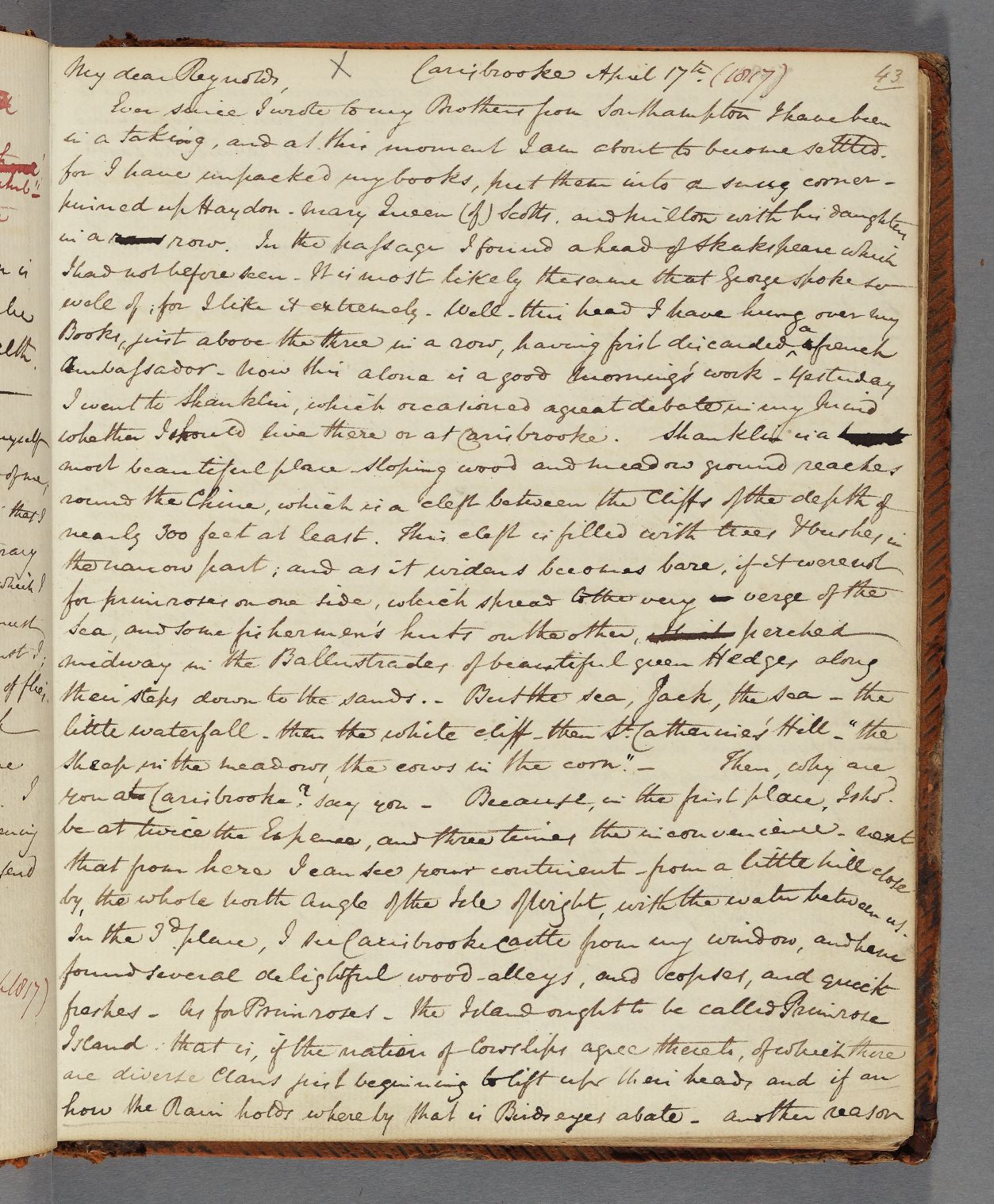
As mentioned back in March with the first letter to Reynolds, the vast majority (18 out of 21) of Keats’s letters to Reynolds come to us via transcripts from Richard Woodhouse. All are available via the Harvard Keats Collection, which we kindly (and with permission) reproduce for you here (click the images for the full size images). And for a readable printed edition, we suggest the same edition mentioned with the previous letter, Harry Buxton Forman’s 1883 volume.

Keats Underway

Richard Marggraf Turley
Aberystwyth University

Re: Keats’s 15 April 1817 letter to George and Tom Keats

In April 1817, Keats was going places. His debut volume Poems (1817) had appeared the previous month to enthusiastic reviews by his friends, and he’d been welcomed into the avant-garde circles of Leigh Hunt and Benjamin Robert Haydon. Now, at four o’clock in the afternoon on 14 April, he was underway in a very literal sense. An onlooker outside The Bell and Crown in Holborn would have seen the Southampton mail coach emerge in black-and-scarlet PO livery from the square arch of the coaching yard and clatter onto Holborn Hill, Keats perched atop, wrapped in a plaid for warmth, a beaver-hatted guard bringing up the rear (toting a blunderbuss and two loaded pistols; as De Quincey was to write: “It is felony to stop the mail. Even the sheriff cannot do that”). Keats’s ultimate destination was the Isle of Wight, where he was decamping to write his “long Poem”, Endymion. Fully conscious of the unstrained juvenile exuberances of his first collection – “bordering on childishness” the Eclectic Review would complain (Conder 270) – Keats was banking on an epic to establish himself as a mature poet.

Fourteen dusty hours later, “muzzy” from his crepuscular journey, he was searching for breakfast in Southampton, afterwards composing a sleepless aubade to his brothers George and Tom, which he deposited at the Post Office in Butcher’s Row (now West Street) before his ferry sailed at three o’clock. Part impressionistic travelogue, part rhapsody on Cockney sociability, Keats’s letter of 15 April, like the mail coach itself, speeds easily on, its own velocity echoing the vehicle’s thundering progress through Surrey and Hampshire. In that letter, Keats regales his brothers with a lamplit montage of scenes and images glimpsed from his window seat; lavishes excitable praise on his new best friend Haydon’s painting of another urban arrival, that of Christ into Jerusalem; displays his literary credentials through some thickly laid-on allusions to The Tempest, Two Gentlemen of Verona and A Midsummer Night’s Dream; gives vent to the boyish energies of Rum-ti-ti, Titmouse and “betty over the way”; before signing off with another literary pun, this time comparing his letter to a “rough plan of Aunt Dinah’s Counterpane” from Tristram Shandy.

Written to announce an arrival, Keats’s dispatch is dashed off with the boyish urbanity of someone who felt they’d arrived twice: once, that morning, in the seaport of Southampton and, during the preceding months, in the giddy social orbits of Hunt, Haydon and Hazlitt. As I read Keats’s letter again, I find myself smiling, pleased to see him so pleased with himself for once. (As John Barnard shows in a recent Romanticism article on Endymion’s composition, this was a disconcerting time for the young poet, a “narvus” period of “depressions” and “forebodings”.) But – and this in the context of preparing a new collection of essays on the theme of “Keats and place” – what grabs me is not so much the letter’s gauche au courantism (which once I saw everywhere in Keats), but rather the humdrum strangeness of that peripatetic sequence that maps Keats’s journey through the interspaces between London and Southampton, the phantasmagoria of those faint visions, lit by the coach’s lamps – unfamiliar towns and hamlets, commons, downs, empaled parks, enclosed farms, wayside pubs and turnpike gates.

Popular guides such as Paterson’s Roads gave Romantic-period travellers the “correct routes of all the mail coaches” from Hyde Park Corner, along with the principal set-downs: Hammersmith – BRENTFORD – HOUNSLOW – STAINES. They help us catch Keats’s drift.

Part of the London to Southampton route from Paterson’s Roads, 15th edn (1811), p. 37.

Because at first sight, Keats’s own em-dashed itinerary of the Mail Coach Road, seen in dim pools of lamplight, appears to have little in common with Patterson’s clipped precision:

All I can tell you is that sometimes I saw dusty Hedges – sometimes Ponds – then nothing – then a little Wood […] – then came houses which dies away into a few straggling Barns – then came hedge trees aforesaid again. As the Lamplight crept along the following things were discovered – “Long heath broom furze” – Hurdles here and there half a Mile – Park palings when the Windows of a House were always discovered by reflection – One Nymph of a Fountain – N.B. Stone – lopped Trees – Cow ruminating – ditto Donkey – Man and Woman going gingerly along – William seeing his Sisters over the Heath – John waiting with a Lanthen for his Mistress – Barbers Pole – Docter’s Shop. (LJK, I 128)

For Walter Jackson Bate, this list shows Keats falling into the “innocence of exuberant simplicity” (159), while for R. S. White, the impressions are “cryptic” (74). We might wish to question the innocence of Keats’s possibly bawdy concatenation of John waiting for his mistress and the barber’s pole. As for cryptic, Keats is rarely that; in fact, he usually repays us for taking him at his word. That’s what I’ve been doing, consulting Romantic traveller and tourist guides for the bare bones of the Southampton mail coach’s route, supplementing them with ordnance survey and enclosure maps to flesh out the A to Z of Keats’s peripateticism. The stone nymph has eluded me, but other materially embedded details emerged to suggest that Keats’s lamplit cartography isn’t puzzling, but is by its own compass “correct”.

Keats begins his overnight journey at the Bell and Crown at 133 Holborn Hill, proceeding west along Piccadilly, past the Gloucester Coffee House, down to Hyde Park Corner, through the Kensington turnpike, down the high street to Hammersmith, famous for its market gardens and fruit nurseries – its pruned fruit trees are possibly the “lopped trees” Keats mentions seeing; next comes Turnham Green – Keats says he “did not know the Names of any of the Towns I passed through” (LJK, I, 128) – Brentford, county town of Middlesex, the Grand Junction Canal, Smallbury Green, Hounslow and its Powder Mills, and new enclosures, then Staines, and across the Thames into Surrey with Egham, Windsor (where George III was in residence), and Windsor Park on the right – Keats remarks on “Park palings” – wooden in 1817, iron today; Shrub’s Hill is next, then Hatton Hall to the left, over Bagshot Heath – Keats jests he saw “William seeing his Sisters over the Heath” – past the wooded park, and on to the village of Bagshot itself – then into Frimley, crossing the Blackwater River at Frimley Bridge, on to Farnborough, crossing the Basingstoke canal, and on to Farnham – Keats is well into Surrey now – where there’s a “set down”, and a chance for the horses to draw breath … as may we …

And off again towards Bentley Green (a “delightful place”, according to The Traveller’s Guide in 1805, with a “large green adjoining” and a “hop plantation”, though it would have been dark when Keats’s mail coach flew through; [Oulton I, 76]) – the black shapes off to the left the trees of Holt Forest; on to Alton, through Chawton (rumbling past the house where Jane Austen lived on Winchester Road), through Ropley Stoke and Ropley Dean and the Anchor Inn, barrelling along (average speed >10mph) the Bishop’s Sutton turnpike road into Alresford (pronounced Awls-fud), through which, according to a Universal British Directory report of 1798, “The Mail coach from London passe[d] … every morning between 3 and 4 o’clock” (Barfoot and Wilkes 23), and where there was a great pond and a roadside barber’s pole, just as Keats describes, the latter sketched by Thomas Rowlandson (see below) in 1792 – Staple Green, over Winchester Downs, arriving into Winchester along the Alresford Road, down and around Magdalen Hill, beneath St Giles’s Hill (from whose top Keats would be inspired to write “To Autumn” two and a half years later), passing Winchester post office at “about five o’clock” (Oulton II, 862), just as the sun would have been rising (at eleven minutes past five on 15 April 1817, according to the NOAA Solar Calculator) – Keats tells us he “saw the sun rise”.

Customers stand around a barber’s shop in Alresford: Thomas Rowlandson, 1792.

Another “set down” in Winchester … and we’re off once more, dashing past the Hospital of St Cross on the St Cross Road – Keats was to walk parallel to this road when he strolled along the Itchin’s water meadows in September 1819 – south on to Compton, hurtling between Compton Down and Twyford Down – Keats records that “from dawn till half past six I went through a most delightful Country – some open Down but for the most part thickly wooded”, noting “an immense quantity of blooming Furze on each side the road cutting a most rural dash” – past the chalk pit, on to Otterbourne and Otterbourne Hill, through thick forest to Chandler’s Ford Bridge, past the “direction post” at the fork in the road there; through Marlbrook pond turnpike gate, passing Common Farm and Marlbrook pond itself, over Chilworth Common – the ancient routeways often followed tracts of common land – and what progressive enclosures and incorporations had left of Stoneham Common, then alongside Stoneham Park, empaled by the influential Fleming family, and a brick kiln, then through Southampton Common, rattling past The Cowherds Inn (still there today), Bevis Mount looming on the left (“extremely romantic and agreeable”, so the Southampton Guide; Lechiot 53), along an avenue of firs that Gilpin praised for forming a “connecting thread between a town and country” (Bullar 116), and, slowing now, pulling past the Royal Military Asylum at the confluence of London Road and the Avenue (a cavalry barracks during the Napoleonic Wars), before coming to a stop, coach springs juddering, at The Coach and Horses on the west side of Above Bar Street, just up from Southampton’s medieval Bargate, whose famous lions Keats inspected on his way to find breakfast. Distance travelled: a total of 77 miles.

The mail coach route from Alresford to the east through Winchester, heading to Southampton. Edmund Crocker, Ordnance Survey drawings (1806). 2” : 1 mile.

Back to that sun up. It strikes me as poignant that as the sun’s limb touched the horizon that morning, Keats, setting out on his poetic career, was rolling through Winchester, a town that would come to be associated through his most achieved poem, 1819’s ode “To Autumn”, with the maturing sun, with sunsets. Keats also thought the event significant, and underscored it: “N.B. this tuesday Morn saw the Sun rise” (LJK, I, 128) – with that pen stroke giving his letter a horizontal plane of its own for the sun to climb above. Nicholas Roe suggests this slant observation alludes to the night of 14-15 April thirteen years earlier, when the Keats brothers’ father had died (Roe 162); Keats, that is, notes he’s just witnessed the sunrise his father hadn’t. If Keats uses that dawn to commemorate his father (as well as announcing a son rise), perhaps he commemorated the sunrise itself in the long poem he began a few days later. Allowing for the analemma of poetic transposition, compare Endymion’s speech to Peona – “I, who still saw the horizontal sun/ Heave his broad shoulder o’er the edge of the world” (Endymion, I, 529-30) – with Keats’s own “N.B.” to George and Tom.

Other key words and phrases appear to undergo a transversal shift into Keats’s epic. In 1792, relating his own journey over Bagshot Heath, the traveller Charles Tomkins complained that a “succession of hills covered with dark furze” (Ulex europæus) – another name for gorse – proved “very ungratifying to the eye” (Tomkins I, 6). Perhaps it was Bagshot’s heath and furze that cued Keats’s spondees from The Tempest: “Long heath broom furze”. At any rate, “Furze” didn’t offend Keats’s eye. Far from it: the shrubby plants make a second appearance later on in his letter, where their bright yellow flowers cut a “rural dash” as dawn broke between Winchester and Southampton:

I forgot to say that from dawn till half past six I went through a most delightful Country – some open Down but for the most part thickly wooded. What surprised me most was an immense quantity of blooming Furze on each side the road cutting a most rural dash. (LJK, I, 129)

Furze spreads easily on the downs – it also takes root in Book 1 of Endymion, in a scene set during “the silent workings of the dawn” (I, 107), and brings along with it another key term from Keats’s letter, “down” (as in hilly plateau). Dawn – down(s) – furze:

Men of Latmos! shepherd bands!
Whose care it is to guard a thousand flocks:
Whether descended from beneath the rocks
That overtop your mountains; whether come
From valleys where the pipe is never dumb;
Or from your swelling downs, where sweet air stirs
Blue hare-bells lightly, and where prickly furze
Buds lavish gold …
Yea, everyone attend! (Endymion, I, 196-212)

This, then, is Keats underway, Keats in transit, commenting on empalement, attuned to enclosure out there in the social world, but equally to the rum-ti-ti of titmouse, to John waiting for his mistress. The letter of 15 April 1817 also opens a lens into the mechanical realities of interurban transport in the Romantic period, just as it allows us insight into the creative energy of Keatsian translocations and translocutions. And finally, em-dashed – cutting its own rural dash – it gives us Keats’s sense of personal rapidity, his debut volume newly printed, the young poet about to embark on an epic.


Works Cited

Barfoot, Peter and John Wilkes. The Universal British Directory of Trade, Commerce and Manufacture, 5 vols. London: British Directory Office, 1798.

Barnard, John. “Keats’s ‘Forebodings’: Margate, Spring 1817, and After.” Romanticism. 21 (2015): 1-13.

Bate, Walter Jackson. John Keats. Cambridge, MA: Harvard UP, 1963.

Bullar, John. A Companion in a Tour Round Southampton. 2nd edn. London: G. Wilkie, 1801.

Conder, Josiah. Review of Poems (1817), Eclectic Review. 2nd series, 8 (1817): 267-75.

De Quincey, Thomas. “The English Mail-Coach”, in Thomas De Quincey: Confessions of an English Opium-Eather and Other Writings. Ed. Barry Milligan. London: Penguin, 2003.

Keats, John. The Letters of John Keats 1814-1821. 2 vols. Ed. Hyder Edward Rollins. Cambridge: Cambridge UP, 1958.

–––––. John Keats: The Complete Poems. 2nd edn. Ed. John Barnard. Harmondsworth: Penguin. 1977.

Rev. Lechiot and multiple contributors. The Southampton Guide: Being a Description of The Ancient and Present State of that Town and Neighbourhood; Together with The Principal Roads to Diferent Parts of the Kingdom. 18th edn. Southampton: T. Skelton, 1805.

NOAA (National Oceanic and Atmospheric Administration) Solar Calculator: https://www.esrl.noaa.gov/gmd/grad/solcalc/.

Oulton, Walley Chamberlain. The Traveller’s Guide; Or, English Itinerary. 2 vols. London: J. Cundee, 1805.

Paterson, Daniel. A New and Accurate Description of All the Direct and Principal Cross Roads in England and Wales. 15th edn. London: Longman, 1811.

Roe, Nicholas. John Keats: A New Life. New Haven, CT: Yale UP, 2012.

Tomkins, Charles. A Tour to the Isle of Wight. 2 vols. London: G. Kearsley, 1796.

White, R. S. John Keats: A Literary Life. London: Palgrave, 2010.
Letter #16: To George and Tom Keats, 15 April 1817

One supposes that at some point we’ll run out of firsts to commemorate, but today is certainly not that day. Keats’s letter sent two hundred years ago today is the first extant letter sent to his brothers George and Tom (we’ve already encountered his epistle to George, but this letter is the first one we have that was addressed to both brothers). Looking forward a bit, the second extant letter to George and Tom comes in December of this year, and… wait for it… it is none other than the negative capability letter! Mark your calendars for December 21-27–the KLP will have plenty of negatively capable action on the docket for that week.

Today’s letter is another breezy one, though much longer than the note to Taylor and Hessey from a few days back. As he was in that letter, Keats is on the move and in a hurry today. He manages a breathless account of the many sites encountered on his journey from London to Southampton, from which he sends his letter before departing on a ferry to the Isle of Wight. Richard Marggraf Turley’s response matches the energy and wit of Keats’s letter point for point. With remarkable detail, precision, and insight, Marggraf Turley reveals a great deal about the landscape Keats traversed on his journey, and also about the rapidity with which Keats was indeed, literally and figuratively, “going places.” We daresay Marggraf Turley’s essay will both instruct and delight!

We present the images of the original MS courtesy of Princeton University Library, which acquired the letter relatively recently: in 1972 as part of the Robert H. Taylor Collection. Taylor amassed a collection of some 7000 items, among which were six of Keats’s letters. A small curious detail which may be of interest only to the most arcane of KLP readers: for his 1958 edition of Keats’s letters, Hyder Edward Rollins printed four of these six letters with the MSS as his copy texts, but not the other two, which included today’s letter to George and Tom, and a March 1820 letter to Fanny Brawne. That is to say, Rollins certainly knew Taylor owned four of the six–did Rollins not know of the other two in Taylor’s possession? Or perhaps Taylor came into possession of today’s letter and the Fanny Brawne letter sometime after the 1958 publication of Rollins’s edition? Perhaps Taylor just wanted to keep two of his letters secret from Rollins?? Hard to say. In any case, today’s letter was printed by Rollins using Harry Buxton Forman’s 1883 edition as the copy text. And it turns out Forman did a solid job of editing–feel free to compare Forman’s edition against the images, which we present for your viewing pleasure below.

**UPDATE**
Of course, we were just kidding about Taylor hiding two of the manuscripts from Rollins. Now we can confirm that Taylor acquired this letter quite late: in late 1976 or early 1977. The Princeton University Library Chronicle for Winter-Spring 1977 features essays dedicated to Robert H. Taylor and the collection named after him. In the issues opening essay, the volume editor Robert J. Wickenheiser informs us that Taylor continues to actively collect. Among the list of his most recent acquisitions (“within the past six months”) is Keats 15 April 1817 letter to George and Tom. The question remains, however: from whom did Taylor acquire it? We know that Rollins in 1958 explained that the MS “was owned by MBF [Maurice Buxton Forman].” For how long and when he owned it is unclear. But the letter was once pasted into Haydon’s diary (likely given to him later in 1817). MBF bought Haydon’s diary in 1932 and removed the Keats letters which were still pasted in it. He seems to have sold some if not all of those. For now, then, that’s all the info we’ve got.


Dear Messrs Taylor & Hessey – An Epistle from Amerigo Mackeral

A KLP Exclusive featuring Amerigo Mackeral
(via Aaron Howard)

RE: Keats’s 12/13 April 1817 letter to John Taylor and James Hessey

Not since Thomas Brown the Younger’s (technically, Thomas Moore’s) Intercepted Letters; or, the Two-Penny Post Bag (1813) has there been quite so exciting a discovery of a letter gone astray as the KLP presents today. We know that Keats’s letter to Taylor and Hessey was delivered by messenger (since there is no postage information on it), but what we didn’t know until today was that the messenger went to the wrong house! It was originally delivered to Amerigo Mackeral, an epistolary poet, musician, troubadour and more, who kindly forwarded Keats’s little scrap to the publishers Taylor and Hessey. Without further ado, here is Messr. Mackeral’s note explaining the mix-up!

Amerigo Mackeral to Messrs Taylor and Hessey. Origins unknown.

What a service Amerigo performed by preserving the letter and sending it to its proper destination. We can only hope as well that his sage advice to Taylor and Hessey was heeded. A scrappy and bereft Keats is no Keats that we want to see. Given Keats’s future successes with Taylor and Hessey, we imagine they must have listened to Amerigo’s good counsel and provided the young poet with plenty of paper. Good work, Amerigo!

Now the truly curious part of this tale is that Amerigo appears to be alive and well in the 21st century! You can read more of his epistles here. And you can even listen to performances of some of them here. The KLP does not argue with the spacetime continuum, but it does seem oddly accommodating in this case. We appreciate such warping of spacetime if it means that we learn more about Keats and his scrappy history.

**For this amazing scoop concerning Amerigo Mackeral and Messrs Taylor and Hessey, the KLP wishes to thank Aaron Howard, who makes art, music & words in brooklyn amongst his cats, plants & aquaria. Learn more about his work at oilcanpress.com. And in case you haven’t caught on, Aaron Howard makes art, music & words in the guise of the Amerigo Mackeral persona.**