Letter #25: To Fanny Keats, 10 September 1817

Another significant first for today: Keats’s first of many lovely letters written to his sister Fanny. Readers of the letters tend to agree that the Keats we see on display in his letters to his sister is one of the most caring and kind versions of the poet. Fanny was just 14 years old when Keats wrote her this first letter. His solicitude as the eldest of the Keats siblings looking out for his young sister clearly comes across. We daresay that Keats behaves in this letter (and later ones to Fanny) “in a way befitting a brother.”

In addition to his kindness, Keats’s playfulness shines through with great frequency in his letters to Fanny. Towards the end of this letter he bemoans the tendency in English education to privilege instruction in the French language (“perhaps the poorest one ever spoken since the jabbering in the Tower of Babel”) over that in Italian (a language “full of real Poetry and Romance”). Keats concludes with an image of youngsters having instruction in French “cramm’d down our Mouths, as if we were young Jack daws at the mercy of an overfeeding Schoolboy.” Maybe not Keats at his funniest (and the KLP begs to differ about the poetry and musicality of the French language), but it’s a good taste of the kind of jocular tone he tends to adopt when corresponding with Fanny.

Keats concludes this letter by suggesting that he and Fanny each save all their correspondence for posterity’s sake (“You will preserve all my Letters and I will secure yours”). Turns out Fanny took this advice. In 1826 she married Valentin Maria Llanos y Gutierrez. After living for a few years in England, she left England in 1833 and lived the rest of her life in Spain. During that time she kept her letters safe, and, after corresponding with Harry Buxton Forman regularly in the late 1870s and early 1880s, arranged for publication of the letters for the first time in Forman’s 1883 edition of Keats’s collected writings. After Fanny died in 1889, her daughter Rosa Keats de Llanos provided the letters (through the care of Forman) to the British Museum. Today they remain at the British Library–in all, 42 letters.

So here we are at letter number 1 to Fanny Keats! We’ll have many more over the next few years, in large part thanks to Fanny’s life-long impulse to preserve the letters and eventually ensure that they make their way into literary history. They now form one of the most significant parts of Keats’s epistolary legacy.

Letter #24: To John Hamilton Reynolds, September 1817

Today’s letter exists only in a fragmentary form. Presumably during one of the first few days of Keats’s visit to Benjamin Bailey at Oxford, Keats wrote to Reynolds to inform him of his arrival. In that letter he included these playful verses offering some initial observations on the place.

Keats’s verses on Oxford, from his letter to Reynolds.

This particular copy of the poem comes from Harry Buxton Forman’s 1883 edition of Keats’s complete writings. Forman got the text from a letter written by Charles Brown to his friend Henry Snook in March 1820. As you can see from the bit of the letter above the poem, Brown says he had just come across the lines for the first time in spring 1820, almost three years after they were first written. Brown may have seen them from the letter itself, probably then still in Reynolds’s possession, but to the KLP it seems more likely that he encountered another copy of the verses. Brown says nothing about the context on the poem provided in the letter.

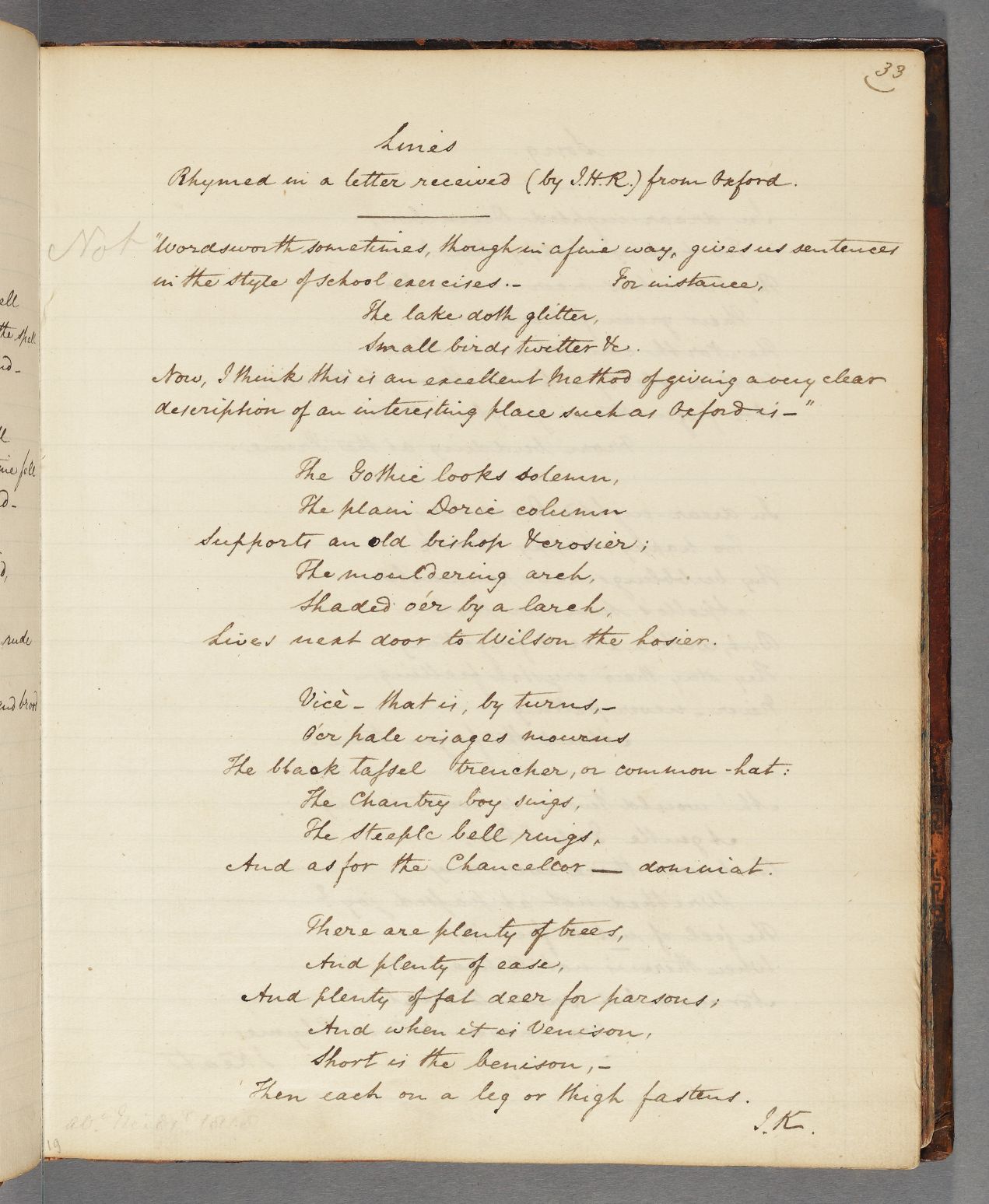
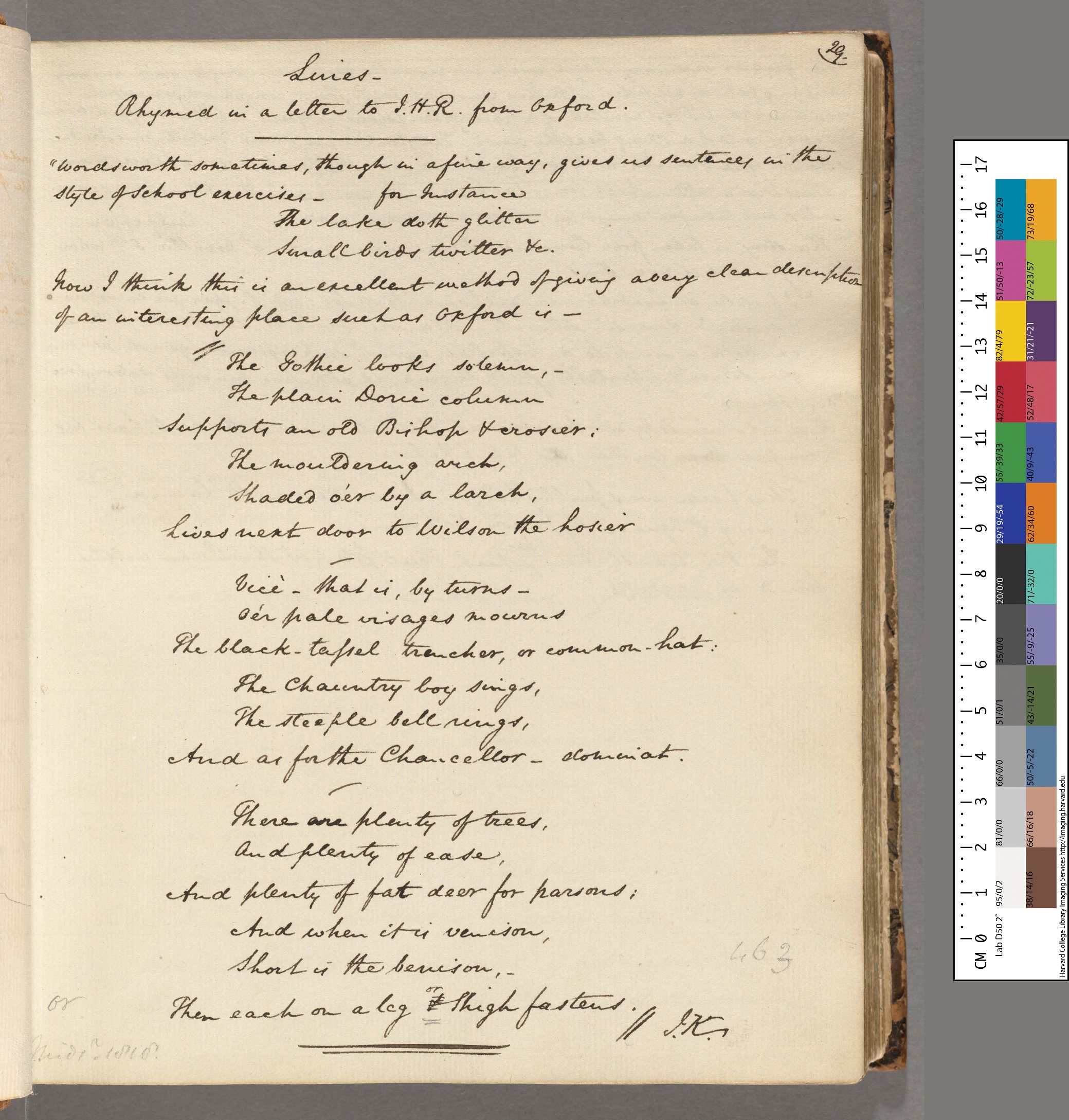
So how do we know about this letter? Well, our indefatigable Keats-chronicler, Richard Woodhouse, made two transcriptions of the poem, and in his copies, he added Keats’s setup for the verses: “Wordsworth sometimes, though in a fine way, gives us sentences in the style of school exercises–for instance ‘The lake doth glitter / Small birds twitter’ &c. Now I think this is an excellent method of giving a very clear description of an interesting place such as Oxford is–”

One of Woodhouse’s two transcriptions, with the two-sentence setup for Keats’s poem.

Sadly for us, Woodhouse did not copy the entire letter. His transcripts are found not among his other copies of Keats’s letters, but in the two notebooks he used for Keats’s poems. Alas. At least we have these two sentences preserved from the letter. If we had only Brown’s letter as the source for the poem, the KLP would likely not be talking about the text as a letter.

Below you’ll find the two images of Woodhouse’s transcripts, courtesy of Harvard. For a response to this fragment of this letter, the co-hosts of This Week in Keats (Brian Rejack and Mike Theune) have been co-writing a poem in imitation of Keats’s imitation of Wordsworth, chronicling Rejack and Theune’s adventures in Oxford during a visit in summer 2015. The poem (and pictures!) will be forthcoming next week. Since the date of the letter is uncertain (and *not* because Brian and Mike are slow composers of poetry), we feel justified in delaying the response until next week. More soon!

Keats’s poem, as copied by Richard Woodhouse. Keats Collection, 1814-1891 (MS Keats 3.1). Houghton Library, Harvard University.

Keats’s poem, as copied again by Richard Woodhouse. Keats Collection, 1814-1891 (MS Keats 3.2). Houghton Library, Harvard University.

Letter #23: To Jane and Mariane Reynolds, 4 September 1817

Today marks the beginning of a series of letters written by Keats during his stay at Oxford with Benjamin Bailey. Many of these letters are sent to members of the Reynolds family, including today’s letter, the first extent letter to Jane and Mariane Reynolds, two of the sisters of John Hamilton Reynolds (the recipient of several letters we’ve encountered previously–see here, and here, and here). During the summer Keats had spent significant time with the Reynoldses, as he indicated in last week’s letter, and including a dinner engagement with them just a day or two before heading to Oxford. As Keats departed for Oxford, the Reynolds sisters also embarked on a journey: they would be doing a bit of late-summer seaside vacationing at Littlehampton.

As we at the KLP are wont to draw attention to firsts of various kinds, we should note that today’s letter is the first of Keats’s sent to female correspondents. Keats himself will regularly note his anxiety about women, as in a letter to Bailey in July 1818 where he writes, “I am certain I have not a right feeling towards Women.” Some of that “not right feeling” is on display in the letter to Jane and Mariane, which is at times affectionate and playful, but at others condescending and mean. That Keats condescends in a self-conscious, slightly self-deprecatory way, however, only highlights his own awareness of his anxiety. So at least he knows he’s being a jerk?? But come on–be nice, JK!

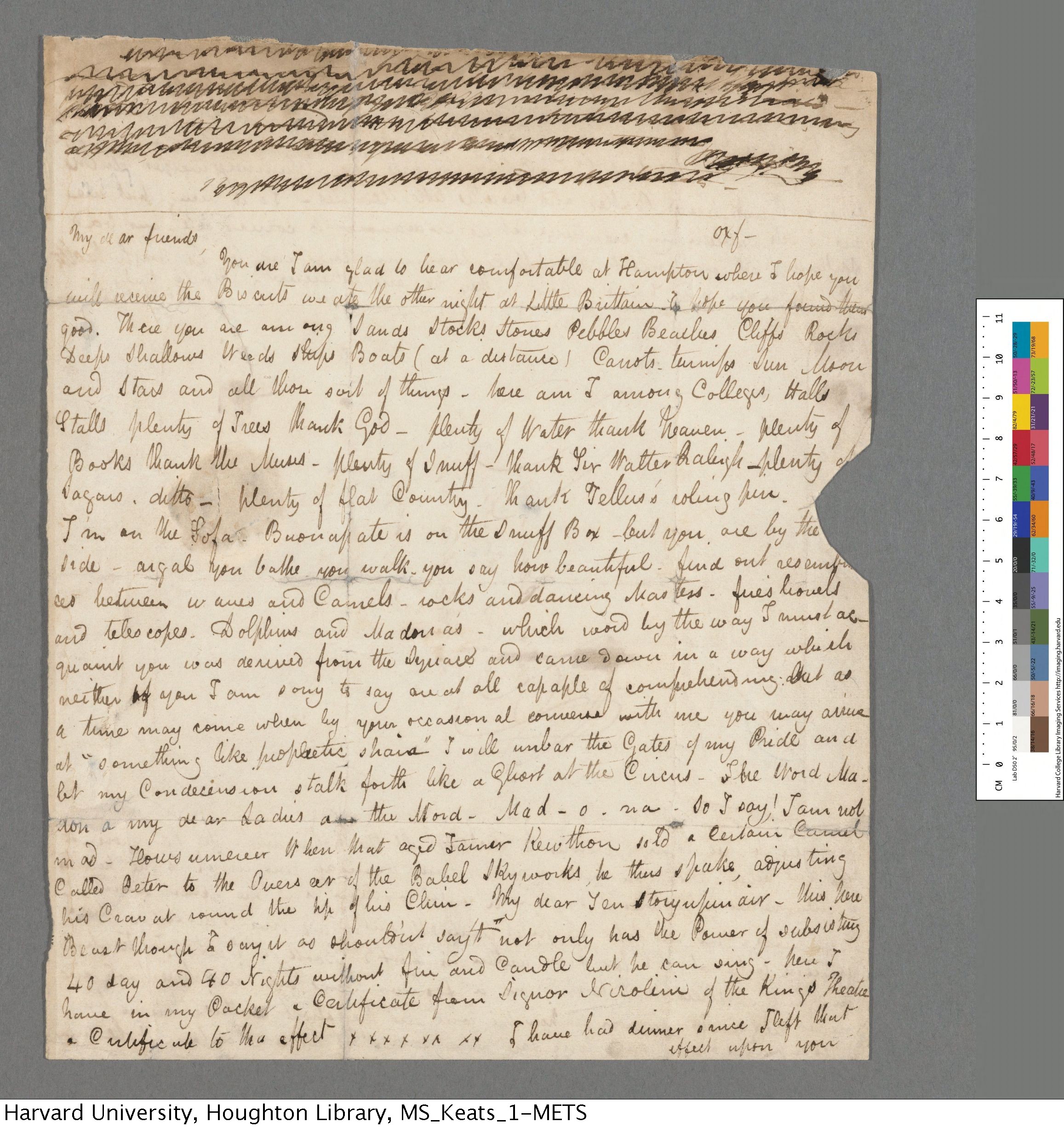
Now, one other factor that may influence his anxiety: Keats has a co-correspondent here. At the top of this letter are several lines written by Benjamin Bailey, and later crossed out rather rigorously. Bailey was at this time courting Mariane, although it seems Keats did not know as much just yet. One wonders what Bailey had to say in his opening half of the letter, and how it might have affected Keats’s own part in the correspondence.

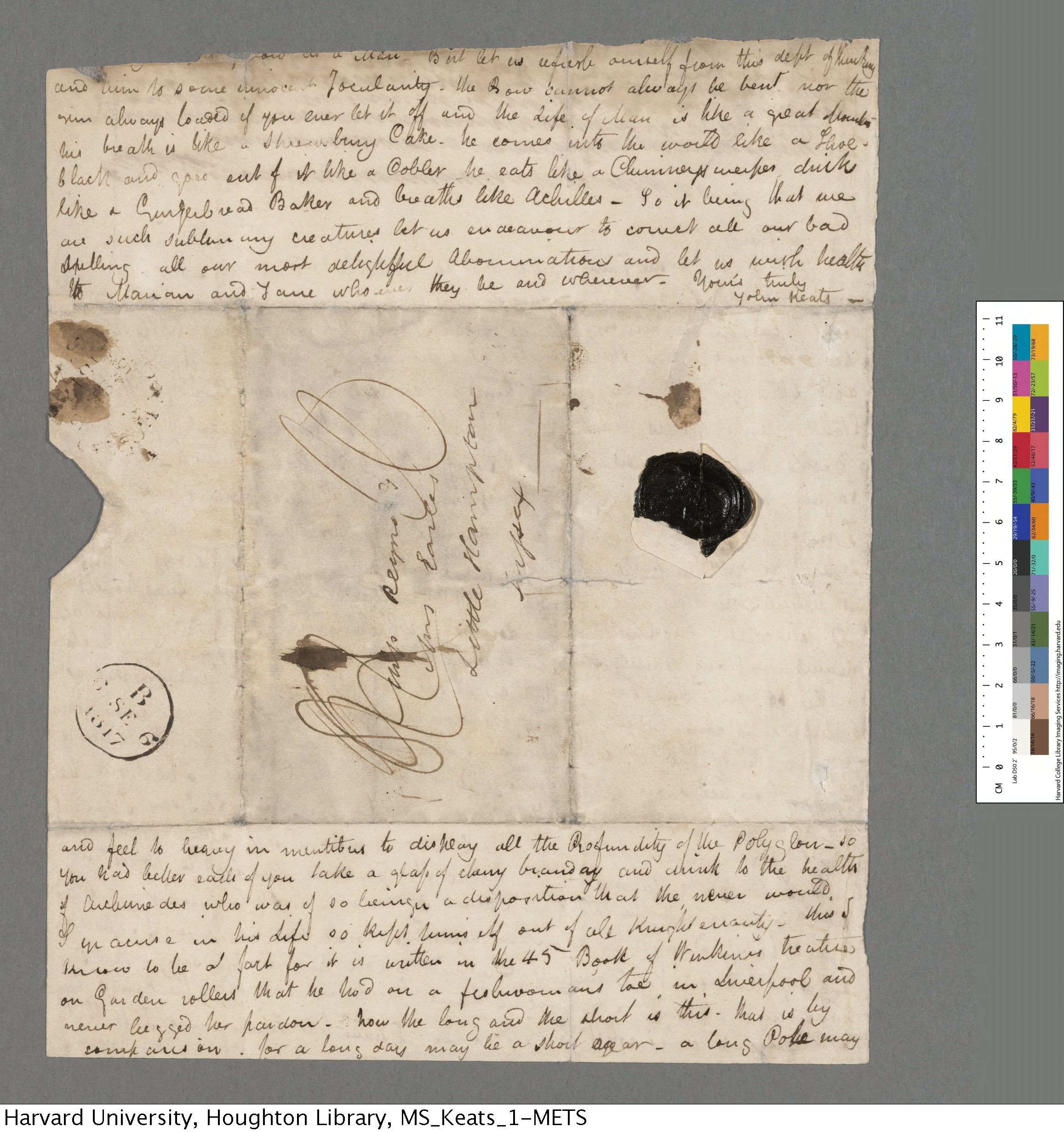
As can be seen from the images of the letter, it’s likely that Bailey wrote not only the few lines at the top of the page which remains, but also filled the first two pages of an adjoining leaf. Recall that Keats’s letters (as would have been true of other letters during this period) were typically written on four sides of two conjugate leaves of paper (or think of it as one sheet folded in half to make a mini-booklet of four pages and two leaves). So, Bailey would have begun the letter, filled the front and back of the first leaf completely, and then finished his message on the top of the second leaf. Although the crossed out lines are almost completely illegible, it seems to the KLP that after Bailey’s struck-through signature, we have a brief post-script that concludes with “Keats.” Thus, Bailey probably wrote something like, “and now I’ll turn things over to Keats.”

The KLP’s educated guess: Bailey’s signature, then just below it to the left, “Keats,” and then Keats’s part of the letter clearly begins below.

“Ah!” you ask, “but what happened to that other leaf??” Well, here’s the KLP’s best guess on that one. In a letter to George and Georgiana in early 1819, Keats explains how the Bailey-Mariane Reynolds drama unfolded: Mariane had rejected a proposal from Bailey sometime in late 1817 or early 1818, but Bailey asked her to give it more thought and reconsider. Meanwhile, having left London after obtaining a curacy at Carlisle, Bailey proceeded to fall in love with a Miss Hamilton Gleig, the sister of one of Bailey’s Oxford classmates. He thereby withdrew his proposal to Mariane, returned her letters and asked for his from her. (Incidentally, Bailey’s conduct in this matter led to the end of his friendship with most of the circle around the Reynoldses. Way to go, Bailey.) Presumably this letter was one of those which Mariane did indeed return to Bailey. After Keats’s death, when Bailey provided much of his correspondence with Keats to John Taylor, he presumably removed the first leaf, crossed out the few lines on the top of the remaining leaf, and sent it on its way. Most of the papers in Taylor’s possession remained in the family until they were sold at auction in 1903 to Bernard Quaritch, soon thereafter purchased by Amy Lowell, and then ultimately bequeathed to Harvard. This letter, however, took a slightly different route, having entered into the possession of a Boston-based collector named William E. Benjamin sometime before March 1886, when he sold it to James R. Osgood. After a few more sales, it eventually wound up with Arthur Houghton, who presented the letter to Harvard.

A final intriguing tidbit: Hyder Edward Rollins notes in his edition of the letters that Bailey’s crossed out lines “fail to reveal their secret to ultra-violet photography.” First, how cool that he (or someone) tried to do so. Second, what additional tools exist now that might be brought to bear on revealing the secret to us? If any DH practitioners want to take a stab at it, please be our guest!

Ok, now comes our admission of guilt… the KLP is a bit “behind hand” with our correspondence right now, as Keats would be at various times. If Keats can fall behind, then we figure we’re allowed some wiggle room too. But fear not, an excellent response from Lauren Neefe is on the way! Once the KLP editorial team catches up again, we’ll have it posted for your reading pleasure. For now, see if you can figure out what Bailey crossed out! Here are the images, courtesy of Houghton Library at Harvard.

Page 1 of Keats’s 4 Sept 1817 letter to Jane and Mariane Reynolds. Keats Collection, 1814-1891 (MS Keats 1.10). Houghton Library, Harvard University.

Page 2 of Keats’s 4 Sept 1817 letter to Jane and Mariane Reynolds. Keats Collection, 1814-1891 (MS Keats 1.10). Houghton Library, Harvard University.

Letter #22: To Benjamin Robert Haydon, August 1817

Alas, it may seem now that warm days will never cease, but summer is indeed on its way out, ready to be replaced by autumn (which, we’re told, has its music too, so there’s that). Here at the KLP we’ve been on a bit of a summer break, thanks to a break in extant letters between June 10 and now. In that interval Keats had been hard at work on Endymion, of which he had completed about 2000 lines at this point. He’ll soon depart for Oxford to visit with Benjamin Bailey. During that time he’ll stay hard at work, proceeding through Book III. And unlike during the summer, we will now have a fairly steady stream of letters to keep us busy this fall!

One thing to note here at the KLP about the contingency of letter-writing and what remains of it for us to digest: there’s no doubt that Keats wrote far more letters than those that have survived in one form or another for 200 years. So although the KLP has been silent for a few months, Keats surely wasn’t in summer 1817. If the sole surviving letter from August gives us any hint, Keats was probably quite socially active while also working steadily on Endymion. So in the spirit of active sociability, for the response to today’s letter, we have for your viewing pleasure a new episode of This Week in Keats! We hope you enjoy the hilarity!

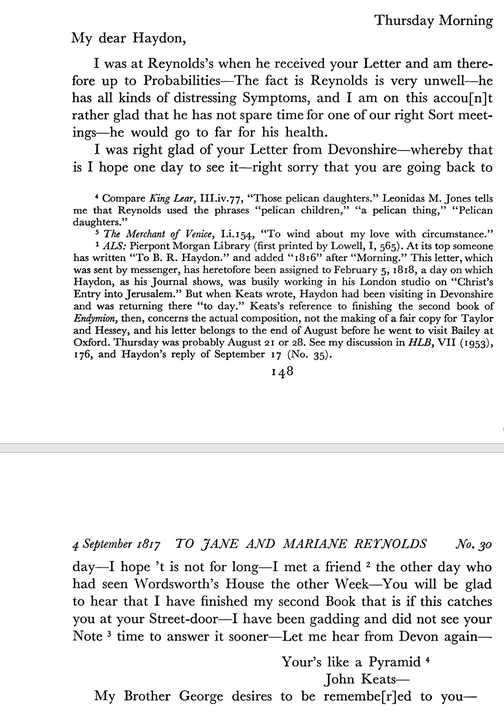
Quick details about this letter–we don’t know the exact date of it, but Hyder Edward Rollins suggests it was likely sent on 21 or 28 August 1817. We’re going with the latter date since we wouldn’t have been able to get the TWiK episode to you earlier (sorry!). In any case, in the spirit of accuracy and full transparency, we really only know for sure that the letter was written on “Thursday morning,” and 21 and 28 August are the best Thursday candidates.

Regarding this letter’s provenance, there are a few mysteries worth noting. First, the vast majority of Keats’s letters to Haydon come to us thanks to Haydon’s diligent habit of placing the letters into his diary, which passed down through his family until the early 20th century, when it was purchased by Maurice Buxton Forman. He then removed the Keats letters and sold them to Arthur Houghton, who presented them en masse to Harvard in 1952. A handful of extant letters to Haydon, however, followed different paths. Today’s letter is one of those. According to the Pierpont Morgan Library catalogue (where the MS still resides), the letter was purchased at auction in 1902, again in 1906, and then passed from Frank T. Sabin (a London-based collector) to J. P. Morgan that same year. The question that remains is what happened to the letter between its one-time place in Haydon’s journal in the 1830s-40s and its sale in 1902. The KLP remains agnostic for now.

Because the letter did not follow the same path as many other Haydon letters, which made their way into print in the 19th century, it was not first published until 1925, when Amy Lowell published it in her biography of the poet. Copyright laws being what they are (1923 is so close!), that means no public domain editions exist online. If Google is so kind as you provide a preview of the same pages of Rollins’s edition that it currently provides us, you should be able to read the letter by following this link. As an additional measure, here is a screenshot of the letter (the KLP legal team, to the best of its knowledge, believes such sharing to be within the purview of fair use).

Keats’s letter to Benjamin Robert Haydon, Aug 1817 (probably 21 or 28 Aug)

“So here goes—”: In which John Keats, feeling a little maidenish, endeavors to lose his Maidenhead, and so his publishers must pay

David Sigler
University of Calgary

Re: Keats’s 10 June 1817 letter to Taylor and Hessey

It’s difficult for me to get into Keats’s headspace at the best of times, but I find his letter of 10 June 1817, in which he asks his publishers for a substantial loan, especially baffling. I can picture John Taylor absentmindedly opening the seal—oh! another letter from John Keats! perhaps he is offering us a provisional schedule for his work on Endymion, or thanking us for the money we recently sent him! I imagine James Augustus Hessey snickering in confusion as Taylor reads Keats’s purpose aloud: “I must endeavor to lose my Maidenhead with respect to money Matters as soon as possible.” Like, in what situation would this be the right rhetorical strategy? Even taken literally, as an attempt at seduction, it disappoints; as a metaphorical way of requesting financial assistance, it bewilders.

What in the world was Keats thinking? I try to imagine myself a young male surgeon-turned-poet with one commercially unsuccessful book of poetry to my name, and just having moved to Hampstead a month or so ago. Just a few weeks ago, my new publishers, unbidden, sent me an advance payment for the poetry I’m now writing, and I had written to thank them in the strangest possible way. But the hydra apparently not defeated, my creditors are coming for me, and things are getting pretty desperate. (Historical value conversions are notoriously difficult to calculate fairly, but if Keats’s creditors needed £30, that would be more than £2000 in 2017 currency, by a conservative estimate by based on purchasing power [Officer and Williamson]). I have with Taylor and Hessey a business relationship of only a few months’ length, and it is not expected to profit anyone involved. How would I go about asking for that loan? Would it be better to be a bit apologetic, or just matter-of fact? All I know for sure is that I would definitely not liken myself, twice in three paragraphs, to a maiden seeking defloration from my publishers.

Yet Keats admits to feeling “a little maidenish or so, and I feel my virginity come strong upon me.” Studies by Anne K. Mellor, Joel Faflak, and Susan J. Wolfson have revealed Keats to be guardedly willing to experiment with female subjectivities, often with tremendous anxiety (Mellor 171–86, Faflak 199–231, Wolfson 205–242). Is this ribald metaphor another of Keats’s gender subversions? Or is it an example of what has been termed, in the parlance of our dark times, “locker-room talk,” signaling a homosocial, and thus homophobic, dude-bro alliance with his publishers? And what is the tenor of this metaphor, anyway? Is there anything that Keats is here trying to experience, relinquish, or enjoy for the first time? Is he capitulating? and if so, to what—to an ongoing business relationship with his publishers? Is he offering to have sex with them for money? That seems to be the subtext, even if it’s only expressed metaphorically. Was the desired loan being likened to a first sexual encounter? No, because Taylor and Hessey had previously sent Keats £20. Matthew Rowlinson explains that: “Keats’s editors and biographers view it as a loan, though it could be regarded as an advance payment for Endymion, then in composition. We know at any rate it that it was not sent in response to any request for a loan on Keats’s part” (Rowlinson 128). Alexander Dick has discussed that situation, and contextualized it for us, in a frustratingly astute (and, for this author writing on the same topic, worryingly recent!) installment for KLP analyzing the letter of 16 May 1817. Perhaps it is Keats’s very asking for money that is now, metaphorically, his “Maidenhead?” No, because that letter of 16 May, which was in many ways the prequel to this one, definitely seemed to insinuate such a request.

As Rowlinson explains, Keats’s agreement with Taylor and Hessey, signed only in April 1817, stipulated that Taylor and Hessey would pay Keats the proceeds from his poetry once the volume had recouped its costs of publication and offset losses from the publication of any of his other volumes. It was not a bad deal for Keats: Taylor and Hessey were presenting themselves to Keats more as “an agency acting on his behalf” than as a commercial enterprise (Rowlinson 127). Between 1817 and 1820, Taylor and Hessey would transfer a total of £70 to Keats. In the end, all of Keats’s writings for Taylor and Hessey would be published at a loss (Rowlinson 126)—except, in a beautiful irony, for the correspondence! Yes, this “Maidenhead” became a commodity when, in 1845, Taylor sold the copyrights to Keats’s letters. In the process, it helped Taylor to “collect” on the imagined debt that the letter had yearned to incur and repay! This is a letter that really arrived at its destination. So deeply satisfying!

I like to think of this letter as a disappointing first draft of “The Eve of St. Agnes,” a poem that Taylor and Hessey would publish in 1820. In the poetically realized version, the virgin Madeline performs rituals that enable her to gain a vision of her future husband, which gives her immense jouissance just thinking about it, even as Porphyro observes her from the closet in his own perverse visual reverie. It is amusing to think about Keats, similarly “meagre, barefoot, wan,” immersed like Madeline in a world of text and dreaming of his future seduction (“Eve” l. 13). He has “duns” pursuing him already, but “it would relieve my mind if I owed you instead,” he says wistfully—just as Madeline has “many a tiptoe, amorous cavalier” ready-to-hand, yet fantasizes about losing her virginity “otherwhere” (“Eve” l. 60, 62). Like Madeline, Keats ensures that the deferral of sexual enjoyment can become, exquisitely, a jouissance in itself. This sort of arrangement lends itself to strange temporalities: we can imagine the penniless Keats going “supperless to bed,” as Madeline did, so that he can receive “all the bliss to be before to-morrow morn” (l. 51, 72). Yet somehow “the bliss to be” must happen immediately if it is be experienced in the future. So too in this letter: the transfer must happen “as soon as possible,” because the creditors, those “pelican duns,” “have opened upon me” earlier than expected, and so “in a month’s time I must pay.” Things now seem to be ahead of and behind schedule. Wonderfully, Keats wrote “The Eve of St. Agnes” out of “an urgent need to make money by writing” (Rowlinson 119)—and thus the poem expresses his desire to repay the imagined debts that he wished to incur in this early epistolary version.

Rowlinson has observed, in his analysis of other Keats letters, how the “process of self-deferral … is resolved in an acknowledgment of debt” (125), and how Keats’s writing of poetry came to be understood as labour, and his poems as commodities. The letter of 10 June 1817 gets at something different: it presents the space and time to write as commodities, and thus a writer in a precarious financial situation would have to purchase their own labour on credit with one’s reputation as collateral. Hence self-deferral is the instantiation of debt. Here, the debt is acknowledged in advance of the loan: Keats signs this letter “your obliged friend,” which was literally and legally true to the extent he was actually friends with his publishers. Keats certainly is obliged in advance, by contract, but is aspiring to add a second layer of obligation, one that steps from his wish for friendship, as incurred by the very fact of his asking for financial assistance. And so his “maidenhead” is neither the publishers’ money, nor his asking for it. Like Madeline, what he is attempting to buy is some time: he currently has money (“25 good notes in my fob”), but knows that he will want money (“in a Month’s time I must pay”), and this feeling from the future impinges upon him at present. He has money but is seeking to borrow time, in the form of more money. Yet Keats’s request for time plays out as an encomium to the relative leniency of Taylor and Hessey: he is asking not for an extension, but for a less vigorous collections agency. In effect, he is seeking to be given a more indeterminate term—meaning that he wants his creditworthiness to be established by his not being good for his loan. And by being already “obliged” in advance, Keats seems to be requesting “a gift of time that is also a demand of time” (Derrida 41). I would say more about this, but I note (once again) that Dick has beaten me to Derrida and Given Time (of course!), so I must reluctantly yield.

“I am sure you are confident in my responsibility,” offers Keats, bafflingly. Here he writes without hesitation about the way that he imagines others to see him. We can feel doubly secure, as he is “sure” that “you are confident.” Keats seeks to confer himself with “responsibility” by imputing the impression of it to his addressees. He thus demonstrates theory of mind: as Jacques Lacan promises, “the subject will see himself, as one says, as others see him” (Seminar XI 268). A psychoanalyst would call this transference. Overriding all material and circumstantial evidence, including his disclosures that “duns” are bearing down on him and that he is barely covering his rent, is a general sense that Keats has “the sense [of] squareness that is always in me,” and that that “sense of squareness” is supposedly perceptible to others. That is how confidence in another person—and thus a system of credit—works in Keats’s estimation: it’s more a relay of perceptions than an evaluation of one’s financial history or prospects. The maidenhead seems to be his guarantee: like Madeline, he is known to be “so pure a thing, so free from moral taint,” even in the glut of his jouissance (Keats, “Eve” l.225). This “sense of squareness” that is “in me”—what Slavoj Žižek would call “factor X”—is supposed to guarantee the repayment (Žižek 145–150). It is in this sense that Keats’s “maidenhead,” and by extension the letter itself, can function as a commodity. Lacan mocked those who would treat the ego as “the subject’s collateral” (Écrits 282). Here, Keats is offering his superego as collateral—it is a property of his, something “always in me” and more than me, that supposedly governs my social and financial behaviors.

What could constitute “the sense of squareness” in this situation, in the absence of any squareness of accounts, and how could it guarantee a loan? All we know is that it is separate from Keats’s sense of “responsibility,” in that it becomes something supplementary to it: “I am sure you are confident in my responsibility,” he says, and (additionally, separately) “in the sense of squareness that is always in me.” Is there any relationship between these two items, or does one simply haunt the other from the other side, so to speak, of a Moebius strip? The former is claimed as an attribute of Keats’s, even an obligation: it is “my responsibility.” The latter is identified as something not naturally belonging to Keats, but inhabiting him—an alien presence “that is always in me.” How did it get there? It seems to have been installed in Keats by the gaze of the Taylor and Hessey—it is an index of the “confidence” with which they have (supposedly) noted Keats’s (supposed) “responsibility.” Imagining himself caught in the gaze of his publishers and aspiring to be worthy of their positive evaluation, Keats is separating his financial reliability along the axes of ego and superego: at the level of ego, he expects he will be worthy of their esteem, but then (also, separately) experiences that esteem again as their evaluator gaze returns. Very Madeline! This is what embeds this “sense of squareness” in him—it arrives as a relay from the Other. That is why it is “the object that cannot be swallowed”—the objet petit a— “never crosses this gap” (Lacan Seminar XI 270): it sustains the gap between ego (imaginary) and superego (symbolic), absolving Keats of his shortcomings but at the cost of his “maidenhead.”

The letter narrates an ongoing battle of wills: in writing, Keats indicates his “will” to lose his maidenhead. This is a will that extends beyond the requirements of necessity. He first says that he “must endeavor to lose [his] Maidenhead,” which makes us wonder about this compulsion—why “must”? Is he saying that the financial situation is so dire, that he must, unfortunately, ask for money and for time? Or does he think that asking for money, or for time, is something everyone must do eventually, so he had better get it over with—a reading that is more in tune with the “maidenhead” conceit. “So here goes—” sounds more like the self-talk of someone cheerfully acquiescing to a norm than someone acknowledging the degradations of personal finance. Yet the must is supplemented by the additional remark, “and I will to.” He must ask for money, yes of course, everyone does, but additionally he desires to.

What function does must fulfill in a world of such desires, which seems governed by the logic of “I will to—so here goes—”? Once again, it enables Keats to distinguish between the level of the ego, with its appeals to personal will, and the level of the superego, with its punishing requirements. But in distinguishing between these levels, Keats makes them coincide, as Keats’s “will” begins to supplement the general “will,” adding nothing to it but sustaining it. Sara Ahmed notes that such “wills,” which express the general “will” of symbolic obligations, become complicit in hegemonic power structures: “When willing ‘agrees’ with what is willed, the part recedes, becoming part of a background” (Ahmed). She retains hope for a willfulness that “might ‘come up’ when an act of willing does not agree with what has receded” (Ahmed). And yet what is truly willful here, in the sense that Ahmed has used that term, are the duns, which are the letter’s most superegoic characters: their voices externalized to become an unruly cacophony, their cries “have opened upon me with a cry most ‘untuneable’ never did you hear such un ‘gallant chiding.’” (Keats, Letters). The letter pits Keats’s own will, which accords with the general will, against the willfulness of the duns, who won’t keep quiet when they were supposed to. Far from being “lonely subjects, who are living rather precariously out on a limb” (Ahmed), these “pelican duns” seem to embody hegemony in their pursuit of squared ledgers and zeal for legal obligations. Here, unusually, precarity comes from a will to obey the rules, while those enforcing those rules seem willful. As a result—and this is exquisitely Keatsian—rule-obeying becomes punishable by further and more fanatical rule-obeying, once rule-obeying can be externalized as a superego. It is the big Other that chides ungallantly in this letter.

Another Will—namely, Shakespeare—bursts upon this scene very willfully, creating a maze of allusions that goes nowhere, as can be the wont of mazes. This had also been the case in the letter of 16 May, which used an even wider and wilder set of literary allusions. Responding to that letter, Dick finds that: “Keats saw a parallel between the structure of literary allegory and the magical substantiality of credit.” Dick posits that literary allusions enabled Keats to offer some cultural capital in place of any actual capital. It suggested:

an easy familiarity with the national poetic canon, a sign of breeding, education, and class, [and so] represents a kind of exclusive knowledge that . . . sustained young, indebted gentleman as they fought perennially with “the Dun.” This is Keats’ standard of value.

Yet Keats’s allusions in the 10 June letter function differently, or perhaps fail to function properly. They seem hyperactive and inapt, and prove unintentionally ominous and counterproductive. In describing the duns, Keats invokes a conversation in Act 4 of A Midsummer Night’s Dream, in which Hippolyta and Theseus admire and claim to emulate “the gallant chiding” of Hercules’s Spartan hounds, with their “cry more tuneable” (4.1.109–124). It seems strange to quote Shakespeare twice in a sentence, but to add “un” each time to negate the allusion, as if nothing from the allusion were actually applicable to the situation at hand. Is there such thing as an unallusion? Keats detests, rather than admires, the sound of the duns, which he calls (in an inversion of Shakespeare) “most ‘untuneable’” in their “un ‘gallant chiding.’” By “untuneable,” Keats seems to suggest that the duns do not have a coordinated effort underway to collect their debt; Keats, in this allusion, would be the bear cornered by the duns, who would be hunting dogs: from the bear’s perspective, I suppose, any barking would have always been “untuneable.” But the allusion does not work very well, as it encourages us, on the one hand, to admire the tenacity of the duns, and on the other hand, to consider them as easy to evade. Similarly, his dismissive reference to his creditors as “pelican duns” un-recalls Lear, who bemoans his ungrateful “pelican daughters.” Keats, in this allusion, is perhaps supposedly Lear, soon to be booted from his house in Hampstead thanks to “unkind daughters” who I suppose would be the duns (Shakespeare, King Lear 3.4.68–73). Yet the pelican metaphor works better for Shakespeare than for Keats: if the duns were ungrateful baby pelicans, would that mean that Keats was their parent—and thus not possessed of his “maidenhead”? It’s hard to see how Keats is in any sense wounding himself to feed his children, the duns. It makes more sense to think of Keats as the baby pelican, feasting upon the wounds of Taylor and Hessey, who have been willing to go to personal expense to support their fledgling poet and to publish him at a loss. The duns would then have nothing to do with the pelican metaphor, and Keats would be teaching Taylor and Hessey to regret having Keats in their stable of poets. As Gordon Downie would say: he is not Cordelia, he will not be there. Keats may even be making a third allusion to Shakespeare here—to the opening scene of Romeo and Juliet, where the Capulet serving-men Sampson and Gregory joke about decapitating maidens as a kind of sexual violence: “I’ll first begin with the maids, and off with their heads … the heads of their maids, or the maidenheads, take it in what sense thou wilt” (I.i.19–23). This allusion falters as well, in that it undermines the entire argument of the letter: it suggests that Keats’s “will” to lose his “maidenhead” to his publishers subjects him to a kind of summary execution, so that the financial help would really be a form of sexual violence and a death sentence. The proper thing to do, by this logic, would be to push John Keats “to the wall,” or marginalize him by ravishment—not to find ways of allowing him to survive. “Thou hadst been poor-john,” as Gregory would say, with reference to shriveled genitals (Romeo and Juliet 1.1.28): Keats sounds pretty self-pitying here. The letter’s Shakespeare allusions tend to work against Keats’s rhetorical aims, then, even when disavowed.

What the allusions do establish, though, is an enormous gap between the letter’s extravagant figural apparatuses and its banal, if presumptuous, purpose: Keats has constructed a baffling “maidenhead” conceit, and then supplemented it with an equally baffling array of inapt Shakespearean allusions, all so he can ask for a loan in the most awkward way possible. He then apologizes, incredibly, for not having asked for the money more straightforwardly: “I am afraid you will say I have ‘wound about with circumstance’ when I should have asked plainly.” Here is a second example of theory of mind: Keats is thinking about what his publishers will be thinking about him, upon receiving the ridiculous letter. He knows that the letter is extravagant, even decadent, and he expects, even sort of asks, to be chided for his bad manners. He sees that he has mismanaged his rhetorical aims. So why not throw away one’s draft and start again? Instead, as if compulsively, Keats introduces a fourth allusion to Shakespeare—this one to The Merchant of Venice—as his way of acknowledging that the previous three may have been a little much. He suspects that Taylor and Hessey aren’t the types to think kindly upon this highly pretentious network of failed allusions—so why not just one more? It seems strange to quote Merchant when asking for a loan, as it seems to make Endymion a pound of Keats’s flesh.

Perhaps the letter could have been more direct, but there’s a perfectly good explanation: he is feeling a little maidenish or so—and he feels his virginity come strong upon him! Well, that certainly explains it. Only Keats, who in three short paragraphs devised to separate the ego from the superego completely enough that he could suffer all the more, even when requesting leniency, could write such a thing. The consequent gap is how and why his virginity seems imposed on him from the outside, instead of being a property of his own experience! It comes upon him strong. Yes, this is a thoroughly weird way to ask for a loan.


Works Cited

Ahmed, Sara. “A Willfulness Archive.” Theory & Event, vol. 15 no. 3, 2012. Project MUSE, muse.jhu.edu/article/484421.

Derrida, Jacques. Given Time: 1. Counterfeit Money, translated by Peggy Kamuf. U of Chicago P, 1992.

Dick, Alexander. “Mental Debauches and Manufactured Rags.” The Keats Letters Project. http://keatslettersproject.com/correspondence/mental-debauches-and-manufactured-rags/

Faflak, Joel. Romantic Psychoanalysis: The Burden of the Mystery. SUNY P, 2008.

Keats, John. “The Eve of St. Agnes.” Lamia, Isabella, The Eve of St. Agnes, and Other Poems. Taylor and Hessey, 1820. 81–104.

—. The Letters of John Keats vol. 1, 1814-1818, ed. Hyder Edward Rollins, Cambridge UP, 1958. 147–148.

Lacan, Jacques. Écrits: The First Complete Edition in English, translated by Bruce Fink. Norton, 2006.

—. The Seminar of Jacques Lacan, Book XI: The Four Fundamental Concepts of Psychoanalysis, edited by Jacques-Alain Miller, translated by Alan Sheridan.  Norton, 1981.

Officer, Lawrence H. and Samuel H. Williamson, “Five Ways to Compute the Relative Value of a UK Pound Amount, 1270 to Present,” measuringworth.com, 2017.

Mellor, Anne K. Romanticism and Gender. Routledge, 1993.

Rowlinson, Matthew. Real Money and Romanticism. Cambridge UP, 2010.

Shakespeare, William. The Comical History of the Merchant of Venice, or Otherwise Called the Jew of Venice. The Norton Shakespeare: Based on the Oxford Edition, edited by Stephen Greenblatt et al. Norton, 1997. 1081–1145.

—. A Midsummer Night’s Dream. In Greenblatt et al., 805–863.

—. Romeo and Juliet. In Greenblatt et al., 856–941.

—. The Tragedy of King Lear: A Conflated Text. In Greenblatt et al., 2479–2553.

Wolfson, Susan J. Borderlines: The Shiftings of Gender in British Romanticism. Stanford UP, 2006.

Žižek, Slavoj. The Puppet and the Dwarf: The Perverse Core of Christianity. MIT P, 2003.

Letter #21: To John Taylor and James Augustus Hessey, 10 June 1817

Today we encounter another letter focused on money issues. And just as we saw a month back with Keats’s 16 May letter to Taylor and Hessey, Keats again broaches the topic with some awkward attempts at humor. Really, this 10 June letter is a weird one. The main weirdness springs from Keats’s odd conceit of being a “Maiden” on the topic of money matters, anxious about losing his “virginity” by requesting money from his new publishers. As David Sigler points out in his virtuosic, rollicking response to the letter, it’s perhaps not the most effective way of asking for a loan in these circumstances. If you don’t laugh out loud while following along as Sigler ponders what Keats was thinking in crafting his financial request, then you might just hate laughter. And as is befitting of the author of Sexual Enjoyment in British Romanticism, Sigler examines the structure of Keats’s desire in the letter, and in so doing, he suggests it offers a tantalizing (though disappointing) first draft of The Eve of St. Agnes (with Keats himself in the place of the virginal Madeline). From a short letter concerning anxieties over scarce resources, Sigler creates a wealth of delightful insights for us to enjoy as we read.

In the spirit of commemoration, we thought we should also point out some intriguing details about this letter’s provenance. As remarked upon before, the majority of the letters between Keats and his publishers were sold at auction by Sotheby’s in 1903, and thereafter purchased by Amy Lowell, who bequeathed her Keats collection to Harvard in 1925. Well, since we’re talking about money, you might be interested to know that the Keats letters in Taylor’s possession (29 of them) were sold in one lot, to Bernard Quaritch, for the sum of £1070. Not too shabby! Using the MeasuringWorth calculator (thanks to David Sigler for bringing this tool to our attention in his post), that amount in 1903 would correspond to anywhere between £100,000 and £1,100,000 today (depending on what sort of estimate one uses). Come to think of it, I’d say that lot was a steal! The KLP would gladly pay that much for just one letter, let alone 29…

But what was that about commemoration, you ask? Well, today’s letter was sold on 8 or 9 June 1903, so almost exactly 86 years after it was first written. Another Keats treat did sell through Sotheby’s on 10 June: copies of all three of Keats’s books published in his lifetime. According to the advertisement in the Athenaeum of 6 June 1903, the “valuable Library of a Gentleman living in Yorkshire” went up for auction on 10 June, and it included Poems (1817), Endymion (1818), and Lamia, Isabella, and the Eve of St. Agnes (1820). We’ll forgive the Yorkshire gentleman for Poems and Lamia being still uncut when sold in 1903–even if he never read them, at least the books we’re effectively preserved. The books sold for £38, £30, and £60 respectively. Again, what a deal! Ah, to have been alive and moderately wealthy in 1903.

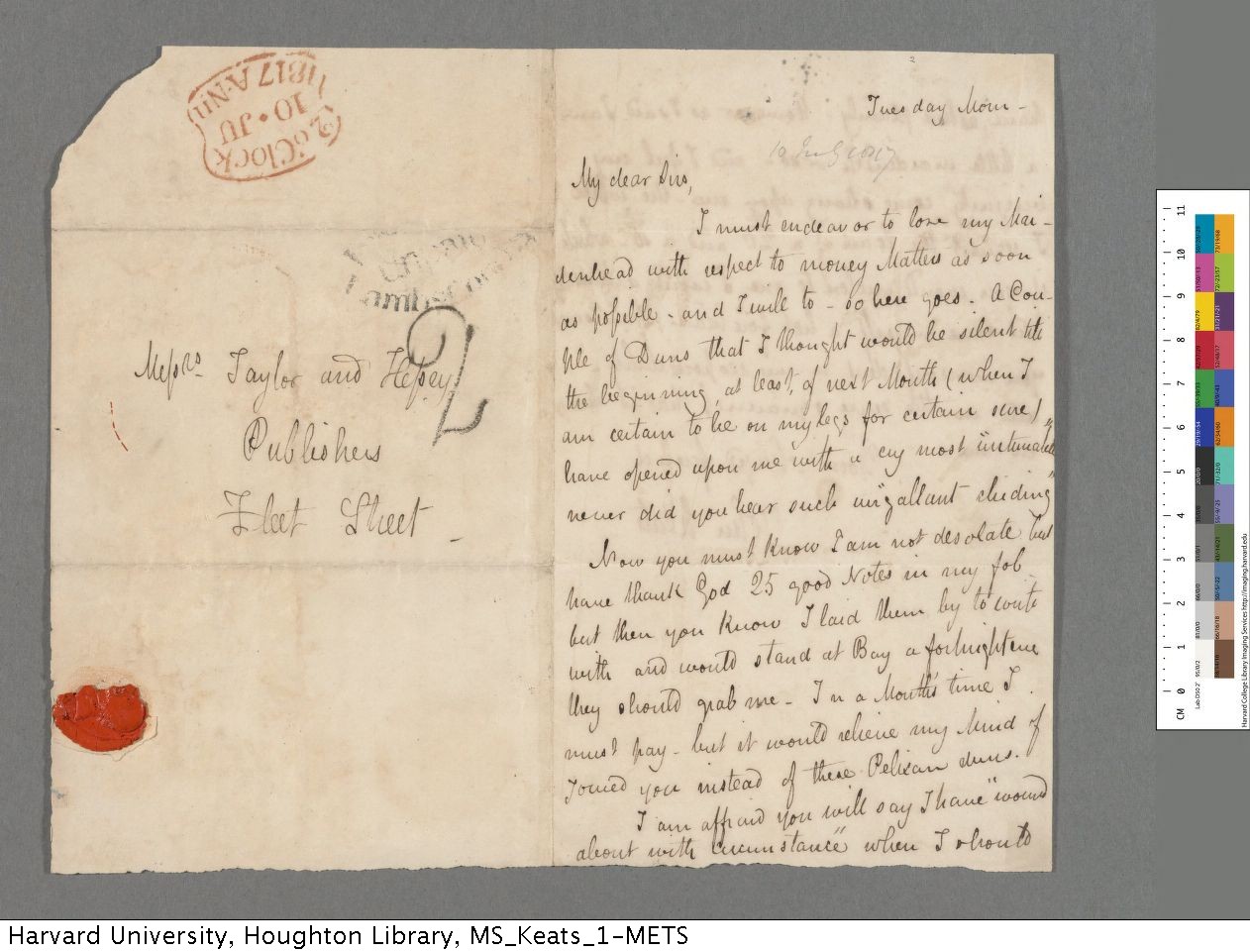
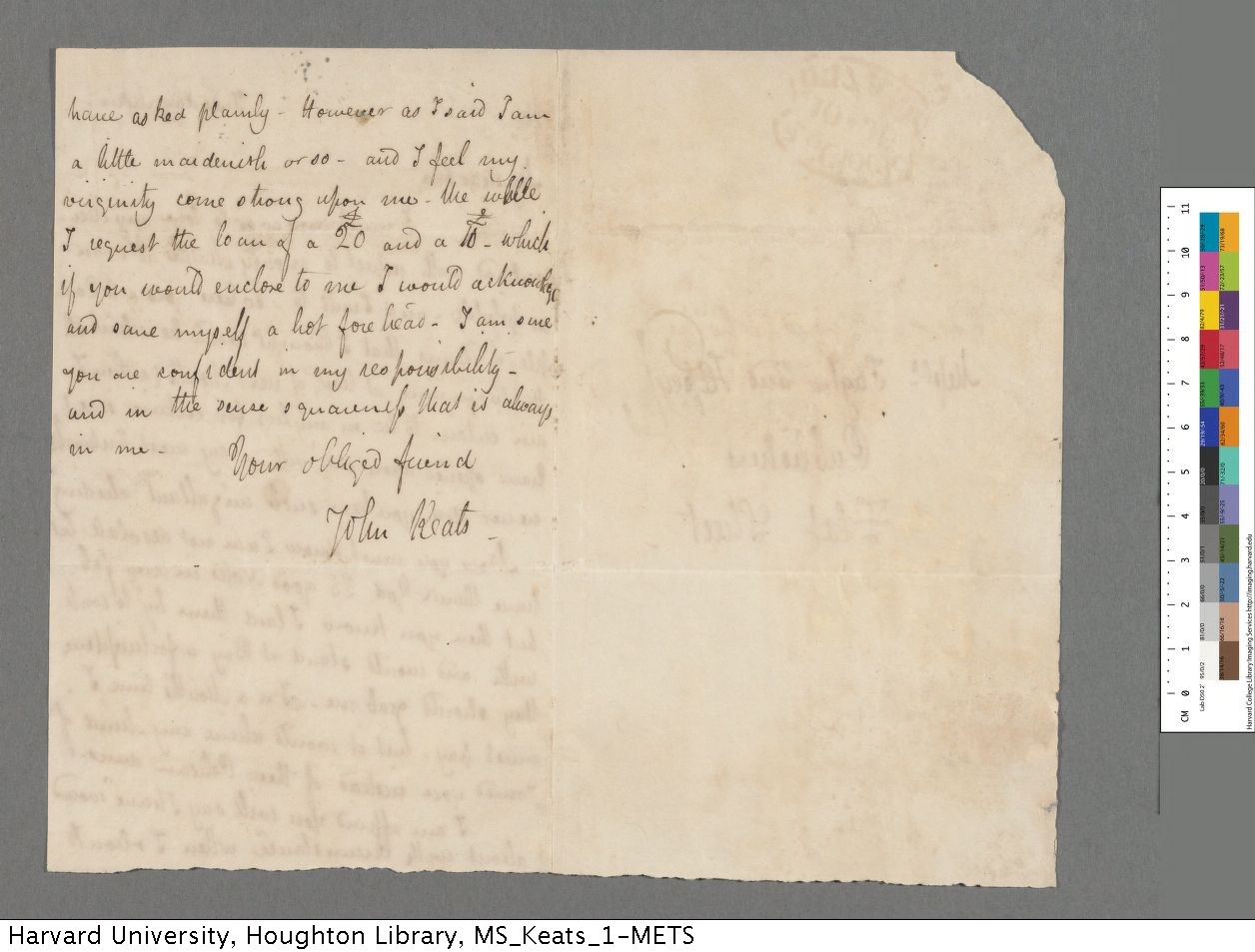
While the KLP pines away for Keatsiana sold long ago, we encourage you to forget any such troubles by reading Dr. Sigler’s response to cure whatever might ail you. The MS images, once again, come to us from Houghton Library at Harvard. And Forman’s 1883 edition once again supplies a decent public domain printed edition. Careful readers will note, however, that Forman excises the opening line for fear of his reader’s delicate sensibilities. And technically, since Forman didn’t have the MS, it’s really Milnes’s fault, since he made the excision in 1848, and Forman was just following Milnes’s text. No delicate sensibilities here! Keats begins with this opening: “I must endeavor to lose my Maidenhead with respect to money Matters as soon as possible–and I will to–So here goes.”


And one quick programming note before we go: there will be a bit of a letter hiatus after today. No more letters for summer until August! In the interim period, however, be on the lookout for other features, including a report on the Keats conference recently held at the Keats House in Hampstead, more pedagogy features, and another episode of This Week in Keats!


Mental Debauches and Manufactured Rags

Alexander Dick
University of British Columbia

Re: Keats’s 16 May 1817 letter to Taylor and Hessey

The subject of this letter from Keats to his publishers John Taylor and James Augustus Hessey is debt. Keats would return to this theme many times in his correspondence with his publishers. And why not? Contracts between writers and publishers during the Romantic period were notoriously gregarious, with each side constantly cajoling each other for promises of investment and guarantees of return. Keats had requested a short advance on his contract for Endymion and they obliged the poet with a note for 20 pounds, which Keats dismissively calls a “manufactured rag.” But Keats’s delight in receiving the loan, an obligation that will allow him to repay the obligations he already owes to others, is palpable. This strange combination of attitudes tells us something very important about the centrality of money, debt, obligation, and friendship to Keats’ poetics if not to Romanticism more broadly.

Debt had been something of a national obsession for decades by the time Keats began his poetic career. The steady increase in the national debt throughout the eighteenth century inspired a good deal of (mainly political) opposition. But things came to head in February, 1797 when a small troop of French soldiers landed at Fishguard in South Wales. Although the soldiers were quickly rounded up, fears of an invasion spread rapidly and frightened country farmers and merchants to take their paper notes to their local banks and demand gold, real money, as they were promised they could on each and every bill. The result was a mass financial panic. The Bank of England closed its doors and refused to exchange any gold for notes, an action known as a “suspension of cash payments.” That the Bank of England held no gold at the time (it had been shipped to the continent to pay for the war effort) was not mentioned. Intended to last about six weeks, the suspension actually went on for twenty-four years.

In the meantime, as I have discussed at length elsewhere, economists, politicians, journalists, and poets debated the relative merits of a paper money system, which Britain then had, and the gold standard, which Britain had never actually had but which was being devised as the most economically prudent and philosophically rational solution to the presumed fragility of paper credit and promoted as the “ancient standard of the realm.” The “bullion controversy,” as its now called, began in earnest in 1810 when a bill drawn up by Francis Horner, one of the founding editors of The Edinburgh Review and then a young MP, urging Parliament to lift the suspension of cash payments and allow the free exchange of coin and bullion to circulate in the banking sector and between Britain and the continent, failed to pass on the grounds that the existing paper credit system was necessary to continue the war. For the next several years, the debate waxed and waned without much effect. Whiggish political economists (like David Ricardo who began his writing career as a commentator on money matters) warned that “excessive” issues of paper notes would inflate prices on domestic goods and thus threaten the equilibrium of the “natural” market. But others, bankers and accountants especially, observed that the economy was doing quite well without gold anyway, so why should an arbitrary standard be imposed on it? Even during the agricultural crises that followed the victory at Waterloo, when bankruptcies threatened the very farmers who had sustained the credit system in the first place, the Bank and Parliament refused to lift the suspension. In the fall of 1816, a few months before Keats penned his letter, Parliament passed at Act of reform the silver coinage, which effectively turned all coins valued below 1 guinea into tokens and put Britain on a gold standard for the first time in its history. But the suspension continued until 1821.

It wasn’t the only suspension of cash payments that concerned the public. Indeed, gentlemen of Keats’ acquaintance had no trouble using and passing paper money unbacked by any metallic guarantee, as we have all been doing quite happily since the Nixon administration suspended the international gold standard in 1971. What really concerned the journalists and writers that Keats knew and read was forgery: through the later 1810s, hundreds of people were transported or even executed merely for holding forged, small 1 and 2 pound notes which even the Bankers themselves could not tell from “authentic ones.” Keats’ expression “manufactured rags” was a slang term for paper banknotes that also referenced the production of rag paper for making books. An anonymous pamphlet published in 1818, entitled Rotten Rag Manufactory!!!, subtitled, The Threadneedle‐Street Catechism; or Bank Bubble Exposed devoted four of its eight pages to railing against the Bank’s use of the courts as a way to protect its already engrossed and enfeebled financial system. It contended that the forgery crisis had been caused by “the common and cheap manner in which … notes are executed; by which any engraver’s apprentice may easily imitate them; thus holding out temptations to weak and wicked persons” and recommended that the only way to secure the currency against forgery was either for the bank to recall all small notes and issue instead “tokens, issued under the mint price” or, at least, for merchants to be allowed to stick examples of forgeries in their shop‐windows to show people what they looked like. Unfortunately, the pamphlet goes on, Bank clerks had taken to “collaring” any merchant sticking up forged notes in their windows on the charge of holding a forged note. Other caricaturists like James Gillray (in the 1790s), George Cruikshank, and William Hone depicted the paper credit system as itself “forgery” and thus, as Ian Haywood has noted, created in the public mind an equation between government finance and arbitrary injustice.


But other thinkers produced various theoretical justifications for maintaining the debt. Samuel Taylor Coleridge, for instance, believed that debt was essential to Christian faith. The Crucifixion was God’s gift to humanity and we are thus obliged perpetually in return for our salvation. Echoing Edmund Burke, Coleridge urged in his Statesman’s Manual and Second Lay Sermon (both published around the time of this letter) that the real arbiters of the national debt were not political economists but the Clerisy, clergyman and aristocrats, the keepers of the nation’s properties and values, and who, in turn, were owed the thanks (and tithes) of the whole population. Percy Shelley, of course, had no truck with Coleridge’s clerical standard, and though, like the radicals, William Cobbett, Thomas Wooler, and William Hone, that he professed to admire, he railed against the existing paper credit system, he did not endorse gold. Instead, Shelley believed in what I have elsewhere called a “poetic standard,” a consciousness of the need for symbols and metaphors to circulate universal signs accompanied by a concomitant awareness, known primarily to the poets themselves, of their inter-relations, complexity, and evanescence. Poetry, for Shelley, was the embodiment of an ideal system, one that was in constant need of reformulation, to which the administrators of economic welfare should appeal. This is why poets were “unacknowledged legislators.”

Keats’ allusive and effervescent manner in his latter to Taylor and Hessey makes the internal contradictions of the poetic standard immediately evident. Evading the demands of creditors—the ‘Dun’—as Keats imagines himself doing here is not a matter of substituting a fraudulent sign of value (paper) for a real one (gold), but of transforming one medium of exchange into another. The imagined myriad of fanciful weaponry, all of which he calls “scaly commodities” and which probably were meant to refer to the “metallic” defenses of the economists against the ever-threatened catastrophe that was the national debt. As Keats’ little allegory implies, the solution to debt, national and personal, is not metal (which is itself presented as farcically excessive) but the “Bank-note of faith and the cash of salvation.” In one image, Keats parodies both the fetishization of real value shared by liberal and conservative economists and the kind of religious justifications for the continuation of the debt outlined by Coleridge—which Keats likely would have known through Hazlitt’s review of The Statesman’s Manual published in early 1817. The promiscuously satirical tone suggests that Keats himself disdained the whole debate. On the other hand, as Rollins’ scrupulous notes make clear, Keats’ references to a panoply of chivalric romances, Spenser’s Fairie Queene (the “spring-headed Hydra”, Archimago, the Castle of Carelessness), the anonymous Amadis of Gaul (Urganda), Virgil’s Aeneid (Sybil’s leaves), Dryden’s Alexander’s Feast (“never ending still beginning”), Cibber’s Love’s Last Shift (“Sir Novelty Fashion”), and Shakespeare’s Venus and Adonis (“Snail’s Horn”) and The Tempest (“green sour ringlets”), suggests that Keats saw a parallel between the structure of literary allegory and the magical substantiality of credit, a parallel that is also evident in his verse. But it also shows, perhaps more tellingly, the way that an easy familiarity with the national poetic canon, a sign of breeding, education, and class, represents a kind of exclusive knowledge that defines in turn Margot Finn calls the “character” that sustained young, indebted gentleman as they fought perennially with “the Dun.” This is Keats’ standard of value.

Nevertheless, the gentlemanly “poetic” standard, the paper-thin romance of both literary imitability and capitalist exchange that enables him to keep the dragons at bay also gives Keats a “swimming in the head.” But like Derrida, who in Given Time: I. Counterfeit Money, and in spite of his awareness of the fictitiousness of money as such, argued that its “true” value is irreducible except to already circulating debts and gifts, Keats finds in his own contemplations on money and value an impulse or promise to carry on, a philosophical confidence that is at the same time a product of his own financial and intellectual embarrassment, to use Samuel Johnson’s definition of the term to mean “perplexity,” what Keats calls his “anxiety” or “mental debauch.” There is no “real” power in money, or even thinking about money, but all the same, the 20 pounds marks a “Progression,”—to leave Margate and go to Canterbury, to “remember” yet another literary personality (Chaucer), to see himself as a “billiard ball” (an image Rollins noted Keats probably derived from Hazlitt’s lecture “On Liberty and Necessity” but which is also a riff on Hume’s refutation of necessary causality), to complete his poem. The media of credit and obligation proliferate here, with only the nose-tapping understanding of its immateriality to sustain its real value. In his next letter to Taylor and Hessey (June 10), Keats would equate his need for money to pay his debts with “los[ing] his Maidenhead,” an image that conjures both the loss of innocence and the pleasure of sex. The letter concludes, “I shall be happy to hear any little intelligence in the literary or friendly way when you have time to scribble.” Gossip too is a medium of value, like allegory, friendship, romance, and desire.

So where is Keats at this moment? Like a banknote, it seems, Keats is nowhere and everywhere: he is perpetually in/between. He is the 20 pounds he receives from Taylor and Hessey which they in turn procured from their banker, who took in money from another investor, who may have procured it as another loan, or a banknote, or a bill of exchange… and on it goes. Like literature, like gossip, like a billiard ball, like money, Keats moves, Keats circulates. An intrepid traveller, Keats knows that this circulation is the meaning of his character, his experience the source of his value.

Eventually, debts would catch up with Keats. The “anxiety” Keats implies means both energy and fear. As well as his own obligation to Taylor and Hessey to finish Endymion (which clearly gives him pause), not to mention the various creditors he apparently relied on during his travels, including the landlady of the Bell tavern on the Margate High Street, Keats was worried about poor sales and bad reception and these did nothing for his straightened circumstances and, later, weak health. Keats also had the misfortune of an “expectation,” what Robert Gittings termed “the Keats Inheritance” a sum of more than 3,000 pounds that he believed was due to him from his grandfather’s estate, but which, because of its own vague wording and perpetual legal delays, the poet never actually saw. This did not stop many of his friends and associates—including Reynolds and Hunt—from asking Keats for personal loans and which, for the sake of said friendships, Keats was loathe to refuse much as he himself here and in the letter that follow repeatedly cajole Taylor and Hessey for loans and advances. In the years that followed excess credit became more of a concern for Keats. After reading The Cenci, a text that itself is replete with subtle references to the credit crisis, he warned Shelley to clip his outlandish poetical wings and “load every rift with ore.” But, as this early letter makes clear, Keats’ financial struggles and debauched reflections can help us explain the economic and political contexts for his vivacious and allusive style.


Works Cited

—. Rotten‐Rag, Manufactory!!!. The Threadneedle‐Street Catechism, 7th ed., London: Fairburn, 1818.

Derrida, Jacques. Given Time I: Counterfeit Money. Trans. Peggy Kamuf. U of Chicago P, 1992.

Dick, Alexander. Romanticism and the Gold Standard: Money, Literature, and Economic Debate in Britain 1790-1830. Palgrave, 2013.

Finn, Margot. The Character of Credit: Personal Debt in English Culture, 1740-1914. Cambridge, 2003.

Gittings, Robert. The Keats Inheritance. Heinemann, 1964.

Haywood, Ian. Romanticism and Caricature, Cambridge UP, 2013.

Keats, John. The Letters of John Keats Vol. 1, 1814-1818, ed. Hyder Edward Rollins, Cambridge UP, 1958.

Letter #20: To John Taylor and James Augustus Hessey, 16 May 1817

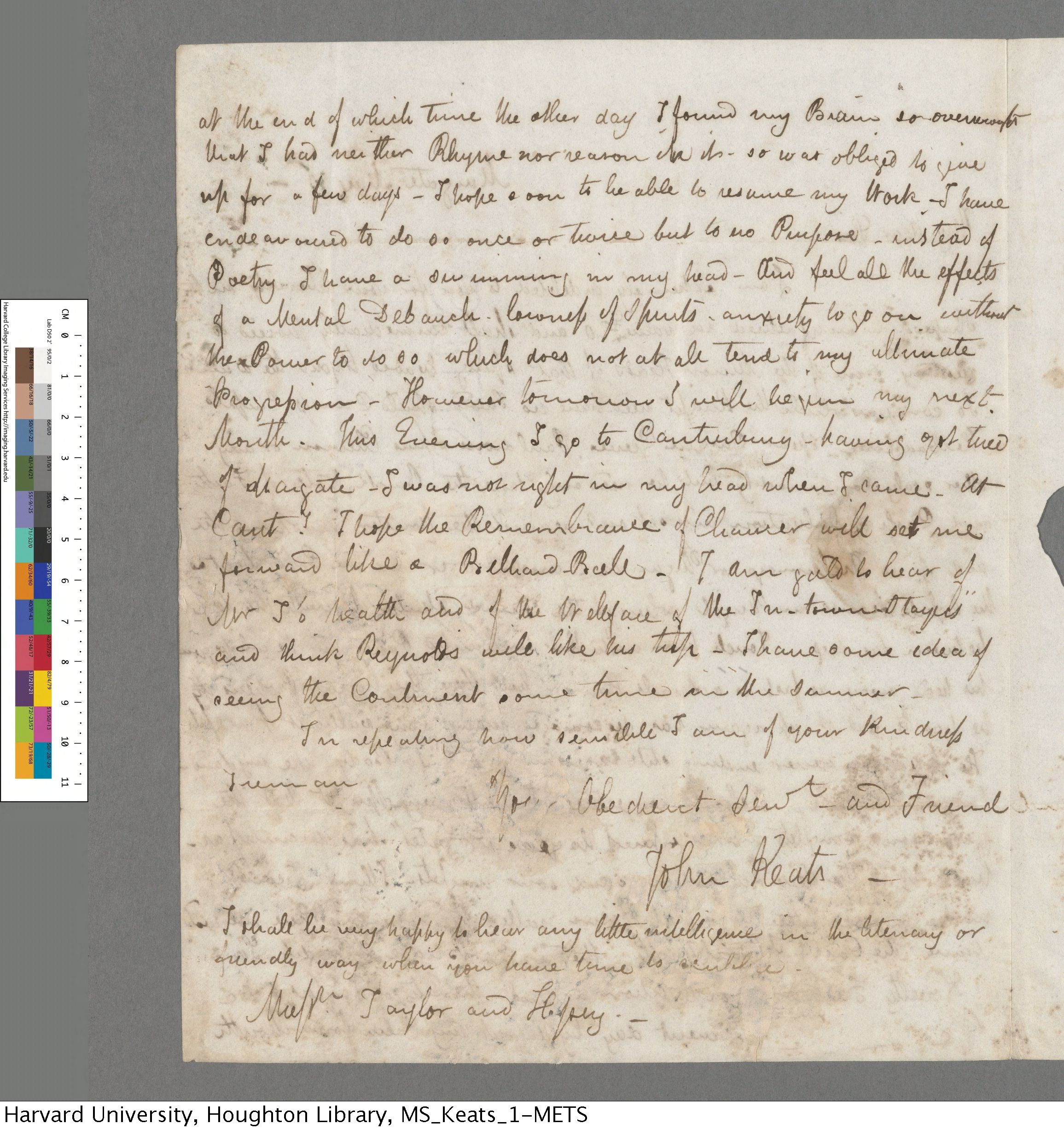
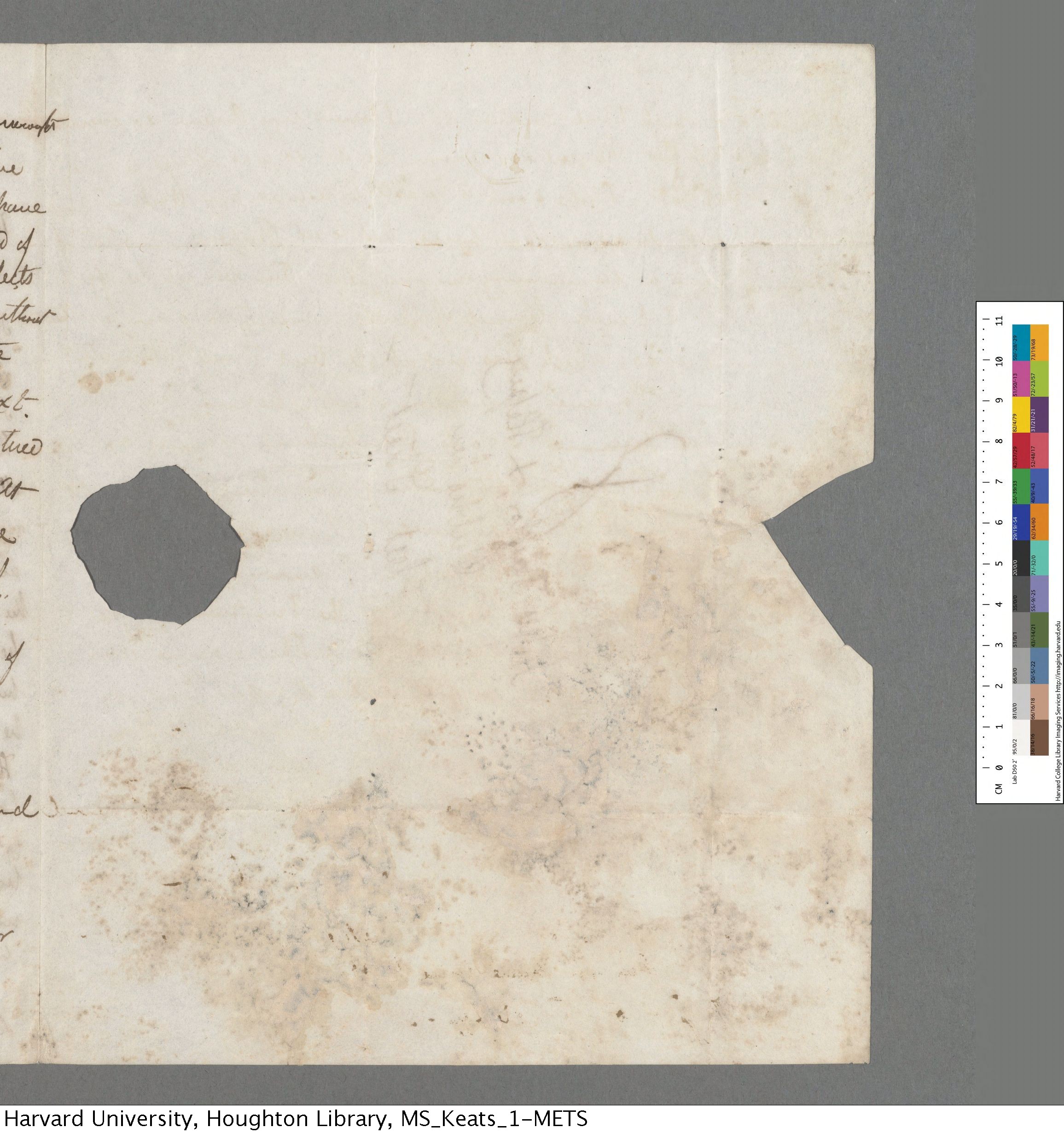
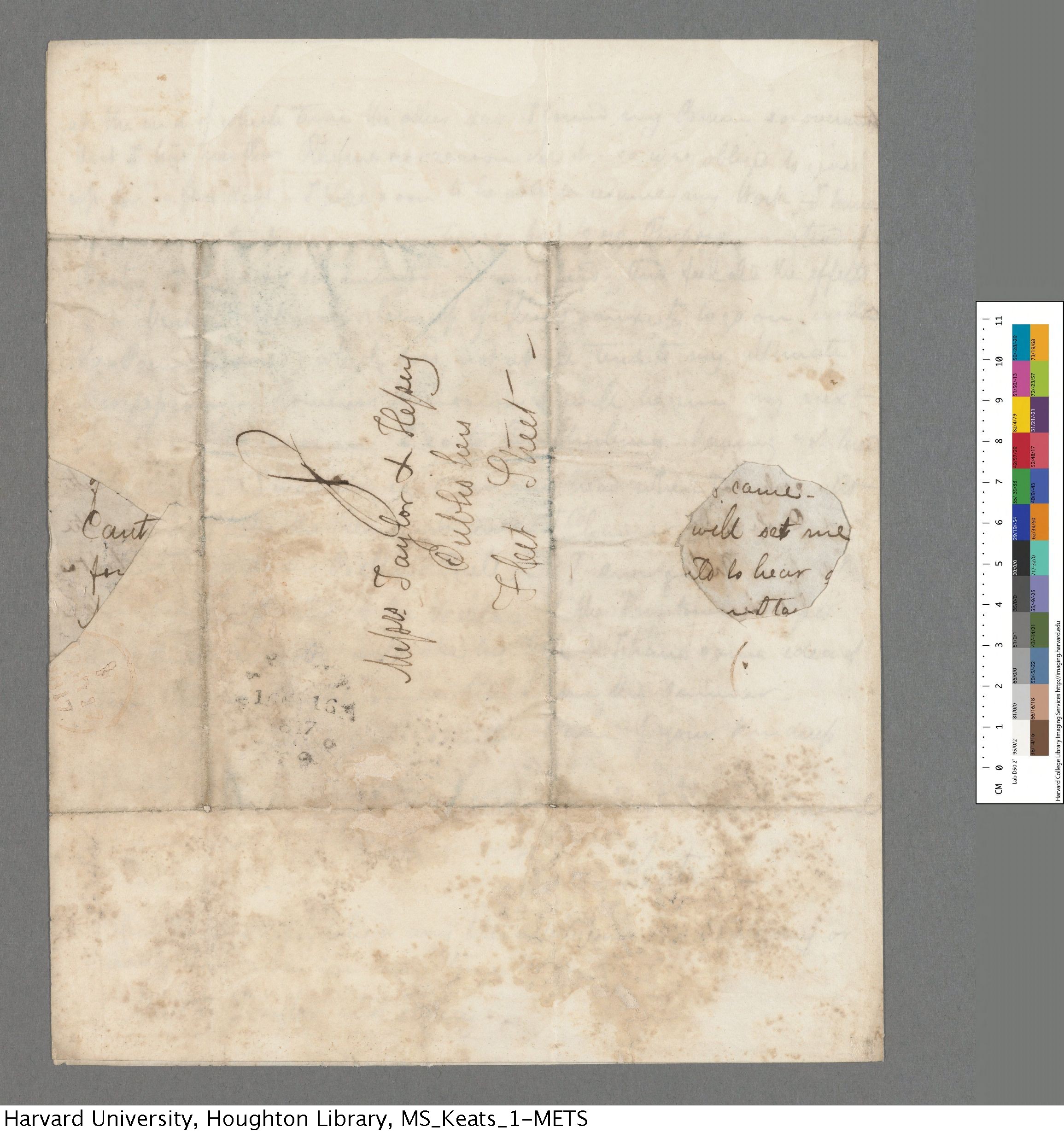
As we’ve seen in the letters this spring, Keats has been on the move. When he last wrote to Taylor and Hessey (on 12 or 13 April), he had time (and paper) enough for but a “shabby affair” of a letter before leaving town. On 15 April Keats was in Southampton, from which he wrote to George and Tom (Richard Marggraf Turley’s response gives us an excellent account of what that journey from London to Southampton would have been like). For about a week, maybe a bit longer, Keats stayed at Carisbrooke on the Isle of Wight, where he began work on Endymion. While there he wrote to John Hamilton Reynolds, and for that letter we have not one, not two, but three fantastic responses! (Allison Dushane’s, Rosie Whitcombe’s, and Victoria Rego’s). Feeling restless and a bit too solitary, Keats relocated to Margate sometime around the last week of April and was joined there by his brother Tom. They would not remain there for long either, but Keats did write more of Endymion during those weeks, as well as three letters that have survived: to Leigh Hunt on 10 May (response from John Strachan), to Benjamin Haydon on 10 and 11 May (response from Mike Theune), and today’s letter to Taylor and Hessey. And then Keats sets off again! He’ll visit Canterbury and then Hastings (where he first meets Isabella Jones) before arriving back in Hampstead by early June.

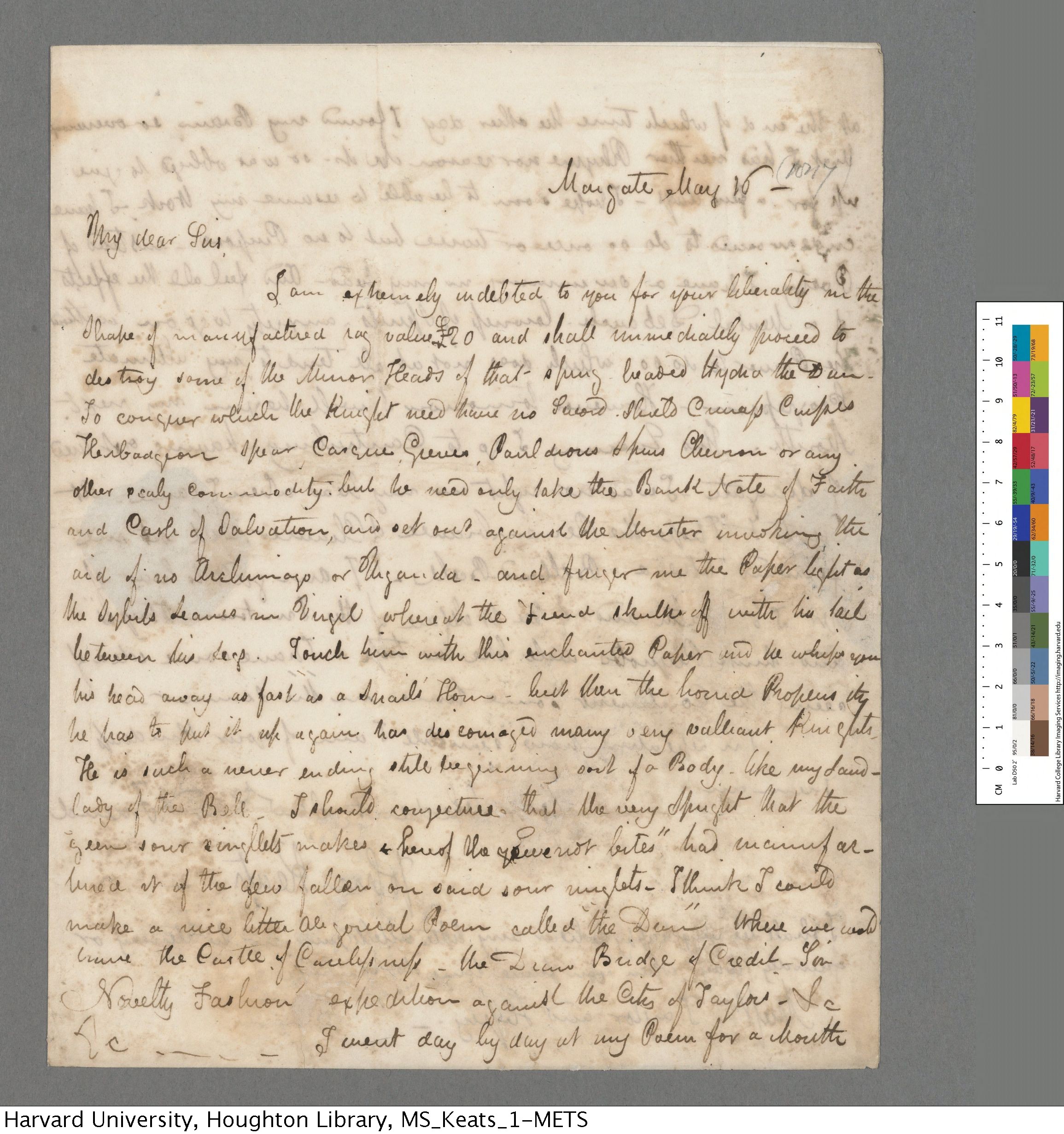
In today’s playful letter to Taylor and Hessey, we see Keats addressing a topic that will remain a source of anxiety in future years: “that spring-headed Hydra the Dun.” Debts and other money matters will only get worse for the Keatses going forward. But now we see how funny Keats can be while discussing money. At the same time, one senses the uneasiness in Keats’s inclination to spin a plan for an allegory of debt when intending to simply express his thanks to Taylor and Hessey. We can also see that Keats’s relationship with his new publishers is a fresh one from the simple fact that he fills only two pages in this letter, and even adds a post-script at the bottom of the second page, perhaps after realizing that he ought to at least attempt to fill the whole of that second page. In this case it’s probably fortunate that the third page was blank, since the hastiness with which the letter was opened left a whole the size of the wax that had sealed the letter. One supposes that the busy publishers were trying to get through their correspondence quickly and didn’t realize that they might be eliminating precious words from the epistolary output of John Keats! Come on, Taylor and Hessey! The KLP forgives and forgets, though. And we thank the Taylor family for caring for these papers until they were sold at auction in 1903. Amy Lowell snatched up most of the Keats items from that sale the next year and bequeathed them to Harvard in 1925. We reproduce the MS images here courtesy of the Houghton Library, and we direct you once again to Harry Buxton Forman’s 1883 edition for a printed text (Forman most likely relied on Milnes’s 1848 or 1867 edition for this letter, not having the MS available to him).

For help understanding the broader historical and cultural context for Keats’s comments on debt and money, we have a response from Alex Dick. He expertly sketches that context, demonstrates its significance for writers during the period, and close reads the letter for an articulation of Keats’s thinking on value, monetary and poetic. Enjoy!


“but here I am talking like a Madman”: Keats’s Capability for Negativity

Michael Theune
Illinois Wesleyan University

Re: Keats’s 10, 11 May 1817 letter to Haydon

Mid-May, 1817. Negative capability is still over seven months away. But, of course, according to the oft-told story of negative capability, the substance behind the term begins to take shape in a number of letters Keats writes prior to the December, 1817 letter to his brothers, including, most famously, the November 22 letter to Benjamin Bailey in which Keats discusses his “Humility and capability of submission” and theorizes the subtle yet pervasive power of “Men of Genius” (I, 184).

Aspects of the May 10, 11 letter certainly have been integrated into the story of negative capability. After all, many of the spring letters’ subjects and themes overlap with those of the December letter. There’s the overt Bardolatry: Shakespeare has become the “good Genius” and, hopefully, Keats’s “Presider” (I, 142). Additionally, there’s the enactment of this adoration through quotation, in both letters, of Antony and Cleopatra (one of Rollins’s notes to the negative capability letter reminds us that the exclamation “in sooth la!!” near the close of the letter comes from Antony and Cleopatra, IV.iv.8 (I, 194)). There’s also the presence of Hazlitt. In the negative capability letter, he is invoked via his term “gusto”; in the letter to Haydon, he is named and noted for being another lover of the Bard: Keats states, “I am very near agreeing with Hazlit that Shakespeare is enough for us” (I, 143), though, according to Rollins, the precise source for this particular insight from Keats is unknown.

There are, as well, as I will show, some deeper connections between the May letter to Haydon and the negative capability letter, and, as a result, I will argue, the letter to Haydon needs to be as closely considered as, say, the November 22 letter to Bailey for what it has to say about negative capability. Of course, it so far has not been considered in this way. This in itself is an interesting fact, and so I’ll use this response as an opportunity to think a bit about that, focusing on the ways that the letter to Haydon challenges some cherished ideas about Keats and negative capability.

Not only does Keats’s May letter to Haydon share subjects and themes with the negative capability letter, but it also shares some argumentative dynamics. In both letters, the genius of Shakespeare is praised in contrast to the work of a lesser poet: Hunt or Coleridge. The ordering of the argument is different in the two letters: Coleridge seems to be something of an afterthought in the negative capability letter while the critique of “Selfdeluder” Hunt serves as the occasion for the turn to considering the greatness of Shakespeare (I, 143). And yet, in each instance, Shakespeare interestingly arrives as a kind of eruptive epiphany from the midst of what is or might become a longer discourse, whether it be the “disquisition” with Dilke when “at once” the notion of negative capability happens to strike Keats (I,193) or the “long Confab” from which Keats manages to “desist” in order to turn his attentions to the satisfying plenitude of Shakespeare (I, 143).

In addition to the similarities of subjects and dynamics, there is one important additional link between this letter of May, 1817, and the negative capability letter: historical circumstance. The two letters were linked by John Dewey in “The Live Creature and ‘Etherial Things,’” the second chapter of his Art as Experience, which would inspire the work of the most important theorist of negative capability, Walter Jackson Bate. Toward the end of this chapter, Dewey clarifies his use of Keats’s quotation in his chapter’s title, offering this version of the relevant passage: “the Sun, the Moon, the Earth and its contents, are material to form greater things, that is, etherial things—greater things than the Creator himself made” (I, 143). Dewey uses (or, as I show below, constructs) this passage to show that Keats was precisely the kind of artist Dewey was trying to encourage: one for whom there was no distance between creaturely, participatory living and even the most ethereal creations of art. Dewey reinforces this view by linking Keats’s famous statements on humanity’s essentially creaturely existence—that just like “a Stoat or a field mouse,” man is a “Creature” that “has a purpose and his eyes are bright with it” (Dewey 32-33; II, 79-80))—with negative capability. Immediately following the above quotations, Dewey cites “Negative Capability” and then closes out his citation of Keats’s letters with a citation of a passage from the November 22 letter to Bailey: “Can it be that even the greatest philosopher ever arrived at his goal without putting aside numerous objections?” (Dewey 33; I, 185).

It was through Dewey’s Art as Experience that Walter Jackson Bate first discovered the term “negative capability.” According to Bate, when he was a teenager, on the advice of his father, who checked out the book from the local library, he read Art as Experience and so discovered the “mysterious phrase” (55). This intrigue turned into the work that became Bate’s undergraduate thesis, which was then published as Negative Capability: The Intuitive Approach in Keats, and which subsequently became the conceptual heart of Bate’s magisterial biography of the poet. Without Art as Experience, Bate may never have put negative capability at the center of Keats’s system of thought, and so draw volumes of critical attention to the term. And here, at this initiating moment, are joined not only Bate and negative capability but also negative capability and the May 10, 11 letter to Haydon.

Given the significant links between Keats’s May 10, 11 letter to Haydon and his negative capability letter, why isn’t the connection between these two letters more broadly recognized? Why, for example, don’t we think of this letter in the same way that we think of Keats’s November 22, 1817 letter to Bailey? Or, a bit more pointedly, why doesn’t Bate, who notes only that the negative capability letter “distills the reactions of three months to the dimension of thinking that had opened to him in September” (237), make provisions for this connection? The answer is: this letter is, or particular aspects of it are, embarrassing. Tracking the trajectory of the letter’s attacks on Hunt, which begin with the projection of “self-dissatisfaction” and then turn into “irritable smugness,” Bate himself notes that Keats arrives at a dismal endpoint:

Then with an unfairness and self-deception unmatched even in Keats until some of the wretched moments near the end, when he was fatally ill, he suddenly condemns Hunt for an ambition to which Hunt never aspired but to which Keats had been completely dedicated for so long, and especially with the generous encouragement of Hunt during the last half year. And ironically he is talking about self-deception. (165)

Here, it goes without saying, Keats reveals his great capability for negativity, and how very far he is from being negatively capable.

It is tempting to ignore or quickly turn away from this ugliness from the poet of truth and beauty. Bate does. Moving on from his discussion of this letter, Bate refers to it by a single descriptor: “cathartic” (166). But we shouldn’t. There is so much more to glean from Keats’s being mean.

The May 10, 11 letter is so much more than merely cathartic. It is, among many other things, also revelatory. In it, Keats admits to possessing “a horrid Morbidity of Temperament,” which he is certain is “the greatest Enemy and stumbling block I have to fear” (I, 142). Keats even goes so far as to say that “it is likely to be the cause of [his] disappointment” (I, 142). That is, if Keats does not succeed as a poet, it will be this particular aspect of himself that is to blame. However, fascinatingly, Keats goes on to recognize this aspect of himself as an advantage:

However every ill has its share of good—this very bane would at any time enable me to look with an obstinate eye on the Devil Himself—ay to be as proud of being the lowest of the human race as Alfred could be in being the highest. I feel confident I should have been a rebel Angel had the opportunity been mine. (I, 142)

This is not catharsis. This is reveling in deep self-understanding. Nicholas Roe, via the discussion of “morbid sensibility” in Hazlitt’s “On Mr. Kean’s Iago,” connects Keats’s “Morbidity of Temperament” with “the corrosive effects of personal ambition mingled with feelings of social disadvantage,” and defines it as “the rankling of a self-made young man who felt himself frustrated by the prejudice of others and hampered by his own self-doubt” (168). And, in part prompted by Roe’s insight, I think we should feel free to connect the above passage from Keats, and especially its linking the lowest with the highest, with his October 27, 1818 letter to Woodhouse. This letter, one as intricately tied to negative capability as the Bailey letter of November 22, 1817), introduces Keats’s notion of the “camelion Poet,” as delighted by “an Iago as an Imogen” (I, 387). Roe, however, suggests that Keats was trying to “overcome” aspects of his morbid temperament and so “be at liberty to create himself” (168), but it’s not clear in this letter that Keats wants to be free of that part of him which is a source of Luciferian strength. (Though Keats may later say that “[i]t is possible to write fine things which cannot be laugh’d at in any way” (II, 174), he also is clear that “there lives not the Man who may not be cut up, aye hashed to pieces on his weakest side” (I, 210). Everyone can be critiqued, sussed out and satirized. Everyone is, to use a term Keats will come to use repeatedly, smokeable.)

What are we to think about the fact that here in this letter with its close ties to negative capability Keats is celebrating his own dark side? I suggest the following:

First, it’s another helpful reminder that Keats’s relationship with negative capability is not as stable as it is sometimes thought to be. It certainly was not after Keats formulated it. Jean-Claude Sallé posits that though “[t]he [negative capability] passage provides so apt a formulation of Keats’s early poetic creed that readers have often been tempted to regard it as the definitive summation of his poetics,” it in fact is not “a permanent credo” but rather “a stage in the evolution of Keats’s thinking, as the definition of an aesthetic quietism which his growing skepticism eventually led him to qualify and relinquish.” And nor was the birth of negative capability without its complications. The May 10, 11 letter, we are given a clear picture of where negative capability comes from, and perhaps see what base material it is made from, how compromised it is, or rather, perhaps, how alloyed it is with this other aspect of Keats, this judging, critical side.

Indeed, secondly, it reminds us that, though it is rarely thought to be so, negative capability in fact has always been a critical term. When we think of negative capability, we tend to think of, as Ou Li succinctly characterizes the concept, “imaginativeness, experiential and artistic intensity, submission of the self, sympathetic identification, the dramatic quality of the poet, disinterestedness, a neutral intellect tolerating diversity and contradiction, and a tragic vision of human experience, all of which are intricately related to one another” (8). But of course the first thing that Keats does after he defines his new term is lambaste Coleridge. Though its substance might include submission and sympathy, negative capability is deployed right away as a battle cry.

Third, if the May 10, 11 letter revises our notion of the context of negative capability, then it also might prepare us to understand the concept in new ways. In particular, it might encourage us to take much more seriously perhaps the clearest and simultaneously the least-attended to contexts of negative capability: the Christmas pantomimes. What about negative capability is pantomimically playful, satirical, violent, socially fluid, and transformative? We’re fortunate that we won’t have to wait too long for an answer: critic Brian Bates already has presented a paper on this, “Keats’ Negative Capability: On Pantomime and ‘Irritable Reaching,’” at the 2016 conference of the North American Society for the Study of Romanticism. When more widely disseminated, this essay has the potential to be paradigm-shifting in terms of the ways negative capability is understood. While I’m confident that Bates’s excellent argument will be persuasive on its own, there’s no reason we should not be ready to hear it.

If any of the above seems too much, too far, it leads us to my fourth and final point: even though we’ve come far in our understanding of Keats, engaging his embarrassment, his boyish imagination, we’re still to prone to clean him, and what he writes, up. In his October, 1818 journal letter to George and Georgiana, Keats says that “there are two distinct tempers of mind in which we judge of things—the worldly, theatrical and pantomimical; and the unearthly, spiritual and etherial” (I, 395). Our ongoing tendency to think about negative capability as spiritual and ethereal and not as worldly and pantomimical indicates this. Dewey did it. In citing the passage from the May 10, 11 letter that resulted in a portion of the title of his second chapter (“the looking upon the Sun the Moon the Stars, the Earth and its contents as materials to form greater things—that is to say ethereal things”), Dewey adds: “—greater things than the Creator himself made” (20). Thus, Dewey stops short of citing Keats’s full addendum to his so far seemingly sincere aesthetic statement: “—but here I am talking like a Madman greater things that our Creator himself made!!” (I, 143; my emphasis). Is Keats proud here? Proud as “a rebel Angel”? Is he critical of this pride? Is Keats here being self-chastisingly spiritual or deliriously, deliciously pantomimical? Significantly, we cannot tell.

Dewey opens the second chapter of Art as Experience by asking rhetorically, “Why is the attempt to connect the higher and ideal things of experience with the basic vital roots so often regarded as betrayal of their nature and denial of their value?” (20) Similarly, we should not wish to sever negative capability’s vital roots in Keats’s painful, powerful, rebellious Temperament as it is revealed in his May 10, 11 letter to Haydon. If we are to have negative capability, it must be as complex as if it were actually made from Keats’s complexities.

Works Cited


Bate, Walter Jackson. “The Endurance of Keats.” The Persistence of Poetry: Bicentennial Essays on Keats. Eds. Robert M. Ryan and Ronald A. Sharp. Amherst, MA: University of Massachusetts Press, 1998.

——. Negative Capability: The Intuitive Approach in Keats. Cambridge, MA: Harvard, 1939.

Dewey, John. Art as Experience. New York: Minton, Balch & Company, 1934.

Li, Ou. Keats and Negative Capability. London: Continuum, 2009.

Roe, Nicholas. John Keats: A New Life. New Haven, CT: Yale, 2012.

Sallé, Jean-Claude. “Negative Capability.” A Handbook to English Romanticism. Eds. Jean Raimond and J.R. Watson. New York: St. Martin’s Press, 1992. 187-9.