Letter #52: To John Taylor, 5 February 1818

Keats continues his work on copying Endymion and delivering it book by book to Taylor and the printers. Today we see him apologizing to Taylor for delaying a bit with Book II. The cause is that, although he’s finished copying it, he wants another day to look it over again, and he’s busy this day with “the affair of Cripps.” Cripps refers to Charles Cripps, a student at Oxford and friend of Benjamin Bailey, for whom Keats had served as an intermediary with Benjamin Haydon. Haydon asked back in October 1817 if Keats would suss out Cripps to see if Haydon ought to take him on as a student. What Keats refers to here is likely his efforts to raise some money from among his circle to help Cripps pay for his study with Haydon.

Not much else of significance to note here, which means it’s time to delve into the realm of insignificance! Yes, it’s time to discuss Keats’s penmanship. Take a look at the word below and see if you can figure out what it is.

Hieppap? Come on, Keats! Help us out!

If you guessed “tresspass,” then you’d be correct! And yes, that extra s is necessary. You might alternatively want to transcribe the word as “trespas,” and your impulse would be a good one. But that long vertical stroke preceding the cursive s is how Keats typically writes out a double s. It looks an awful lot like his p, right? Why, you ask, does the KLP know about this fact, let alone care about it? Well, we just so happen to be stuck in an airport trying to make it through a 3+ hour delay, and what else would you have us do but look at Keats’s handwriting?? Ok, we confess, it’s actually because one of the KLP co-editors, Brian Rejack (who may or may not be the one of the editorial We currently stuck in said airport), has written about Keats’s orthography with respect to negative capability. He’s suggested that one possible mistake John Jeffrey may have made in transcribing the word has to do with the uncanny similarity between how Keats writes p and ss. It’d be really nice if cassability were a word… Anyway, if you ever do work with Keats’s handwriting, now you know to be on the lookout for the p and ss uncanny valley. Otherwise you might end up wondering what “hieppap” means.

You can read today’s letter from Forman’s 1895 edition, although he was working from Woodhouse’s transcript (which you can tell because he has “2nd” instead of “second,” which is what Keats has in the MS. You can see the image of Keats’s letter below.
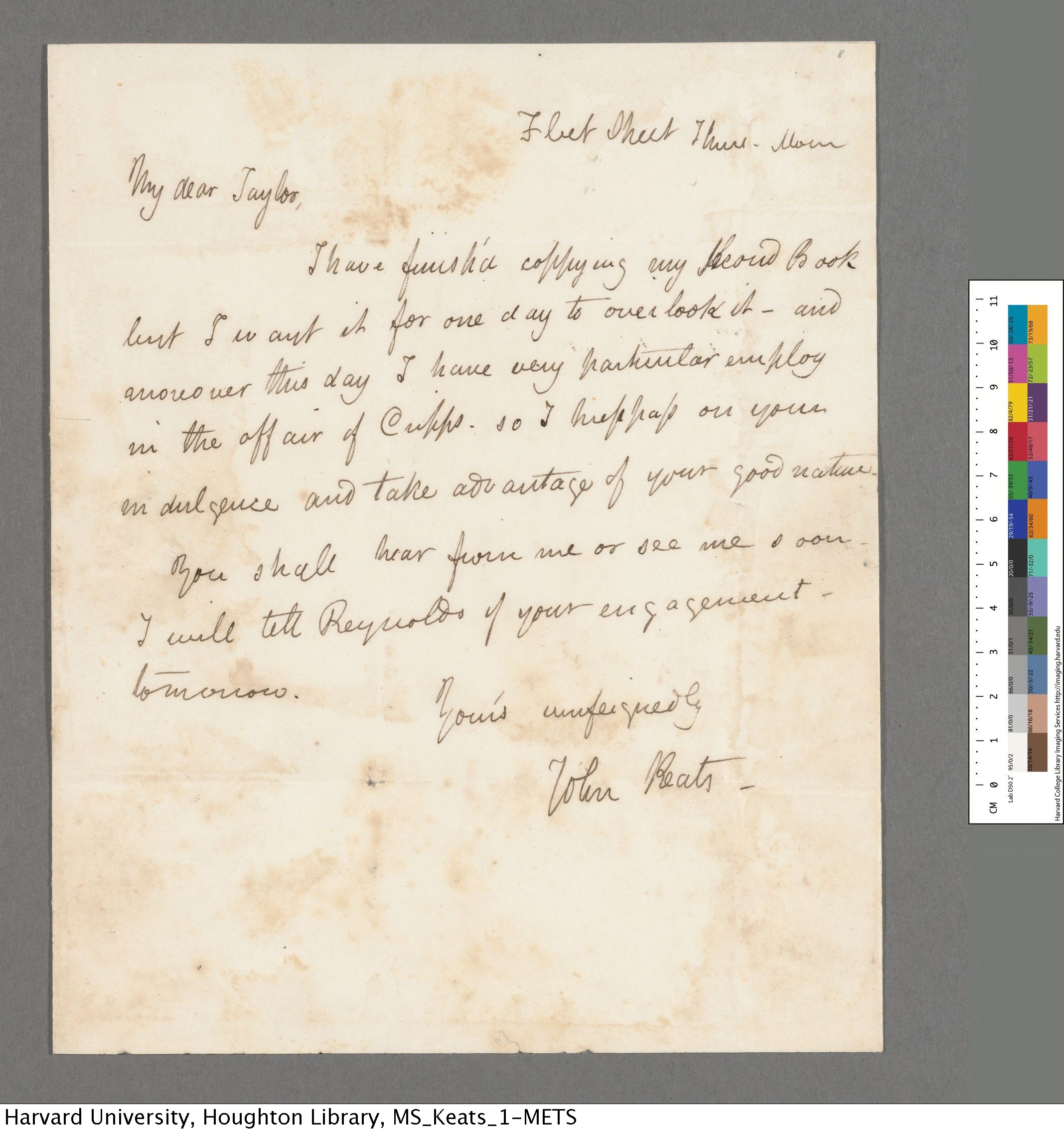
Page 1 of Keats’s 5 February 1818 letter to John Taylor. Keats Collection, 1814-1891 (MS Keats 1.21). Houghton Library, Harvard University.

The address and postmarks from Keats’s 5 February 1818 letter to John Taylor. Keats Collection, 1814-1891 (MS Keats 1.21). Houghton Library, Harvard University.

Letter #51: To John Hamilton Reynolds, 3 February 1818

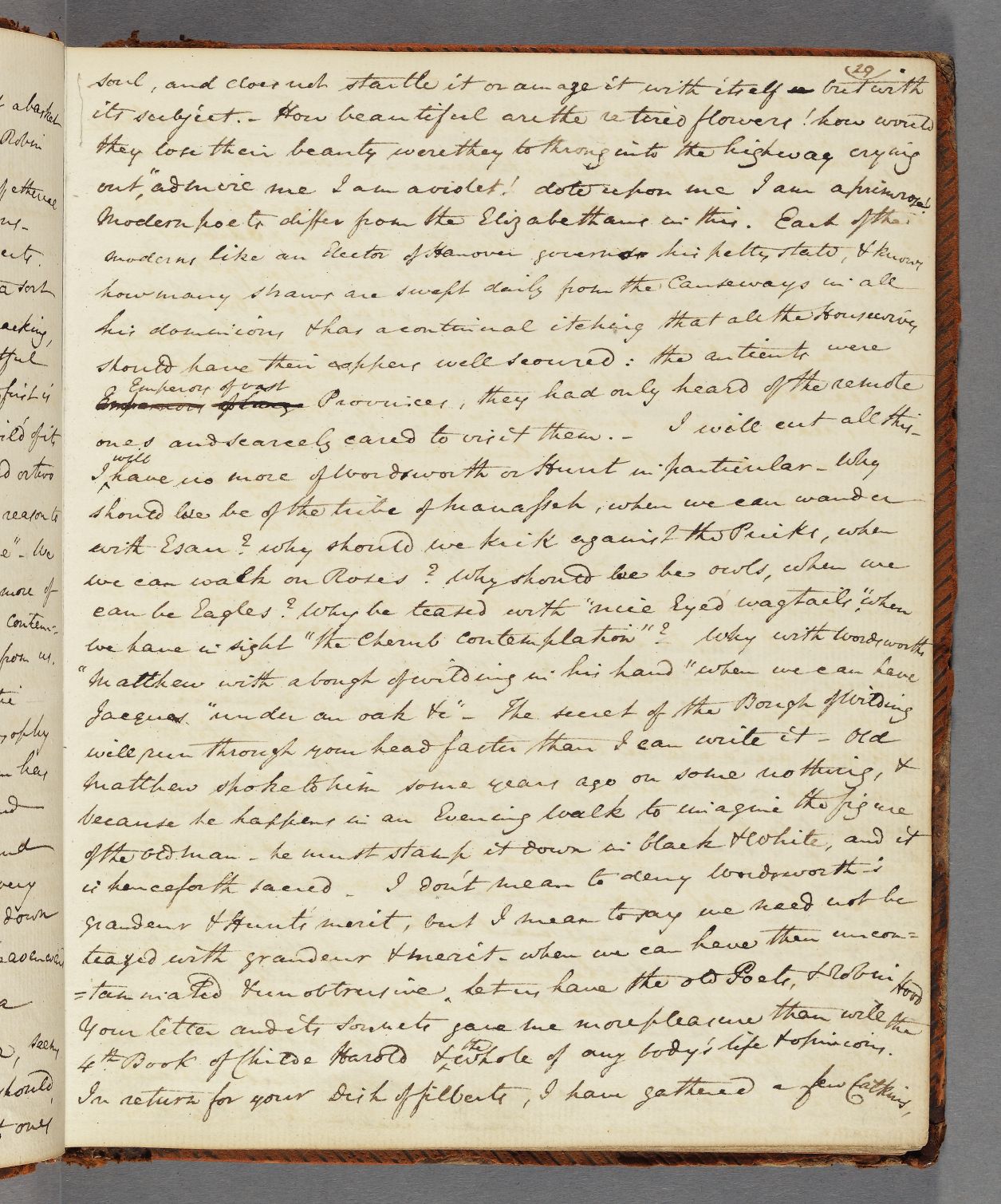
A remarkable treat for you today: one of the KLP’s favorite letters of 1818, maybe even top 10 all-time! It’s another letter to Reynolds, following up on one just a few days ago. And as with that one, today Keats shares some poems with his fellow poet friend. But before the poems we encounter Keats’s response to two sonnets Reynolds had sent to him. The metaphor he uses to describe reading them leads into one of the more hilariously weird moments in the correspondence, which we extract for your enjoyment here:

I thank you for your dish of Filberts–Would I could get a basket of them by way of desert every day for the sum of two pence. Would we were a sort of etherial Pigs, & turn’d loose to feed upon spiritual Mast & Acorns–which would be merely being a squirrel & feed upon filberts for what is a squirrel but an airy pig, or a filbert but a sort of archangelical acorn.

As Keats often does so well, he pivots from this charming bit of whimsy to serious contemplation about the significance of poetry. (Perhaps we should just say the silly and the whimsical are often very serious for Keats.) This line of thinking takes Keats to Wordsworth and the problems of “poetry that has a palpable design upon us.” It’s a remarkable moment in which Keats forcefully articulates his notion of how poetry should work and what it should do. And it continues his distancing of himself from Wordsworth, from Hunt, and from other modern writers (Keats takes a jab at Byron a bit later in the letter).

Our response to today’s letter comes from Seth Abramson, who situates Keats’s thinking on the role of poetry by looking forward to how similar debates have played out, especially in the American context, over the last two hundred years. It’s an essay you won’t want to miss. Abramson gives a tour de force reading of the letter while also raising the crucial question of how poetry and poets can and should operate in the world of 2018. He claims that Keats arrives in this letter at something like the realization that “We must learn poetry to exceed it.” The KLP is pleased to play even one small part in that educational process by putting Keats and his work in conversation with writers and thinkers like Abramson, alongside the rest of us still trying to make sense of the world two hundred years on.

For the text of the letter, head over to the 1895 Harry Buxton Forman edition, or check out the images of the Richard Woodhouse transcripts below.

Page 1 of Woodhouse’s transcript of Keats’s 3 Feb 1818 letter to John Hamilton Reynolds. Keats Collection, 1814-1891 (MS Keats 3.3). Houghton Library, Harvard University.
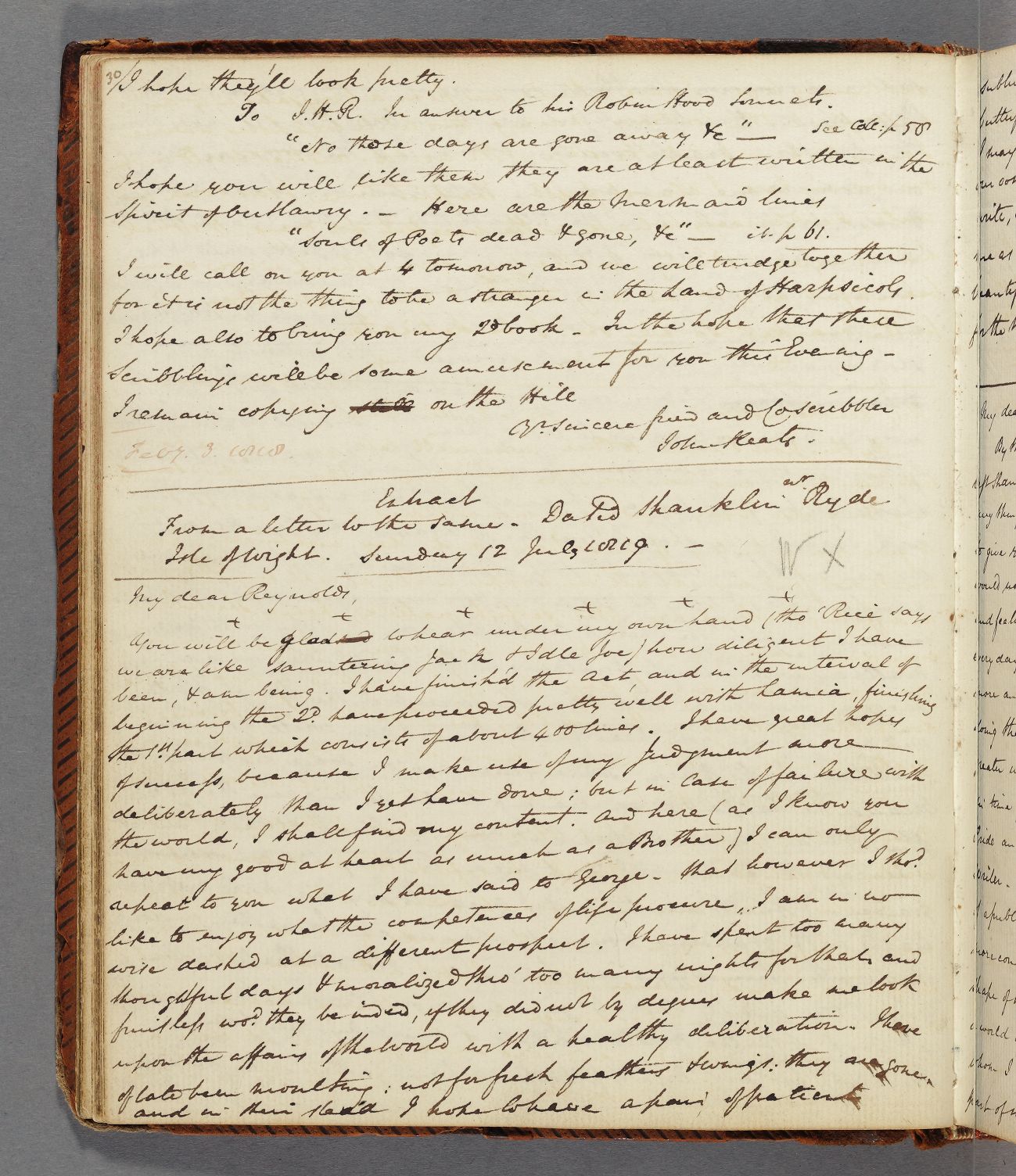
Page 2 of Woodhouse’s transcript of Keats’s 3 Feb 1818 letter to John Hamilton Reynolds. Keats Collection, 1814-1891 (MS Keats 3.3). Houghton Library, Harvard University.

Page 3 of Woodhouse’s transcript of Keats’s 3 Feb 1818 letter to John Hamilton Reynolds. Keats Collection, 1814-1891 (MS Keats 3.3). Houghton Library, Harvard University.
Letter #50: To John Hamilton Reynolds, 31 January 1818

One thing that the letters from the last week or so of January 1818 suggest to us is just how many of Keats’s letters have been lost. We’re fortunate to have as many as we do, but even so, there are lots of hints (and some hard facts) that point toward letters that remain unknown to us. That is, we know about many letters that we don’t actually have in the cultural record. Yes, there’s always the vain hope that new ones will continue to crop up, but we’re on a 20+ year drought now! Come on, universe, send us some more lost Keats letters!

We saw back on 23 January that Keats wrote four letters, and, remarkably, all four still exist (even though one just in transcript form). Well here on 31 January 1818 Keats tells Reynolds that “I have parcelld out this day for Letter Writing.” And yet this letter to Reynolds is the only one still extant. What might have been the others? Keats ends this letter by writing, “I must take a turn, and then write to Teignmouth.” Presumably Keats did return to his task of letter writing after his walk, but alas, no letter to his brothers (then staying at Teignmouth) from this date exists.

Perhaps at this point you’re thinking, “but hold on a sec, KLP–what about that letter to George and Tom from yesterday? Maybe that’s the 31 January lost letter and it was just misdated?” Well, we’re glad that you’re paying attention, and it’s not a bad guess. Here’s the problem: that recently discovered letter has a postmark of 30 January. The Royal Mail doesn’t mess around. “But, KLP, I have another idea: maybe the Reynolds letter is misdated. It’s a transcript, right? Maybe Woodhouse got that one wrong. Yeah!” Well, gentle reader, we’re again very pleased at your attentiveness. But this solution doesn’t pass the smell test either. Yes, today’s letter is from a Woodhouse transcript, but he’s a pretty reliable copyist, and when he includes dates, he tends to get them correct. The other problem is that Keats notes “Hampstead Saturday” at the beginning of the letter. On his 30 January letter to Taylor Keats began with “Friday,” and even though he’s not all that good with dates and days, it seems unlikely that he would have written “Friday” on one of his letters and then that same day written “Saturday” on another. The more exciting conclusion: Keats wrote to his brothers on both the 30th and the 31st! The latter letter could still show up some day…

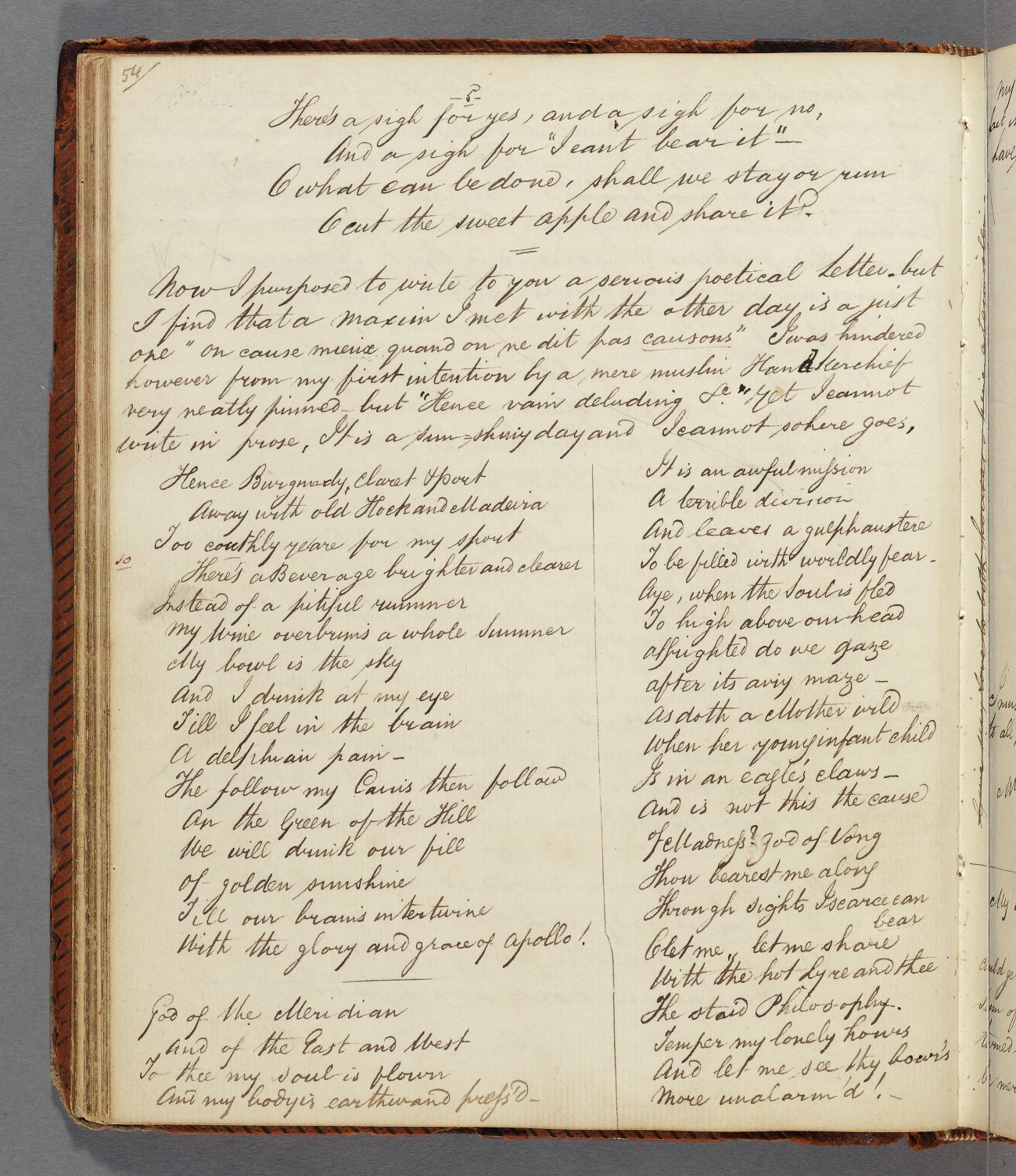
But for now we have just one for today. Much of this letter to Reynolds is devoted to sharing poetry with his friend, a practice that will continue in the next few weeks (get ready for “airy pigs” and “archangelical acorns” on 3 February!). Here we encounter Keats’s lyrics “O blush not so,” “Hence Burgundy, Claret & port” (sorry, Keats–but we prefer claret to sunshine, especially in this wintry season), “God of the Meridian” (sometimes consider a second stanza of “Hence Burgundy”), and then finally he copies his “last sonnet.” It’s this last text that’s the most famous of the group: “When I have fears that I may cease to be.”

And with that we’ll leave you to Keats’s poems amid his bits of prose. As mentioned above, we have the letter only in transcript form, which we include below.

Page 1 of Woodhouse’s transcript of Keats’s 31 January 1818 letter to John Hamilton Reynolds. Keats Collection, 1814-1891 (MS Keats 3.3). Houghton Library, Harvard University.
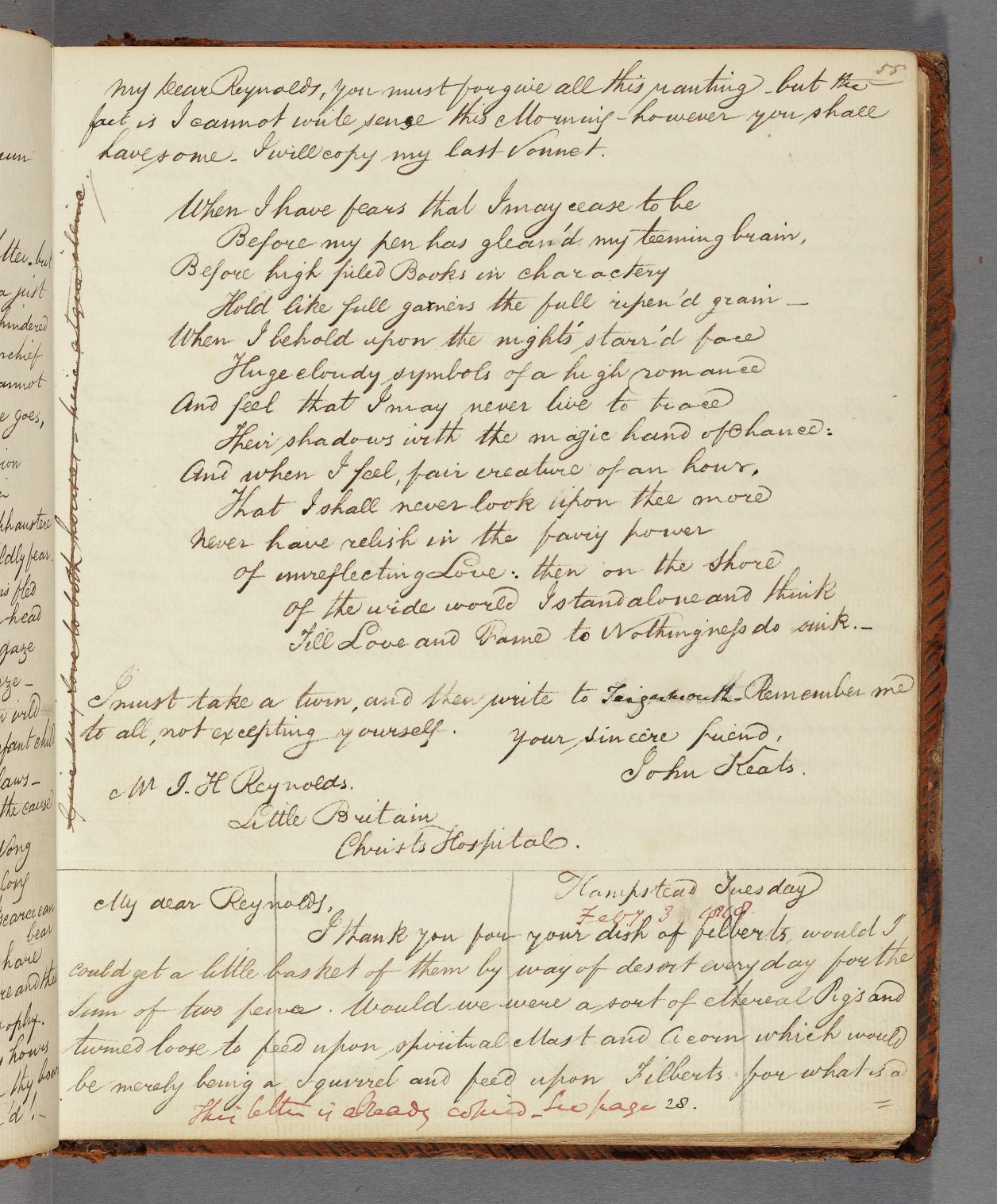
Page 2 of Woodhouse’s transcript of Keats’s 31 January 1818 letter to John Hamilton Reynolds. Keats Collection, 1814-1891 (MS Keats 3.3). Houghton Library, Harvard University.

Page 3 of Woodhouse’s transcript of Keats’s 31 January 1818 letter to John Hamilton Reynolds. Keats Collection, 1814-1891 (MS Keats 3.3). Houghton Library, Harvard University.
Letter #49: To George and Tom Keats, 30 January 1818

The second letter for today is one that has been known about for a long time, but not known in full until the mid-1990s. It was quoted from in an 1877 article in Harper’s by Edward F. Madden, who saw the letter in Louisville while visiting with Emma Keats Speed, the poet’s niece. It must have been some time after that visit that EKS gave the letter in question to Sally Fauntleroy Sears, who later gave it to her niece Juliet Fauntleroy. The rest of the story is really better told by Dearing Lewis, the nephew of Juliet Fauntleroy, who wrote about the discovery of the letter for Romantic Circles back in November 1998. We encourage you to visit there to learn about the letter’s fascinating history, and for the text of the letter.

Once you’ve done that, then you certainly need to read Arden Hegele’s response to the letter, which brilliantly takes up Keats’s comment about “gelding” book one of Endymion. It’s a fascinating analysis, one attuned to the multiple resonances of that term for Keats, particularly as someone with a background in surgical procedure. And let’s not forget about the fact that this letter includes some bawdy verses from Horace Smith about Horace Twiss (keep your Horaces straight, everyone). Hegele also makes excellent connections between this late-January letter and some of what we’ve seen from others earlier in the month. It’s a great response to bring January to a close!

For the text of the letter, we direct you, as above, to the Romantic Circles post from Dearing Lewis. Enjoy!

Letter #48: To John Taylor, 30 January 1818

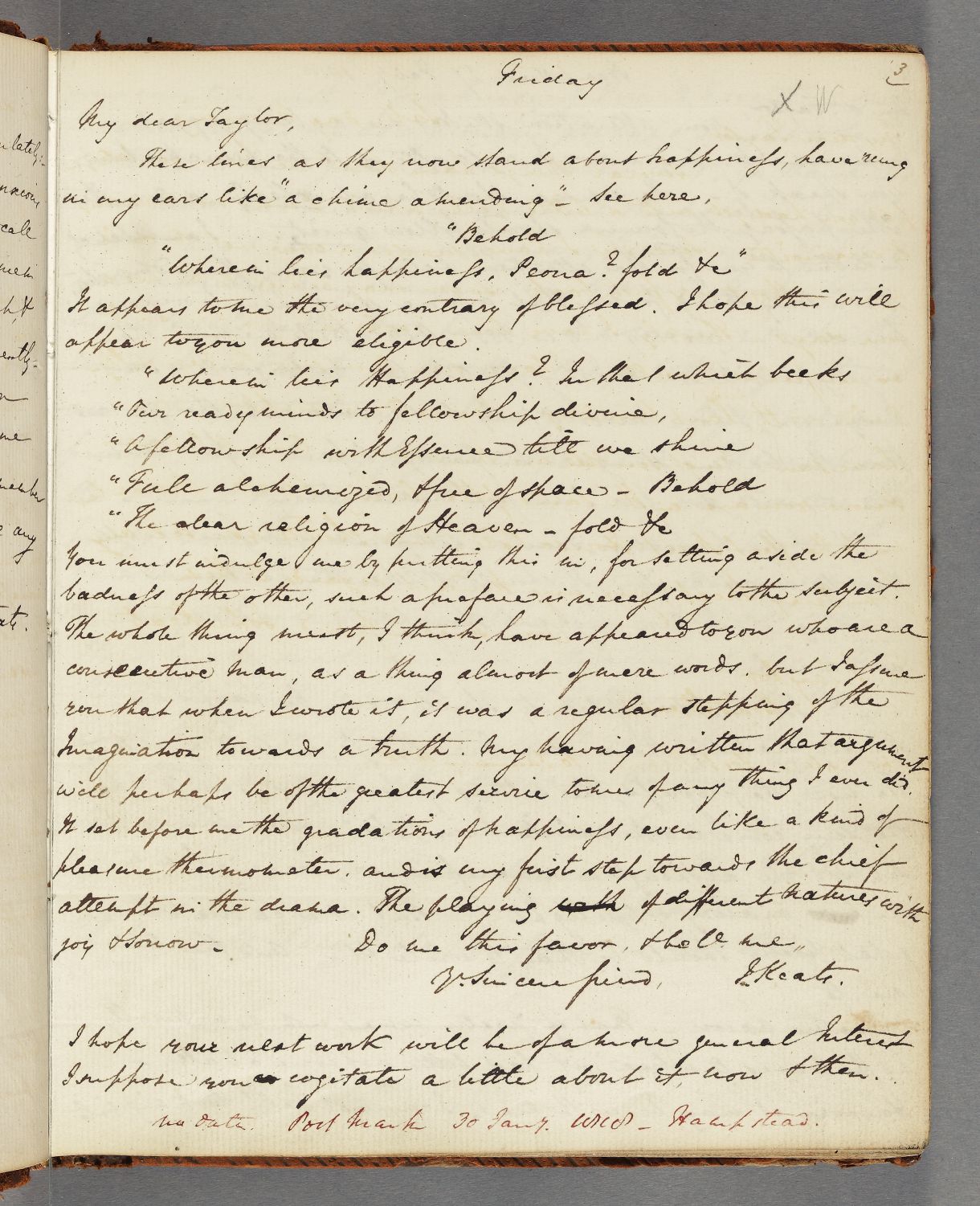
Two letters from today, first one to John Taylor as Keats is in the midst of his copying of and revisions to Endymion. The main focus of the letter is a revision that Keats wants to make to a moment late in Book I. That moment is now famous because of the name Keats gives to what he devises as he goes back and elaborates this part of the poem: the Pleasure Thermometer.

In the poem the title character is attempting to explain to his sister Peona how he conceives of the nature of happiness. This lead Endymion to conclude that there are gradations of pleasure. And Keats in returning the passage and adding a few lines to it says this to Taylor:

My having written that Passage Argument will perhaps be of the greatest Service to me of any thing I ever did–It set before me at once the gradations of Happiness even like a kind of Pleasure Thermometer–and is my first Step towards the chief Attempt in the Drama–the playing of different Natures with Joy and Sorrow.

It’s a fascinating analogy for many reasons. Among them is the oddity that the Pleasure Thermometer itself is only one degree on the way to something larger. He seems to have come up with a thermometer to measure all pleasure that there is, but then he realizes that this metric is just one small piece of a larger project, which he’ll need to pursue further by writing a drama. As we all know, he never succeeded in “the Drama” in the way he hoped, but he sure did figure out how to write poetry that plays with the “Joy and Sorrow.”

In order to reflect upon this letter, the KLP has fabricated the world’s first genuine (rhymes with wine) Pleasure Thermometer. We call it the PT2K18TM.

The PT2K18TM in all its glory. Patent pending.

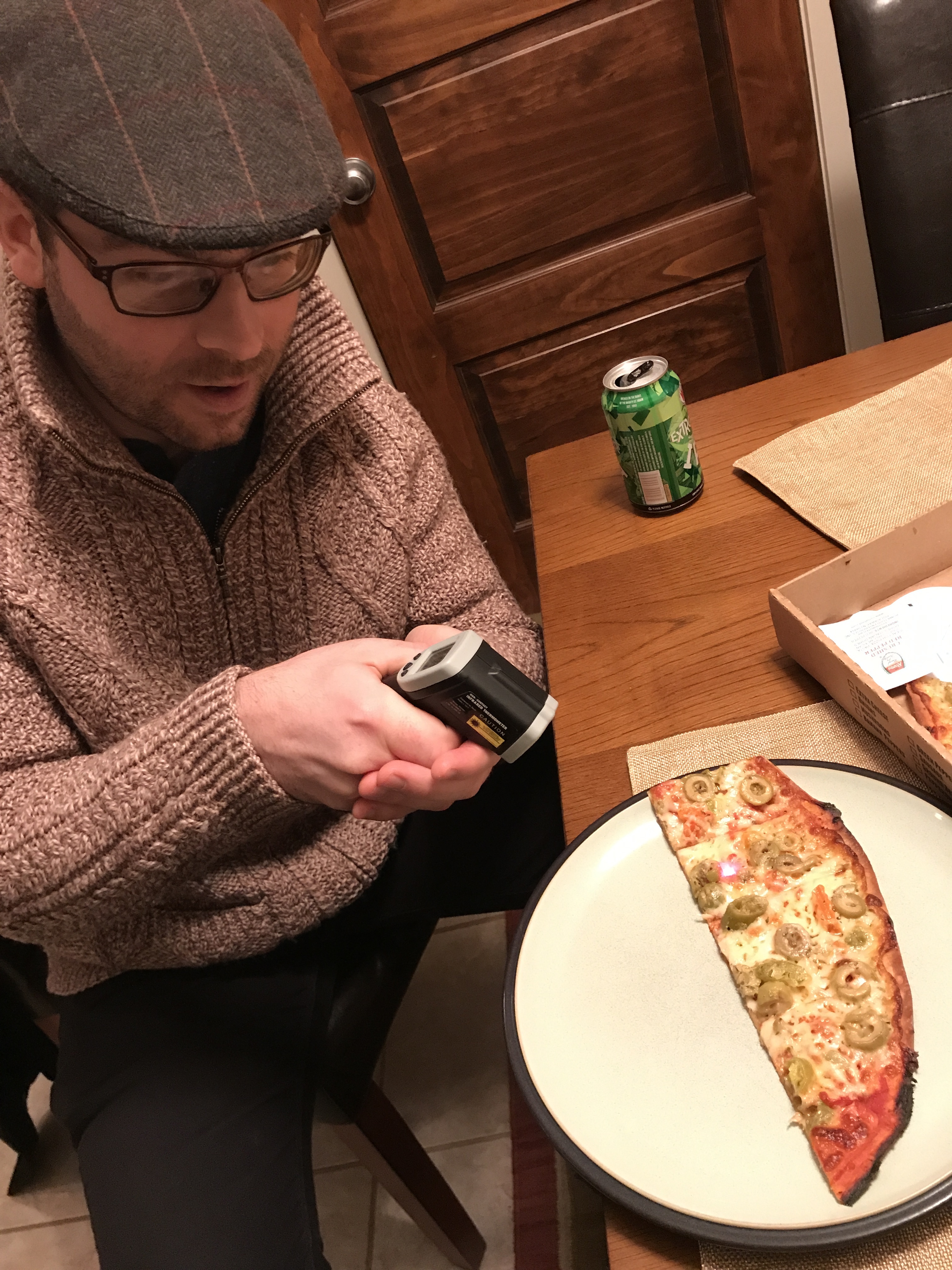
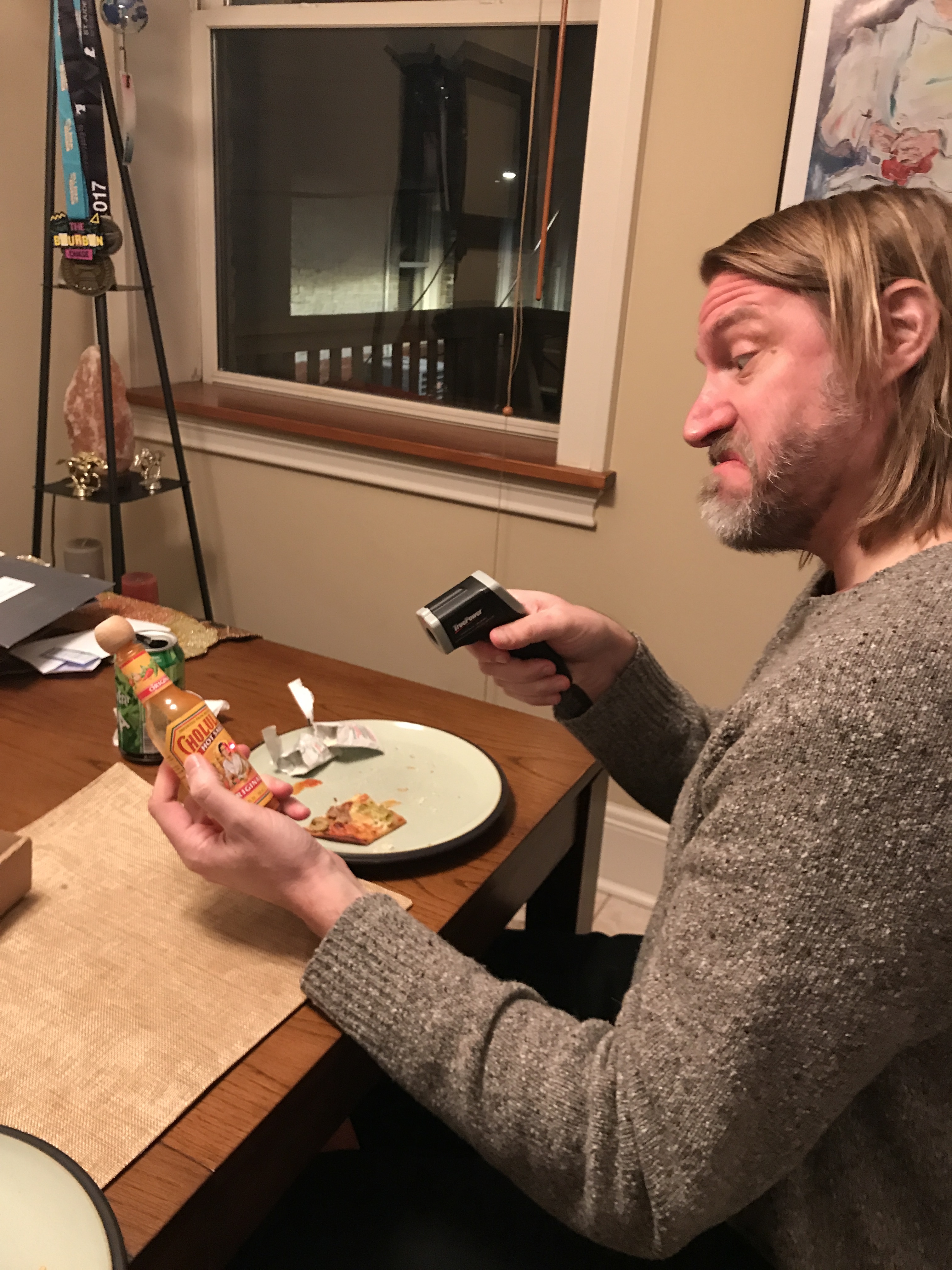
At press time KLP co-editors Brian Rejack and Michael Theune have just begun to experiment with this powerful instrument. They are documenting the results of various measurements (pleasurements?). So far we can share with you this exclusive finding: their pizza, topped with giardiniera and green olives (plus sausage for the savage meat-eater Mike), received the official PT2K18TM rating of … ONE KEATS. We don’t know what other results will follow on this marvelous device, but we shall keep you posted when more pleasures have been tested and the results analyzed. For now, enjoy these pictures from the initial findings.

Brian performs an initial measurement of his first slices.

Mike sees how the Cholula stacks up (which will adorn his pizza).

AND THE RESULT IS….

The PT2K18TM comes through with a solid reading. The pizza (with and without Cholula) was indeed one blissed out Keats mask.

For further pleasurements (we think Keats would be down with this neologism), check out the KLP next week!

And don’t forget about the letter, which you can read via Harry Buxton Forman’s 1895 edition. We don’t have images of the manuscript, but the transcript in Woodhouse’s notebook is at Harvard, which we include below.

Transcript of Keats’s 30 January 1818 letter to John Taylor. Keats Collection, 1814-1891 (MS Keats 3.3). Houghton Library, Harvard University.
Letter #47: “To any friend who may call” (on John Taylor), January (?) 1818

We’re running out of days in January, and the best guess for the date of today’s letter is sometime in January 1818, so we’ll go with today! There’s a lot we don’t know about this letter. We’ll count among the uncertainties that it was even written in January 1818. The note was acquired by Amy Lowell in 1903 when John Taylor’s descendants auctioned off his papers. She ventured a guess of January 1818 as the date of the letter’s composition, and no one else has made another guess since. Rollins prints it as the first letter of January 1818, but we’re guessing that, if it were written during that month, it probably happened toward the latter half of it. Here’s why.

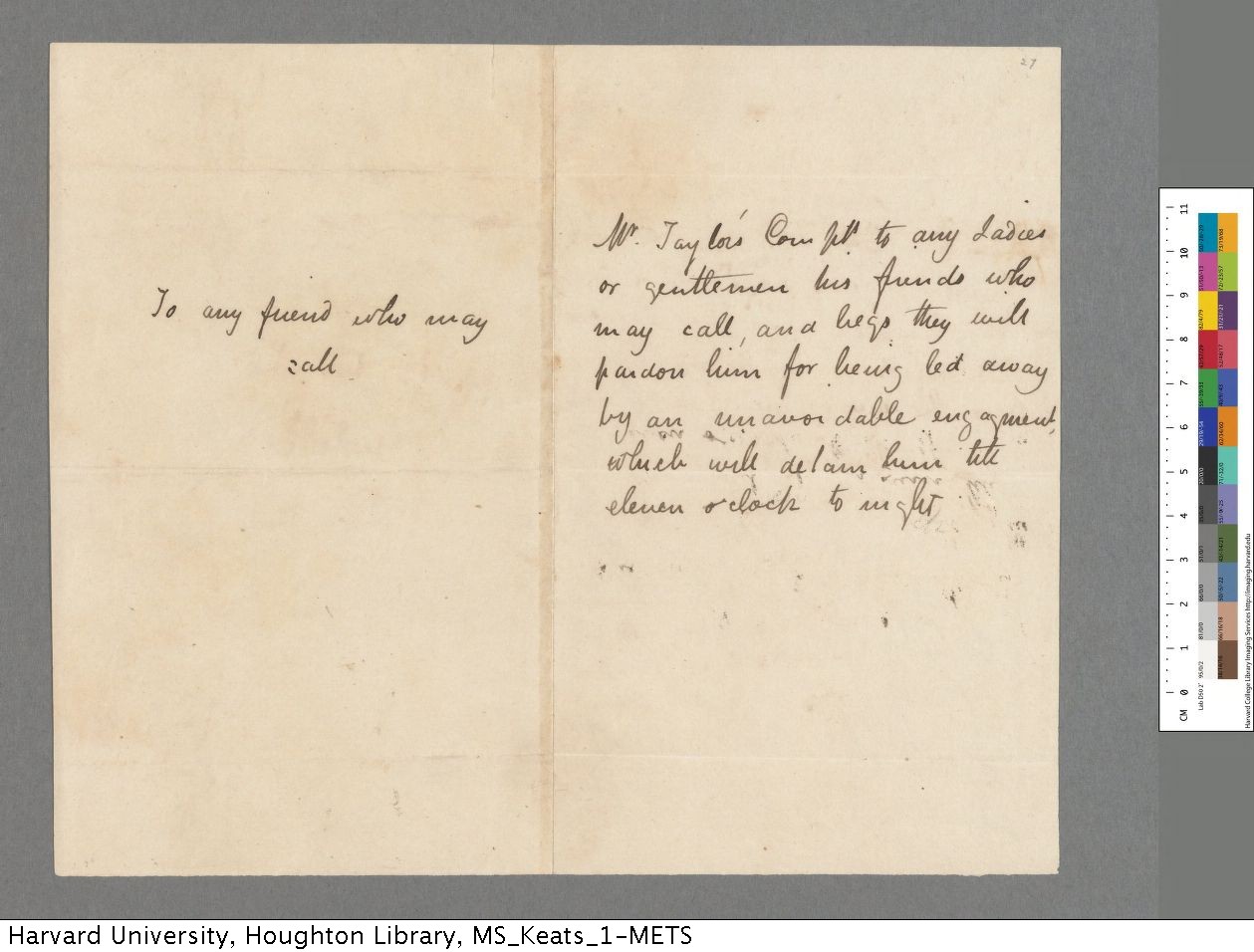
The letter is addressed “To any friend who may call,” and it reads like this:

Mr Taylor’s Com pts to any Ladies or gentleman his friends who may call, and begs they will pardon him for being led away by an unavoidable engagement, which will detain him till eleven o’clock to night

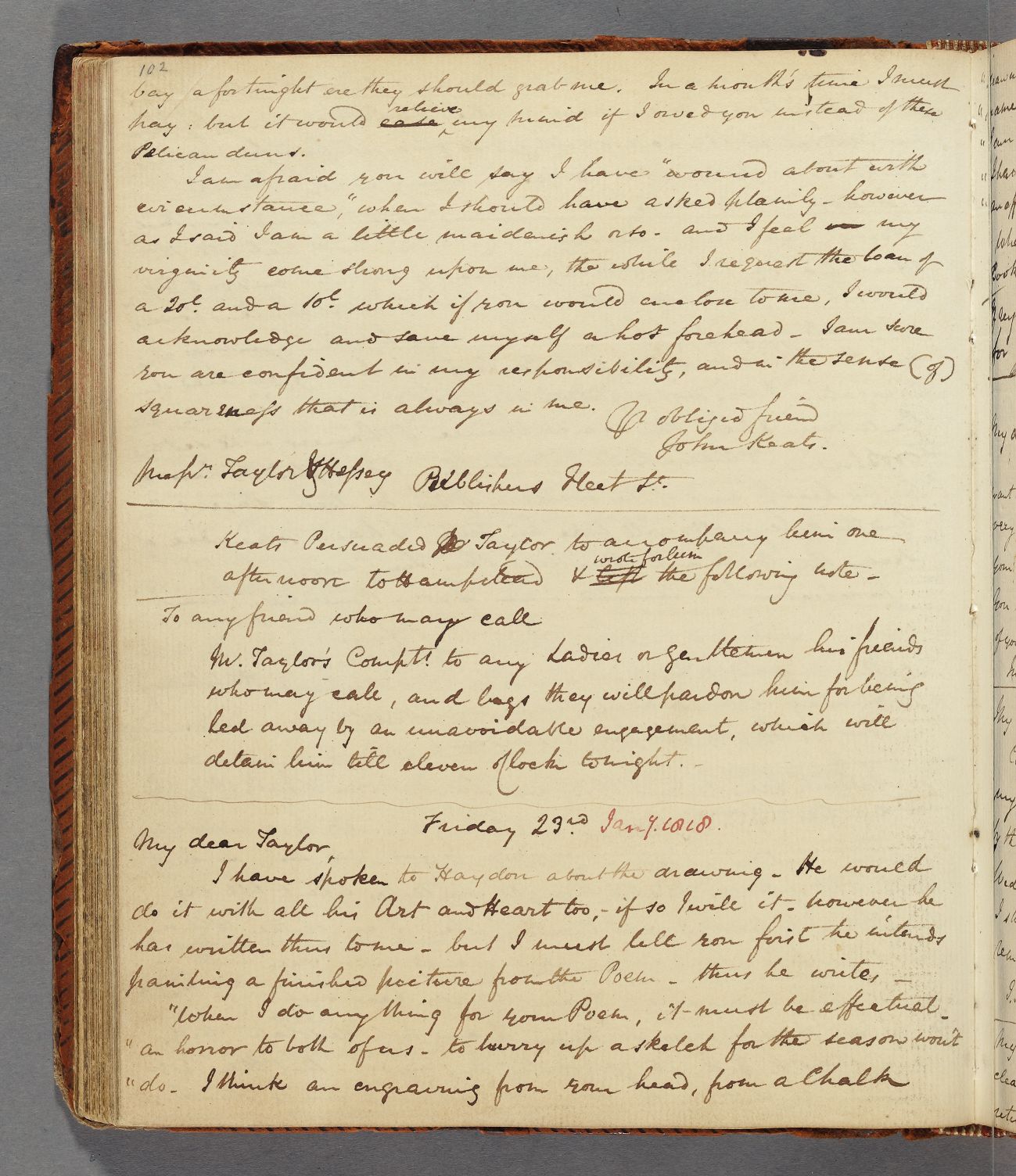
In Richard Woodhouse’s transcript of the note, he prefaces it with this explanation: “Keats Persuaded Taylor to accompany him one afternoon to Hampstead & left wrote for him the following note–“. Woodhouse offers no date. In his notebook he copies this letter after Keats’s 10 June 1817 letter to Taylor and Hessey, and before the 23 January 1818 letter to Taylor (see image below). Woodhouse’s transcripts are not copied in a regular chronological order, but if the transcript’s placement before the 23 January letter is the justification for dating the letter to that same month, then we could just as well argue that we ought to date it to the month of the transcript that precedes it: June 1817. Keats was in Hampstead during that month as well, and he could presumably have visited Taylor during that month (he had, after all, asked Taylor for a loan in his 10 June letter). All of this is to say, we’re dating this letter as January 1818, but we have no real confidence in that dating.

Now, why are we going with late January instead of early? All respect to our hero, Hyder Edward Rollins, but there is some decent circumstantial evidence to point the letter toward later in the month. So here goes. Keats writes to Taylor on 10 January and apologizes for not seeing him for a while. If he had convinced Taylor to spend an afternoon with him in Hampstead at some point in the nine days preceding that letter, it seems unlikely that he would open the letter by apologizing for a long absence. We know Keats visited Taylor on 11 and 12 January, but there’s no evidence to suggest Taylor went to Hampstead on either of those days (and Keats writes to George and Tom on 13 January of being absent from Hampstead for the two days prior). Keats brought his first book of Endymion to Taylor on 20 January, but he also attended Hazlitt’s lecture at the Surrey Institution that evening (or tried to do so–he arrived at 8 pm for a 7 pm lecture). So if Taylor spent an afternoon and evening (“till eleven o’clock at night”) in Hampstead with Keats, it wasn’t on that day. Our supposition, then, is that the visit occurred sometime after January 23, when Keats had corresponded with Haydon and with Taylor about the prospect of having an engraved frontispiece for Endymion. Perhaps while still mulling the possibilities, Keats persuaded Taylor to walk with him from his shop in Fleet Street northwest toward Haydon’s residence in Lisson Grove, and then on to Hampstead where they could all chat further.

But alas, we just don’t know! Sorry, folks–the KLP demands of its readers a bit of that good ol’ fashioned negative capability. Now stop irritably reaching after fact and reason!

Keats’s Jan (?) 1818 letter to callers on John Taylor. Keats Collection, 1814-1891 (MS Keats 1.17). Houghton Library, Harvard University.

Transcript of Keats’s January (?) 1818 letter to callers on John Taylor. Keats Collection, 1814-1891 (MS Keats 3.3). Houghton Library, Harvard University.
Letter #46: To George and Tom Keats, 23/24 January 1818

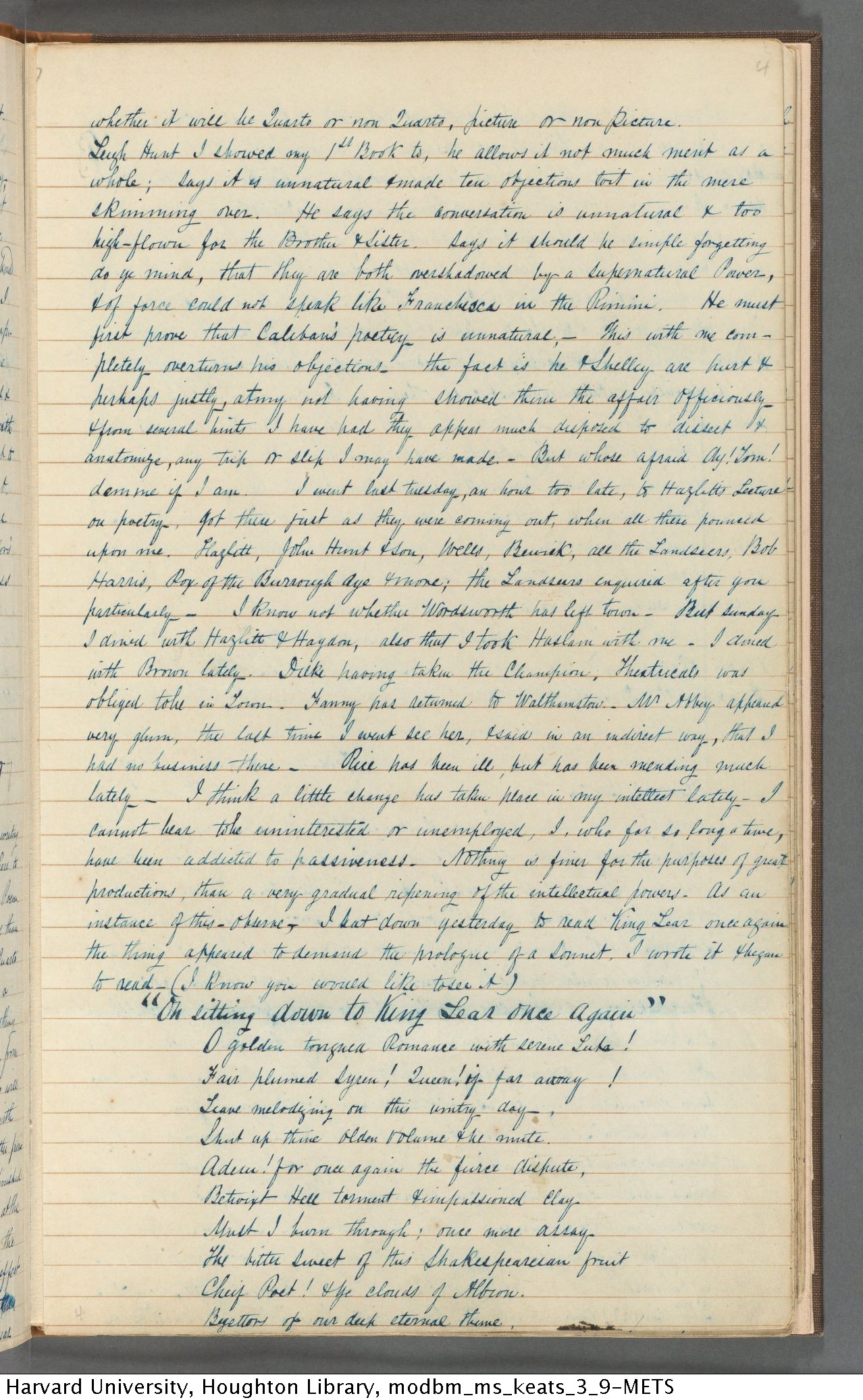
And now for the fourth letter of 23 January 1818! Keats, after feeling “rather tired” and with “head rather swimming” from writing so many letters that day, finished on 24 January and sent it off to his brothers in Teignmouth. We hear again about the topic covered in the letters to Haydon and Taylor (the working plans for an engraving for Endymion, plans which never panned out). And we hear more about social tensions in their circle of friends. Keats notes that Leigh Hunt had read the first book of Endymion and “allows it not much merit as a whole.” Ever the astute observer of human behavior, Keats attributes Hunt’s huffiness to disappointment that Keats did not show proper deference to the elder poet and mentor. Keats did most of his writing away from London, and he did so in part to avoid the constant “dissect[ing] & anatomiz[ing]” that he knew Hunt would provide throughout the process. So now Hunt obliges after the fact. But Keats seems pretty unfazed: “But whose afraid Ay! Tom! demme if I am.”

More accounts of goings-on about town follow, including Keats showing up an hour late to one of Hazlitt’s lectures, whereupon he was met by everyone flowing out of the Surrey Institution. And then we shift to King Lear. This letter is perhaps most famous for its account of the sonnet “On Sitting Down to Read King Lear Once Again,” which Keats copies in the letter. He also wrote the sonnet (perhaps drafted?) in his facsimile of the First Folio of Shakespeare’s plays. We certainly share Keats’s self-assessment of the poem: “So you see I am getting at it, with a sort of determination & strength.”

Keats’s sonnet, written on the page facing the beginning of King Lear in his copy of a First Folio facsimile.

When Keats returns to the letter the next day, his mind remains on the theatre. He recounts his visit to a “private theatrical” at an “oily place.” Keats managed to get behind the scenes thanks to his friend Charles Wells, and they witnessed “the oily scene shifters” and “a little painted Trollop” who says: “‘damned if she’d play a serious part again, as long as she lived.'” All in all, it sounds like a fun time! For a response to today’s letter we turn to Marc Palmieri, a playwright himself, among other things. He reflects from that perspective on what such a visit to “the theatre’s bowels” might have felt like for a playwright. We hope you enjoy it!

For the text of the letter, we point you to Harry Buxton Forman’s 1895 edition. And we include the images of the John Jeffrey transcript (the only source for the letter) from Harvard’s Houghton Library.

Page 1 of Jeffrey’s transcript of Keats’s 23/24 January 1818 letter to George and Tom Keats. MS Keats 3.9 (Houghton Library, Harvard University).

Page 2 of Jeffrey’s transcript of Keats’s 23/24 January 1818 letter to George and Tom Keats. MS Keats 3.9 (Houghton Library, Harvard University).

Page 3 of Jeffrey’s transcript of Keats’s 23/24 January 1818 letter to George and Tom Keats. MS Keats 3.9 (Houghton Library, Harvard University).

Page 4 of Jeffrey’s transcript of Keats’s 23/24 January 1818 letter to George and Tom Keats. MS Keats 3.9 (Houghton Library, Harvard University).


Letter #45: To Benjamin Bailey, 23 January 1818

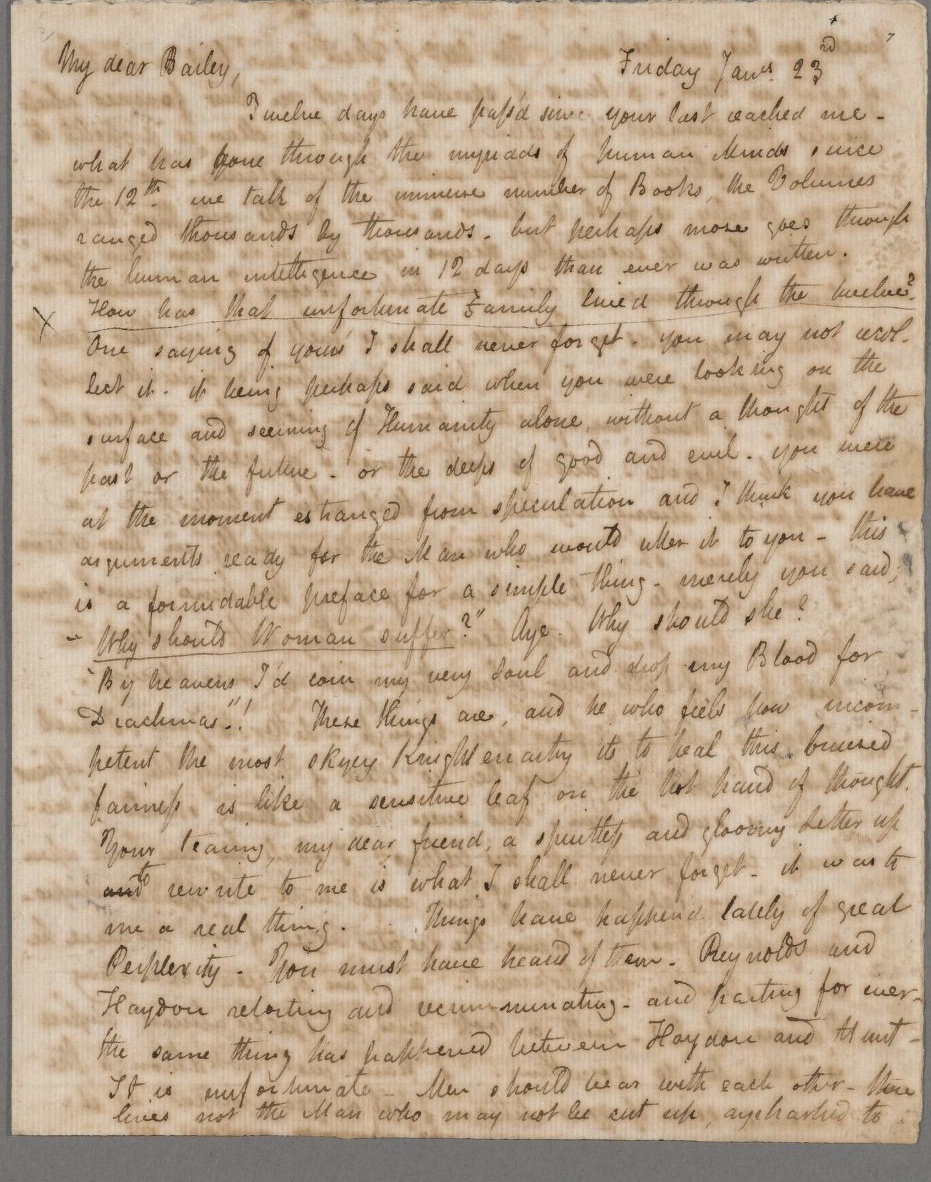
For his third letter of the day, Keats sat down to write to Benjamin Bailey. As we saw in the letter to George and Tom back on 13 and 19 January, Keats has been thinking fondly of Bailey in comparison to the antics of Reynolds and Haydon, and Hunt and Haydon (fighting over minor slights). And we see Keats returning to this theme as he addresses Bailey directly. The squabbles he refers to as things “of great Perplexity.” And, indeed, it does seem that Keats’s frustration was much more a product of his inability to understand why his friends wouldn’t simply get over themselves and make up (“Men should bear with each other”), than it was about him being upset about any particular individual’s behavior.

As Keats moves on to report on how their other mutual friends are doing, he tells of a recent visit to Leigh Hunt’s where they looked at a lock of Milton’s hair. Naturally, they had to write some poems about it. And the majority of the rest of the letter includes the poem and a few more words about it from Keats after he’s copied it. That poem–along with the hair of Milton, and of Keats–is the focus of the response to this letter, from Jayne Lewis (University of California Irvine). It’s a sharp and witty essay, which we think you’ll thoroughly enjoy whether you prefer Keats’s or Milton’s hair. Of course the KLP is partial to Keats’s locks, but we recognize that there’s plenty of room in the temple of fame for Milton’s tresses too.

The letter is at Harvard’s Houghton Library, which provides the images below. And Harry Buxton Forman’s 1895 edition offers a good reading text, just in case you’re not yet used to reading Keats’s handwriting (just takes a bit of practice!).

Page 1 of Keats’s 23 Jan 1818 letter to Bailey. Keats Collection, 1814-1891 (MS Keats 1.20). Houghton Library, Harvard University.
Page 2 of Keats’s 23 Jan 1818 letter to Bailey. Keats Collection, 1814-1891 (MS Keats 1.20). Houghton Library, Harvard University.
Page 3 of Keats’s 23 Jan 1818 letter to Bailey. Keats Collection, 1814-1891 (MS Keats 1.20). Houghton Library, Harvard University.

Page 4 of Keats’s 23 Jan 1818 letter to Bailey. Keats Collection, 1814-1891 (MS Keats 1.20). Houghton Library, Harvard University.

Letter #44: To John Taylor, 23 January 1818

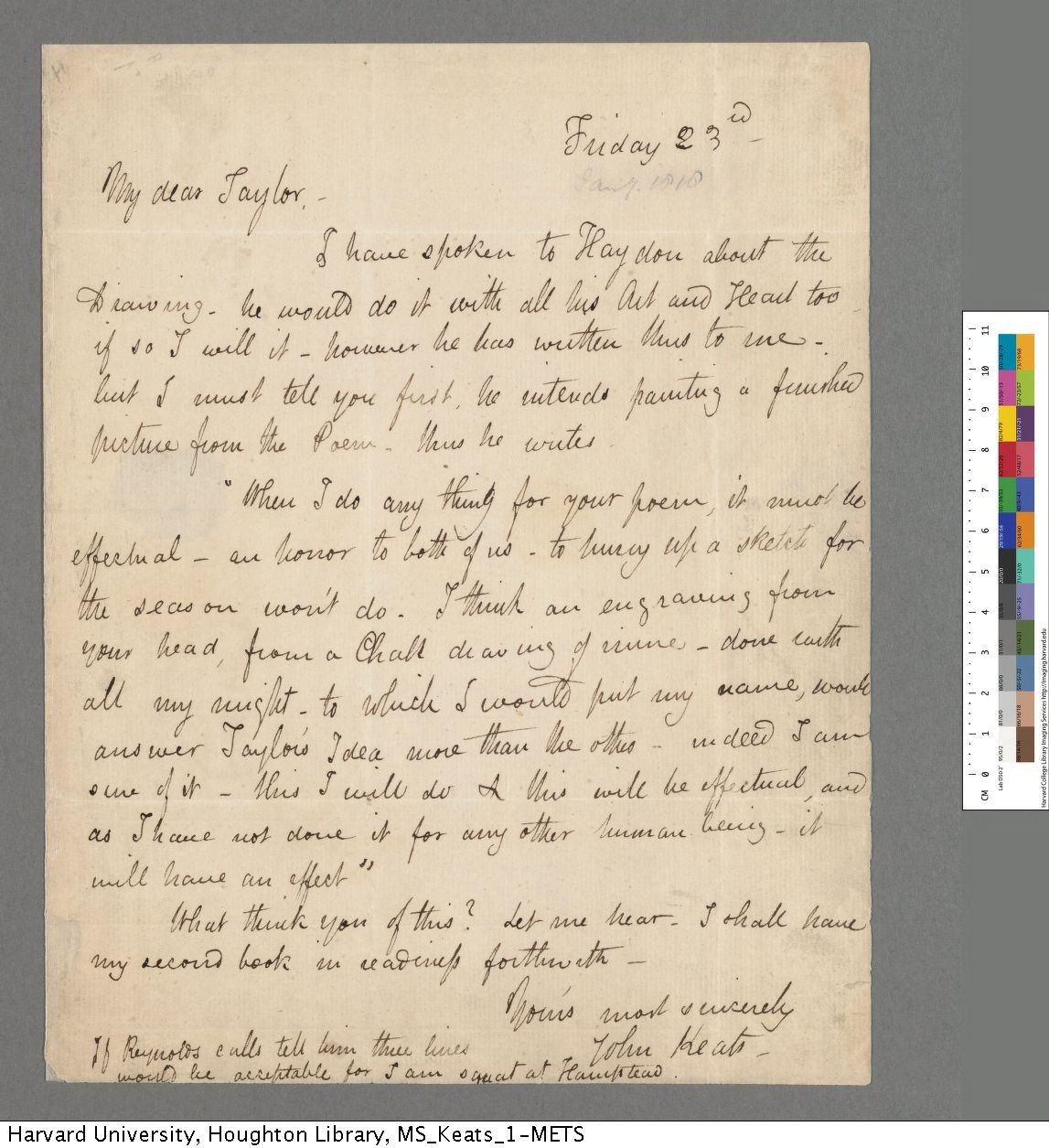
The second of the day’s letters concerns the same topic as the first: the possibility that Haydon might provide an image to be engraved for Endymion. Keats here informs Taylor of Haydon’s hesitation about illustrating a scene from the poem. Quoting Haydon’s letter, Keats explains the reasoning for Haydon’s reluctance: “to hurry up a sketch for the season won’t do.” Haydon also suggests, however, that he could offer one of his chalk drawings of Keats’s head (done as study for including Keats in Christ’s Entry into Jerusalem). He even specifies that he would agree to put his name to the drawing if Taylor were to have it engraved for the book. One suspects that Taylor is thinking strategically, and that Haydon gets the idea too. Keats’s first book was not exactly a smash hit. And Haydon has a name that carries more weight at this point, so he’s offering to help out his friend in whom he sincerely believes, but it seems he also understands that to put his name to a frontispiece might help Taylor’s (and Keats’s) financial interests as well.

To learn more about this topic, we hope you’ll check out the first KLP Interview, with Thora Brylowe (University of Colorado, Boulder). She and KLP co-editor Brian Rejack chat about this letter to Taylor and the one to Haydon that proceeded it, and Thora explains some of the bigger issues at work in the relationships between painters, authors, engravers and publishers during the period (which she explores in more depth in her forthcoming book from Cambridge UP, Romantic Art in Practice: Cultural Work and the Sister Arts, 1760–1820). We hope you enjoy it!

The letter comes to us from Harvard, but it has some intriguing details regarding its travels before resting there. The vast majority of the letters to Taylor remained in his family until they were sold at auction in 1903 and then acquired by Amy Lowell, who bequeathed them to Harvard. This letter to Taylor, however, was sold at the Bangs & Co. auction house in New York in 1897. The collector William Harris Arnold snagged the letter then. After he died in 1923, his collection of over one thousand manuscripts and books was auctioned off at the Anderson Galleries (which had absorbed Bangs & Co. in 1903) in New York in November 1924. One person who did pretty well at the auction was Amy Lowell, who purchased four Keats manuscripts: the verse epistle to George from 1816, two different sheets from the Feb-May 1819 journal letter to George and Georgiana, and a portion of The Cap and Bells / The Jealousies–namely, the best portion: that containing “This living hand”. (If we trust the annotations in the margins of the University of California’s copy of the Arnold sale catalogue, Lowell spent just over $7000 for the four items–about $100K in 2017 dollars.)

There were six Keats manuscripts for sale, though, so what happened to the two others? One went to Owen D. Young, another collector like Lowell–Young’s books and manuscripts would go on to form a significant portion of the Berg Collection at the New York Public Library. So that leaves today’s letter to Taylor–it went to Edith Lindsley Reynolds (1883-1964). It seems that she was not invested in collecting in the way that Lowell and Young were. We imagine she was simply a true Friend of Keats. Reynolds was the daughter of a wealthy banker in Wilkes-Barre, Pennsylvania, so she apparently had the funds to spend $1275 on the letter. Her diary, written from 1898-1901, is at Special Collections at Penn State–perhaps it may hold some clues about her thoughts on Keats and why she might have wanted to own an item from his hand. In any case, we’re glad she had the pleasure of owning the letter, which she eventually bequeathed to the Osterhout Free Public Library in Wilkes-Barre. Arthur Houghton acquired it at some point later on and presented it to Harvard.

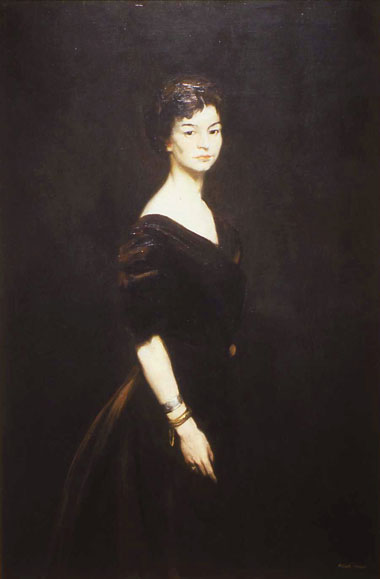
Reynolds also seems to have studied art with the painter Robert Henri, who also painted her in at least two versions. One of those is at the National Gallery of Art in Washington D. C. (but not currently on display). The other, which we include below, is at the Everhart Museum in Scranton, Pennsylvania.

Portrait of Miss Edith Reynolds, by Robert Henri, 1908. Everhart Museum.

Oh, right–the letter! You can read the text of it via the catalogue for the Arnold sale here (it also includes a facsimile of the manuscript). And the image below comes courtesy of Harvard, and, indirectly but importantly, courtesy of Edith Lindsley Reynolds.

Keats’s 23 Jan 1818 letter to Taylor. Keats Collection, 1814-1891 (MS Keats 1.19). Houghton Library, Harvard University.
Letter #43: To Benjamin Robert Haydon, 23 January 1818

The 23rd of January was a busy day of letter-writing for Keats. It’s a sad fact that many letters Keats wrote have not survived. It’s simply the nature of things. Paper is ephemeral, and people don’t always preserve correspondence forever. We’re coming to terms with it. So we know that there are plenty of other days when Keats probably wrote four or more different letters. But today is unique: today marks the only day on which Keats wrote four letters that have all survived! It was such a busy day of letter-writing that he even commented on it in the fourth letter, to George and Tom: “this is my fourth letter this morning & I feel rather tired & my head rather swimming–so I will leave it open till tomorrow’s post.”

OK, so that letter comes to us only via a Jeffrey transcript, and Keats wrote it across the 23rd and the 24th, but still. Pretty cool stuff. There are many days from which we have multiple letters that survive, but today is the only 4-bagger. (Apologies to our UK readers for the baseball metaphor.) In fact, strangely enough, there is only one day from which we have three letters that survive (22 September 1819). All the rest of the multiple days are for two letters. All of that said, we should note that there could be other 4- or 3-letter days, but many of the letters, especially once we get to 1819 and 1820, are difficult to date precisely, so really we’re talking about the only certain 4- and 3-letter days.

First up, then, is the letter to Haydon. The topic is a proposal John Taylor seems to have devised upon seeing the fair copy of Book I of Endymion. He thought Haydon could do an illustration of a scene from the poem which could be engraved and featured as a frontispiece to the volume. Taylor even offered to go with the bigger format of a quarto book if Haydon agreed. Keats’s letter to Haydon shows why it happen this way: basically Haydon (understandably) felt uncomfortable trying to rush something to completion. As we’ll see from the day’s next letter (to Taylor), Haydon even graciously proposed another idea (an engraving of one of Haydon’s sketches of Keats’s head in profile). That didn’t happen either. Alas.

For a response to both the Haydon letter and the Taylor letter, we are debuting a new format: the KLP Interview! Brian Rejack sat down with Thora Brylowe (University of Colorado, Boulder) to talk about some of the bigger issues at work in the relationships between painters, authors, engravers and publishers during the period (which she explores in more depth in her forthcoming book from Cambridge UP, Romantic Art in Practice: Cultural Work and the Sister Arts, 1760–1820). We hope you enjoy it!

Before heading over to check out the interview, you can read the letter where it was first published, The Athenaeum in May 1904. The letter, which is now in the British Library, appears to have taken a different path than many of the other letters to Haydon (which Haydon tipped in to his diary, and which were eventually acquired as a unit by Arthur Houghton and then bequeathed to Harvard). Harry Buxton Forman learned of this letter from the Henry Sotheran bookshop (still in existence today), although where they acquired it remains unknown to us at the moment. In any case, you can read the letter and Forman’s thoughts on it via this link or the image below.

Harry Buxton Forman on the (then) new Keats-Haydon letter, in the May 21, 1904 issue of the Athenaeum. Click for full size.