Letter #93: To John Hamilton Reynolds, 22 [?] September 1818

The date for this letter, which we have only via a transcript by Richard Woodhouse, is basically an educated guess. In yesterday’s letter to Dilke, Keats mentioned that he “just had a Letter from Reynolds.” He also includes his translation of a sonnet by the 16th-century French poet Pierre de Ronsard, one line from which Keats had offered Dilke in yesterday’s letter. So it seems likely that this letter to Reynolds was written sometime soon after the letter to Dilke.

The Ronsard sonnet offers a conceptual link to the letter to Dilke as well, since, as we learned from Andrew Burkett and Olivia Loksing Moy yesterday, there are a number of ways in which Keats was engaging with the sonnet form during these days. A few things worth noting about the Ronsard translation, then. To begin, Keats has a habit of writing sonnets (and some other poetic forms) in books, often about those books. Think for instance of his sonnet “On Sitting Down to Read King Lear Once Again,” written in his facsimile edition of Shakespeare’s first folio (close students of the KLP may even know that an image of that sonnet graces the background of the second slide on our homepage). Or his sonnet “Written on a Blank Space at the End of Chaucer’s Tale of ‘The Floure and the Lefe,'” written in a copy of Chaucer owned by Charles Cowden Clarke (now owned by the British Library, which doesn’t allow personal photos of it, alas). Or yet another sonnet, “As Hermes once took to his feathers light,” written (perhaps even drafted) at the end of volume I of Henry Cary’s translation of Dante’s Commedia. Now, we don’t know if Keats wrote his Ronsard translation in the book of Ronsard’s poetry that he borrowed from Richard Woodhouse in mid-September 1818. One imagines Woodhouse would have kept track of the book if that were the case. But we should at least keep in mind that Keats’s work with this particular sonnet is bookish in nature. That is, it seems likely that Keats, ever conscious of the materiality of media, would have engaged with Ronsard in ways that made sense with the particularities of the book as well as of the text.

There isn’t much help from Woodhouse in identifying what edition of Ronsard he owned, so we’re limited in the speculations we could make. But perhaps the most distinctive thing about Keats’s sonnet translation is that in all the versions of it still extant, it comprises only 12 lines. In the letter to Reynolds, Keats explains “I had not the original by me when I wrote it, and did not recollect the purport of the last lines.” However, that does not mean Keats was unhappy with the 12-line form his translation ended up taking. If Shakespeare can write some 12-line sonnets, why can’t Keats?? Perhaps the Ronsard translation represents not only Keats’s inability to recall the “purport of the last lines,” but also yet another example of his attempt to “discover a better sonnet stanza than we have” (as he writes to George and Georgiana in May 1819 as he provides his example, “If by dull rhymes our english must be chaind”). The concluding line, “Love pour’d her beauty into my warm veins,” is a great way to end. Its ending while there is still the expectation of two more lines enhances the effect of the ambiguity of what it might mean for Love to pour Cassandra’s beauty into the speaker’s veins. Is the result joyful, horrifying, some combination of the two? Given that the speaker’s “heart began to burn” upon seeing Cassandra’s beauty, and that “only pains, / … were [his] pleasures,” it seems that the direct injection of beauty into the veins would probably produce an even more intense mixture of pleasure and pain.

It’s not only through his reading of Ronsard that Keats has beauty on the brain and in the veins. He also mentions to Reynolds that “the voice and the shape of a woman has haunted me these two days.” That reference is to Jane Cox, about whom we’ll hear much more from Keats in his October journal letter to George and Georgiana. What’s interesting here is that Keats positions his “haunting” in relation, and somewhat in contrast, to Reynolds’s happiness in love. Keats was writing to his friend when Reynolds was staying in Devonshire with the family of Eliza Drewe, to whom Reynolds had recently become engaged. Keats counsels Reynolds to glory in his joy, to “Gorge the honey of life.” Keats’s happiness, however, can only be experienced partially and guiltily, for always lurking behind any moment of joy from poetry or from the beauty and candor of Jane Cox is the remembrance that Tom is dying. He writes to Reynolds: “Poor Tom–that woman–and Poetry were ringing changes in my senses–now I am in comparison happy–I am sensible this will distress you–you must forgive me.” And then it’s on to other topics.

These conflicts–between Keats’s solicitude for Tom and his desire to find escape from his hospice care through poetry and “the honey of life” in all its forms–will continue throughout the next several months. At the same time Keats has to look after his own health. As he writes to Reynolds today, he has been “confined by Sawrey’s [his doctor’s] mandate,” but nonetheless asserts that it is “an undangerous matter” and that he “shall soon be quite recovered.” Keats’s vitality insists on continuing.

Text of today’s letter can be read via Forman’s 1895 edition. Images below of Woodhouse’s transcript come courtesy of Houghton Library at Harvard.
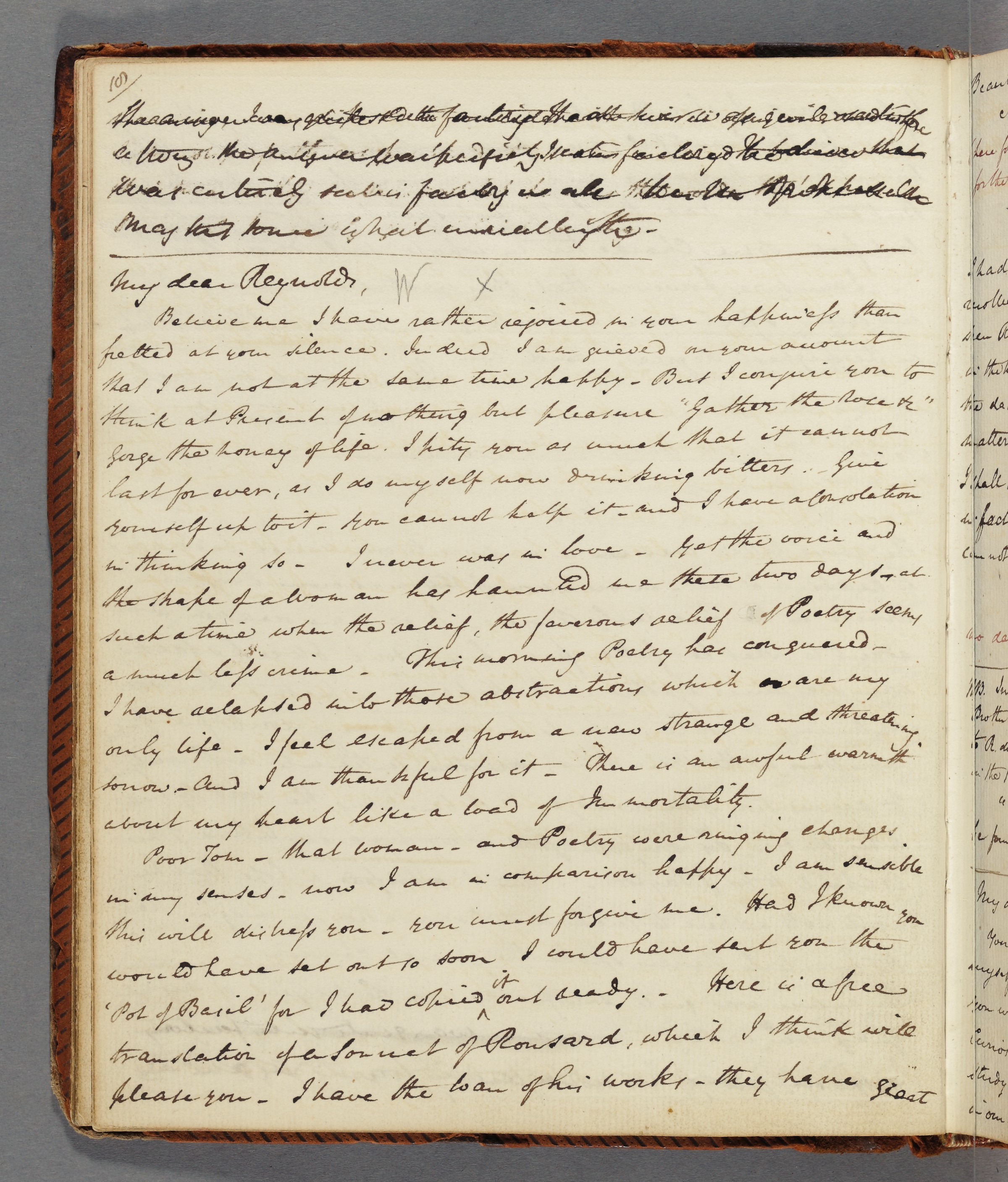
Page 1 of Woodhouse’s transcript of Keats’s 22 [?] September 1818 letter to John Hamilton Reynolds. Keats Collection, 1814-1891 (MS Keats 3.3). Houghton Library, Harvard University.

Page 2 of Woodhouse’s transcript of Keats’s 22 [?] September 1818 letter to John Hamilton Reynolds. Keats Collection, 1814-1891 (MS Keats 3.3). Houghton Library, Harvard University.

Filling Up Space

Olivia Loksing Moy
City University of New York, Lehman College

Re: Keats’s 20-21 September 1818 letter to Charles Dilke

[See also Andrew Burkett’s response to the letter, which also reads Keats’s table as a sort of sonnet form]

How do you recognize a poem when you see one?[1] The table embedded in Keats’s September 21 letter to Dilke, ostensibly just a list of paper formats, is brimming with poetic devices. We see alliteration along the vertical and horizontal axes of the “table-sonnet” with “Folio” and “fools cap,” “Bath” and “Boarding schools,” and the trisyllabic list of “Projectors, Patentees, Presidents, Potatoe” growers. Trochaic patterns emerge in the parade of professionals (“Parsons, Lawyers, Statesmen, Physians”) and the two travel writers “Eustace—Thornton.” In the final lines, Keats gestures loosely towards a couplet (or triplet) with “Strip,” “Slip,” “Snip.” Through the verbal play of these near-redundant words, Keats truly seems to be just filling up spaces—especially since the last three words are not actual paper sizes, just informal units with rough measurements. (Foolscap in nineteenth-century England measured 17 x 13.5 in., but how long exactly is a strip, slip, or snip?)

This “table-sonnet” anticipates a playful category of metasonnets in which form takes precedence over content, where the poet purports to be penning lines merely to fulfill a poetic structure. Consider Billy Collins’ “Sonnet”:

All we need is fourteen lines, well, thirteen now,
and after this one just a dozen
to launch a little ship on love’s storm-tossed seas,
then only ten more left like rows of beans.
How easily it goes unless you get Elizabethan
and insist the iambic bongos must be played
and rhymes positioned at the ends of lines,
one for every station of the cross.
But hang on here while we make the turn
into the final six where all will be resolved,
where longing and heartache will find an end,
where Laura will tell Petrarch to put down his pen,
take off those crazy medieval tights,
blow out the lights, and come at last to bed.

In his letter, Keats elongates his table with “Strip,” “Slip,” and “Snip” not only to complete the fourteen lines of a sonnet, but to fill the physical page, reaching the bottom margin so that he can finally speak his mind on the verso: “Yet when I consider that a sheet of paper contains room only for three pages and a half, how can I do justice to such a pregnant subject?…I ‘with retractile claws’ draw this into the form of a table—whereby it will occupy merely the remainder of this first page—.”

The first page of Keats’s 20-21 Sept 1818 letter to Dilke. From The Keats Letters, Papers and Other Relics.

It soon becomes clear that Keats’s little “dissertation on letter writing” is in fact a ploy to delay broaching two painful topics. At the top of Page 2, he reveals the true “pregnant subject” of his letter: the unfavorable attack against the “Cockney School of Poetry” in the August 1818 issue of Blackwood’s Edinburgh Magazine and the suffocating effects of Tom’s poor health. In each case, Keats does not confront the problem head on but withdraws from conflict, fading away into the background. In the first instance, we learn that “Hazlitt has on foot a prosecution against Blackwood.” But Keats’s protest is expressed through silent signals; his offense remains unspoken: “I dined with him a few days since at Hessey’s—there was not a word said about it.” In the second instance, Keats’s grief at the degradation of Tom’s health results in his own physical negation: “I wish I could say Tom was any better. His identity presses upon me so all day that I am obliged to go out.”

Keats, the chameleon poet, hides his pain in plain sight, using the shape of the page itself both cover and display, though tacitly, what wounds him most. Paper size and format are not merely blank material to fill lines; they enable Keats’s artful self-awareness. He exercises the skills of placement and self-positioning, opting for a restrained response that suits his character. His greatest sources of grief are all contained within the second page, bookended by the pleasantries on pages 1 and 3. Reading poetically, we might characterize the transition from page one to two as end-stopped rather than enjambed. His pen arrives at “Your sincere friend, John Keats” exactly at the bottom margin of the third page. Keats’s spatial planning, even of prose, may be lost in transcriptions of this letter, but through a reading of his handwriting in the manuscript – perfectly planned, meticulously measured –  we can read his “table-sonnet” about measurements of paper as reflecting the “measured” response of his reaction to the review and Tom’s illness.

Hazlitt might have opened his letter with a burst of indignant exclamations, positioning the review front and center. But Keats remains true to his own strategies of sequence and order: “in the simple process of eating radishes I never begin at the root but constantly dip the little green head in the salt— … in the Game of Whist if I have an ace I constantly play it first.”

Notes
[1] In Stanley Fish’s essay, “How to Recognize a Poem When You See One,” he describes tricking students from his Metaphysical Poetry seminar into close reading leftover blackboard markings from a previous linguistics class.

John Keats’s “Dissertation on Letter Writing”: On Poetry and Prose Composed on a Final Summer’s Day, 21 September 1818

Andrew Burkett
Union College

Re: Keats’s 20-21 September 1818 letter to Charles Dilke

At the autumnal equinox of 1818, John Keats was experimenting in both his poetry and his prose. This letter, which he completed on 21 September, reveals a range of ways in which the poet was trying out a number of new ideas concerning not only what a letter might convey but also how the very medium of correspondence opens up new possibilities for writing and thinking. Clearly conscious of the materiality of his correspondence, Keats begins four lines down the first page to announce in this letter to Charles Wentworth Dilke “in this forth [fourth] line” his plans for what will be “a dissertation on letter writing.” And by the end of this opening page, he creates a quite intricate table in fourteen lines (including his two lines of ellipses, after “Bath” and “Giltedge”) in what we might do well to consider as something like an experimental sonnet form, of sorts, concerned with the materiality of the page, the letter, and even the form of paper itself. He writes:

Detail of the first page of Keats’s 20-21 Sept 1818 letter to Dilke. From The Keats Letters, Papers and Other Relics.

From Hyder Edward Rollins’s The Letters of John Keats.

In this “form of a table,” which blurs the lines between prose and verse, Keats reveals his complex interests in the medium of the letter. With his references, for example, to “Bath,” a type of paper 8 x 14 inches (flat) and embossed at the top with that word, as well as his reference to “Fools cap” (or foolscap), the slightly larger paper type very popular during the Romantic period, Keats exposes his concerns with the materiality of the page, even noting his own preferences for paper type (“ut egomet” meaning “such as myself”). Also registered here in this “table” is the poet’s recurring fascination with British class and caste systems: we read at the start of these lines that “Parsons, Lawyers, Statesmen, [and] Physi[ci]ans,” prefer the larger “Folio” while “Milliners and Dressmakers” commonly use “Duodec,” or “duodecimo”—a smaller size of paper so called because of its being made by folding and cutting a single sheet into a dozen leaves. Keats’s brilliant little “sonnet table” holds riches to be mined, indeed.

And Keats was not only experimenting in the form and materiality of letters on 21 September. In fact, on that very same day he composed another sonnet type of sorts—the first fourteen lines of Hyperion:

Deep in the shady sadness of a vale
Far sunken from the healthy breath of morn,
Far from the fiery noon, and eve’s one star,
Sat grey-haired Saturn, quiet as a stone,
Still as the silence round about his lair;
Forest on forest hung above his head
Like cloud on cloud. No stir of air was there,
Not so much life as on a summer’s day
Robs not one light seed from the feathered grass,
But where the dead leaf fell, there did it rest.
A stream went voiceless by, still deadened more
By reason of his fallen divinity
Spreading a shade: the Naiad ’mid her reeds
Press’d her cold finger closer to her lips. (i.1-14)

On this final “summer’s day” of 1818, Keats marks with these experimental lines his abandonment of Leigh Hunt’s run-on couplets in favor of Miltonic blank verse, and this sonnet announces his plans for an expansive epic narrative. Did letter writing—and, perhaps, letter theorizing—help Keats to launch Hyperion? And how might Keatsian correspondence, in general, shed new light on his poetry written during this period? While it is not fully clear to what degree Keats’s investigational interests in the medium and form of the letter helped to shape his turn to the blank verse sonnet form, the poet was certainly admitting in this letter to Dilke his desires “to write and plunge into abstract images.” Indeed, it seems that Keats found such abstractions in both his poetry and his prose composed on this day, two hundred years ago.

Letter #92: To Charles Dilke, 20-21 September 1818

Although the Dilkes figured largely in Keats’s life (among other things, they co-owned, with Charles Brown, the house that would eventually become the Keats House), there are surprisingly few extant letters that Keats sent to them. We saw back in November 1817 a very short note requesting a copy of Coleridge’s Sybilline Leaves. Today’s letter is the first one since then. It was sent to Charles Dilke, who was then staying at Bedhampton at the home of his brother-in-law John Snook. Incidentally, Keats and Joseph Severn would stay with the Snooks in that same home the night before they set sail for Italy just about two years later.

There is some amazing stuff in this letter to Dilke, not the least of which is his attempt at a “dissertation on letter writing.” It takes shape as a table of paper types/sizes matched with the kinds of people who write with them. It’s a bit difficult to render spatially in plain text with our limited HTML skills, so instead here is an image of that part of the letter, from the facsimile of it printed in The Keats Letters, Papers and Other Relics Forming the Dilke Bequest in the Hampstead Public Library (1914):

From the first page of Keats’s 20-21 Sept 1818 letter to Dilke

Ok, so it’s not the best image, but it is a screenshot of a scan of a collotype of a letter. Not too bad considering. Here’s how Rollins renders it in print:

From Hyder Edward Rollins’s The Letters of John Keats.

We could say more about this lovely exercise in epistolary theory, but we don’t need to do so, because we have two great contributions which focus on precisely this aspect of Keats’s letter. Tomorrow we will hear from Andrew Burkett (Union College), who argues that we can see Keats playing with the sonnet form with his table of paper types. And we’ll also hear from Olivia Moy (Lehman College, CUNY), who takes up Burkett’s sonnet idea and proposes some additional ways we might understand how Keats is experimenting and why. So stay tuned for those paired responses tomorrow!

In the meantime, you can read Keats’s letter and glory in his brief dissertation on letter writing. The text of the letter you can read in the aforementioned The Keats Letters, Papers and Other Relics, which includes a printed version of the letter along with the facsimile images. We’re experimenting by embedding the Google Books version below, which seems to be working?? (You can also click the link above if you prefer.)

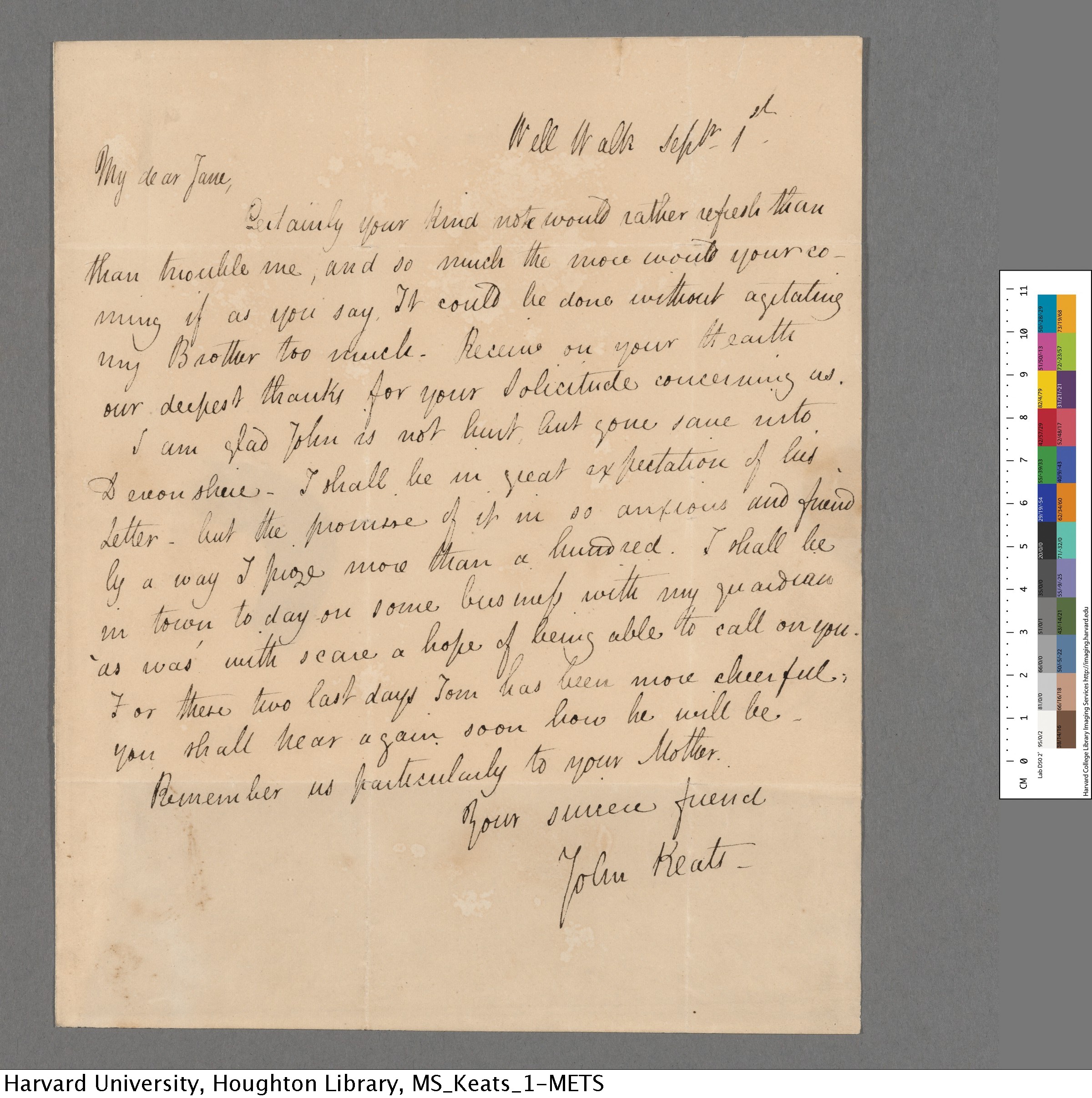
Letter #91: To Jane Reynolds, 1 September 1818

A very brief note today, thanking Jane Reynolds for her “Solicitude” concerning Tom’s health. Keats was responding to her letter, which he notes “would rather refresh than trouble,” suggesting that Jane had expressed some concern in her letter that she might merely increase Keats’s anxiety by inquiring about Tom’s health. Such polite people!

We also hear news of Jane’s brother John. He had recently emerged uninjured from a carriage accident. James Hessey wrote to his publishing partner John Taylor that Reynolds “had the happiness to be overturned just opposite his friend Hunts old residence in Horsemonger Lane–no one was materially hurt.” The joke there about “Hunts old residence” refers to the jail in which Leigh and John Hunt were held between 1813 and 1815 for their publication of a libel against the Prince Regent. We’re glad that all the Hunts and Reynolds emerged from Horsemonger Lane more-or-less ok.

One other detail of note from today’s letter: Keats mentions “some business with my guardian ‘as was.'” That would be the dastardly Richard Abbey. The business likely concerned Keats’s desire to have Abbey let Fanny Keats visit her brothers in Hampstead. As we wrote with respect to this issue last week, Abbey did relent and allow the visits for a time. But we’ll hear more from him and his villainy! Sorry–we’re not big fans of Abbey here at the KLP. But he makes it so easy to see him as a villain…

Text of today’s letter can be read from Forman’s 1895 edition. The manuscript image below is courtesy of Houghton Library at Harvard.

Page 1 of Keats’s 1 September 1818 letter to Jane Reynolds. Keats Collection, 1814-1891 (MS Keats 1.37). Houghton Library, Harvard University.

Letter #90: To Fanny Keats, 25 August 1818

Keats writes to Fanny just a brief letter today, with the main goal of letting her know that he’s hoping to see her soon. The problem is that Keats finds it difficult to get to Walthamstow to visit her (because of his own “little Indisposition” as well as Tom’s more serious illness), and Fanny’s guardian Richard Abbey is not too keen on having Fanny go to Hampstead to visit them. Keats did manage to convince Abbey, though, and Fanny visited with John and Tom in Hampstead several times between the end of August and early October. Two things conspired to bring those visits to an end: Tom’s health continued to worsen after the first week of October, and Abbey decided that the influence of the Keats brothers and their friends were not good for Fanny. During one of her visits to Hampstead, Keats brought Fanny to see some of his friends (probably at Wentworth Place). Abbey essentially cut off the visits after that point, which also coincided with Tom’s more dire condition. Marie Adami, Fanny’s biographer, deduces that Fanny’s last visit with Tom “cannot have been later than the first few days of October.”

We’ll see plenty more of the conflict between Abbey and Keats. Today’s letter represents the clearest suggestion yet that Abbey will take actions to limit Fanny’s contact with her siblings. Not cool, Abbey. Not cool.

Lastly, we hear again about Keats’s intention to buy Fanny a flageolet as a present, which he says he’ll have ready for her by the time she visits Hampstead. So the big question is: did Fanny ever get her flageolet? And did she help to soothe Tom and John’s spirits by piping a few ditties while the three siblings sat together during those autumn days? One hopes so.

Text of the letter can be read via Forman’s 1895 edition. The manuscript, along with most of the letters to Fanny Keats, is at the British Library. We’ll try to get images eventually!

Letter #89: To Fanny Keats, 19 August 1818

Keats arrived back in London on the evening of 18 August 1818, via the George, which departed Cromarty on 8 August. He arrived at the Dilkes’ at Wentworth Place looking, according to Mrs. Dilke, “as brown and as shabby as you can imagine; scarcely any shoes left, his jacket all torn at the back, a fur cap, a great plaid, and his knapsack.” Well, who can blame him. It’d been quite the journey!

At some point the next day he sat down to write of his return to his sister Fanny. He begins by apologizing for not answering her last letter, which she had sent on 12 June. Since the letter had to follow Keats around Scotland, it didn’t reach him in Inverness until the time he was about to depart for London. So we’ll let his delinquency slide this time. For the rest of 1818 Fanny will receive much more regular correspondence from her eldest brother. In part this is because of Tom’s continued decline and his death at the beginning of December. One suspects that Keats not only wanted to comfort his sister, but also would have himself needed the correspondence with her to help his grieving. After December, John and Fanny are the only two Keats siblings who are not separated by an ocean or by mortality.

In today’s letter it appears that Keats is mostly catching Fanny up on the latest. He tells her of the stories he’ll soon share with her about his travels. And he responds to a number of things she must have written to him in her last. He advises against playing the flageolet, but he says he’ll get one for her if she insists. He promises to get her a copy of Endymion, and another copy of his 1817 volume. He promises as well to speak with Richard Abbey (her guardian) about some situation at her school (“what you say concerning school”). And he notes, “I am sorry for your poor Canary.” Poor canary indeed! We hope Fanny got another pet to comfort her.

Lastly, it’s worth noting that Keats mentions his own health as well as Tom’s. He tells Fanny of the “bad sore throat” that led him to cut his trip short, and he also mentions “a confounded tooth ache” that is keeping him from doing much writing and from visiting her in Walthamstow. It’s tempting to see nothing but doom-and-gloom when it comes to Keats’s health from here on out. But let’s resist that temptation and remember that Keats isn’t quite at death’s door just yet. There’s plenty of vitality that he’ll display in the letters to come over the next two years, so we don’t want to overemphasize the significance of the “sore throat” too much just because we know how the story ends. Much remains possible as Keats embarks on his last phase of writing as 1818 begins to approach its end.

Text of the letter can be read via Forman’s 1895 edition. The manuscript, along with most of the letters to Fanny Keats, is at the British Library. No images for you yet–sorry!

Keats’s Comic Turns

Michael Theune
Illinois Wesleyan University

Re: Keats’s 6 August 1818 letter to Mrs. Wylie

[Editor’s Note: This post was originally published on Voltage Poetry, a website devoted to analyzing great poetic turns. Theune, one of the editors at Voltage Poetry, has allowed us to republish it here. You can read the original here.]

When we go to Keats’s letters, we very often go in search of brilliant fragments: Men of Genius, the egotistical sublime, the camelion poet, the mansion of Many Apartments, the vale of Soul-making, Negative Capability, or (the best of them all) T wang dillo dee. These are the kinds of fragments for which one might hunt with the help of, for example, “Where Did Keats Say That?,” a section in The Cambridge Companion to Keats which offers, as the section’s subtitle promises, “Sources for some famous phrases and comments.” Of course, there is little wrong with this: Keats’s letters are—as Keats says of Shakespeare’s sonnets—full of fine things, and it is important to know where to find them.

However, this approach—which views the letters as having an easily extractable content—overlooks a vital characteristic of Keats’s correspondence: that Keats’s epistolary writing often is more accurately characterized as action rather than statement, and that action is, primarily, the turn.

In “Multiple Readers, Multiple Texts, Multiple Keats,” an essay in Romantic Complexity: Keats, Coleridge, and Wordsworth, Jack Stillinger states that the “oscillation between seriousness and hilarity, which we find throughout the letters, is one of their chief attractions to readers.” This certainly is the case with what Stillinger argues, and I agree, is one of Keats’s greatest and funniest letters: his letter of 6 August 1818, to Mrs. James Wylie, the mother-in-law of Keats’s brother George.

George and his wife Georgiana have emigrated to the United States, leaving Mrs. Wylie bereft of their company, perhaps permanently—as Stillinger notes, “Emigration in those days was a serious disruption of family relationships—in most cases, the family members who stayed behind never again saw the ones who left.” Keats—who also was away, on a northern walking tour with his friend Charles Brown—writes a letter to Mrs. Wylie that begins in tones of utmost, even elegiac, seriousness about how he wishes that he could be a comfort to Mrs. Wylie in her loneliness. But, eventually, Keats acknowledges he cannot offer any legitimate assistance, and chooses instead to not attempt to argue Mrs. Wylie out of her sorrow, recognizing that it “is impossible to prove that black is white; it is impossible to make out that sorrow is joy or joy is sorrow.”

But then something amazing happens. As Stillinger notes, “It is at this point in the letter that, without any transition whatsoever, Keats launches into his account of the gentleman in the fur cap falling over a precipice in Kirkcudbrightshire.” Without any transition whatsoever is worth dwelling upon. There is nothing to point to here, no language that registers the massive shift taking place, no real content. Never will this vital maneuver be included in a list of the great things Keats said because here, at the key part of this letter, Keats does not say anything. Rather, he does something.

And what Keats does, of course, in the most sublime and hilarious way possible, is jump off a precipice. (Figuratively, of course, but still—) Immediately after stating that it is impossible “to prove that black is white” and “to make out that sorrow is joy or joy is sorrow,” Keats just decides to go for it. He will not prove or reinterpret anything. Instead, Keats leaps into the void, and simply does his damnedest to actually create joy—and he delivers a comedic tour de force.

Like any great comic routine, Keats’s is complex and multifaceted, a rich tapestry of structural maneuvers, of building set-ups and delivering punch lines, of subtle gambits and sudden blows. I love, for example, how Keats develops the “very romantic affair” that could be made from tumbling down a precipice into the sea. Women would be unable to resist him, especially if it was made clear—by Mrs. Wylie, whom Keats draws into his plot as his co-conspirator—that his falling was really a heroic chasing after “Jessy of Dumblane” (a reference to Robert Tannahill’s traditional song, “Jessie, The Flow’r o’ Dumblane”). Keats concludes his long, detailed story with a terrific act of comedic understatement, essentially: but, of course, Mrs. Wylie, even after I’ve told you the specific details that will work best, feel free to use your own discretion.

Keats then leaves off joking to shift into even more fast and furious joking. In the context of being “very romantic,” Keats in fact is just the opposite, deflating romanticism time and again. Here, when one climbs up a mountain—the site of theophanies, of encounters with God, or at least, in Wordsworth’s account, with “Imagination!”—one also comes down again. (I love the subtle typographical wit here, the way in which the “B…N” of “Ben Nevis” turn into “N.B.,” signifying both nota bene but also the return from the mountain.) Here, when one leans “rather languishingly on a rock”—that is, VERY romantically—one may be in position to attract—as Keats had hoped to do with his tale of his romantically unsuccessful derring-do—or at least have visions of, “some famous Beauty,” a gorgeous Godiva on her “Palfrey.” This Beauty, however, does not just pass by, but stops, and approaches with her breasts…I mean, “her saddle-bags”! And then she gives Keats a kiss…I mean, “a dozen or two capital roastbeef Sandwiches”! This vision is a hilarious letdown for very romantic Keats, and it is a fulfillment of all he—having recently eaten many “oat cakes”—actually wants. And that it is both at the same time is what makes it genius.

Keats famously says that the Grecian Urn “dost tease us out of thought,” but this also is exactly what Keats attempts to do with this letter: tease Mrs. Wylie out of her own loneliness. We do not know whether or not the letter actually worked, but it’s hard to imagine Keats not succeeding in his endeavor at least to some extent. It’s hard to imagine Mrs. Wylie not smiling or laughing at Keats’s lovely, friendly buffoonery; it’s hard to imagine Mrs. Wylie not being transported, if only for a moment, from what one could only imagine to have been her real sorrow, to feel inspired, warmed and brightened—enlivened—by Keats’s conviviality, to feel—as we continue to feel—his presence.

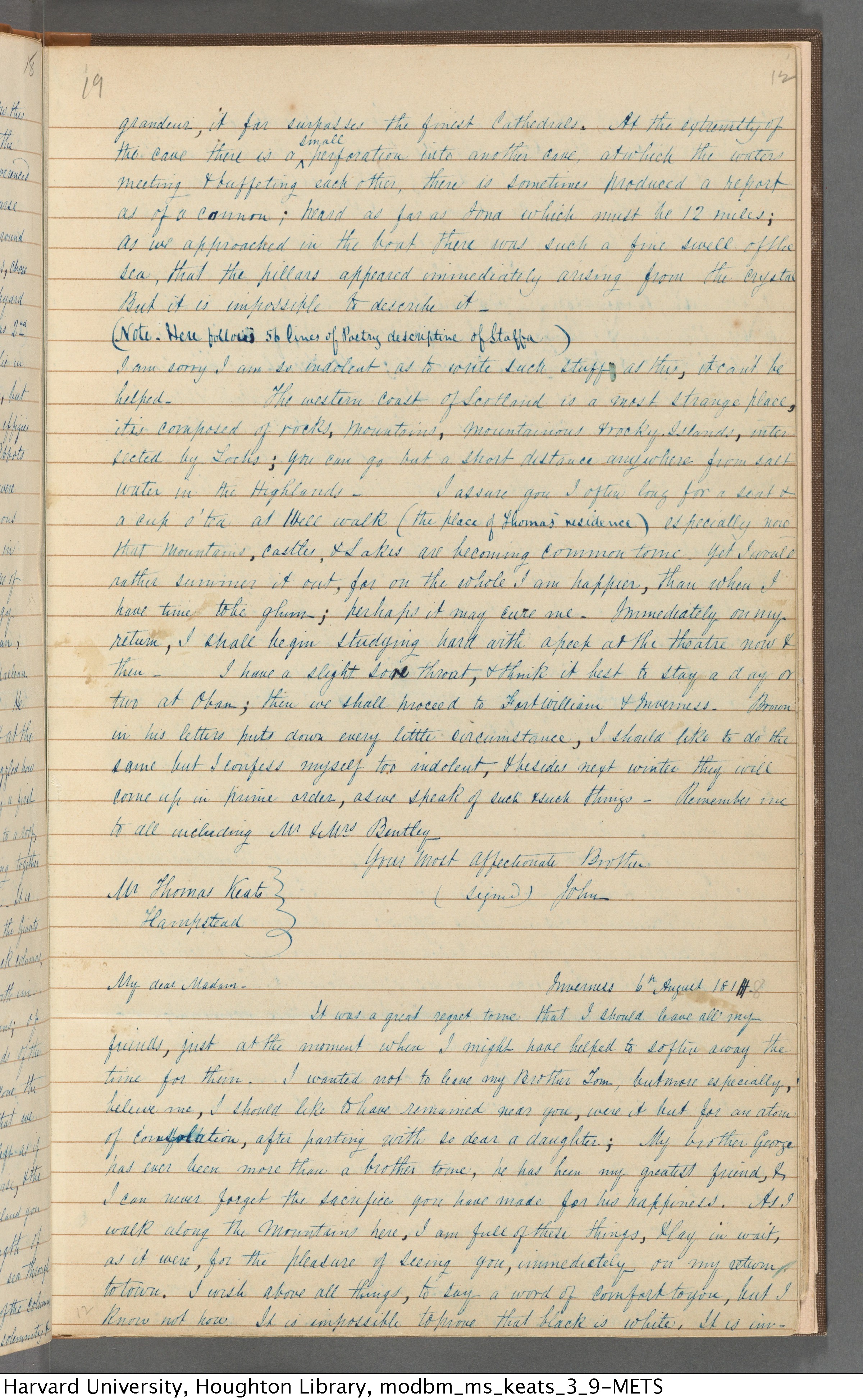
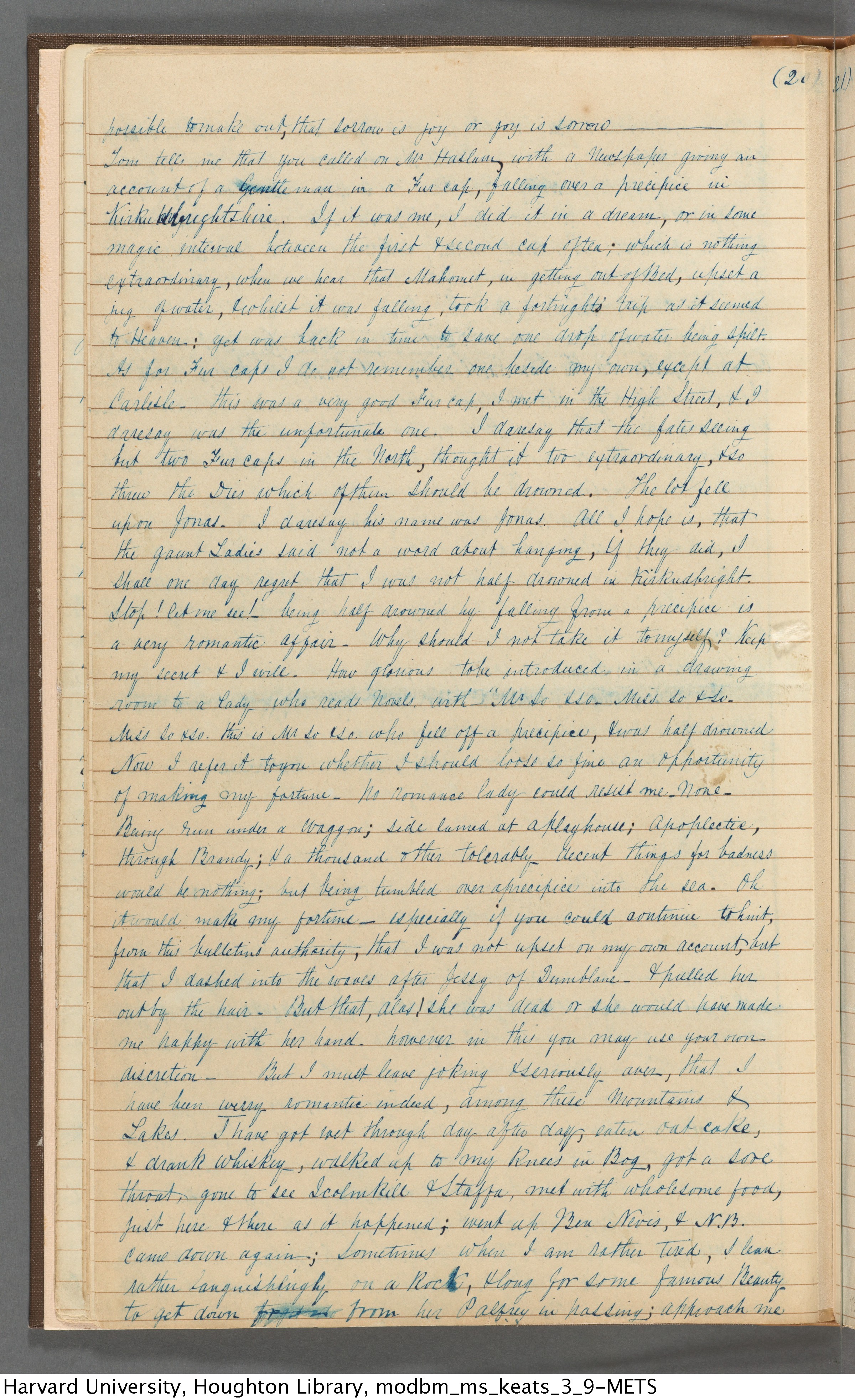
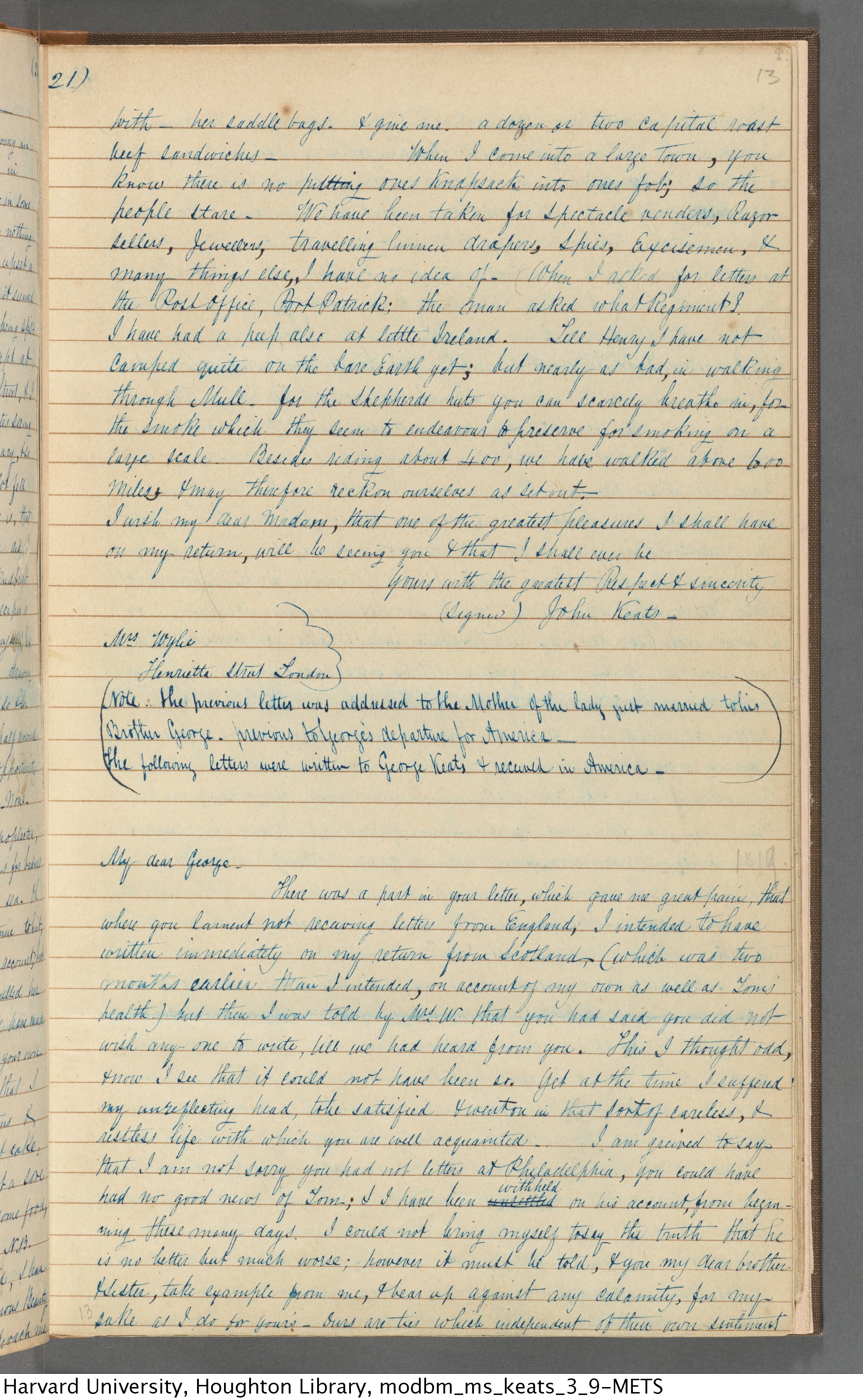
Letter #88: To Mrs. Wylie, 6 August 1818

The last extant letter from Keats’s northern tour is written to George Keats’s mother-in-law, Ann Amelia Wylie (neé Griffin). You’ll perhaps recall that the tour began at the same time that George and Georgiana Wylie Keats left for America. It’s no surprise, then, that Keats would want to keep in touch with Mrs. Wylie while she was cut off from communication with her daughter and new son-in-law. (It wasn’t until the middle of October that a letter from the Keatses sent from America arrived in London.) As he writes here, “I wish above all things, to say a word of Comfort to you.” As Keats is so often wont to do, he also recognizes the inherent limitations of the epistolary medium. Of his wish to “say a word of Comfort,” he adds that: “I know not how.  It is impossible to prove that black is white, It is impossible to make out, that sorrow is joy or joy is sorrow.” And yet he proceeds to try to offer that comfort anyway.

His primary method of conveying comfort: humor! Today’s letter is Keats at his comedic best. And it’s really too bad that the only source we have for the letter is John Jeffrey. If you don’t find Keats funny here, then you should probably blame it on Jeffrey for not transcribing correctly. But if you do find it funny, well then Jeffrey did a fine job! Anyway, read the letter and see for yourself. And then go read the KLP’s own Michael Theune’s response to the letter. It was initially published on Voltage Poetry almost five years ago, which demonstrates that Theune has for a long time been an acolyte of comedic Keats. Enjoy!

You can read text of the letter from the original post as it appeared on Voltage Poetry, or you can find it here via Forman’s 1895 edition of the letters. Images below (from Jeffrey’s transcript) are courtesy Houghton Library at Harvard.

Page 1 of Jeffrey’s transcript of Keats’s 6 August 1818 letter to Mrs. Wylie. MS Keats 3.9 (Houghton Library, Harvard University).

Page 2 of Jeffrey’s transcript of Keats’s 6 August 1818 letter to Mrs. Wylie. MS Keats 3.9 (Houghton Library, Harvard University).

Page 3 of Jeffrey’s transcript of Keats’s 6 August 1818 letter to Mrs. Wylie. MS Keats 3.9 (Houghton Library, Harvard University).

John Keats and the Vile Descent

Anne C. McCarthy
Penn State University

Re: Keats’s 3, 6 August 1818 letter to Tom

They will see us waving from such great heights
Come down now, they’ll say
But everything looks perfect from far away
Come down now but we’ll stay

–-The Postal Service

Back in April (April 8, to be precise), writing to Haydon from Teignmouth, Keats had looked forward to the summer of 1818 as “Prologue to the Life I intend to pursue,” a life that would unite physical and poetic achievement:

I will clamber through the Clouds and exist. I will get such an accumulation of stupendous recollolections that as I walk through the suburbs of London I may not see them—I will stand on Mount Blanc and remember this coming Summer when I intend to straddle ben Lomond—with my Soul!

The Scottish mountain was only supposed to be the beginning; indeed, it seemed to Keats in April that he could already imagine it as a memory on the way to the most sublime peak of them all. He would seek a higher consciousness, build up a reserve of “stupendous recollolections” capable of erasing the quotidian for good—and he would do it the hard way, the right way—John Keats, triumphant mountaineer, the very embodiment of the figure in Caspar David Friedrich’s Wanderer Above the Sea of Fog who continues to grace roughly 90% of the covers of romantic literature textbooks.

Figure 1. Our intrepid wanderer, also from 1818. You can find this image by looking up “Romanticism” in Wikipedia.

This particular view of mountaineering was a relatively new phenomenon when Keats was making his plans, so it’s interesting that these peak experiences are given such emphasis in this stage of his poetic life. Of course, even in 1818, he was already treading in the hiking boots of Wordsworth and Coleridge, of Percy Shelley and Victor Frankenstein, to say nothing of the Continental writers and adventurers who had ennobled the work of ascent. (For more on this, see Cian Duffy’s Landscapes of the Sublime and Simon Bainbridge’s essay on romantic mountaineering.) As Keats’s April letter makes clear, it’s not just about having the physical ability to “clamber through the Clouds”; to elevate the body is nothing less than to elevate the imagination.

Figure 2. “I will stand on Mount Blanc and remember this coming Summer when I intend to straddle ben Lomond—with my Soul!”

The Keats of April 1818, anticipating Maria Von Trapp, intends to climb every mountain and then to keep to the “Heights which the soul is competent to gain,” as Wordsworth put it in The Excursion, even after his feet return to the streets of Hampstead. Keats is, in other words, fully on board with the idea that mountain climbers possess a certain moral authority and a romantic impatience with the crowdedness and inauthenticity of a world that is too much with us.

By the time Keats sits down to write to his brother Tom from Inverness in August, the lofty heights of travel planning have long given way to the realities of the walking tour; as our recent contributors have shown, for every mind-blowingly sublime vista there are plenty of oatcakes and overly-friendly drunkards. There’s the sore throat he can’t quite manage to shake off that’s going to mean cutting the trip short. London has already begun to creep in; Keats describes the experience as akin to “mounting 10 Saint Pauls without the convenience of Stair cases.” Though in April he’d been planning to straddle Ben Lomond, August finds him on Ben Nevis, the highest peak in Great Britain—“Skiddaw is no thing to it either in height or difficulty.”

In many ways, the account of the ascent of Ben Nevis is very much of a piece with the other letters Keats has sent from the walking tour: anticipated sublimes cleaved by material realities (loose rocks and the necessity of proceeding on all fours); poetry that doesn’t entirely rise to the occasion (in particular the bawdy and slightly cruel doggerel about one “Mrs Cameron of 50 years of age and the fattest woman in all inverness shire who got up this Mountain some few years ago—true she had her servants but then she had her self—She ought to have hired Sysiphus”); a careful accounting of whiskey consumed; the general play of the elevated and the mundane. But what I’ve always been struck by most forcefully in this letter is Keats’s description of Nevis’s “shattered heart or Core in itself,” made up of “Chasms … 1500 feel in depth … they turn one giddy if you choose to give way to it.” The play of cloud and mist both reveals and conceals, but there’s something about the vertigo of the image that lingers, even after reaching the top—maybe that’s why Keats has to stabilize himself by snickering at Mrs. Cameron behind his poetic sleeve.

And it’s the story of Mrs. Cameron, incidentally, that leads Keats to what’s arguably his most significant insight about mountaineering: “what surprises me above all is how this Lady got down again.” It’s a curious feature of most mountaineering literature that, while the ascent is described in all its character-building and mettle-testing detail, the descent is treated as more or less inevitable. To take only one example, the official account of the 1953 summiting of Everest by Edmund Hillary and Tenzing Norgay—The Ascent of Everest—virtually ends at the top, narrating the return to base camp in about two pages. While this might be understandable from a narrative perspective, it’s downright deadly in practice. Coleridge almost killed himself on Scafell in 1802 because, after reaching the top, he more or less stopped paying attention to what he was doing—not everyone who has followed him up has been that lucky. (Alan Vardy’s account of this escapade is fantastic.) Jon Krakauer’s bestseller Into Thin Air, which details what until recently was the deadliest climbing season on Everest, makes this point again and again—nearly everyone who dies does so after getting to the top.

Figure 3. “With enough determination, any bloody idiot can get up this hill. … The trick is to get back down alive.” –Everest guide Rob Hall, as quoted in Into Thin Air

“’T was the most vile descent—shook me all to pieces—”

Keats proves himself a mountaineer by remaining tight-lipped about the come-down. It provides him with no immediate poetic material, and it certainly doesn’t do any favors for his already unstable health. The account ends in a dash, picks up with a sonnet on the overleaf, and leaps forward to the stop in Inverness. Whatever happened on the way down, it’s not something that Keats can communicate to Tom.

Figure 4. Ben Nevis in the summertime. Mrs. Cameron not pictured.

Of course, despite—or because of—the mountaineer’s tradition of mystified (mist-ified?) descent, I keep coming back to this single line. The vile descent, the shaking to pieces: might there be, in this zone of the unwriteable, the cracking open of a certain reservoir of poetry—something that evokes, and will allow him to continue to evoke, the “shattered heart or Core” whose unveiling he witnessed on the way up? It wasn’t supposed to happen this way, of course. Going up was supposed to be the hard part. The path was supposed to lead to Mont Blanc, not to the fly on the wainscot. The jeering at Mrs. Cameron notwithstanding, I value this letter for its ability gaze into those Chasms, for the vertigo it doesn’t try to hide, and for the way it begins, or begins to begin, the process of letting go of the pursuit of the egotistical sublime that had gotten him there in the first place.

—

A brief coda, by way of full disclosure and a bit of shameless self-promotion. Some of what I’ve written here is loosely adapted from “Reading The Red Bull Sublime,” an essay I published last year in PMLA. There, I suggested that we see the aftereffects of this vile descent in the image of Hyperion, falling into history (though not, however, in “The Fall of Hyperion”). I wonder now whether I was too fatalistic in my sense of this journey’s effect on Keats, though, either poetically or biographically.


Works Cited

Bainbridge, Simon. “Romantic Writers and Mountaineering.” Romanticism, vol. 18, no. 1, 2012, pp. 1-15.
Duffy, Cian. The Landscapes of the Sublime, 1700-1830: Classic Ground. Palgrave, 2013.
Hunt, John. The Ascent of Everest. Mountaineers, 1993.
Krakauer, Jon. Into Thin Air: A Personal Account of the Mount Everest Disaster. Anchor Books, 1999.
McCarthy, Anne C. “Reading the Red Bull Sublime.” PMLA, vol. 132, n0. 3, May 2017, pp. 543-57.
Vardy, Alan. “Coleridge on Broad Stand.” Romanticism and Victorianism on the Net, vol. 61, Apr. 2012. http://id.erudit.org/iderudit/1018600ar