An Era in My Existence: The ‘Season of Mists and Mellow Fruitfulness’

Greg Kucich
University of Notre Dame

As I contemplate Keats’s 9 October letter to his special friend and early mentor, Charles Cowden Clarke, I look out my study window on the ruddy landscape of a Midwestern autumn and travel back to my first significant article publication, an essay on the intersection of mental maneuvers in Keats’s letters and poems (Kucich). I had learned by then to love and admire this epistolary treasure–already recognized by generations of Keats scholars as perhaps the most creatively vibrant body of letters ever produced by a poet–for their astonishing depth of wisdom about the infinite complexities of human experience, their tactile greeting of the spirit with so many great writers past and present, their stunning theoretical formulations of so many distinctive ways of knowing and writing, their utterly distinctive playfulness and humor, and, perhaps above all, their uniquely kind and charitable ways of thinking into our shared human frailties. As I read and re-read that first recorded prose letter of 9 October for this exercise, only a brief paragraph in length yet packed with the density of thought and good will that would become a hallmark of Keats’s correspondence, I imaginatively moved much further back to the promise-filled October of 1816 and then slightly forward to the more complicated autumns of 1819 and 1820. The “Era in my existence” literally refers to Keats’s fervid excitement about the prospect of meeting through Clarke’s introduction the renowned, controversial poet-critic-editor-political prisoner and hero of Liberty, Leigh Hunt, producer of many sensational poems as well as the influential weekly periodical, The Examiner. Keats had avidly consumed Hunt’s liberal political views writ large in The Examiner during his salad days at Enfield School and, far from coincidentally, he had published his first poem, “O Solitude! If I must with thee dwell,” in Hunt’s Sunday weekly. Unbeknownst to Keats at this moment, however, that “Era” may also be construed proleptically as the astonishing span of only four years during which he produced the vast majority of his poems and advanced through a lightening arc of creative acceleration that landed him “among the English Poets” (Letters 1: 394).   That same stretch would also mark the onset of his fatal disease, congenital tuberculosis, and the tragic end of all that might have been. All this striking combination of transitional change linked to the turning of the seasons in autumn and a stark fixity of span, with the start containing subterranean traces of the end, resides in Keats’s first recorded letter, a rather mind-boggling prototype of the packed density of thought and feeling that his later poetry of 1818-19 would exemplify for so many amazed readers over the last two centuries.

The 9 October letter to Clarke marks several key transitions in Keats’s young life and literary career. His friendship with Clarke, son of and assistant to the Headmaster of progressive Enfield School, where Keats lived and studied from age 8-16, took on a special resonance during his last two years at Enfield, 1810-11. It was during those years, Clarke recalled years later in his Recollections of Writers, Keats began to display a passionate fascination with literature and a unique capacity for rapid, almost embodied assimilation of all that he read. Clarke, eight years older than Keats, played the role of mentor in an enduring relationship that continued through the next five years after Keats left Enfield to assume an apprenticeship with the surgeon Thomas Hammond in nearby Edmonton. (For Keats’s sustained acknowledgement of his debt to Clarke’s literary instruction, see Jayme Peacock’s recent post on this website regarding Keats’s verse epistle “To Charles Cowden Clarke.”) Clarke would later recall their many delightful sessions reading together and exchanging books in a “rustic arbour” near a pond on the Enfield School grounds, in which the song of nightingales could be heard during May evenings and the glories of Tasso, Spenser, Shakespeare, Milton, classical mythology and, eventually, Homer, in George Chapman’s seventeenth-century muscular translation, all unfolded for an impassioned young Keats (Clarke, “Note” 343-44). Enthralled with what Clarke helped reveal in the great traditions of literature, and inflamed with ardor for its sheer, physical fascinations, Keats virtually “ramp[ed]” like an unloosed horse through Spenser’s Faerie Queene and hoisted himself up, “[l]ike a true poet,” Clarke recalled, in tactile identification with Spenser’s grand, magnificent imagery, “looking burly and dominant, as he said, ‘what an image that is—sea-shouldering whales!’” (qtd. in Bate 33). Much as Keats experienced an almost devotional passion for the literature he explored with Clarke, he was also capable of discrimination from early on. Clearly remembering Keats’s self-directed immersion in classical mythology and Latin literature, Clarke later pointed out how Keats began translating Virgil’s Aeneid at 14 and felt self-confident enough to surprise his mentor by hazarding an opinion “that there was feebleness in the structure of the work” (qtd. in Bate 26).

These ongoing literary interactions with Clarke cemented their friendship and highlighted Keats’s evolving artistic interests throughout his adolescent years, but the letter of 9 October also flags a different transitional point of connection between the two men. Notwithstanding his self-awareness of his jejune status as an aspiring poet, Keats rather confidently stakes a higher access of literary awareness by somewhat casually quoting, as a maturing student might do for a former teacher, Horace’s warning about invoking the gods in poetry. “ . . . I think,” the younger man begins in what would become a characteristic mode of Keatsian nuancing and half-perception, “Horace says, ‘never presume to make a God appear but for an Action worthy of a God” (1: 113; accurately quoted, from Horace’s Ars Poetica, line 191). Further reinforcing a mutually shared love of reading and writing literature, Keats half-jokingly nudges Clarke to hand over some of his recent poetic efforts: “I have no doubt but that you have something in your Portfolio which I by rights should see—I will put you in Mind of it” (1: 114). This intensifying habit of sharing poems and jointly immersing themselves in the work of eternal writers reached a culminating moment later in October when, after opening Keats’s astonished eyes during one all-night session to the vigorous translation of Homer by George Chapman (published 1614), Clarke awoke the next morning to discover on his breakfast table a note containing what is widely regarded as Keats’s first great poem, the sonnet “On First Looking into Chapman’s Homer.” “We had parted at day-spring,” Clarke remembered, “yet he contrived that I should receive the poem from a distance of, may be, two miles, by ten o’clock” (Recollections 130). By October of 1816, then, this intimate relationship had begun to launch Keats on his incandescent rise into the higher reaches of poetry.

Alongside such an inspiring bond of literary experience, Keats also strongly grounded his intimacy with Clarke in their shared commitment at Enfield School and beyond to the high significance of their time’s struggle for the ideals of political liberalism. Both found this ideal best exemplified in the public career of Leigh Hunt and his political writings in The Examiner. Together with Gilbert Burnett’s History of his Own Time, Hunt’s ceaseless mental fight in the pages of The Examiner against voting corruption, state prejudice toward Dissenters and Catholics, the British’s government’s attempts to prosecute its own liberal citizens for sedition, and its continuance of an unjust war against revolutionary France, all this and more in The Examiner, Clarke recalled, “no doubt laid the foundation for [Keats’s] love of civil and religious liberty” (qtd. in Bate 25). During his first years out of Enfield School, Keats drew on this political inspiration to create poetry that celebrated Hunt’s own love of sensuous beauty and his noble battle against political tyranny. Imprisoned for two years as a result of his relentless attacks on the Prince Regent’s excessive spending at taxpayer’s expense, his licentious lifestyle, and his betrayal of the cause of political reform, Hunt had created an incredible bower of bliss in his prison cell at Horsemonger Lane Gaol, complete with busts of poets, portraits of political/poetic heroes like Milton, a pianoforte, multiple cases filled with books, a ceiling painted blue to imitate the Italian sky, venetian blinds over the window bars, and flowers, flowers, everywhere. Here he continued to rail against the Government and the Regent in his weekly Examiner while reading Tasso aloud, playing the pianoforte, hosting wine-fests, and entertaining a non-stop parade of famous liberal visitors, including Bentham, Hazlitt, and Byron, the last of whom dubbed him “the Wit in the Dungeon.” Charles Lamb, also a frequent visitor, enjoyed the flabbergasted look of everyone who entered this phenomenally embowered site of detention to meet such an improbable Prospero of the Dungeon, declaring “there was no such other room, except in a fairy tale” (Hunt, Autobiography 243).   Clarke, who had known Hunt for some time, was one of the regular visitors to this fantastic literary salon, regularly bringing baskets of fruit for Hunt and his family. He certainly would have shared such unbelievable experience with Keats, who then felt inspired to write sonnets honoring Hunt’s rare gifts for admiring and producing poetry of sensuous luxury while also unreservedly locking political horns with Britain’s top leadership—see “Written on the Day That Mr. Leigh Hunt Left Prison” (the first poem that Keats showed to Clarke) and “On The Story of Rimini.” Keats also featured Hunt, named “Libertas,” in his verse epistles of 1816 and his brief chivalric narrative “Specimen of an Induction to a Poem” (imitative of Hunt’s The Story of Rimini), as a kindly mentor, a projection of Clarke with zing, who would introduce him to his beloved Spenser’s amiable influence.

Emphasizing in the 9 October letter these deeply shared connections with Clarke’s literary experience, and his particular link to Hunt’s poetry and politics, Keats signaled two points of major transition and growth in his own literary life: his initial turn to intellectual life and its literary associations as a boy at Enfield School; and his more substantial, possible embrace of a life of poetry and politics, modeled on Hunt’s experience, in the autumn of 1816. He had recently completely his medical studies at Guy’s Hospital, passing the examination in mid-July that licensed him to practice as an apothecary and a surgeon, the middle-brow career picked out for him by his dubious advisor, Richard Abbey, some years ago. He refers to his graduation at the very beginning of this letter, telling Clarke that “The busy time has just gone by. . . .” (1: 113). Keats had to wait until he was twenty-one on 31 October before he could actually practice medicine, and during the interval he took a holiday at Margate on the sea, accompanied for part of the time by his younger brother, Tom. Instead of planning to launch into the medical profession, however, Keats now began to make his monumental turn to a life of poetry and immediately sought out literary associates upon his return to London at the end of September. Clarke undoubtedly saw the change coming and endorsed it. He showed some of Keats’s poems to Hunt, now released from prison and re-establishing the dungeon salon in his pastoral cottage within Hampstead’s leafy Vale of Health, just outside of London. Hunt’s response was immediately enthusiastic, and he asked to meet the young poet. As Clarke put it, “I could not but anticipate that Hunt would speak encouragingly . . . but my partial spirit was not prepared for the unhesitating and prompt admiration. . . . After making numerous and eager inquiries about him personally . . . the visit ended in my being requested to bring him over to the Vale of Health” (Recollections 132-33). A thrilled Keats then announces his memorable inclination to a literary instead of medical life when he begins the 9 October letter by telling Clarke since the “busy time” has ended, “I can now devote any time you may mention to the pleasure of seeing Mr. Hunt—‘t will be an Era in my existence . . .” (1: 113).

Several days later, Keats crossed the river from his residence near Guy’s Hospital in Dean Street, Borough, to Clarke’s home in Clerkenwell, not a short distance, and then the two set off for the walk of six miles to Hampstead. Decades later, Clarke still remembered Keats’s stunning look of keen anticipation as they traveled on: “The character and expression of Keats’s features would arrest even the casual passenger in the street. . . . As we approached [Hampstead] Heath, there was the rising and accelerated step, with the gradual subsidence of all talk” (Recollections 133). The visit was animating and successful beyond measure for the enchanted Keats, whose fiery energy and love of classical mythology and Spenser thoroughly delighted Hunt. “We became intimate on the spot,” Hunt recalled (Lord Byron 410). Heartily encouraged, Keats returned to Hunt’s cottage for three morning calls shortly after and soon became a regular member of Hunt’s circle, “a familiar of the household” (Clarke, Recollections 133), where he met painters, musicians, politicians, and poets, including Shelley, and found a generous, welcoming home in this world of art and conviviality. Furnished with such a new-found community of professional support and emotional encouragement, tellingly recorded in his Sleep and Poetry, Keats only needed several months before setting aside medicine and beginning the literary life that, lasting only four years, nevertheless made him immortal. Hence began his new “Era.”

Keats’s closeness to Hunt has long been the subject of great critical controversy about his overall creative development and only recently the impetus for what have become arguably the most exciting new breakthroughs in Keats scholarship. The core essentials of this ongoing communication between Keats and Hunt may actually be traced in the 9 October letter, which provides additional evidence for several compelling, new ways of comprehending Keats’s “Era.” Until recently, Keats scholars have tended to regard his involvement with Hunt in severely divided ways—fortuitous in serving Keats with vital professional support when he most needed it, but damaging both in its political imperatives, thought to be an unproductive distraction from the craft of poetry, and particularly in what has been considered an undisciplined and superficial kind of chatty, sometimes even vulgar, poetic style favored by Hunt and pervasive throughout Keats’s poetry of 1816-17. Only when Keats distanced himself from Hunt’s politics and poetics, so the argument runs, did he ascend to the bold density of poetic phrasing that distinguished his major poetry of 1818-19 (see Bate 77-82, 97-101, 185-87, 312-15). More recently, an increasing number of Keats scholars, led primarily by the path-finding work of Nicholas Roe and Jeffrey Cox, have substantially qualified this history, tracking a much more complex type of Huntian poetic continuing throughout Keats’s later work and grounded in a performative “Cockneyism” that aligns aesthetic luxury, grammatical and linguistic innovation, open-ended couplets, and high-spirited sociality with a determined republican politics. All of these poetic qualities surface in the one poem Keats mentions in the Clarke letter that he will “suffer to meet the eye of Mr. H.” (1: 113), his verse epistle “To George Felton Mathew.” That early effort from 1815 also celebrates the liberty loving heroics of King Alfred, William Tell, and William Wallace, historical figures whom the more conservative Mathew later repudiated in their linkage to what he called the “republican school” (Rollins 2: 186-87).

Central to this republican poetics and politics is the joy of warm-hearted, supportive sociality, which Keats had already experienced with Clarke but could now hope for on a broader level in Hunt’s Hampstead coterie. The Huntian model was a form of boisterous, sometimes conspiratorial sociality, raucously practiced during wine-drinking, poetry-reciting, Mozart-playing late evenings in the unbelievable jail cell and then transported to the pastoral charms of the Vale of Health. This was the world of innovative poetics, republican politics, and optimistic, metropolitan sociality that Keats yearned to join, just the obverse of the small-minded, oppressing sphere of government tyranny and the isolating, conservative despondency that plagued Wordsworth and so many of his generation after the perceived failure of the French Revolution. In telling Clarke about the “Era” he expected in his existence, Keats immediately links it with his eagerness “to become acquainted with Men” of Hunt’s character (1: 113).

Many Keats scholars have examined the complex gender dynamics of his poetry, which frequently entail imaginative gender crossing, even transitioning; but not enough has been written yet about the unique inspiration and support that Keats felt pouring into his heart and mind from the company of supportive, invariably gentle, affectionate men like Clarke and Hunt and others he would meet at the Vale of Health cottage. One of the most significant forces of inspiration throughout Keats’s experience in the Hunt circle is what he calls the “gentle amity” of male friends who nurture, support, and enable each other to thrive in poetry, politics, and life (“Imitation of Spenser” line 30). Keats often addresses Clarke by his given name, “My dear Charles” (the only friend so greeted in all of Keats’s correspondence), and affectionately calls him, echoing Burns, “My daintie Davie” (1: 114).   Hunt describes himself to Keats several years later, when the fatal illness was coming on, as “Your Affectionate Friend.” In Keats’s verse epistle “To My Brother George,” “knightly Spenser” most generously teaches Hunt, or “Libertas” (line 24), the pleasures of poetry. Hunt, as “lov’d Libertas,” intercedes with Spenser to assist Keats in “Specimen of an Induction to a Poem” (lines 57-62). “[K]ind Spenser” does just so, coming pleasantly to a comforted Keats in imagination “like a clear sunrise to my mind” (lines 50-51). In “Calidore,” Keats’s “gentle,” young knight first receives guidance from the “kind voice” of good Sir Clerimond, and then enjoys a heart-warming welcome from “the far-famed, brave, Sir Gondibert,” who, looking very much like both Spenser and Libertas, “Came up—a courtly smile upon his face, / And mailed hand held out / ready to greet / The large-eyed wonder . . . Of the aspiring boy . . .” (lines 32, 99, 122-28). Finally, as Keats reflects dreamily in Sleep and Poetry upon a day passed amid the “brotherhood” and the “gentleness” of affectionate friends at “the poet’s house” in the Vale of Health, he listens in recollection to “the chimes / Of friendly voices” that give way to a “sweet silence, / When I ‘gan retrace / The pleasant day, upon a couch at ease.” Such an experience leaves him feeling “refreshed and glad and gay” after spending the entire night in delighted wakeful reverie at the “poet’s house,” resolving to begin that very day / These lines,” which he conceives as a kind of transgendered “father” giving birth to “a son” (lines 314-18, 350-54, 402-4).

Anticipating such a gentle welcome from Mr. H. in the 9 October letter, Keats not surprisingly considers “Charity” in the same letter as, according to St. Paul, “the father of all the Virtues” (1: 114) He would later find such affectionate masculine charity, which he did indeed receive at the poet’s house, coming vitally to his aid whenever his notorious anxieties about facing the sublimity of poetic tradition, that phallic “Cliff of Poesy” towering above (Letters 1: 141), threatened to overwhelm his creative aspirations. He makes one other Huntian association in this same letter that would in time help enormously to catapult himself over that Cliff into the Olympian heights of immortal poetry—that is, the complex duality of all human experience, what Hunt often refers to in his own writings as “the grave and gay.” The famous drama of contraries or play of opposites that empowers so much of Keats’s later poetry—in the major odes, The Eve of St. Agnes, Lamia, and especially the contrariety of mutable seasons and eternal life cycles in “To Autumn”—already surfaces more than once in the Clarke letter, as Keats considers the pointed distinction men like Hunt, “in their admiration of Poetry,” know how to make between Shakespeare and Erasmus Darwin; or in the vividly material difference between Keats’s own congested Borough neighborhood, “a beastly place in dirt” (1: 114), and the leafy expansiveness he would soon inhale in Hampstead Heath and the Vale of Health.

The beginning of Keats’s epistolary life thus prefigures in such an amplitude of provocative richness so much of that lofty creative destination toward which he would travel. Yet perhaps the most poignant anticipatory element of this first letter rests with its combination of Mr. H. and that “Close bosom-friend of the maturing sun,” the autumnal “Season of mists and mellow fruitfulness” Keats would embrace in “To Autumn” (lines 1-2). As he walked hurriedly with Clarke through the burnished foliage of Hampstead Heath, Keats could not have known that four years later, when he would set sail in mid-September on that last voyage to Italy, Hunt would pen an Indicator essay on the “Return of Autumn,” resonant with echoes of Keats’s ode to the season, in which he would bid a plangent adieu to his “dear friend” who had just “gone away with the swallows to seek a kindlier clime” in Italy. Thinking of the way of swallows and nightingales, Hunt would also hope for Keats’s renewal and return:

. . . thou shalt return with thy friend the nightingale, and make all thy other friends as happy with thy voice as they are sorrowful to miss it. . . . farewell, for awhile: thy heart is on our fields: and thou wilt soon be back to rejoin it. (Selected Writings 316-17).

Such hope denied, so would come to a close the “Era” that began on 9 October 1816.

Works Cited

Bate, Walter Jackson. John Keats. Cambridge: Harvard UP, 1963.
Clarke, Charles Cowden. “Note on the School House . . . at Enfield.” The Complete Works of John Keats.. Ed. H. B. Forman. New York: T.Y. Crowell & Co., 1900-01. Vol. 5.
Clarke, Charles Cowden and Mary Cowden Clarke. Recollections of Writers. 2nd edition. London 1878.
Cox, Jeffrey. Poetry and Politics in the Cockney School: Keats, Shelley, Hunt and their Circle. Cambridge: Cambridge UP, 1998.
Hunt, Leigh. The Autobiography of Leigh Hunt. Ed. J.E. Morpurgo. London: The Cresset P, 1949.
. . . Lord Byron and some of his Contemporaries. 2 vols. London 1828. 2nd. edition. Vol. 1.
. . . Selected Writings of Leigh Hunt. Eds. Greg Kucich and Jeffrey N. Cox. 2 vols. London: Pickering and Chatto, 2003. Vol. 2.
Keats, John. The Poems of John Keats. Ed. Jack Stillinger. London: Heinemann, 1978.
Kucich, Greg. “The Poetry of Mind in Keats’s Letters.” Style 21.1 (1987): 76-94
Roe, Nicholas. John Keats and the Culture of Dissent. Oxford: Clarendon P, 1997.
. . . John Keats: A New Life. New Haven, Yale UP, 2012.
Rollins, Hyder, ed. The Keats Circle. 2 vols. Cambridge: Harvard UP, 1965.
 

Keats, Confidence, and the October Spring

Noah Comet
US Naval Academy

Oh, to be John Keats at this moment.

Keats was a poet whose best writing was perhaps the best writing, and I think most of us find much to admire in the man, too. Modest yet pugnacious, brilliant yet never secure enough in his brilliance to lord it over his readers like Wordsworth did, Keats was a small, impecunious man in a giant city that, for him, loomed “beastly” and rattled with death and classism: he was the under-est of underdogs.

Many of us might wish to write like Keats; few of us would wish to live like him; none of us, I think, would wish to die like him. But to be Keats here, in this moment, in October of 1816?—yes, please.

Here is Keats positively amped-up to meet one his idols, and he can hardly know what a fortuitous meeting it will be. Leigh Hunt—the liberal champion and editor of The Examiner, who with his brother had declined to recant his verbal attack on the Prince Regent and so did two years’ time; whose narrative poem The Story of Rimini, published six months before, had given Keats a template for fluid sentiment, irreverent, even anti-authoritarian classicism, metrical departures and neologistic play; who was perhaps no less an influence on Keats than Spenser was, in style, subject, and versification, and who had, in May, published one of Keats’s own sonnets in his magazine—had invited him to his home. Keats, diverging from his medical training, had written several poems by this time, and was, largely thanks to Hunt’s example, gaining some meager confidence in his own talents.

Much was to come of this visit, which extended to three visits, actually, and was followed by many more in the ensuing months. Keats and Hunt would grow enchanted with each other, and Keats would produce several poems to, about and in imitation of Hunt. Hunt, for his part, would pen his essay “Young Poets” that December, canonizing Keats (with Shelley) as part of a new school of verse. (For the conservative Blackwood’s, Hunt’s endorsement would be provocation enough to brand this school “the Cockney School,” and to make Keats an object of the magazine’s scorn.)

Hunt was the first established poet that Keats would meet; Keats could little imagine that he would have such a warm reception from him, such encouragement, and a playful nickname (“Junkets”)—to say nothing of the fact that The Examiner would go on to publish and brag on several more of his works.

Even more inconceivable at this moment is the time when the two men would grow estranged from each other (if never quite unfriendly), when Keats would seek to distance himself from the Hunt style that had dominated his earliest poems and that would overshadow his critical reception. It is something of a cliché in Keats studies to say that the ‘good Keats’—the poet of 1818 and ‘19—is he that has exhausted the Huntian phase of his career and awakened to self-criticism and original idiom. If that is to be true, it is yet far from true in this moment, when all is new and thrillingly possible, when Hunt represents novelty, defiance, and boundless potential. It is October, but Keats hears the songs of spring.

Charles Cowden Clarke, whose father ran the Enfield School, which Keats had attended, and who had helped introduce Keats to The Examiner, was a close acquaintance of Hunt and had been feeding him Keats’s verses for a few months, hence, at last, this invitation. For his efforts, Clarke merits a thankful “Sir” and perhaps more than that: editors are at pains to decide just who is the author of the “Sonnet to the Sun,” but some have suggested Clarke himself, in which case his facilitations with Hunt elicit Keats’s own esteem in the literary arena. (The commentary on taste—not conflating Shakespeare and Darwin—is presumably an inside joke between Keats and his school-friend.)

What I love about this early letter is how much of himself Keats packs into it. There is the (likely) posturing of “busy time”: after all, can we really believe that, however frantic his medical training may have been, Keats would have deferred a meeting with Hunt if summoned earlier? There is what would become an abiding feature of his poetry and letters, the self-historicizing of a young man keen to understand his own stadial growth within larger historical frames: “an Era in my existence.” There is the ambivalent confidence of his neoclassicism (“what, I think, Horace says”), recalling the still-recent sonnet on Chapman’s Homer (sent to Clarke, then published by Hunt), here both an assertion of his learning and the fixture of his embarrassment at having sinned against it. There is, as ever, his goodness to his friends, whose writings and commonplace journalings he will read, appreciatively. There is Keats the pragmatist (often at odds with Keats the poet), the proto-Garmin, providing Clarke with turn-by-turn guidance through Southwark. There is the sly mocking of charity by someone so ready to give and so reluctant to need it, and, finally, the goofiness of “Gout.”

So much of Keats’s temperament—his humor and his humility—is visible here.

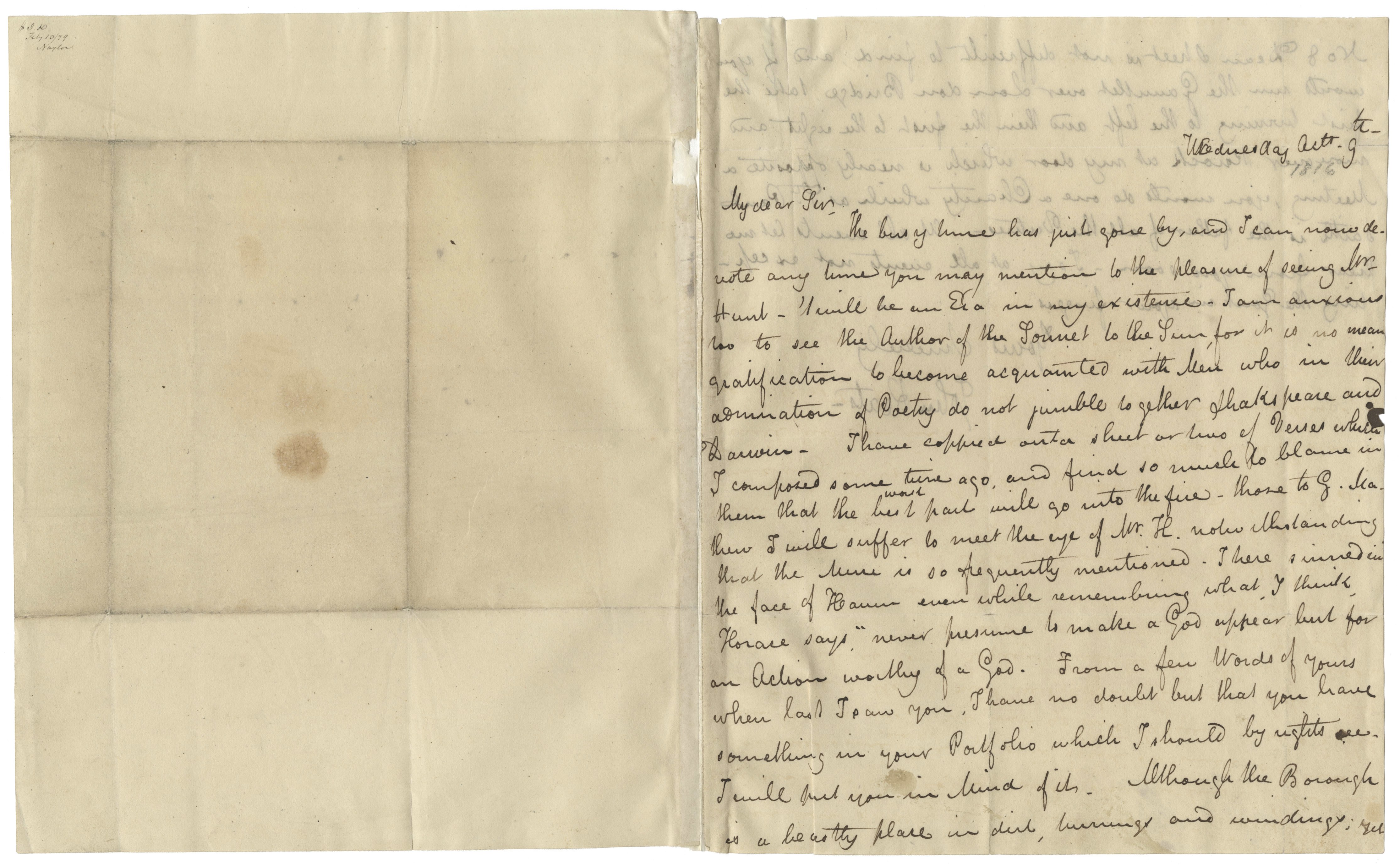
And what stands out for me is best v. worst, a semantic challenge, and a representational one to those who would print his letters in posterity. In sorting through his small portfolio of poems Keats claims to find little worthy of Hunt’s reading. Of what he has “coppied” (a misspelling that inadvertently puns on the smallness and infantilization of a coppy stool or a coppice woods [later, for him, a “copse”]) he first writes that [even] the “best” deserves to be burned. Subsequently, above the line, he writes “worst,” but (an editorial frustration) never cancels “best.” You weren’t the first, Charles Dickens.

best-vs-worst

From MS letter. Courtesy of the Historical Society of Pennsylvania.

It is always fun to see how modern editors, working within the parameters of their publishers, handle this. Oxford is perhaps the most visually faithful, placing “worst” just above “best” like so:

From Keats's Selected Letters (Oxford). Courtesy Google Books.

From Keats’s Selected Letters (Oxford). Courtesy Google Books.

But in doing this they give “worst” a rather powerful isolation. It’s far less prominent in the ms. Norton takes the opposite tack, via superscript (“some time ago, and find so much to blame in them that the best worst part”), in which case “worst” has been unfairly bested. Some editors avoid the confusion, leaving “worst” out altogether; advantage “best.”

Of course, if we take Keats at his word(s), “best” and “worst” are in equal proportion to each other, each intact, each meant to mean what they do all at once. (One can imagine a hypertext edition in which best and worst alternate ad infinitum.) It’s a bit early in the Keats Letters Project to reach for “negative capability” and to drop it, quite stylishly, into a new context, but we are confronted here with an uncertainty that might irritate us if we let it.

To return to Keats’s temperament, I think this ambivalence (and it is as ambi-valent as an ambivalence can be) captures an important part of it. I don’t mean anything too profound here, only that this is Keats accepting a self-contradictory measure of his own early talent: that his best is also his worst, as it is merely the greatest expression of his embarrassing lack (in his estimation, not mine). Of course his confidence grows over the next four years but it seldom appears without some alloy of diffidence and uncertainty (“I think I shall be among the English poets…”).

So it is that Keats’s correspondence begins and ends with an “awkward bow” (though here what might seem gauche is truly an insightful deprecation). Regardless, we will mark the immense talent that erupts between these bows, both before and after Hunt’s “era,” and find many ways not to share in Keats’s apologies for himself.

Letter #5: To Charles Cowden Clarke, 9 October 1816

Here Keats ponders his first meeting with Leigh Hunt, which would indeed become “an era in [his] existence,” as he recognized then. Noah Comet’s response to the letter captures with gusto the attitude of the young poet as he began to make his way toward being “among the English Poets.”


Thanks to the Historical Society of Pennsylvania for digitizing the manuscript of the letter, and for giving us permission to reproduce it here. And thanks to Ferdinand J. Dreer (1812-1902) for collecting over 15,000 autograph letters during his lifetime, and donating them all to the HSP! Keats’s letter was one of them. Good work, Ferdinand! The letter remained in the museum without making its way into print until 1932, however. If you have access (or want to pay), you can read about the re-discovery of the letter in this article by J. H. Birss, in Notes and Queries from 5 November 1932. Birss was at the time researching Herman Melville, and when looking through a bibliography in Widener Library, he just so happened to open the book to the Ks instead of the Ms. The 9 October letter was listed there, and when Birss realized no such letter had ever been printed, he undertook the search that would eventually lead him to find it at the Historical Society of Pennsylvania. So we can also say thanks to Melville, and to the alphabetical proximity of K and M! Lots of thanks to go around.

The KLP would also like to take this opportunity to confess that we fantasize on a semi-daily basis about discovering a new Keats letter in a manner such as this. Some day… some day.

Keats’s Delight With Spenser (via Charles Cowden Clarke)

Jayme Peacock
Pennsylvania State University

In this letter to his friend and mentor Charles Cowden Clarke, Keats puts on display his deep affinity for, emulation of, and modifications to the poetic style and career trajectory of Edmund Spenser. More so than “Imitation of Spenser,” which was penned the same year, this private correspondence contains a deep and nuanced demonstration of Spenser’s influence on the young poet. In the late sixteenth century, Spenser crafted for himself a publication career modeled on those of Virgil and Ovid, and his works correspondingly evolved from pastoral to epic to love lyric (Cheney). After “Imitation,” Keats would seldom write in the Spenserian stanza, and while he abandons Spenser’s form in this letter, he engages more subtly and more deeply with those same genres that Spenser used to build his literary career. Opening with pastoral, moving to epic, and ending on a version of amorous lyric, Keats portrays in microcosm the Spenserian trajectory. As Spenser repurposes the pagan poetics of Virgil and Ovid to suit an early modern Christian nation, Keats turns aside from Spenser’s antique didacticism to infuse this generic progression with Romantic feeling. Yet though Keats adheres to Spenser’s model, he must ultimately abandon Spenser’s moralizing to prioritize feeling as a specifically English characteristic.

Like Spenser, Keats anticipates his own poetic immortality in a published statement of career ambitions. He pens “Sleep and Poetry” in 1816 and strategically places it at the end of his first volume of poetry as a forecast of his intended achievements. He plans to move through “the realm . . . / Of Flora, and old Pan” (101-102), but he cannot linger there. He must move on to epic and “bid these joys farewell / . . . / for lo! I see afar, / O’er sailing the blue cragginess, a car / And steeds with streamy manes—the charioteer / Looks out upon the winds with glorious fear” (122-28). But Spenser does not end with epic, and neither will Keats. Near the end of the poem he predicts his eventual shift from epic to love lyric, envisioning “Petrarch, outstepping from the shady green, / Starts at the sight of Laura,” where “between them shone / The face of Poesy” (389-94). Pan, of course, is a crucial figure in Spenser’s Shepheardes Calender, and the reference to Petrarch may well stem from Sir Walter Ralegh’s “Methought I saw the grave where Laura lay,” which was published at the end of the 1590 Faerie Queene.

Unlike “Sleep and Poetry,” however, the 1816 letter to Clarke actually performs in miniature the Spenserian literary career—and makes some modifications to Spenser’s Christian, nationalist didacticism. Keats opens with an extended description of a swan—an image that frequently appears in his more Spenserian pieces—that takes a full fifteen lines to emerge as an epic simile: “Just like that bird am I in loss of time.” But the hero of this epic moment is no Red Cross Knight, but Keats-as-poet. The image of the swan often represents the poet in Spenser’s work (see, for example, the October Eclogue of The Shepheardes Calender), and Keats retains the Renaissance expectation of death following the swan’s song, worrying here and elsewhere about the “loss of time”—an inevitable loss that drives his creative urgency. This epic simile, however, operates very much within the mode of Spenserian pastoral. With an emphatic humility that resonates with the dedicatory epistle of The Shepheardes Calender; Keats writes of his “shatter’d boat, oar snapt, and canvas rent,” while on the “stream of rhyme” he sails, “scarce knowing my intent” (16-18). Where E.K. of The Shepheardes Calender anticipates a day when he no longer will be “Uncouthe unkiste,” but “his name / shall come into the knowledg of men, and his worthines be / sounded in the tromp of fame,” for which he will be “beloved of all” (1, 12-15), Keats maintains the tone of insecurity for his lone reader, “unwilling still / For you [Charles] to try my dull, unlearned quill” (50-51). Yet as Spenser goes on to demonstrate his learning and ability in the eclogues of the Calender, so does Keats move to perform all that he has gleaned from his mentor (a role Clarke had fulfilled during much of Keats’s time at Enfield School, where Clarke’s father was headmaster).

Shifting from the authorial simile of the swan, Keats enters a lengthy catalogue of sensuous, pastoral, romance, and importantly literary pleasures via apophasis. In enumerating all the ways in which his verse is unfit, he invokes an epic literary genealogy and places it in a sensuous, idyllic space, thereby invigorating these subjects with Romantic sensation. “[O]n Baiae’s shore,” he writes, Clarke has “reclin’d at ease,” tasted “sparkling Helicon,” and basked in the “soft music from Armida’s bowers” (27-31), transforming the world of Tasso’s epic into one of “fragrance,” “flowers,” and indulgence. Keats performs a similar transformation of Spenser, characterizing Clarke’s encounter with Spenser as that of

one who had by Mulla’s stream
Fondled the maidens with the breasts of cream;
Who had beheld Belphoebe in a brook,
And lovely Una in a leafy nook,
And Archimago leaning o’er his book. (33-7)

Keats captures Spenser’s lush scenes and creamy bodies, but rather than turning aside from such indulgence in pursuit of a higher spiritual truth, he makes it the point of this epic catalogue. “[A]ll that’s sweet” must be “tasted and seen” (38), from places to people. The kind of epic Keats appears to be formulating frees itself from Spenserian moralizing. If Spenser’s stated purpose for The Faerie Queene is to “fashion a gentleman” (Letter to Raleigh), then Keats’s unstated purpose is to indulge him, to flood him with sensation. This sensuous epic effusion would manifest most completely in Endymion, a work that Keats hoped would finally bring him “laurel chaplets, and Apollo’s glories” (45).

As if to prove his hybrid epic style a matter of choice rather than capability, Keats supplies a final catalogue, one of genres, that rises to the “great pith and moment” more traditionally associated with epic. He thanks Clarke for teaching him

The grand, the sweet, the terse, the free, the fine;
What swell’d with pathos, and what right divine:
Spenserian vowels that elope with ease,
And float along like birds o’er summer seas;
Miltonian storms, and more, Miltonian tenderness;
Michael in arms, and more, meek Eve’s fair tenderness. (54-9)

The force of these lines contrasts distinctly with those soft, almost indolent preceding passages. Keats tightly packs five styles into a single line—“The grand, the sweet, the terse, the free, the fine”—hammering home his own versatility. He employs loftier language and more robust verbs in characterizing these genres, from “the sonnet swelling loudly” to the “rapier-pointed epigram,” culminating in epic, “Round, vast, and spanning all like Saturn’s ring” (60-67). “Miltonic storms” and “Michael in arms” bring war-like images into the catalogue, and Keats carries them through in “The might of Alfred, and the shaft of Tell; / The hand of Brutus, that so grandly fell / Upon a tyrant’s head” (70-72). These lines also exhibit the Virgilian and later Spenserian nationalist agenda of “the patriot’s stern duty” (69), lauding those bloodied martial figures that contributed to the founding of Britain. And lest Clarke should think Keats incapable of Spenserian form, Keats includes a couplet of alexandrines conspicuously placed after the lines on Spenser. The tension in the proximity to and deliberate distance from the lines on Spenser defiantly reflect Keats resistance to a more exact imitation of the early modern epicist.

The catalogue of genres bears another important contrast to the catalogue of authors that precedes it: it is about writing, rather than reading, poetry. The previous catalogue expresses Keats’s wonder at the epics of Tasso and Spenser, thereby evoking the pleasures of encountering the text. Reading these literary masterpieces does not, for Keats, contribute to moral or spiritual growth, but carries him away on a wave of passion and sensation. By crafting his catalogue of genres in a more epic form and style, Keats rests the mantle of epic hero squarely on the poet’s shoulders. If reading is a Romantic, pastoral indulgence aimed toward “enjoyments” (74), writing itself is the grand epic accomplishment.

Keats, however, is not satisfied with casting himself in the role of epic hero. At the end of his genealogy of genre, he hopes his “rhymings please” Clarke, and if they do Keats “shall roll on the grass with two-fold ease” (79-80). With an awareness of the literary importance of epic, Keats still hopes to return to the pleasant and mild fields of the pastoral. But this pastoral differs from the mode Keats employed earlier in the verse letter. It does not dally in whimsical bowers and fondle imaginary maidens. Rather, it relishes the “pebbly water” of the “lucent Thames” and the “lawny fields” of London and the surrounding area (85-88). The poet needs to “feel the air that plays about the hills, / And sips its freshness from the little rills” (90-91). The moment Keats can feel and hear London in his mind, he finds himself inspired to write this verse epistle. Yet he needs more than the memory of London to pen this letter—he needs the memory of friendship. Here he revels in the memory of past conversation with Clarke, for the writing of this letter “required an inspiration / Of a peculiar sort—a consummation” (96). It is not the pastoral imagery or the epic adventure that follows Keats, but the memory of a “chat that ceased not” (117) until long after the two had parted, “your accents bland / Still sound[ing] in my ears” (122-23).

Keats’s demonstration of his Spenserian, laureate abilities transition from pastoral to epic and back to pastoral, ending finally with an affectionate love lyric to a dear friend. Spenser, too, sets epic aside for a time to focus on (specifically romantic) love lyrics, producing his Amoretti and Epithalamion (on Keats and Epithalamion, see Kucich 147-8). Keats knew his Spenser well, and he expressed a desire for poetic immortality that echoes Spenser’s throughout his poetic career. And while his career is certainly less linear (and perhaps less well received) than Spenser’s, the bones of a Spenserian career model provide a skeleton for Keats’s 1816 letter to Clarke. Like Spenser, Keats was not happy simply to follow a path already trod by others. Where Spenser fused the career models of Virgil and Ovid and molded them to be specifically English, Keats abandons Spenser’s moralizing agenda and re-Englishes his poetics (Cheney). Keats injects Romantic sensibility into Spenser’s early modern career model. He focuses not on teaching readers how to live but on showing them how to feel, and ties that feeling to a new sort of nationalism. For, as Spenser asks and Keats repeats in the epigraph to his 1817 Poems, “What more felicity can fall to creature, / Than to enjoy delight with Liberty”?

Works Cited

Cheney, Patrick. Spenser’s Famous Flight: A Renaissance Idea of a Literary Career. Toronto: University of Toronto Press, 1993. Print.
Keats, John. John Keats. Ed. Susan J. Wolfson. New York: Pearson Education-Longman, 2007.
—. The Letters of John Keats, 1814-1821. Ed. Hyder Edward Rollins. 2 vols. Cambridge: Harvard University Press, 1958.
Kucich, Greg. Keats, Shelley, and Romantic Spenserianism. University Park: Pennsylvania State University Press, 1991.
Spenser, Edmund. “Letter to Raleigh.” The Faerie Queene. Ed. A. C. Hamilton. Harlow: Pearson Education-Longman, 2001. 713–18.
—. The Faerie Queene. Ed. A. C. Hamilton. Harlow: Pearson Education-Longman, 2001.
—. The Shorter Poems. Ed. Richard A. McCabe. Harmondsworth, Middlesex: Pengiun, 1999.

Letter #4: To Charles Cowden Clarke, September 1816

Charles Cowden Clarke died in March 1877, and the next year his widow, Mary Cowden Clarke (née Novello) would publish their co-written Recollections of Writers. Friends of Keats likely know this text for the extended memoir of the poet which Charles had written and published in a shorter form in the Atlantic Monthly in 1861. But Mary’s contributions are valuable too, particularly for the poignancy of her autobiographical “General Recollections” which open the volume, and which can’t but be read in light of her husband’s recent death. The book’s preface features this heart-breaking conclusion:

Charles and Mary Cowden Clarke may with truth be held in tender remembrance by their readers as among the happiest of married lovers for more than forty-eight years, writing together, reading together, working together, enjoying together the perfection of loving, literary consociation; and kindly sympathy may well be felt for her who is left singly to subscribe herself,

Her readers’ faithful servant,

MARY COWDEN CLARKE.

One example of their “loving, literary consociation” can be found in Mary’s recollection of their honeymoon in Enfield in July 1828, where two decades before, Keats and Charles began their own affectionate relationship rooted in reading and writing together. As the newlyweds Mary and Charles make their way from Edmonton to Enfield, strolling in post-nuptial bliss, they pass the spot where Keats “used to lean over the rail of the foot-bridge, looking at the water and watching ‘Where swarms of minnows show their little heads, / Staying their wavy bodies ‘gainst the streams, / To taste the luxury of sunny beams / Temper’d with coolness.” Next they come upon “the exact spot recorded in Keats’ Epistle to C. C. C., where the friends used to part.” After again quoting some lines from Keats, this time from the epistle from September 1816, Mary remembers that she and Charles “loitered under a range of young oak-trees, now grown into more than stout saplings, that were the result of some of those carefully dropped acorns planted by Charles and his father.” One wonders if they then thought of the poet who had been outlived by those young trees.

But we do rush ahead of ourselves, dwelling as we are in 1828, when a newlywed couple celebrated their union by remembering the departed Keats, and in 1878 when the recently widowed Mary published a book that was the product of a life-long literary partnership between her and Charles. In 1816 we see a different sort of partnership, but one based as deeply in the bonds of “loving, literary consociation.” Keats’s “Epistle to C. C. C.” is a moving tribute to the poet’s friend and the experience of poetry they shared together. And as Jayme Peacock shows in her response to the epistle, Keats uses that relationship with Clarke to think through his own emerging sense of himself as a poet. From the beginning, Keats expressed a deep commitment to poetry as a social endeavor, and we certainly see that on display here.

_______________________________________

“To Charles Cowden Clarke”

Oft have you seen a swan superbly frowning,
And with proud breast his own white shadow crowning;
He slants his neck beneath the waters bright
So silently, it seems a beam of light
Come from the galaxy: anon he sports,—
With outspread wings the Naiad Zephyr courts,
Or ruffles all the surface of the lake
In striving from its crystal face to take
Some diamond water drops, and them to treasure
In milky nest, and sip them off at leisure.
But not a moment can he there insure them,
Nor to such downy rest can he allure them;
For down they rush as though they would be free,
And drop like hours into eternity.
Just like that bird am I in loss of time,
Whene’er I venture on the stream of rhyme;
With shatter’d boat, oar snapt, and canvass rent,
I slowly sail, scarce knowing my intent;
Still scooping up the water with my fingers,
In which a trembling diamond never lingers.

By this, friend Charles, you may full plainly see
Why I have never penn’d a line to thee:
Because my thoughts were never free, and clear,
And little fit to please a classic ear;
Because my wine was of too poor a savour
For one whose palate gladdens in the flavour
Of sparkling Helicon:—small good it were
To take him to a desert rude, and bare,
Who had on Baiae’s shore reclin’d at ease,
While Tasso’s page was floating in a breeze
That gave soft music from Armida’s bowers,
Mingled with fragrance from her rarest flowers:
Small good to one who had by Mulla’s stream
Fondled the maidens with the breasts of cream;
Who had beheld Belphoebe in a brook,
And lovely Una in a leafy nook,
And Archimago leaning o’er his book:
Who had of all that’s sweet tasted, and seen,
From silv’ry ripple, up to beauty’s queen;
From the sequester’d haunts of gay Titania,
To the blue dwelling of divine Urania:
One, who, of late, had ta’en sweet forest walks
With him who elegantly chats, and talks—
The wrong’d Libertas,—who has told you stories
Of laurel chaplets, and Apollo’s glories;
Of troops chivalrous prancing through a city,
And tearful ladies made for love, and pity:
With many else which I have never known.
Thus have I thought; and days on days have flown
Slowly, or rapidly—unwilling still
For you to try my dull, unlearned quill.
Nor should I now, but that I’ve known you long;
That you first taught me all the sweets of song:
The grand, the sweet, the terse, the free, the fine;
What swell’d with pathos, and what right divine:
Spenserian vowels that elope with ease,
And float along like birds o’er summer seas;
Miltonian storms, and more, Miltonian tenderness;
Michael in arms, and more, meek Eve’s fair slenderness.
Who read for me the sonnet swelling loudly
Up to its climax and then dying proudly?
Who found for me the grandeur of the ode,
Growing, like Atlas, stronger from its load?
Who let me taste that more than cordial dram,
The sharp, the rapier-pointed epigram?
Shew’d me that epic was of all the king,
Round, vast, and spanning all like Saturn’s ring?
You too upheld the veil from Clio’s beauty,
And pointed out the patriot’s stern duty;
The might of Alfred, and the shaft of Tell;
The hand of Brutus, that so grandly fell
Upon a tyrant’s head. Ah! had I never seen,
Or known your kindness, what might I have been?
What my enjoyments in my youthful years,
Bereft of all that now my life endears?
And can I e’er these benefits forget?
And can I e’er repay the friendly debt?
No, doubly no;—yet should these rhymings please,
I shall roll on the grass with two-fold ease:
For I have long time been my fancy feeding
With hopes that you would one day think the reading
Of my rough verses not an hour mispent;
Should it e’er be so, what a rich content!
Some weeks have pass’d since last I saw the spires
In lucent Thames reflected:—warm desires
To see the sun o’er peep the eastern dimness,
And morning shadows streaking into slimness
Across the lawny fields, and pebbly water;
To mark the time as they grow broad, and shorter;
To feel the air that plays about the hills,
And sips its freshness from the little rills;
To see high, golden corn wave in the light
When Cynthia smiles upon a summer’s night,
And peers among the cloudlet’s jet and white,
As though she were reclining in a bed
Of bean blossoms, in heaven freshly shed.
No sooner had I stepp’d into these pleasures
Than I began to think of rhymes and measures:
The air that floated by me seem’d to say
“Write! thou wilt never have a better day.”
And so I did. When many lines I’d written,
Though with their grace I was not oversmitten,
Yet, as my hand was warm, I thought I’d better
Trust to my feelings, and write you a letter.
Such an attempt required an inspiration
Of a peculiar sort,—a consummation;—
Which, had I felt, these scribblings might have been
Verses from which the soul would never wean:
But many days have past since last my heart
Was warm’d luxuriously by divine Mozart;
By Arne delighted, or by Handel madden’d;
Or by the song of Erin pierc’d and sadden’d:
What time you were before the music sitting,
And the rich notes to each sensation fitting.
Since I have walk’d with you through shady lanes
That freshly terminate in open plains,
And revel’d in a chat that ceased not
When at night-fall among your books we got:
No, nor when supper came, nor after that,—
Nor when reluctantly I took my hat;
No, nor till cordially you shook my hand
Mid-way between our homes:—your accents bland
Still sounded in my ears, when I no more
Could hear your footsteps touch the grav’ly floor.
Sometimes I lost them, and then found again;
You chang’d the footpath for the grassy plain.
In those still moments I have wish’d you joys
That well you know to honour:—“Life’s very toys
“With him,” said I, “will take a pleasant charm;
“It cannot be that ought will work him harm.”
These thoughts now come o’er me with all their might:—
Again I shake your hand,—friend Charles, good night.

September, 1816.

John Keats and the Dolphin’s Turn

I want to think here, in my response to Keats’s August 1816 letter to his brother George, about Keats’s interest in turning, in creating those vital rhetorical and/or dramatic shifts at the core of so much great poetry. I will use as my guide Peter Sacks’s “You Only Guide Me by Surprise”: Poetry and the Dolphin’s Turn (Berkeley, CA: The Bancroft Library, The University of California, Berkeley, 2007). This work was first delivered on May 7, 2004, at The University of California, Berkeley, as the Second Memorial Judith Lee Stronach Lecture on the Teaching of Poetry.  (You can listen to the lecture here.) In it is a fascinating reflection upon a new kind (or, rather, an ancient kind—just one that so far has not been theorized) of turn: the dolphin’s turn.

According to Sacks, the dolphin’s turn is “a transformative veering from one course to another, a way of being drawn off track to an unexpected destination…” (3). Sacks adds, more generally, that “this turn is paradigmatic for the transportation system of poetry itself, both in its technical ‘versing,’ and in its thematic and figural changes” (3). The dolphin is associated with such turning, of course, because it is a creature that itself is always transgressing boundaries, leaping and diving. Sacks states,

Imagine that we are sailing, or swimming, or watching, or drowning—which we are.  Suddenly (a natural adverb of the dolphin, since sudden derives from underneath, from the same sub as sub-marine, going below or above, sur-facing, by sur-prise, as from hidden depths), a creature emerges.  It breaks the surface between two elements, perhaps as the poem breaks from silence to sound and back, line after line, leaping and turning through what differentiates poetry from prose: its more frequent encounters with wordlessness, its high quota of turns, both of speech and thought, and of actual lineation, its navigating according to its own frequency even as it finds its course, responsively, by echolocation, by soundings.

The dolphin’s turn, however, is more specific than this.  According to Sacks, the dolphin’s turn is signaled by the actual presence of a dolphin in a poem.  That is, the dolphin becomes a kind of totemic animal, a familiar whose appearance marks the presence of other, larger forces: the sighting of a dolphin in a poem often announces the advent of a radical turn.  As Sacks states,

[A]s the dolphin appears, imagine it has leapt not merely into your sight, but into your blood, breath, and the primal reaches of the mammalian mind, the part of us “in here” that responds and perhaps corresponds to the creature “out there”….[T]his partial correspondence has charged the human imagination since the earliest poems of history.  As we send exploratory pulses out toward the origins of poetry itself, the soundings ripple back to us through the waters of almost three millennia from the “Homeric Hymn to Apollo” to such twentieth century poets as Eliot, Rilke, Mandelstam and Celan, as well as Lowell, Walcott, and Bishop, whose great vocational portrait, “The Riverman,” begins “I got up in the night / for the dolphin spoke to me.” Always en route, the dolphin makes its way, and poetry’s way, via Shakespeare, Milton, and many others. You may already be recalling that the crucial turning point of “Lycidas” (1637), “Weep no more, woeful shepherds, weep no more, / For Lycidas your sorrow is not dead,” leaps from the preceding lines, “Look homeward angel now, and melt with ruth: / And, O ye dolphins, waft the hapless youth.” (4)

After discussing the dolphin’s turn generally, Sacks’s lecture becomes, largely, a consideration of many of the instances of the dolphin’s turn in poetry, including:

In a final note, Sacks also acknowledges other examples of the dolphin’s turn in poetry, including Robert Browning’s “Fifine at the Fair,” Theodore Roethke’s “A Dolphin at My Door,” C. Day-Lewis’s “Boy with Dolphin: Verocchio,” and (“the magnificent close of”) Derek Walcott’s book-length poem, The Prodigal (27).

However, the “prosing verse,” as Keats called it, of his verse epistle to George, which was reprinted with some (as Rollins refers to them) “slight variations” (I.5, note 1) in Keats’s Poems (1817), is not listed as a poem embodying the dolphin’s turn. I think, though, it should be.

The connections are clear: a dolphin appears at a crucial turning point in Keats’s verse epistle, and it prepares readers for an even more significant turn, the poem’s concluding address to George. But even more fundamental than these connections is the fact that Keats’s verse epistle to George, which is largely a meditation on and an enactment of the powers of poetry, links mention of Apollo and the presence of the dolphin. As Sacks notes: Apollo’s Delphi is etymologically connected to dolphin via its Greek designation, delphin, and he even goes so far as to say that “[t]he link between dolphin and lyric poetry could hardly be closer” (4).

Indeed, when in the “Homeric Hymn to Pythian Apollo” Apollo selects his first priests, he does so as a dolphin:

Then Phoebus Apollo pondered in his heart what men he should bring in to be his ministers in sacrifice and to serve him in rocky Pytho. And while he considered this, he became aware of a swift ship upon the wine-like sea in which were many men and goodly, Cretans from Cnossos, the city of Minos, they who do sacrifice to the prince and announce his decrees…. These men were sailing in their black ship for traffic and for profit to sandy Pylos and to the men of Pylos. But Phoebus Apollo met them: in the open sea he sprang upon their swift ship, like a dolphin in shape, and lay there, a great and awesome monster…

The ship then follows the wild course determined by the god, who “kept shaking the black ship every way and [made] the timbers quiver.” When the ship finally lands where the god decrees, Apollo reveals himself in his glory and makes priests out of those who had just been merchants and politicians. Sacks, who reads the “Homeric Hymn to Pythian Apollo” as a complex pattern of multiple kinds of turns, states,

Celebrating the inauguration of the Delphic oracle, and most importantly, Apollo’s selection of his first priests, a scene of election that literally turns them from one life-course to another, the poem enacts the ur trope of poesis itself. This marks one of the first, but by no means the last, scenes of hijacking in all of literature, and we may wonder to what degree the experience of a lyric poem resembles the action of being hijacked. (5)

Keats’s verse epistle to George is a poem of great turns, including some final gestures that are gorgeous acts of transport, if not stunning acts of (loving) hijacking. The poem opens in despondency: the speaker-poet is concerned that he will not catch, and so be able to convey, divine music; he fears he “should never hear Apollo’s song.” In this state, however, the poet still can glimpse other, further possibility (“But, there are times…”), entering into reveries in which he sees the skies animated, brought to life. These “trances,” when “open[ed] wide,” allow for heavenly vision: “The Poet’s eye can reach those golden Halls.” And even further than this, the speaker-poet once again catches glimpses of immortal “bowers.” But here this inability to see fully is a good thing: the poet-speaker explains that mortals can only peep the bowers’ “Flowers” because (as “well Apollo knows”), a view of such glorious flora would make all terrestrial blossoms fade in the eyes of beholders: “‘T would make the Poet quarrel with the Rose.” The poet-speaker then tries to describe how that distant, wondrous place appears:

All that’s reveal’d from that far seat of Blisses,
Is, the clear fountains, interchanging kisses
As gracefully descending, light, and thin,
Like silver streaks across a Dolphin’s fin,
When he upspringeth from the coral Caves,
And sports, with half its Tail above the Waves.

The dolphin becomes here, for the speaker-poet, just what it represents for Sacks: a mediator between worlds and a sign of transformation. The impossible-to-perceive divine world (how are readers to imagine “clear fountains”?) is embodied in (or on) the dolphin’s fin as the avatar springs up from the sea, breaching the limit of one world to dazzle momentarily in the next. The leaping dolphin stunningly re-presents the speaker-poet’s imagination as it leaps from one state (or realm) to another, emblematic of the movements of the speaker-poet’s mind, which the poem’s turns trace.

The verse epistle takes some further turns: it dives easily back into the world of poetic fancy (though, as the “waviness / of whitest Clouds” indicates, the sea has not been left completely), and then it veers even more greatly into the future, the consideration of poetry’s gifts to its readers, “Posterity’s award.” This act of imagination, too, transports the speaker-poet, and, bidding the “[f]air world Adieu!” he, “upon widespreading Pinions” (a Pegasus’s? a nightingale’s?), he ascends.

But then comes what I believe is the verse epistle’s most significant turn: the final address to George. Although George had been addressed three times previously–once as “dear George,” and twice as “ye”–each time was a rather brief acknowledgement of him as primary audience for the verse epistle. Here, nearly everything changes: verticality (earth/sea-sky-heaven) goes horizontal; the gods disappear, replaced by human companionship. Certainly, some vestiges from the earlier parts of the verse epistle remain (the speaker-poet remains concerned about the nature of his calling, for instance), but, radically, the speaker-poet now is, in full conversation with his brother, at home in the world. Imaginative invention is subdued, and the world can be described much as it is:

E’en now, I’m pillow’d on a bed of Flowers,
That crown a lofty Cliff, which proudly towers
Above the Ocean Waves–The Stalks, and Blades
Checquer my Tablet with their quivering shades.

Out on that ocean no supernatural dolphins sport. Indeed, there is no otherworldly transport, but a ship (which seems to have inherited some of the dolphin’s silver); a lark, “down dropping to her Nest”; and a Sea Gull, that either flies or else bobs on the waves, “dancing on the Reastless Sea.” In this world of limits and horizons, the speaker-poet still has many moves to make, and his closing maneuver is a literal turn, toward the sunset, but also, as his answer to his self-reflexive question (“Why westward turn?”) makes clear: to offer a gesture, “‘T was but to say adieu! / ‘T was but to kiss my hand dear George to you!”

I wish to dwell for a moment on the turning to George in Keats’s verse epistle. Three things deserve special note. First, the turning to George feels, at some level, like a challenge to the dolphin turn. Discussing the “Homeric Hymn to Pythian Apollo,” Sacks suggests that the important trajectory of the poem’s turns are from the horizontal to the vertical (8). The very human, companionable turn to George undoes this. Second, this is a kind of turn already familiar to Keats, and one that would engage him for some time. Keats had practiced it in his sonnet “To My Brother George,” in which the speaker-poet catalogs the “wonders” he has seen during his day to then turn to claim that such visions would be insignificant without “social thought” of his brother. And Keats will think about this kind of turn for years, perhaps fully instantiating its movement from charming to warming in the twists and turns of his writing career (including his inability to make the turn from Hyperion to Apollo yet again in The Fall of Hyperion) to arrive at the warm “To Autumn.”

Third, while the turn to George in the final section is wonderfully surprising, it is important to consider that the surprise would have felt, I think, even more significant in the context of its letter. Keats opens his letter by saying that if there is room left on his sheet after he copies his poem, he will then “say a few things to [George] in downright Prose–” (the substance of which is now missing). The letter’s prose introduction, it turns out, is a lovely little bit of misdirection. Keats has much to say to George in his poem, and especially at the end, where George not only is addressed, but featured and focused on. (Keats’s turn at “Ah, my dear friend, and Brother!” is not, strictly speaking, apostrophic, as George has been addressed at other times in the verse-epistle, but it certainly has the power of apostrophe.) What a thing, to be referred and gestured to inside this poem, about the divine, future-informing nature of poetry! Our surprise at this ending would have to have been much greater for George, reading it in this letter, and in a section that so clearly, if subtly, overrides by sidestepping the poem’s early mysticism.

In the final note in his book on the dolphin’s turn, Sacks remarks, “[W]e may be encountering a force within language, which at its most poetic simply embodies what Georgio [sic] Agamben speaks of when he writes, in Infancy and History: The Destruction of Experience, “Like dolphins, for a mere instant, human language lifts its head from the semiotic sea of nature” (27). It is impossible to read this passage without thinking of what Keats wrote to Leigh Hunt (10 May 1817): “I must mention Hazlitt’s Southey – O that he had left out the grey hairs! Or that they had been in any other Paper not concluding with such a Thunderclap – that sentence about making a Page of the feeling of a whole life appears to me like a Whale’s back in the Sea of Prose.”

Whether or not the sentence Keats refers to in Hazlitt’s “A Letter to William Smith” can or should be read as a turn in Hazlitt’s prose (I think it could be), we need to recognize that Keats, as much as he was a “lover of fine Phrases,” also was, like all great poets, a connoisseur of and experimenter with turns. Turns, of course, often occur in places where scant language (minor words or sounds: but, and yet, ah, o) or none exist–turns often take place between words. They exist momentarily. But these moments, these visitations, these greetings, these surprises, are major elements of what we call poetry. When they appear, they breathe new life into language, and into us.

Letter #3: To George Keats, August 1816

Here we have the earliest letter written by Keats for which we have an extant manuscript (you can read the text of the poem here, and also read more about that particular digital copy here). Like so many of the Keats manuscripts (both letters and poems), this one resides at the Houghton Library as part of the Harvard Keats Collection. Their wonderful website offers digitized images of dozens of manuscripts (some of the transcripts from Richard Woodhouse and John Jeffrey, as well as those in Keats’s autograph). For the Keats scholar and Keats lover alike, the Harvard Collection is indispensable, and we here at the KLP are grateful for their embrace of the spirit of open access and free use. We will frequently direct our readers to the Harvard site, and if you don’t already have it bookmarked, you ought to!

[slideshow_deploy id=’487′]


So it’s August 1816, and Keats and his brother Tom are staying at Margate for a several week visit. During this time Keats writes two verse epistles, this one to George, and another to Charles Cowden Clarke in September (be on the lookout for a response to the Clarke epistle soon!). Although we have the manuscript of the poem (and the few words Keats writes by way of preface and conclusion), we also know that part of the letter is missing. To understand about that missing piece, it’s important to recognize that during this period letters were not sent in envelopes–instead, writers folded the letter in such a way as to seal itself (here’s a handy guide on how to fold nineteenth-century style, from the Iowa State University library). In order to keep his poetry manuscript protected from any damage in transit, Keats took another sheet of paper and used it to enclose the poem. Sadly that enclosing sheet, along with Keats’s few words of “downright prose” for George included on it, has disappeared. Perhaps it still lingers in an old attic somewhere in Louisville, Kentucky, since we know George took the existing manuscript with him to America in 1818, and perhaps at that time still had the enclosing sheet as well. The man who married Georgiana Keats after George’s death, John Jeffrey, when he made copies of several letters to send to Richard Monckton Milnes in 1845 (who was then preparing his biography of the poet), neglected to transcribe the verse epistle because it had been previously published–at the top of the first page of the manuscript Jeffrey wrote, “(published).” As Jeffrey was by no means a careful textual scholar, it wouldn’t be unreasonable to assume that if the enclosing sheet was still there, he found the words of “downright prose” not worth his time either. In any case, with or without that enclosing sheet, the poetry manuscript at some point made its way into the collection of William Arnold Harris, an American book collector who owned a handful of Keats manuscripts at the time of his death in 1923 (including one of the most haunting of Keats’s manuscripts, that containing the blood-chilling fragment, “This living hand”). At the auction of Arnold’s collection held in New York on 10-11 November 1924, Amy Lowell purchased the verse epistle to George (and “This living hand,” although a few other items were claimed by other collectors, presumably to Lowell’s extreme disappointment). Thanks to the work of assiduous collectors and that of equally–if not more–assiduous librarians and archivists, this letter to George can be glimpsed in digital form alongside a wealth of other Keats manuscripts. Enjoy! And also enjoy Michael Theune’s deft exploration of the poem’s dolphin-like leaps and turns!

‘Three planets rise in transit…’

[The Keats Brothers to Richard Abbey/13 June 1816]

Three planets rise in transit, but their star
is someplace else, occulted and half-dreamt–
like money, childhood, a mother’s death.
What orbits can that x-ed out cipher
organize. What bright mold grows on debt,
compounded and shipped back
in lung, on air, on deck, bacterium
or barreled cash crop from the States, dream
of lossless compression, Pacific
health, a bud that will not fade.

It’s mid-June. Roses hide in petticoats
letters with brown signatures, presages
of decadence.  And now a livid star emerges
from the planets that concealed it.

–Joyelle McSweeney

Letter #2: The Keats Brothers to Richard Abbey, 13 June 1816

As students of Keats’s life and work quickly discover, financial issues loom large for the poet and his siblings for much of their lives. It’s perhaps fitting that one of the earliest letters (of a sort) concerns the fraught relationship between the Keats children and the trustee of their maternal grandparents’ estates, Richard Abbey. The text of the document, pictured below courtesy of Google Books, authorizes a payment from that estate.

Screen Shot 2016-06-03 at 1.16.11 PM

For a response to this brief note, we asked the poet Joyelle McSweeney for a poem inspired by it. Enjoy!

Kissing Matters: Keats’s Material Addresses

To launch the KLP, we’ll be featuring responses, written by the founders, to Keats’s first extant letter, the verse epistle ‘To George Felton Mathew.’ You can read the poem here, and the previous response in the series here. Once collected, all responses will be here.

Dear all,

I am with you in this “great partnership,” maybe even ineluctably as a partial friend.  Almost as soon as Keats begins to characterize his “great partnership” with George Felton, he calls himself, or perhaps them both, a “[t]oo partial friend!” (11).  Keats’s classic wit perhaps could not pass up the pun on partiality’s meanings, companionate in their opposition.  The partial friendship might be that relationship that is always incomplete, qualified, limited, and imperfect not simply because most of us are flawed humans but because even friends always remain, in some sense, withdrawn from us.  This isn’t all for Keats, as such a fragmentary or incomplete understanding may just as well stem from our own selfish desires and biases and rivalries, or perhaps even more strange, our desire to favor someone, to project our own liking for and flattery onto them and their experiences.

Even at this early moment in Keats’s writing career, such partiality comes from or is perhaps exacerbated by something of the virtual experience of verse:  “Too partial friend! Fain would I follow thee / Past each horizon of fine poesy” (11-12).  This simulation, by its very nature fragmentary and yet seductively immersive, works as much through a series of sensory descriptions that might evoke Felton’s response as through an encompassing projection on the screen of the imagination. So Keats’s verse seems formed to elicit from Felton a series of discrete responses even as it subtends the act of reply with a narrative worlding where Keats and Felton might take that magic carpet ride beyond the horizon of nineteenth century poetry.  If Keats is an arch-poet of virtuality, it might be less about getting as close to another person’s subjectivity through the prosthesis of the imagination and more a kind of constant material mediation, like a continual stream of texting, a series of rampant and constant encounters with material-poetic screens.

So as much as I am only partially with you, I quite can’t be with you in brotherhood. Not just because, as Ian and Anne both so wonderfully argue, I am a double agent of our absent-present correspondence but because in this space where I spend so much of my day—typing, pausing, twirling my hair, clicking and reclicking on my inbox, command-tabbing from Word to Chrome and back again, I stay for so long.  In this space of fingers and eyes and screens that hold different boxes with your many beautifully crafted words, I maybe naively can’t but feel as though I am with you in some small but persistent sense.  Maybe not the whiskey stained, shaky handed manuscript letters and their material, moving bodies that Emily so delicately traces.   But if the brotherhood that initiates the poem through partial rivalry and loving bias begins in a world of presences and absences, I can’t help but want to see the poem as ending elsewhere, in the non-brotherly transformations of the Matthew’s non-human journey, his stint as swan-fish-flower-river.  Yes, I know using that world I’m about to use—the non-human—will elicit the sigh that perhaps rightfully belongs to the current hot fuzz of OOO.  But what happens at the end of the letter, like what I think sometimes, at some moments, happens in the material screen-space of our profession, marks a turn to a post-masculine, post-human transformational interaction between two entities in the world.

When Keats tracks the end of this journey with Felton to “the source, bright, pure, and undefil’d / Whence gush the streams of song” (), he Keats is not ultimately after pure, ummediated poetic bliss, a stream both he and Felton can dip into together to redeem their partiality.  Rather, we find a host of differences ontologically mediated:  Felton was a flower that, after having been plucked and thrown into that stream, is changed by Apollo into a goldfish, then a black-eyed swan.  Though the non-human transformations here create an oblique end to a story that seems to project a design for “being with” or entering into productive conversation, perhaps Keats and Felton are well beyond human conversation.  Like that silent bride and the full-throated nightingale, Felton’s non-human flower, fish, and swan become what speculative realists might call recalcitrant objects whose perforated forms resist our tendencies to anthropomorphize them, to understand them as living subjects in communication with human thought and feeling, and instead garner their own ontological status largely, if not totally, withdrawn from human subjectivity.  So Keats’s address to Felton, his attempt to project a poetic epigenesis that they might both share if only through Keats’s own virtual experience, ends in an object’s silence and its a perpetually untold tale.

Yet this isn’t the whole story, since three more lines get us to “Kissing thy daily food from Naiad’s pearly hands.”  Finally, a Keatsian kiss at the end of a long, flirtation with flush’d Aurora, the Muse, the Naiads, and even chaste Diana!  But not quite that sort of intercourse.  Kissing pushes us past a model of relationality where Felton, as a proxy for Keats or other poets, can only either advance or withdraw from an object, whether the anthropomorphized feminine keeper of poesy or the non-human raised on its streams.  This final movement of kissing suggests a different relationship between the poem’s sets of partial friends (Felton-flower and the stream, the poet and his inspiration, and Keats and Felton), something more along the lines of what Jane Bennett in Vibrant Matter has described as a vital materialism.  Bennett posits an inherent relationality between humans and objects that is not subsumed into human desires or thoughts, rather, an assemblages of things and forms of agency “distributed across an ontologically heterogeneous field” (23).   In other words, Keats manages to displace human subjectivity at the origins of poetry itself and instead conjures a field of relations between various things whose emergent interactions form poesis itself.

Poetry becomes not the act of kissing or being kissed, not the tale told or the tale listened to, not the feeling of sensation or being felt, but “kissing,” a congregational energy that super-charges the air with a new nexus of materials, a particulate exchange between speaking voice and shining river.  What is at stake, finally, may be a model of interaction that is not so much immediacy or absent response but a limited, quantum material exchange, the momentary kissing of all the streams.  Certainly in ways I cannot articulate, I have been materially changed by all your mic checks, still rushing by me.

Kate Singer