Letter #36: To John Hamilton Reynolds, 22 November 1817

And now for letter number two from today, this one to John Hamilton Reynolds. It seems that after Keats wrote to Bailey earlier in the day, he ventured out from his room at the Fox and Hounds inn (now the Burford Bridge Hotel) and took a stroll up Box Hill. Romanticists likely know Box Hill for the famous excursion to the site depicted in Austen’s Emma. More recently Box Hill was featured as the site of several laps of the Olympic cycling road race in 2012 (ok, so the KLP may have a cycling fan among its ranks). In any case, after his jaunt up Box Hill–seeking “after the Moon,” he tells Reynolds–Keats returned to his lodging and wrote “some lines” of Endymion. You may recall that Keats is just “winding up” his poem, as he puts it to Bailey, and he has a few hundred more lines to go before he finishes. He will do so less than a week from now, on November 28.

Now, as if we didn’t already have this sense from earlier letters, it’s pretty clear at this point that Keats is ready to move on from Endymion. He tells Reynolds in today’s letter that although under normal circumstances, “every Letter shall bring you a lyric,” Keats decides against sending extracts from Endymion (“I am too anxious for you to enjoy the whole, to send you a particle”–he does end up copying 10 lines at the end of the letter, though). One wonders if his hesitancy might have something to do with his desire to proceed to the next challenge. It’s clear that other things are occupying his mind in this moment. In the place of a lyric written by himself, Keats offers up some “beauties” and “fine things said unintentionally” from his presider, Shakespeare. As Brian Rejack and Mike Theune note in today’s episode of This Week in Keats, alongside the inventiveness of Keats’s fine phrases in the letter to Bailey, we have here in the letter to Reynolds excellent examples of Keats’s allusiveness. References to Shakespeare permeate this letter, and not only when discussing him directly. Towards the end of the letter he includes a burst of allusions to a handful of plays after having discussed earlier the sonnets and Venus and Adonis. In short, Shakespeare is this letter’s presiding genius.

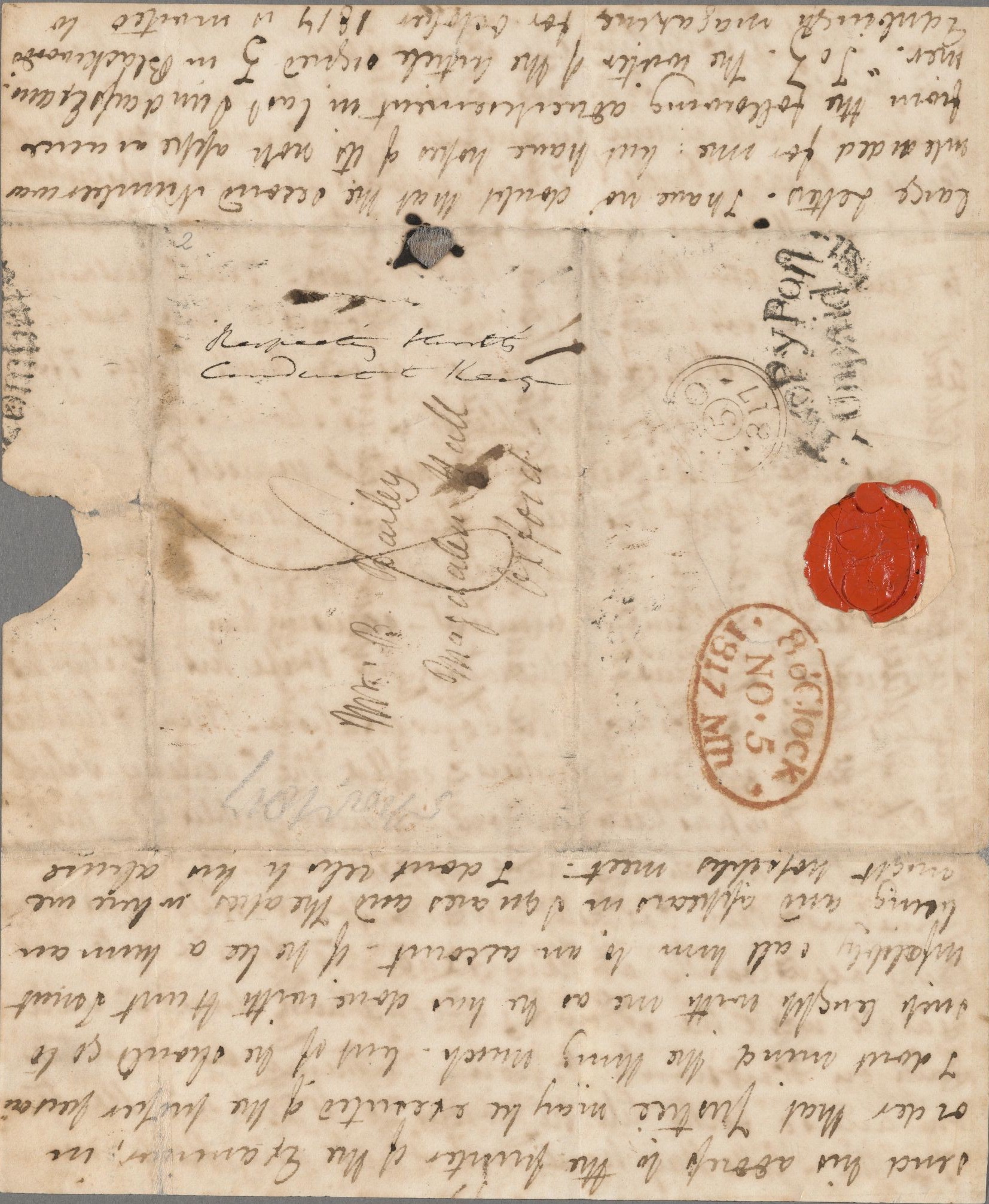
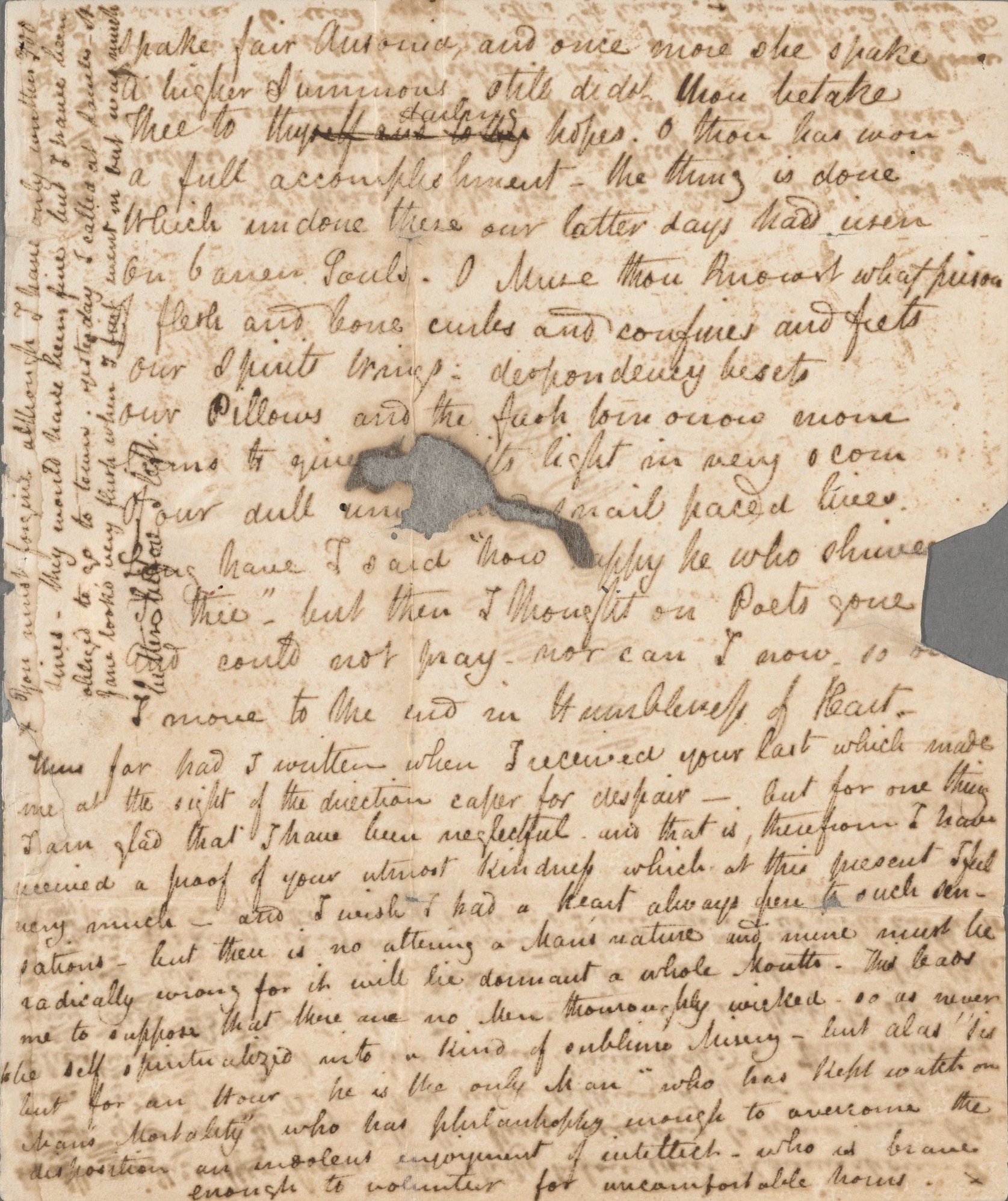
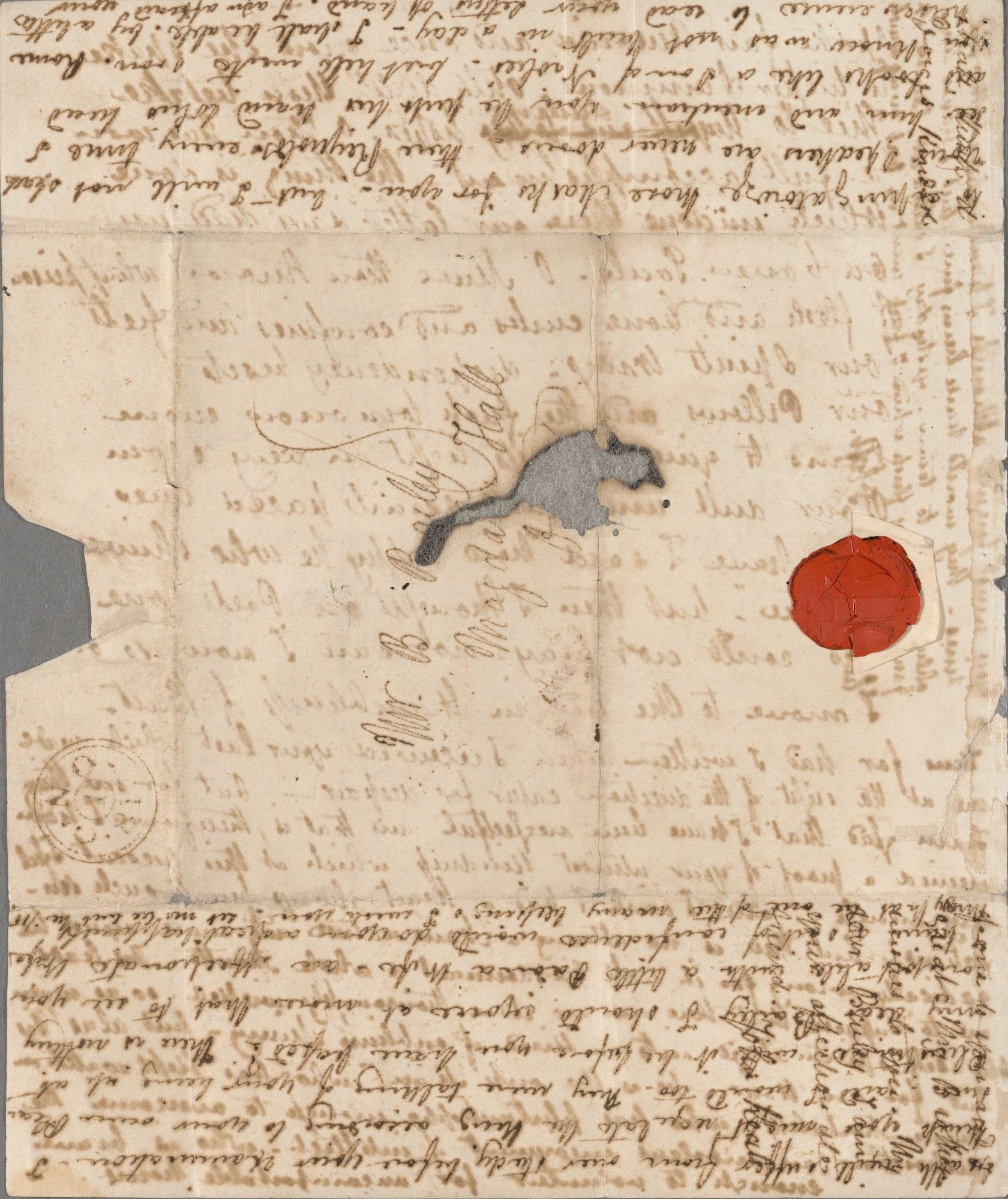
Like most of the letters to Reynolds, this one comes to us from a transcript made by Richard Woodhouse. Since Keats seems to have written the letter in the evening after his walk up Box Hill, it likely did not post until the next day, 23 November. And like the letter to Bailey, for which we have the postage information from the MS, it likely departed from Leatherhead, about five miles north of Dorking (the transcript records the location as Leatherhead and a date of 22 Nov, presumably from the postage, since Keats was not there himself–it’s unclear if the letter did indeed make it to the post late in the evening of 22 Nov and receive a stamp indicating as much, or if Woodhouse saw a 23 Nov postage date and figured out that the “Saturday” indicated at the beginning of the letter referred to 22 Nov… but we digress!). We provide you here with both the images of the Woodhouse transcript, and a reading edition from Harry Buxton Forman’s one-volume text from 1895. Enjoy!

Page 1 of Keats’s 22 November 1817 letter to J. H. Reynolds. Keats Collection, 1814-1891 (MS Keats 3.3). Houghton Library, Harvard University.

Page 2 of Keats’s 22 November 1817 letter to J. H. Reynolds. Keats Collection, 1814-1891 (MS Keats 3.3). Houghton Library, Harvard University.

Page 3 of Keats’s 22 November 1817 letter to J. H. Reynolds. Keats Collection, 1814-1891 (MS Keats 3.3). Houghton Library, Harvard University.

Letter #35: To Benjamin Bailey, 22 November 1817

Today the KLP offers quite the treat for your enjoyment: two letters from Keats and a new episode of This Week in Keats! But more important than the latest TWiK episode (which is VERY important, of course), is that these two letters contain some premium Keats. Especially in this first letter to Benjamin Bailey–which Keats wrote early on November 22, after having arrived at Dorking, about twenty miles south of the city–we find several of Keats’s most famous epistolary moments.

First it’s worth noting that Keats himself, at several different points in his letters, expresses admiration for the power of “fine Phrases” which, as he tells Bailey in August 1819, he “look[s] upon . . .  like a lover.” As we’ll see in today’s second letter, to John Hamilton Reynolds, Keats is admiring some of Shakespeare’s lovely turns of phrase today. But he is also creating several of his own. In the space of just a few sentences to Bailey, Keats writes the following: “the holiness of the Heart’s affections,” “What the imagination seizes as Beauty must be truth,” “The Imagination may be compared to Adam’s dream–he awoke and found it truth,” and “O for a Life of Sensations rather than of Thoughts!” And that doesn’t even count other highlights like the distinction between “Men of Genius” and “Men of Power,” the notion of the afterlife consisting of the “redigestion of our most ethereal Musings on Earth,” and Keats’s striking reverie: “if a Sparrow come before my Window I take part in its existince and pick about the Gravel.”

One way to make sense of this letter–and it’s a way that Brian Rejack and Mike Theune discuss in the latest episode of This Week in Keats–is to read it as anticipating the negative capability letter, which arrives at the end of December this year. Clearly at this point in his poetic development, Keats is thinking through the imagination, the particular kinds of mental characteristics necessary for poetry, and the ramifications the imaginative, poetic character has on notions of identity. These issues (among others) will continue to occupy Keats’s attention in his letters from here on out. What’s remarkable about today’s letter is how rich it is even at this early moment. Sure, more impressive things are to come, but even now–at this moment when Keats is just finishing his first real poetic challenge (Endymion)–this letter demonstrates remarkable depth of thinking about poetry and why it matters.

For a reading edition of the text, we direct you to one of our usual 19th-century editions, the one-volume text edited by Harry Buxton Forman in 1895. We also have the MS from Harvard’s Houghton Library. Like the 8 October 1817 letter to Bailey, this one was given by Bailey to John Taylor after Keats’s death and remained in the Taylor family until it was sold at auction in 1903 (to Bernard Quaritch, who sold it to Amy Lowell, who bequeathed it to Harvard). One odd feature of the MS: since Keats wrote a bit too much (even crossing all of the first page and one line on the second), he enclosed the folded letter in a second sheet of paper, on which he wrote the address on one side, and the instructions to “Direct Burford Bridge / near dorking” on the other. It’s a carelessness toward the material dimensions of the page which belies the care that seems to have gone into his construction of memorable phrases. But then again, one of the great things about the letters is how they contain such amazing achievements which emerge out of the contingencies of lived moments.

Page 2 of Keats’s 22 Nov 1817 letter to Benjamin Bailey. Keats Collection, 1814-1891 (MS Keats 1.16). Houghton Library, Harvard University.

Page 3 of Keats’s 22 Nov 1817 letter to Benjamin Bailey. Keats Collection, 1814-1891 (MS Keats 1.16). Houghton Library, Harvard University.

Page 4 of Keats’s 22 Nov 1817 letter to Benjamin Bailey. Keats Collection, 1814-1891 (MS Keats 1.16). Houghton Library, Harvard University.

Page 5 of Keats’s 22 Nov 1817 letter to Benjamin Bailey. Keats Collection, 1814-1891 (MS Keats 1.16). Houghton Library, Harvard University. Bailey added the note seen here when sending the letter to John Taylor: “Extracts from this letter might be made with great credit to the unfortunate writer’s memory. BB.”

Page 6 of Keats’s 22 Nov 1817 letter to Benjamin Bailey. Keats Collection, 1814-1891 (MS Keats 1.16). Houghton Library, Harvard University.

Keatsian Interleavings

Anne C. McCarthy
Penn State University

Re: Keats’s 5 or 12 Nov 1817 letter to the Dilkes

The following collection has been entitled Sibylline Leaves; in allusion to the fragmentary and widely scattered state in which they have been long suffered to remain.

(Coleridge 186-87)


The Cumaean Sybil, the one who is most closely associated with the prophecies written on oak leaves and scattered by winds through the cave, the figure who guides Aeneas through the underworld and sings the founding of Rome, had attracted the attention of Apollo in her youth. Ovid tells the story in the Metamorphoses. Apollo granted her a single wish—that she would live a thousand years, one for each of the grains of sand she held in her hand. But here, the foresight of the prophetess fails: she asks for life but not for youth to go along with it. And so, she shrinks and shrivels a little more each year, until her whole being is nothing more than a voice.

In her cave she was accustomed to inscribe on leaves gathered from the trees the names and fates of individuals. The leaves thus inscribed were arranged in her order within the cave, and might be consulted by her votaries. But if perchance at the opening of the door the wind rushed in and dispersed the leaves the Sibyl gave no aid to restoring them again, and the oracle was irreparably lost.

(Bulfinch 275)


He didn’t even specify the date, John Keats, when he dashed off a mock-formal note to C. W. Dilke, his wife Maria, and his brother William, requesting that whoever gets this message first send him a copy of Coleridge’s new collection of old poems gathered together for posterity from the yellowing pages of old periodicals and earlier volumes. There were a handful of poems that had never been published before, and even some juvenilia. But much of the Sibylline Leaves—or, as Keats renders it, the “Sybilline Leaves”—is made up of the kinds of poems we associate with a younger Coleridge: The Rime of the Ancient Mariner (published for the first time with the poet’s name attached and with his annotations), “The Eolian Harp,” “Fears in Solitude,” “Dejection: An Ode,” and many others. Sibylline Leaves was published the same year as the Biographia Literaria, and we know that Keats was reading both in the final months of 1817—absorbing the poetry and the philosophy, the willing suspension of disbelief and the supernatural strangeness of Coleridgean love, and—perhaps (as Richard Holmes intimates)—meditating on the song of the nightingale.

We could make out little by the dim light, but they seemed to contain prophecies, detailed relations of events but lately passed; names, now well known, but of modern date; and often exclamations of exultation or woe, of victory or defeat, were traced on their thin scant pages. This was certainly the Sibyl’s Cave …

(Shelley 3)


Dilke and Charles Brown had built a house together. Brown lived on the “lesser” side, while Dilke, Maria, and their young son Wentworth occupied the other. “It was,” as a biographer of Dilke writes, “a modest dwelling … but the surroundings were quiet and peaceful, the grounds were rolling, the air was pure …” (Garrett 5-6). Dilke met Keats in early 1817, and the young poet became a frequent visitor at a house known for its hospitality and conversation. When Keats returned to London after his 1818 walking tour, he would often make the trip across Hampstead Heath to see the Dilkes after caring for his dying brother Tom. After Tom’s death, Keats moved in with Brown and would lodge there during most of his remaining time spent in London before departing for Italy late in 1820. Thus, Keats was living in Wentworth Place when he crossed paths with Coleridge in April 1819. They talked, and Keats doubled back after saying goodbye to shake the elder poet’s hand. This becomes the stuff of legend. “There is death in that hand,” Coleridge remarked to his companion (Holmes 497). They should have met again; if nothing else, they were both authors published by Taylor and Hessey. Wentworth Place is better known to us as the Keats House.

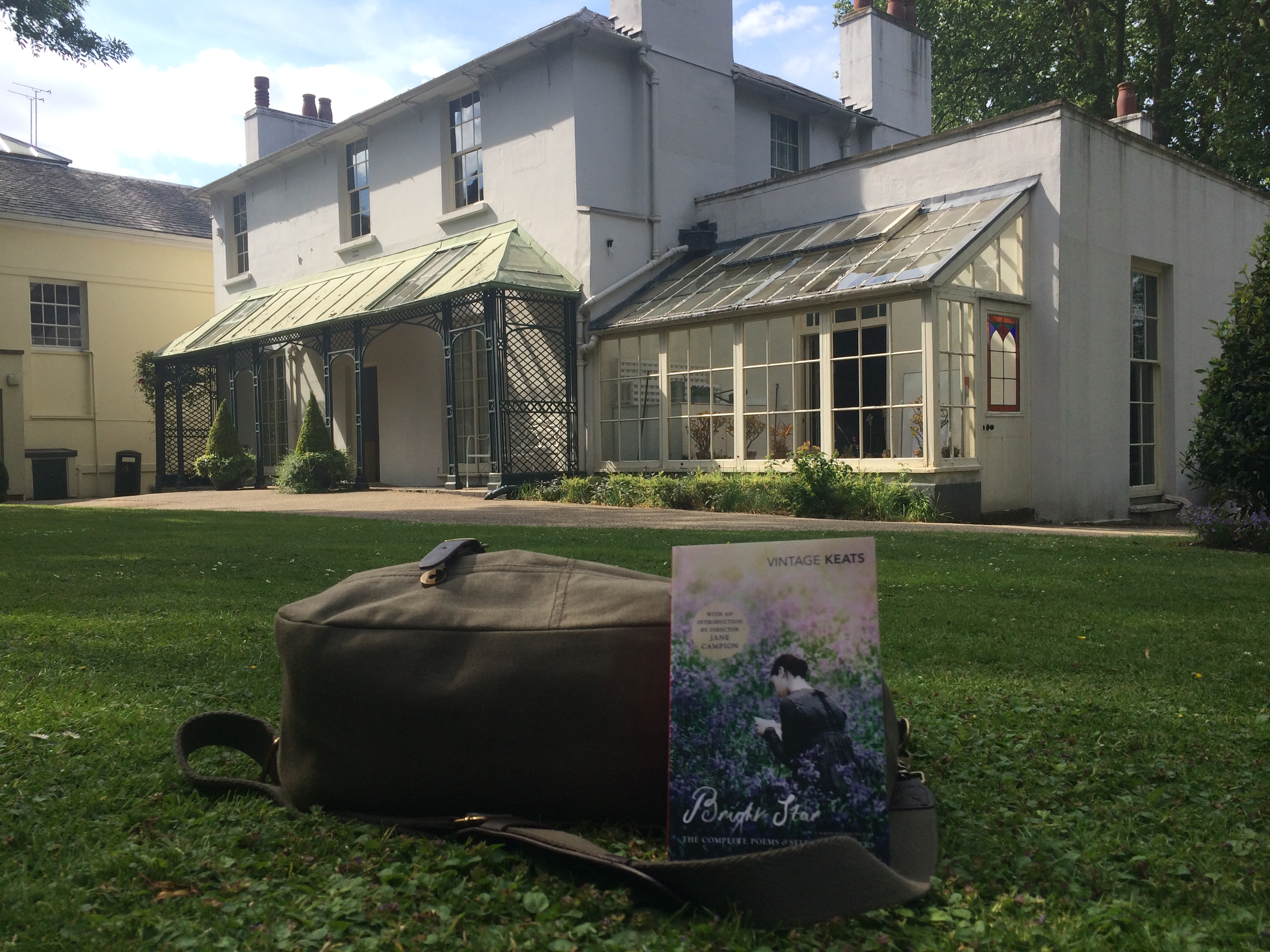
The Keats House in July 2015. Photo courtesy Brian Rejack.

When in 1829 the Paris publisher Galignani produced a pirated anthology of three English poets, Coleridge was moved to discover that his work had been chosen alongside that of Keats and Shelley. He had become one of the young English poets again, and Keats had paid the long-delayed visit to Highgate after all.

(Holmes 500)


The Sibylline leaves, stirred and scattered by the wind, remind us of the ways that our words are never entirely our own. They inhabit other temporalities, appear in places that we never visited, predict events that we cannot possibly foresee. Keats promises to his friends that he will remain “in duty bound” to their kindness in forwarding the volume—bound to a future both longer and shorter than the one he anticipates. Our inscriptions exceed and escape us, they take on inhuman lives of their own and render us posthumous observers of the future to come. But on “this Wednesday morning of Novr 1817,” all of that remains in the future, casting only the faintest of shadows on Keats’s present. What is contained in this vision—the fatefulness, the fatedness—continues to unfold across many other Wednesday mornings and through many other Novembers.


Works Cited

Bulfinch, Thomas. Bulfinch’s Mythology: The Age of Fable; The Age of Chivalry; Legends of Charlemagne. T. Y. Crowell Company, 1913.

Coleridge, Samuel Taylor. Coleridge’s Poetry and Prose. Ed. Nicholas Halmi, Paul Magnuson, and Raimonda Modiano. Norton, 2004.

Garrett, William. Charles Wentworth Dilke. Twayne Publishers, 1982.

Holmes, Richard. Coleridge: Darker Reflections, 1804-1834. Pantheon, 1999.

Ovid. The Metamorphoses of Ovid. Trans. Mary McInnes. Penguin, 1955.

Shelley, Mary Wollstonecraft. The Last Man. Ed. Anne McWhir. Broadview, 1996.

Letter #34: To the Dilkes, 5 or 12 November 1817

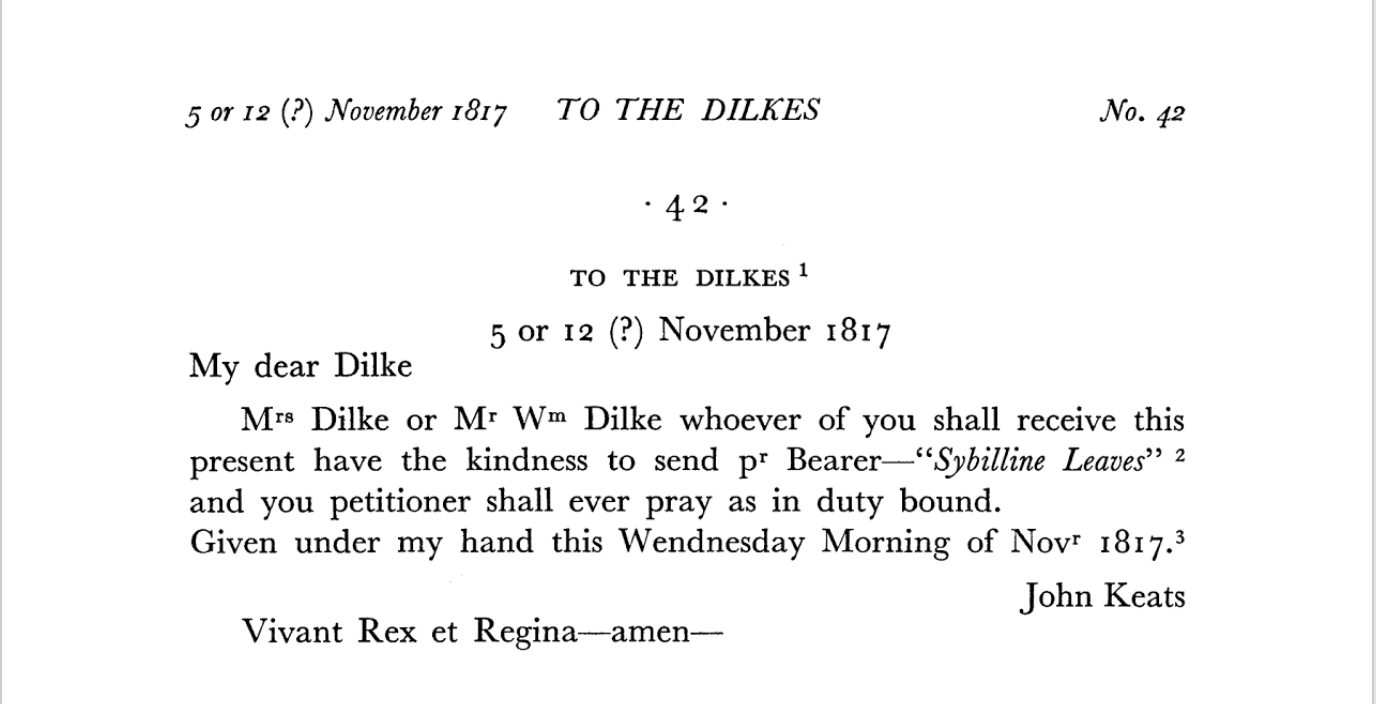
Today’s letter dates to either 5 or 12 November, and as is our wont, we’re going with the latter date for our post. It’s a seemingly inconsequential letter, but it is nonetheless significant for a few reasons. First, it’s a first! This letter is the first sent to Charles Dilke (and also addressed to Dilke’s wife Maria, and his brother William, or whoever will send Keats a book!). The Dilke family will become more and more significant to the Keats story, particularly after the second half of 1818, once Keats started to share Charles Brown’s half of the house in Hampstead which Brown and the Dilkes owned together. That house remains and is now the Keats House–if you haven’t made a pilgrimage there, then get to it! Among many other treasures, the MS of today’s letter is there (technically it’s probably at the London Metropolitan Archives, where most of the Keats Museum’s collection resides when not on display at the house itself).

The letter also shows Keats in one of his common epistolary modes: the mock formal. One wonders what other funny little notes like this one were dashed off in a hurry two hundred years ago only to disappear into obscurity like so many scattered leaves. Even in the moment of a mundane matter like requesting his friends send him a book we can see Keats’s humor and goodwill come through. As the KLP’s own Anne McCarthy writes in her response to the letter, one never knows how one’s words will persist and take on lives of their own. Despite its inconsequential subject matter, even this little scrap contributes to the Keatsian archive, and we celebrate it for surviving into the present.

John Keats to the Dilkes, 5 or 12 Nov 1817.

On the Difficulty of Loving Keats AND Blackwood’s

Nicholas Mason
Brigham Young University

Re: Keats’s 3 Nov 1817 letter to Benjamin Bailey.

As a long-time fan of both John Keats and Blackwood’s Edinburgh Magazine, reading the poet’s 3 Nov 1817 letter to Benjamin Bailey is a bit like watching two favorite sports teams duke it out on the field. The undeniable – and only slightly guilty – pleasures of seeing the Blackwood’s gang clobber would-be laureates from the “Leg of Mutton School” (country-house poets whose chief aim is landing a spot at the local squire’s dinner table) and the “Sable School” (specialists in boot blacking jingles) vanish altogether when the object of the magazine’s derision is as sympathetic, and, in 1817, vulnerable as Keats. In real ways, it’s as squirm-inducing a spectacle as witnessing your plucky little hometown team endure a six-touchdown beat-down at the hands of the powerhouse team of your youth.

If we are to believe the popular blogger and podcaster Bill Simmons, such confusing and traumatic fan experiences might easily be avoided in the realm of sports if boosters were to stop violating one cardinal commandment: don’t practice “sports bigamy.” In Simmons’s mind, “Sports teams are just like wives … you can only have one wife, you can only have one sports team.” Needless to say, then, this transgression goes from lamentable to positively heinous when the second spouse is a long-time rival of your first. A special place in hell, it would seem, is reserved for the Yankees fan who carries a flame for the Red Sox or the Celtic supporter who owns a stitch of Rangers apparel.

Compared to the strict monogamy Simmons prescribes for the truly orthodox sports fan, the diehard enthusiast for particular artists has it relatively easy. Here the commitments are comparatively lax, as–to follow the nuptials metaphor–open marriages, polygamy, and even free love aren’t altogether prohibited. Within this code, adoring Elena Ferrante not only doesn’t preclude buying the complete works of Karl Ove Knaussgard but might even incentivize it. Likewise, immersing oneself in Joyce is an entirely natural gateway to falling head over heels for Beckett or Woolf.

Still, it’s not a complete love-in, as taboos against rooting for a hated rival can be as strict in the arts world as in sports. Contemporary popular culture offers a slew of famous feuds – think, for instance, of East Coast vs. West Coast, Stars Wars vs. Star Trek, Oasis vs. Blur, Team Edward vs. Team Jacob – spilling over from the page, disc, or screen to the middle-school hallway or the streets. Yet high-brow literature can be just as prone to high-profile spats that force fans to choose teams. Just ask those queuing up at a Jennifer Weiner book signing about their enthusiasm for the new Jonathan Franzen novel, or poll John le Carré diehards about the genius and nobility of Salman Rushdie.

Fortunately, any prohibitions against reading or, worse, enjoying a favorite authors’ rivals tend to go to the grave with the writers in question. It’s hard to imagine, for instance, that legions of Gore Vidal readers still refuse to read Norman Mailer. And it’s equally unlikely that the Samuel Richardson scholar might risk imperiling his or her reputation by admitting a fondness for Henry Fielding.

Even so, certain rivalries fade more slowly than others, and the Cockneys vs. Blackwood’s spat is a prime example of how long such feuds can continue infecting the organisms of literary history. During the lifetimes of the principal combatants – John Gibson Lockhart (the “Z.” of the original Cockney School attack), John Wilson, and William Maginn on the one side and Keats, Leigh Hunt, and William Hazlitt on the other – roughly equal numbers of readers and commentators sided with either group, with the divide largely falling on partisan lines (i.e., conservatives siding with Blackwood’s and liberals with the Cockneys).

Beginning in the mid-nineteenth-century, however, when the literary reputations of Keats, Shelley, and Hazlitt were ascendant and those of Lockhart, Wilson, and Maginn were rapidly waning, admission to the Keatsian or Hazlittean fraternity seemingly required swearing eternal enmity toward Blackwood’s. Leading literary anthologies and histories uncritically propagated the Shelleyan myth that Keats’s was a death by a thousand cuts at the hands of Tory reviewers – never mind the tuberculosis or Keats’s admirable inclination to take the Blackwood’s attacks in stride. Much to the poet’s credit, in fact, in his 3 November 1817 letter to Bailey, he is much more splenetic over his friend’s being denied a promised curacy (“I cannot express how I despise the Man who would wrong or be impertinent to you”) than his own rough treatment at the hands of the mysterious “Z.” (“I don’t mind the thing much”).

Paradoxically, though, Keats’s refusal to follow Leigh Hunt’s lead in using the Examiner to excoriate Blackwood’s or sending William Blackwood cease-and-desist letters seems to have resulted in his supporters feeling compelled to avenge his honor well beyond the standard statute of limitations. While the Treaty of the Canon Wars might have brought an ecumenicalism to literary studies whereby few writers have committed genuinely unforgivable ideological or aesthetic sins, Keats partisans remain unusually disinclined to extend such grace to Blackwood’s.

Nevertheless, there are promising signs that even this literary equivalent of the Hatfields and McCoys feud might be headed toward rapprochement. In my experience, the very same scholars who passionately articulate how the field of British Romanticism has impoverished itself by neglecting the age’s most ingenious literary magazine are quick to acknowledge how sneaky, misleading, and heartless Blackwood’s leading lights could be when pursuing a cause.

On the other side of the divide, important studies like Jeffrey Cox’s Poetry and Politics in the Cockney School have begun demonstrating that the fair-minded scholar can respect the memories of Keats and Hunt while simultaneously appreciating the ideological, professional, and aesthetic imperatives that drove Blackwood’s to declare war on the Cockneys. At the end of the day, then, while it’s completely human to wince at the Blackwoodian bullying that threatened Keats’s poetic career before it had even begun, we might finally have arrived at the moment when one can declare allegiance to both the London and Edinburgh squads without risking charges of literary bigamy.


Contributor bio:
Nicholas Mason is Professor of English at Brigham Young University. He served as the general editor of
Blackwood’s Edinburgh Magazine, 1817-1825: Selections from Maga’s Infancy (Pickering and Chatto, 2006), a six-volume scholarly edition that offers annotated versions of the entire Cockney School series and includes various other reviews and parodies of Keats, Hunt, and their circle. Mason also touches on the Cockney School debates in his recent monograph, Literary Advertising and the Shaping of British Romanticism (Johns Hopkins UP, 2013), where he contextualizes Blackwood’s‘ attacks in terms of the magazine’s disdain for widespread self-reviewing within the Hunt circle.

Letter #33: To Benjamin Bailey, 3 November 1817

And so the dark times begin… In today’s letter to Bailey, Keats briefly discusses the appearance of what he calls “a flaming attack upon Hunt in the Endinburgh Magazine.” That attack was, of course, the first battle in the notorious “Cockney School of Poetry” flamewars. After six months of a tepid debut, the Edinburgh Monthly Magazine, edited by Thomas Pringle and James Cleghorn, was relaunched in October 1817 with William Blackwood, John Wilson, and John Gibson Lockhart leading the way in a more combative, playful, and sensationalist manner. Lockhart’s “Cockney School of Poetry No. I,” written under the sign of “Z,” became one of several incendiary pieces in that first issue which showed that the Blackwood’s crew was bringing artillery to a knife fight.

It’s a funny thing to reflect back on Blackwood’s from the perspective of 2017, when an insult like Z’s of Hunt, that “He talks indelicately like tea-sipping milliner girl,” seems tame in comparison to precisely 97.3% of all content on Twitter (*not an actual statistic*). But if the KLP might for a moment defend Blackwood’s and Twitter, as much as both might sometimes feel like cesspools of the worst human affects, they also contain their fair shares of brilliant wit, savvy self-reflexivity, and incisive cultural analysis. As Nicholas Mason writes in his response to today’s letter, it ought to be possible for us to appreciate both Blackwood’s and Keats, even as the former ends up treating the latter with such virulent nastiness.

That said, it is true that the Cockney School attacks cast a long shadow over the reception of Keats across the nineteenth century (and, arguably, continuing into today). With that in mind, the KLP shares Mason’s sense that it’s important to remember that Keats himself was much more upset by an injustice done to his friend Bailey–he spends the greater part of the letter on that topic–than by Z’s promise to place Keats in his cross-hairs next. He writes here, “I dont mind the thing much,” and in late 1818 after Cockney School No. IV does take up Keats in full, he makes his famous declaration to George and Georgiana, “This is a mere matter of the moment–I think I shall be among the English Poets after my death.” If Keats doesn’t feel too bad about Blackwood’s and Z, then perhaps we can move on as well. After all, Keats was right about being among the English Poets! Take that, Z!

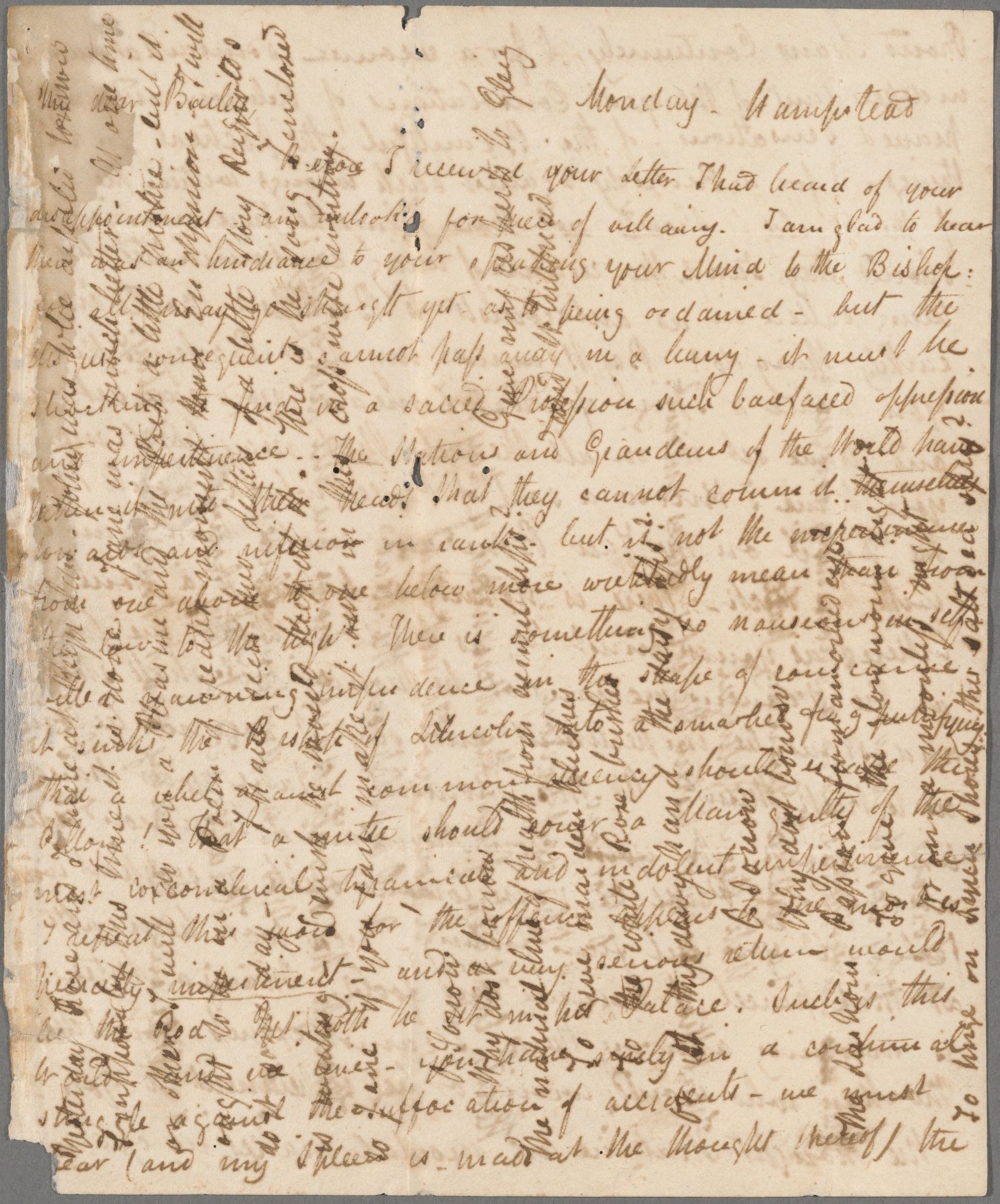
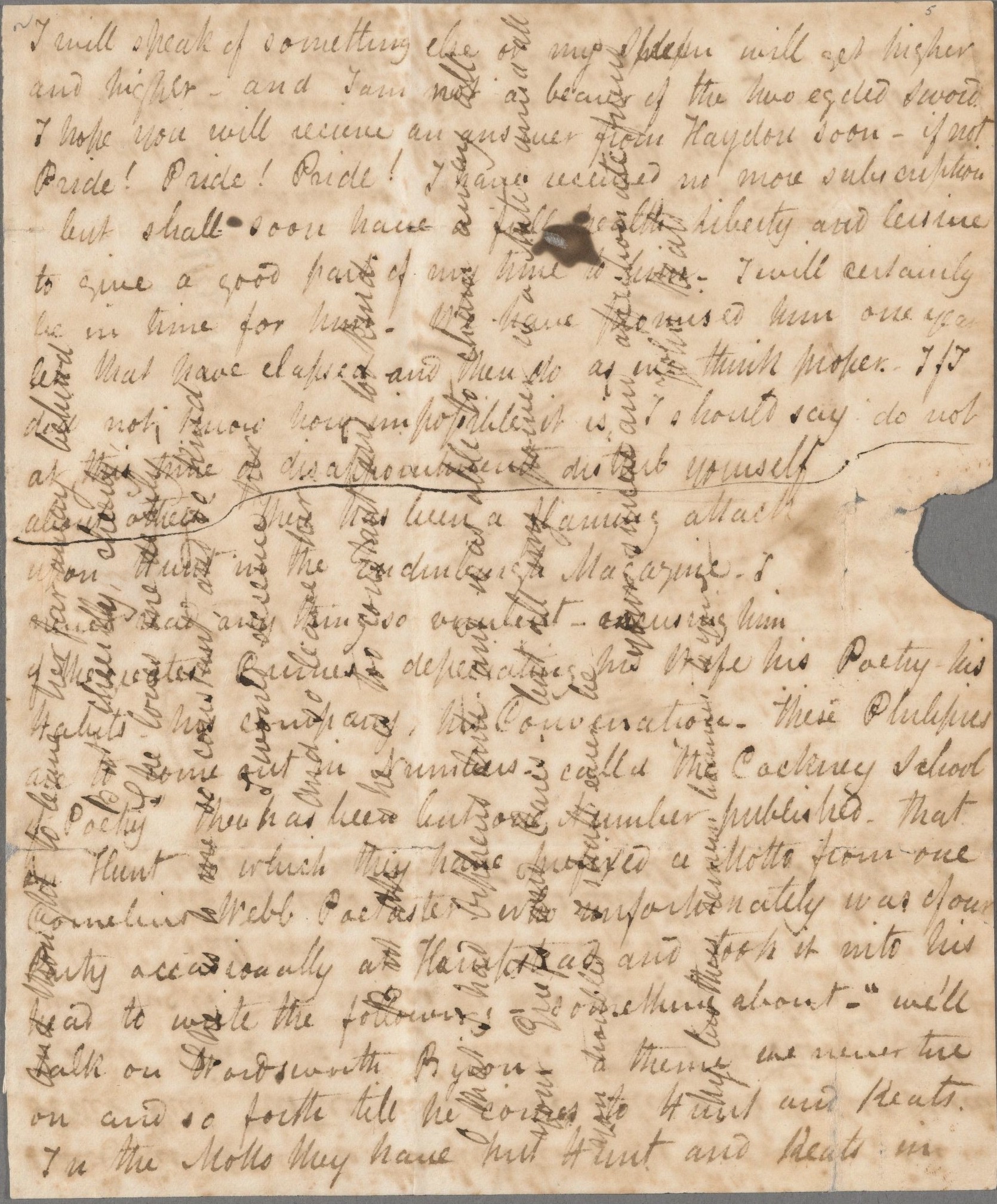
As mentioned, today’s response comes from Nicholas Mason, who uses an appropriately-time sporting metaphor (the World Series having just concluded) to delve into the Blackwood’s context. Images of the letter come courtesy of Harvard’s Houghton Library (the letter is partially crossed, so have fun with that!). The reading edition from Harry Buxton Forman includes only a portion of the letter (the portion in which Keats discusses Blackwood’s). Bailey sent just one leaf of the letter to John Taylor in 1821, presumably keeping the other to himself since it concerned only Bailey’s personal matters. That portion of the letter remained in Bailey’s family (and, thus, must have traveled with him to Sri Lanka and remained there for many years–see the previous letter to Bailey). It was not until 1953 that the first leaf was reunited with the second when it was presented to Harvard.

Page 1 of Keats’s 3 Nov 1817 letter to Benjamin Bailey. Keats Collection, 1814-1891 (MS Keats 1.15). Houghton Library, Harvard University.

Page 2 of Keats’s 3 Nov 1817 letter to Benjamin Bailey. Keats Collection, 1814-1891 (MS Keats 1.15). Houghton Library, Harvard University.

Page 3 of Keats’s 3 Nov 1817 letter to Benjamin Bailey. Keats Collection, 1814-1891 (MS Keats 1.15). Houghton Library, Harvard University.

Page 4 of Keats’s 3 Nov 1817 letter to Benjamin Bailey. Keats Collection, 1814-1891 (MS Keats 1.15). Houghton Library, Harvard University.

Keats Underlined

Brian Rejack
Illinois State University

Re: Keats’s 31 October letter to Jane Reynolds

Leave it to the consistently generous and kind-hearted Keats to give a gift to someone else on his own birthday. He seemed to never care all that much about his birthday (or to even know exactly on which day it fell). In the first of his many great journal letters sent across the Atlantic to George and Georgiana Keats, he ends with an almost throwaway postscript—“This day is my Birth day”—as if he just realized the fact himself in that moment (I, 405). It’s perhaps an afterthought because he’s so concerned about his brother and sister-in-law who are no longer with him. Likewise, in this brief letter to Jane Reynolds precisely one year earlier, Keats cares more about her well-being than about commemorating his date of birth.

Two days earlier, on 29 October, Keats had dined with the Reynolds family at their residence in Lamb’s Conduit Street. After the visit he noted in another letter to Benjamin Bailey that “Jane look’d very flush when I first went in but was much better before I left” (I, 175). It’s not entirely clear what the “flush” indicates, but presumably Jane was feeling unwell in some manner. This fact becomes clearer in today’s letter, in which Keats writes, “I hope you are getting well quite fast.” To help along her convalescence, Keats includes part of the “Ode to Sorrow,” the little ditty sung by the Indian Maid to Endymion in Book IV of the poem. He prefaces the poem thus: “I send you a few lines from my fourth Book with the desire of helping away for you five Minutes of the day—” (I, 176).

As many scholars have shown, Keats’s medical training informs his thinking about poetry continuously throughout his career, perhaps best exemplified in The Fall of Hyperion, where Keats poses the poet as a “physician to all men” who “pours out a balm upon the world.” (Books by Hermione de Almeida, Donald Goellenicht, and James Allard are great places to go for thorough treatments of Keats and medicine.) Here in late 1817—when Keats has given up his medical career and his rounds at Guy’s Hospital, and before he’ll become a nurse (and hospice worker) for his brother Tom in autumn 1818—we see Keats the physician nonetheless still in practice. It’s but one small unremembered act of kindness among a life of many performed by John Keats.

The poem itself is of interest for many reasons. It shows Keats engaging with a trope he’ll return to again and again in future poems: the yoking together of sorrow and joy. Of course there is “Welcome joy, and welcome Sorrow,” written towards the end of 1818, and the more famous union of Joy and Melancholy in the “Ode on Melancholy” from spring 1819. But I want to dwell on a very minor detail: Keats’s use of underlining in two places in the extract sent to Jane (Keats does not underline anything in the same extract he sends to Bailey in a letter a few days later). This underlining raises a few questions I’ll attempt to answer: why does Keats underline these four words? and what are Keats’s underlining practices like across his correspondence? The latter question is of particular interest for a letter coming up at the end of this year: the negative capability letter! Or, rather, I should say, the Negative Capability letter.

Detail of transcript of Keats’s 21-27 Dec 1817 letter, showing the underlining of Negative Capability. MS Keats 3.9 (Houghton Library, Harvard University).

The question about Keats’s intentions in these cases of underling, I confess, mostly baffles me. The first word underlined is “among,” which occurs at the end of the poem extract’s third stanza: “That thou may’st listen the cold dews among.” The second instance occurs in the next stanza: “Though he should dance from eve till peep of day.” If I had to hazard a guess, I’d say Keats is probably making some sort of joke or bit of word play that doesn’t land for me in a way it might have for Jane Reynolds. Perhaps there was some humorous bit of conversation at the dinner gathering on October 29 which the words “among” and “peep of day” would have signaled for her? It’s not like “among” is a particularly important word—why draw attention to it? I could see Keats maybe being proud of “peep of day” and underlining it to draw attention there. But really, I’m at a loss with these examples of underlining when it comes to what purpose underlining was meant to serve.

Part of the reason that my first hazarded guess goes to the possibility of something humorous is that I’ve done a lot of work tracking instances of underlining in Keats’s letters, and he almost always uses the tactic for some humorous, playful, or punny effect. I became interested in underlining in Keats because of negative capability, which occurs only once in Keats’s correspondence, and when it does, it is underlined. However, the negative capability MS is not extant! We have the text of the letter only because of a shoddy transcript made by John Jeffrey, the second husband of Georgiana Keats, who married Jeffrey a few years after George Keats’s death. Since we know that Jeffrey was sloppy in his transcription work (of the fifteen letters he transcribed, nine still exist in MS form, which means one can compare his work against the originals), I started wondering what the chances were that Keats would have underlined the term. So I scoured Keats’s letters that still exist for some sense of his underlining habits. The first thing I learned is that Keats very sparing in his underlining. Out of the twenty-seven extant letters written by Keats in 1817, only eleven letters feature any underlining. In all they comprise a total of ­­­sixty-six underlined words. Of those eleven letters, four exist only via transcripts (­­three by Richard Woodhouse, one by Jeffrey), and those four transcribed letters account for forty-one of the sixty-six total underlined words. In short, if Keats did underline negative capability, it was at least somewhat out of character given how rarely he uses the tactic elsewhere in his letters. And of the ten underlined words in the negative capability letter, there’s a good chance that some, and perhaps all, were not underlined in Keats’s MS. (I’m no statistician, so I can’t back up that claim with numerical analysis. But I stand by my assertion nonetheless.)

Now, when Keats does underline, he frequently does so to produce comic effect. Particularly in his letters of 1817–8, the rare instances of underlining usually signal not gravity, but wordplay or some other form of levity. The earliest examples of underlining in Keats’s correspondence occur in his 15 April 1817 letter to George and Tom. (Demonstrating how rarely Keats underlines, the thirteen extant letters preceding this one feature no underlining at all—eleven exist in MS and two others via transcripts by Woodhouse.) Keats is not engaging in wordplay per se with his underlining in this letter, but he definitely uses it to humorous effect. The first example comes amid Keats’s playful catalog of objects he viewed while traveling by stagecoach from London to Southampton. One of these sights was a “Nymph of Fountain,” which after listing, Keats clarifies, “N.B. Stone” (i.e. no, he did not see an actual nymph). A few lines later, he returns to this same method of emphasizing his playfulness, when he relays that “after having had [his] fill” of the lamplit scenes during the night, “I popped my Head out just as it began to Dawn—N.B. this tuesday Morn saw the Sun rise—of which I shall say nothing at present” (I, 128).

Detail of letter to George and Tom Keats, 15 April 1817, showing Keats’s underlining. Courtesy Princeton University Library. Click for full size.

As with the stone nymph example, here Keats’s cheeky nota bene states the obvious: yes, the morning did indeed see the sun rise. Such underlining is anti-romantic, deflating any hope for an imaginary world of pagan wonder; it resignedly but playfully conveys acceptance that “The world is too much with us.” There may also be a bit of Keats’s “boyish imagination” on display here. That he “will say nothing about” popping his head out or about the “rise” at dawn suggests some youthful phallic humor, particularly as the previous underlined reference concerned a “Nymph of Fountain.” Whatever the actual intended messages are, Keats’s underlining certainly helps him approximate “writ[ing] a wink, or a nod, or a grin” to accompany them (II, 205).

So, again, I really don’t know why Keats underlined these four words (“among” and “peep of day”) of the extract from Endymion in today’s letter to Jane Reynolds. But given that he’s hoping to “help away … five Minutes of the day” for her while she’s convalescing, I can’t help but think that he sought to add a bit of humor to his poetic prescription.

Letter #32: To Jane Reynolds, 31 October 1817

While in the midst of writing his multi-day letter to Bailey, Keats dined with the Reynoldses on 29 October. As he told Bailey when he returned to letter later that evening, he had found Jane a bit under the weather. On 31 October, he decided to send her a bit of his latest from Endymion, with the hope of “helping away for you five Minutes of the day.” What a guy. And he’s doing this on his birthday! Which, by the way, happy birthday, Keats! On completing his 22nd year, Keats had one book of poetry published under his name, and he was only a few hundred lines from completing the poem that would become his second book. Quite the precocious little scamp.

The MS of today’s letter is at Yale’s Beinecke Library, where they have a few Keats letters. Sadly, the KLP has been derelict in its duty of requesting images of said MS. So we can’t share that with you yet, but we shall update this post should we manage to emerge from our indolence.

The letter as first published in Amy Lowell’s biography (1925). She had access to it through Frederick Holland Day, who owned the letter at the time, and who was, like Lowell, one of the Bostonian “Keats lovers” who did so much to preserve and advance Keats’s legacy around the turn of the century. Ann Rowland has been doing fantastic work on Keats’s American reception, and you can find her latest on the topic in the most recent issue of the Keats-Shelley Journal! We’re not sure how the letter ended up at Yale, although Rollins notes that someone named Mitchell Kennerley owned it after Holland Day did. Again, were we not indolent (and pressed for time!), the KLP could tell you more. But for now, that’s it–time to go trick-or-treating!

Keats’s 31 Oct 1817 letter to Jane Reynolds (from The Letters of John Keats, ed. Hyder Edward Rollins, Cambridge: Harvard UP, 1958.)


Letter #31: To Benjamin Bailey, 28-30 October 1817

Keats’s progress on Endymion continues to be steady, as he now heads toward completion of Book IV. In this multi-day letter to Bailey, Keats includes the opening lines of the poem’s final book. He’ll also quote the ‘Ode to Sorrow’– the little song or ’roundelay’ which the Indian Maid sings to Endymion at the opening of Book IV–in his next letter to Jane Reynolds, and then again to Bailey on 3 November. This letter to Bailey also includes some criticism of Wordsworth, via Hazlitt, which hints at the more full-throated criticism to come in spring 1818 (when Keats will decry poetry that has a “palpable design upon us”) and fall 1818 (when Keats will distinguish his notion of the “poetical Character” from that of “the wordsworthian or egotistical sublime”).

As you can see from the below images, this letter is one of Keats’s more difficult to read letters. The letter is crossed. Although the KLP could have sworn we’d already come across a crossed letter, it appears that today’s letter is the first example of such a thing from Keats. So, let’s explain what a crossed letter is. We have four pages: two leaves formed by folding one sheet. Typically the letter-writer writes on each of the four pages, leaving the proper space on the last page for folding and addressing. After writing on all of those spaces, the letter-writer would go back to page 1, rotate the paper 90 degrees, and write cross-wise over the original writing. It allows the writer to include twice as much writing on the same amount of paper. It also makes it a bit difficult to read!

Keats does some weird stuff, though, that makes it even harder to follow what’s happening in this letter. It appears that Keats wrote only on the first three pages, and then went back to page one, rotated the sheet, and started writing cross-wise. Things get tricky again on page two, because Keats had copied the lines from Book IV of Endymion, and Keats seemed to think that he ought not to write cross-wise over the lines of verse. As such, after writing cross-wise on page one, Keats then went to page 4 (which he had not yet written on at all), where he wrote the remainder of the letter on the wings (the top and bottom spaces which would be folded into the sheet before being addressed and sent).

But wait, there’s more! Keats crossed his writing on the wings, or at least part of the original writing, taking up enough space to get in his parting wishes for Bailey to find marital bliss (“with a little Peona Wife”). Then, not content to leave any blank spaces, Keats goes back to page two, and writes cross-wise in the space left available from the indented lines of verse and over the prose writing from the first go-through on the top half of the page. Then on page three he adds a little “x” at the bottom right corner which points toward another “x” in the blank space on the left side of the page where Keats writes one final little post-script.

All of this is to say, Keats sure is all over the place! One suspects that Bailey found himself a bit lost in this “sea of prose.” He kept the letter for several decades, however, taking it with him to Sri Lanka (then Ceylon), where he became Archdeacon at Colombo. Richard Monckton Milnes, in 1848, incorrectly consigned Bailey to the grave, noting in his Life, Letters, and Literary Remains of John Keats that “Mr Bailey died soon after Keats.” In October of 1848, after having read of his own early demise, Bailey wrote a letter to Milnes explaining that he was in fact still alive and well. With his letter to Milnes, Bailey included the MS of the 28-30 October 1817 letter, and offered to let Milnes print the letter in any future editions of his life of Keats (he did so in the updated edition published in 1867). This particular letter, then, spent many years far from London and Oxford, between which it first traveled back in 1817. The letter remained in Milnes’s family collection and eventually found a home at Harvard’s Houghton Library.

Courtesy of Harvard, here are images of the letter–good luck trying to track all of Keats’s scribblings! A print version of the letter can be found here, via Harry Buxton Forman, who used Milnes 1867 Life as his copy text. He follows Milnes in leaving out the Endymion extract and some other minor parts.

Page 1 of Keats’s 28-30 Oct 1817 letter to Benjamin Bailey. Keats Collection, 1814-1891 (MS Keats 1.14). Houghton Library, Harvard University.

Page 2 of Keats’s 28-30 Oct 1817 letter to Benjamin Bailey. Keats Collection, 1814-1891 (MS Keats 1.14). Houghton Library, Harvard University.

Page 3 of Keats’s 28-30 Oct 1817 letter to Benjamin Bailey. Keats Collection, 1814-1891 (MS Keats 1.14). Houghton Library, Harvard University.

Page 4 of Keats’s 28-30 Oct 1817 letter to Benjamin Bailey. Keats Collection, 1814-1891 (MS Keats 1.14). Houghton Library, Harvard University.

Poetry as Labor; or, Keats Gets Down and Dirty

Deven Parker
University of Colorado, Boulder

Re: Keats’s 8 October letter to Benjamin Bailey

In his letter to Benjamin Bailey on October 8, 1817, Keats quantifies poetic fame: to be a great poet, he argues, one must write a poem of at least four-thousand lines. The passage, originally excerpted from a letter he wrote to his brother George the previous spring, documents his attempt to reach this goal by writing Endymion (1818), the famously bad “poetic romance” that garnered so much attention in the press. Keats writes:

The high Idea I have of poetical fame makes me think I see it towering high above me. At any rate I have no right to talk until Endymion is finished—it will be a test, a trial of my Powers of Imagination and chiefly of my invention which is a rare thing indeed—by which I must make 4000 Lines of one bare circumstance and fill them with Poetry; and when I consider that this is a great task, and that when done it will take me but a dozen paces towards the Temple of Fame—it makes me say—God forbid that I should be without such a task! [….] Did our great Poets ever write short Pieces? [….] I put on no Laurels till I shall have finished Endymion […].”

Besides his remarkable combination of audacity and anxiety—that he presumes to crown himself with laurels even before completing a poem that he knows will be difficult—Keats uses an unusual image to describe Endymion’s writing process: that he “must make 4000 Lines of one bare circumstance and fill them with Poetry.” In this odd turn of phrase, he envisions the work’s physical shape and formal structure paradoxically preexisting its composition: its four-thousand lines serve as a holding-vessel for its contents, the poem taking the shape of the mold into which he pours it. Like a sitcom writer working under required lengths and rhythms dictated by commercial breaks, Keats keenly feels the constraints under which he writes. In addition, his claim that he must “make” four thousand lines suggests something labor intensive about his poetic process: like a carpenter or metalworker, he must manually create his work of art.

Taking my cue from this letter, this response explores how, in Endymion, Keats casts poetic composition as manual labor and calls attention to the physical and formal constraints that mediate his process, inscribing the poem with the marks of its making. I also suggest that Endymion’s repeated references to its own creation and its existence in the world as a print object partly account for its bad reception (in addition to those many political and class factors that others have brought to light). The poem’s unabashed embrace of labor marks Keats as a middle-class poet, one who, according to his Tory critics, had no legitimate claim to laurels.

In Endymion’s preface, Keats brings the work’s material constraints to the fore, allowing his compositional process to intrude on the imaginative landscape of the poem. In an unusual move, he guarantees that readers will attend to these moments of transparent self-reflexivity when he explains that:

Knowing within myself the manner in which this Poem has been produced, it is not without a feeling of regret that I make it public. What manner I mean, will be quite clear to the reader, who must soon perceive great inexperience, immaturity, and every error denoting a feverish attempt, rather than a deed accomplished (Keats 147).

We might understand “the manner in which this Poem has been produced” to refer to any of constraints under which Keats worked, including the fixed length, deadline, or the fact that printers Taylor and Hessey were eager to publish his work. We are clued in from the start that Endymion is a physical object with a concrete history of making.

In the poem proper, Keats delineates Endymion as the written remediation of an oral myth. His first readers would have been familiar with the original tale of the shepherd-prince who falls in love with the goddess of the moon from Ovid’s Metamorphoses and from classical handbooks like Lempriere’s Classical Dictionary and Tooke’s Pantheon (1809). Of course, Keats wasn’t the only one rewriting classical mythology, with Wordsworth taking up myth in book IV of The Excursion (1814) and Shelley using classical ideas in Alastor (1816). Unlike them, Keats depicts the poem’s poet-narrator as scribal rather than vocal: what is an “adventurous song” for Milton or a “solemn song” for Shelley is for Keats a written endeavor:

Therefore, ‘tis with full happiness that I
Will trace the story of Endymion.
The very music of the name has gone
Into my being, and each pleasant scene
Is growing fresh before me as the green
Of our own vallies: so I will begin
Now while I cannot hear the city’s din….
Many and many a verse I hope to write,
Before the daisies, vermeil rimm’d and white,
Hide in deep herbage; and ere yet the bees
Hum about globes of clover and sweet peas,
I must be near the middle of my story.
O may no wintry season, bare and hoary,
See it half finished: but let Autumn bold,
With universal tinge of sober gold,
Be all about me when I make an end (I: 34-40, 49-57)

The poet-narrator opens not with a sung invocation to the Muse, but what’s effectively an outline of his composition process. Instead of singing, he “traces” the story, evoking the act of putting pen to page. While the “music” of Endymion’s name inspires him, it pushes him to write rather than produce music in response. The noise of the outside world—“the city’s din”—juxtaposes the peaceful solitude of the writer’s mind as he sets a plan to write “many and many a verse” in the span of one year, using the changing seasons to mark his progress. Keats doesn’t elide the process of writing under the guise of song, but makes explicit the constraints under which he writes—his schedule for completion—as well as the bodily act of writing.

Throughout the remainder of the poem, Keats continually portrays the work as an epic of pen and paper rather than song and voice. During Endymion and Selena’s first sexual encounter in Book II, for instance, the poet-narrator conveniently interrupts by asking, “Who, who can write / Of these first minutes?” (II. 531-532) After being drawn in by the scene’s sensuous detail and evocative content, the line abruptly pulls us back into the writer’s present, preventing us from fully entering into the fictive setting. The scene of writing forcibly interrupts the story’s eroticism again in Book II:

They trembled to each other. – Helicon!
O fountain’d hill! Old Homer’s Helicon!
That thou wouldst spout a little streamlet o’er
These sorry pages; then the verse would soar
And sing above this gentle pair (II. 716-720)

The sudden invocation to Helicon, marked by an abrupt period and dash, interrupts the trembling couple, even as we learn that the sun god, a traditional source of epic inspiration, is nowhere to be found. With Helicon’s help, Keats’s verses might “soar / And sing,” but in his absence they merely consist of “sorry pages.” In these self-referential moves, Endymion draws attention to the object in the readers’ hands even in the midst of its sensuous eroticism.

Endymion makes transparent the process of poetic composition not only through explicit references to writing, pages, and pens but also through its notoriously convoluted heroic couplets. In what are usually seen as evidence of Keats’s unpracticed talent—what Jack Stillinger calls “faulty rhymes, faulty meter, and […] passages of physical and rhetorical extravagance” (xiii)—I read as Keats’s labor rising to the surface of his poem. In these moments, his couplets prove so unwieldy that they obscure the lines’ content and momentarily derail the narrative. Distracted by their artificiality, we’re unable to ignore the work’s feeling of being constructed. Especially evident in descriptions of natural imagery, Keats’s remarkably unnatural verses feel almost tongue-in-cheek:

Fountains grotesque, new trees, bespangled caves,
Echoing grottos, full of tumbling waves
And moonlight; aye, to all the mazy world
Of silvery enchantment! (I: 458-464).

Intricate wordplay and inconsistent line length distract from the images they mean to evoke. If a verse succeeds in conjuring one, another quickly replaces it. Before we can consider what “fountains grotesque” might possibly be, we’re abruptly faced with “new trees, bespangled caves / echoing grottos, full of tumbling waves.” Images and language pile up on one another until the line comes to an abrupt stop with “silvery enchantment!” Keats deploys natural imagery in heavily unnatural diction, emphasizing the texture of language instead of the images it means to convey.

In selecting excerpts of Endymion to mock, an anonymous reviewer in the British Critic pays special attention to stanzas that explicitly mention writing, including “many and many a verse I hope to write,” remarking that the poem’s “flimsy veil of words” (Cox 249) can’t hide its explicit immorality. The reviewer finds the work’s physical form only redeeming quality: “We do most solemnly assure our readers that this poem, containing 4047 lines, is printed on very nice hot-pressed paper, and sold for nine shillings by a very respectable London bookseller” (Cox 250). For this reviewer, the quality of Endymion’s medium overshadows its content—it’s “flimsy” language draws attention to the material that comprises it.

In the Quarterly Review, John Wilson Croker claims to have “painfully toiled” through Endymion’s “uncouth language” (Cox 277), which leave him unable to summarize it. He accuses Keats of playing “bout rimes” (Cox 278), a game that involves creating a poem out of a list of rhymed words, suggesting that formal constraints of rhymed couplets drive the poem forward and contribute to its incoherent narrative: “He seems to write a line at random, and then he follows not the thought excited by this line, but the rhyme with which it concludes. There is hardly a complete couplet inclosing a complete idea in the whole book. He wanders from one subject to another, from the association, not of ideas but of sounds” (Cox 278). Endymion’s formal artifice effaces the content proper. For Croker, good poetry is led on by ideas rather than language and poetic form provides an invisible structure that should support but not shape ideas.

Perhaps most telling of all, John Gibson Lockhart’s review in Blackwood’s Edinburgh Review calls Keats a “versifier” who writes “laboriously affected descriptions” (Cox 272)—perhaps suggesting that he notices the marks of labor in Endymion’s highly-wrought couplets—and claims that this kind of writing is characteristic of middle and laboring class poets. “Uneducated and flimsy striplings,” like Keats, who can’t produce “one original image” are part of the larger trend of “metromanie,” in which “our very footman compose tragedies, and there is scarcely a superannuated governess in the island that does not leave a roll of lyrics behind her in her bandbox” (Cox 272). Good poetry, Lockhart and Croker suggest, renders invisible the formal markers of its creation while the poetry of Keats and others of his class quite literally contains signs of their labor and position.


Works Cited

John Keats. The Letters of John Keats. Ed. Hyder Edward Rollins (Cambridge: Harvard University Press, 1958). Print.

–. Keats’s Poetry and Prose, Ed. Jeffrey N. Cox (New York and London: W. W. Norton and Company, 2009). Print.

Stillinger, Jack. “Introduction.” John Keats Poetry Manuscripts at Harvard (Cambridge: Harvard University Press, 1990). Print.