Letter #72: To Marian and Sarah Jeffrey, 4 June 1818

When Keats left Teignmouth back at the beginning of May, he and Tom were (most likely) accompanied on the first part of their trip by Sarah Jeffrey, one of the daughters of Margaret Jeffrey, to whom Keats sent a polite note assuring her that the beginning of their journey had gone well and that Tom’s health was stable. As explained in our post about that letter, the Keats brothers had become friendly with the Jeffreys during their stay. After their departure, they would send a few letters to them over the next year or so. Tom was the first to do so, on 18 May. At the end of that letter he wrote that “John will write to you shortly.” Well, as we say in his most recent letter to Bailey, Keats was not exactly on top of his correspondence at this time. So it took him a little over two weeks to get around to his letter. Give the guy a break!

Anyway, once Keats did get around to writing his letter to Marian/Marianne/Mary Ann and Sarah, he seems to have found some good humor. The letter is a pretty darn funny one. He begins by apologizing for his delay in writing, and then quickly turns playful: “I am a fool in delay for the idea of neglect is an everlasting knapsack which even now I have scarce power to hoist off–by the bye talking of everlasting knapsacks I intend to make my fortune by them in case of a War (which you must consequently pray for) by contracting with Government for said materials to the economy of one branch of the Revenue. At all events a Tax which is taken from the people and shoulder’d upon the Military ought not to be snubb’d at.” Who doesn’t love a good war profiteering joke? His next bit of whimsy involves a plan to clean St. Paul’s Cathedral, which had apparently turned black “on the tolling of the great Bell for the aimable and tea-table-lamented Princess [i.e. Charlotte, whose death following childbirth in 1817 had set off intense national mourning, the genuineness of which Keats questions a bit here). That idea of “sympathy in inanimate objects” leads to another illustration of the principle from one of the “veal-thigh Aldermen” reputedly discussing the plan to clean St. Paul’s. By the by, jokes about the London Aldermen as idle gourmands were commonplace in the early-19th century. Not sure if they still have that reputation. So this Alderman who suggested St. Paul’s darkened to mourn Princess Charlotte tells the story of Robert Waithman, then MP and later Lord Mayor of London, quoting Peter Pindar, at which point “the head of George the third although in hard marble squinted over the Mayor’s seat at the honerable speaker so oddly that he was obliged to sit down.”

The laugh riot continues as Keats interrupts his writing for a snuff break: “You see how badly I have written these last three lines so I will remain here and take a pinch of snuff every five Minutes until my head becomes fit and proper and legetimately inclined to scribble.” Regular readers (and regular viewers of This Week in Keats) will recall Keats spelling legitimate in this same manner all the way back in December 1816. You can see what Mike Theune and Brian Rejack had to say about the spelling in December 2016 (in the very first episode of This Week in Keats!). They still do not agree.

Keats seems to have been successful with his snuff inspiration (to use snuff one breathes it in–see what we did there???). The rest of the letter certainly feels a bit influenced by a stimulant. As is proper when one has been inspired, Keats first praises his muse: “Oh! there’s nothing like a pinch of snuff except perhaps a few trifles almost beneath a philosophers dignity, such as a ripe Peach or a kiss that one takes on a lease of 91 moments,–on a building lease.” Here we encounter the limitations of HTML to effectively present Keats’s pun on building/billing lease. Notice in the image below that he crosses our the u and the d in “building” and adds an l above the crossed-out d.
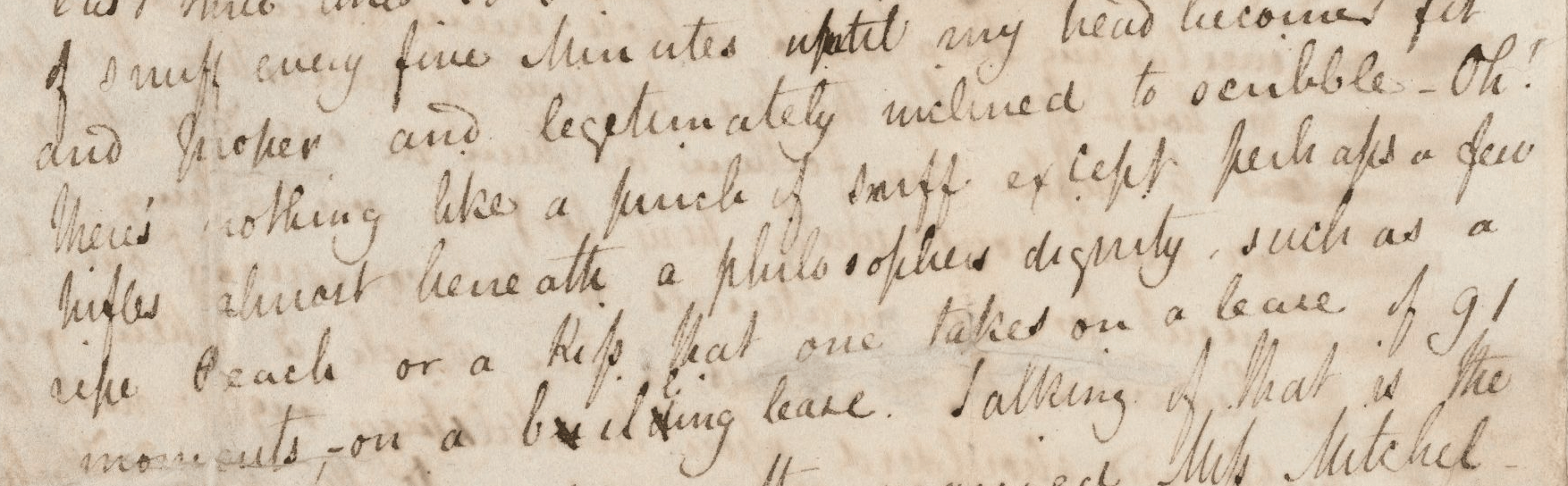
Keats’s ode to snuff, which he enjoys almost as much as a kiss taken on a building/billing lease.

Lots of possibilities regarding what Keats is hinting at here, but it certainly seems to be the case that he’s being a bit flirtatious with the Jeffrey sisters. There’s been lots of speculation about the Keats brothers’ relationships with these young women. Albert Forbes Sieveking, who first published the letters, notes that Keats writes “in terms of such warm intimacy and friendship.” Harry Buxton Forman in 1901 noted the tradition, apparently still believed in Teignmouth at that time, that Marian had been in love with Keats. More recently Angus Graham-Campbell (in the Keats-Shelley Journal in 1984) entertained the possibility by turning to Marian’s poetry.

Yes, in 1830, then recently married to Isaac Sparke Prowse, Marian published a volume, titled simply Poems, just like the first volume published by Keats, under the name Mrs. I. S. Prowse. You can read the book here. According to Rollins, the “effusions” are “up to the low standard of the 1830’s,” which, although it is a sick burn on both Marian and the 1830s, is also not that nice. And more importantly it’s also rooted in masculinist and misogynistc assumptions about canonicity. So nuts to that! We suggest you read Graham-Campbell’s much more detailed and fair assessment of the work, and of the question of what sort of relationship existed between Keats and Marian Jeffrey. The sense we gather from this letter and the two later ones to Marian is that Keats had a great fondness for the sisters, and that he also respected and valued Marian’s intellect and friendship. And while he seems not to have developed any serious romantic feelings, Keats certainly displays a bit of coy flirtation in this letter.

We’ll conclude with one of the poems from Marian Jeffrey’s 1830 volume. In the spirit of her affection for and appreciation of Keats, we’re going with “To Autumn.”

“To Autumn,” from Poems by Mrs. I. S. Prowse (Marian Prowse, née Jeffrey)

“To Autumn,” from Poems by Mrs. I. S. Prowse (Marian Prowse, née Jeffrey)

For the text of Keats’s letter we direct you to Forman’s 1895 edition. Or go ahead and practice reading Keats’s hand via the images below (courtesy of Harvard).

Page 1 of Keats’s 4 June 1818 letter to Marian and Sarah Jeffrey. Keats Collection, 1814-1891 (MS Keats 1.29). Houghton Library, Harvard University.

Page 2 of Keats’s 4 June 1818 letter to Marian and Sarah Jeffrey. Keats Collection, 1814-1891 (MS Keats 1.29). Houghton Library, Harvard University.

Page 3 of Keats’s 4 June 1818 letter to Marian and Sarah Jeffrey. Keats Collection, 1814-1891 (MS Keats 1.29). Houghton Library, Harvard University.

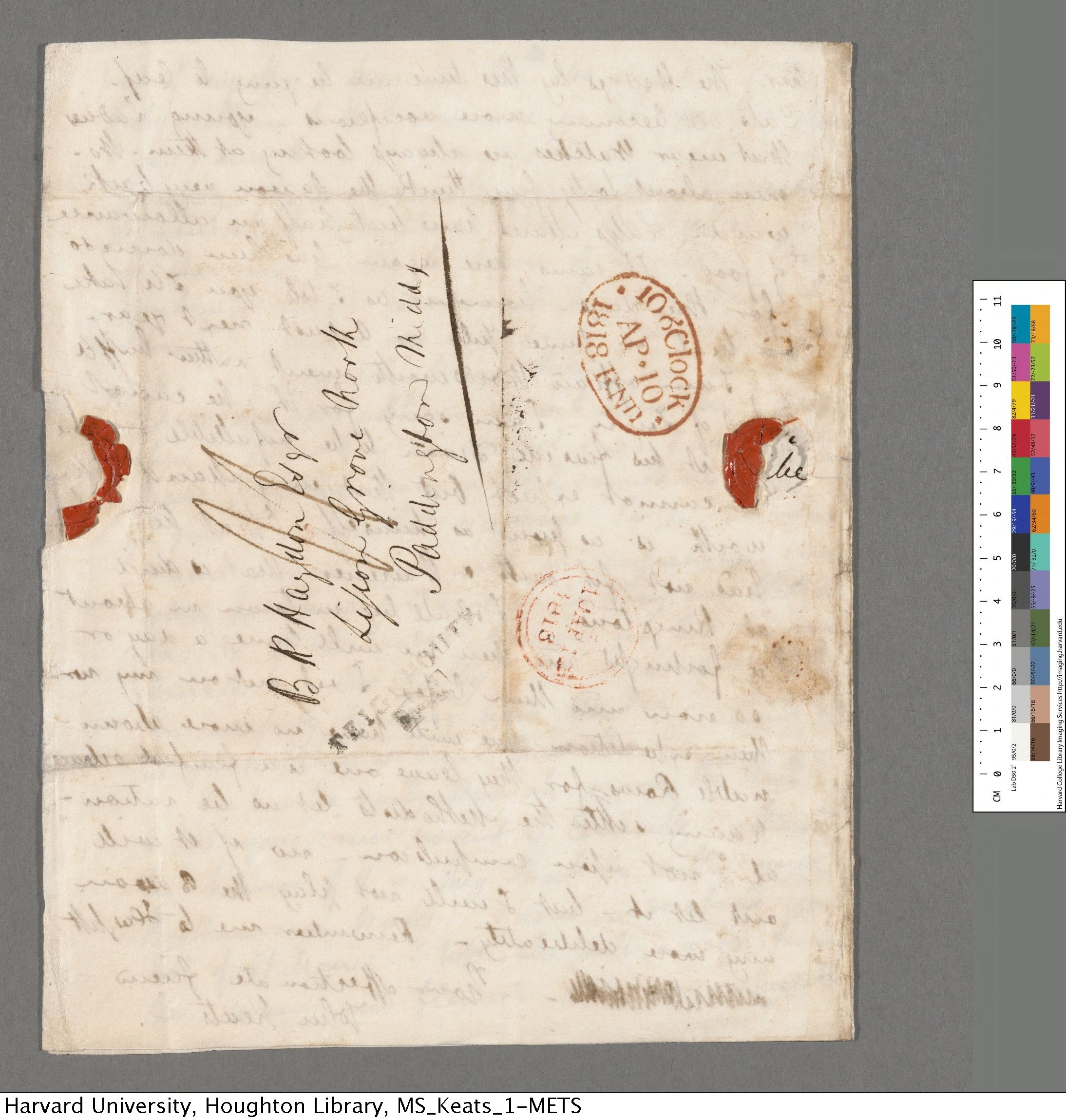
Page 4 of Keats’s 4 June 1818 letter to Marian and Sarah Jeffrey. Keats Collection, 1814-1891 (MS Keats 1.29). Houghton Library, Harvard University.

P. S. Keats has a funny post-script in his letter about other possibilities that P. S. might stand for. One sample: “Upon a Garter Pretty Secret.” See, Keats being playful, saucy, flirtatious, what have you.

P. P. S. How did this letter get delivered? You’ll notice that there are no postage marks, and no address. One possibility: in his letter two weeks prior Tom mentioned a “Mrs. Atkins” who had come to London bearing a letter from Mrs. Jeffrey. He claimed that he was thinking about sending his letter back with her, but instead he posted it. So perhaps she stuck around in London until after June 4 and then took John’s letter back to the Jeffreys? One other connection: Keats mentions “Atkins the Coachman” in his 14 March letter to Reynolds. Perhaps Mrs. Atkins was his wife?
Letter #71: To Benjamin Bailey, 21 and 25 May 1818

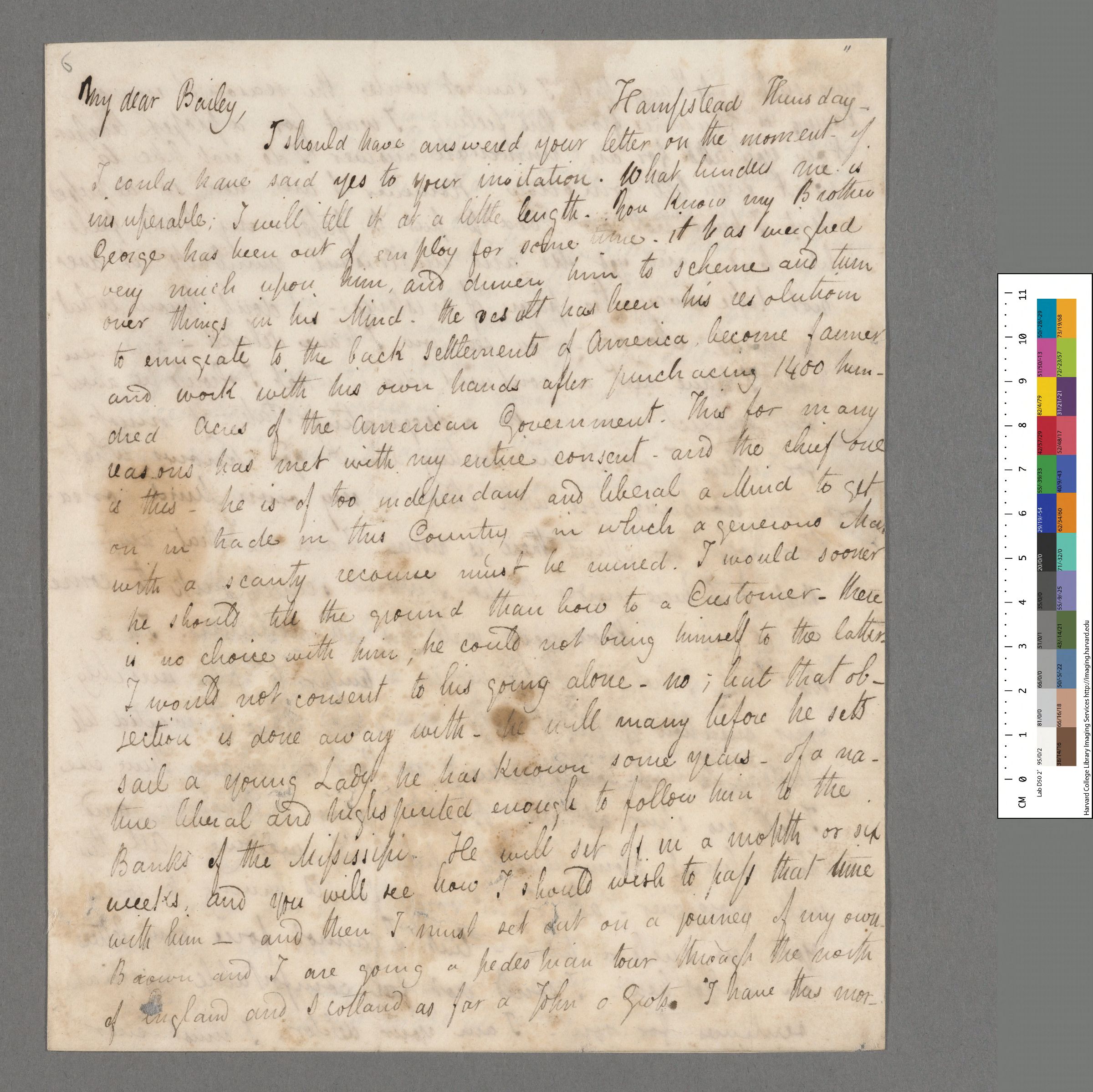
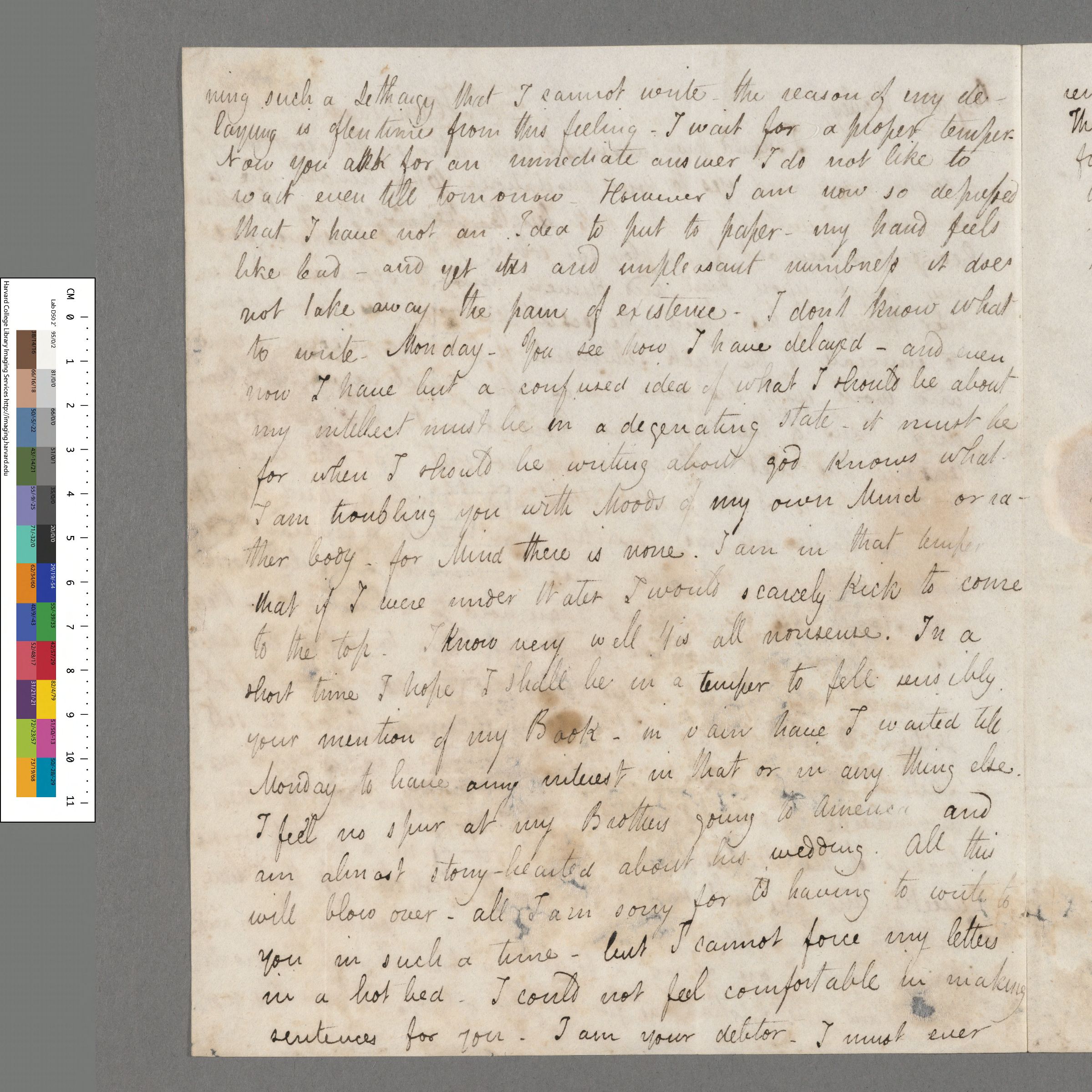
As he starts this letter to Bailey, Keats finds himself in a predicament which we’re sure no other writers ever find themselves in: feeling obligated to write but unable to do so. Here’s what Keats has to say on the matter: “I have this morning such a Lethargy that I cannot write–the reason of my delaying is oftentimes from this feeling–I wait for a proper temper–Now you ask for an immediate answer I do not like to wait even till tomorrow–However I am now so depressed that I have not an Idea to put to paper–my hand feels like lead–and yet it is and unpleasant numbness it does not take away the pain of existence–I don’t know what to write.”

After that portion of the letter, Keats doesn’t return to it for another four days! So he wasn’t kidding about not being in the proper temper. He had a pretty good excuse, though, which is more than the KLP can say for its delinquency in posting this response. Oh sure, we might try to fool you by backdating the post, but we know that you’ll see through that ruse. Ok, we admit it! It’s June and we were suffering from “a Lethargy” when this letter’s 200-year anniversary came around. If Keats can do it, so can we.

Now back to Keats’s reason for his depressed mood: it’s now official that his brother George will be emigrating to America. Keats understands his brother’s wish to seek out a better life. He notes that George “is of too independant and liberal a Mind to get on in trade in this Country–in which a generous Man with a scanty resource must be ruined. I would sooner he should till the ground than bow to a Customer.” George didn’t end up becoming a farmer, but he certainly succeeded in becoming an independent business man, and pillar of the community, in Louisville, Kentucky. One can understand why Keats would be anxious about his younger brother, however. Particularly as Tom’s health remained uncertain, the prospect of George’s departure had to be somewhat bittersweet. The three brothers had lived together almost uninterruptedly for the last few years, but now they have only a month left together. George would never again see Tom. And John would see George just one more time (for several weeks in January 1820) before his own death.

It’s perhaps unsurprising then that Keats tells Bailey on 25 May that his depression continues unabated. Indeed, it seems even worse than when he cut off the letter four days earlier. Keats offers what will become an oft-cited example of his tendency toward “melancholy fit[s]”: “I am in that temper that if I were under Water I would scarcely kick to come to the top.” He adds, “I feel no spur at my Brothers going to America and am almost stony-hearted about his wedding.” But even amidst the depression, Keats still maintains some optimism: “All this will blow over.”

And it certainly will, as Keats summons his energy to trek across Northern England and Scotland from late June to early August, and he writes some amazing letters during that trip. We also know that even if he was “stony-hearted” about George’s wedding, Keats was extremely fond of George’s wife, Georgiana Wylie Keats. The letters Keats sends to George and Georgiana in America contain some of his best epistolary writing, but also some of his most heartfelt expressions of familial love.

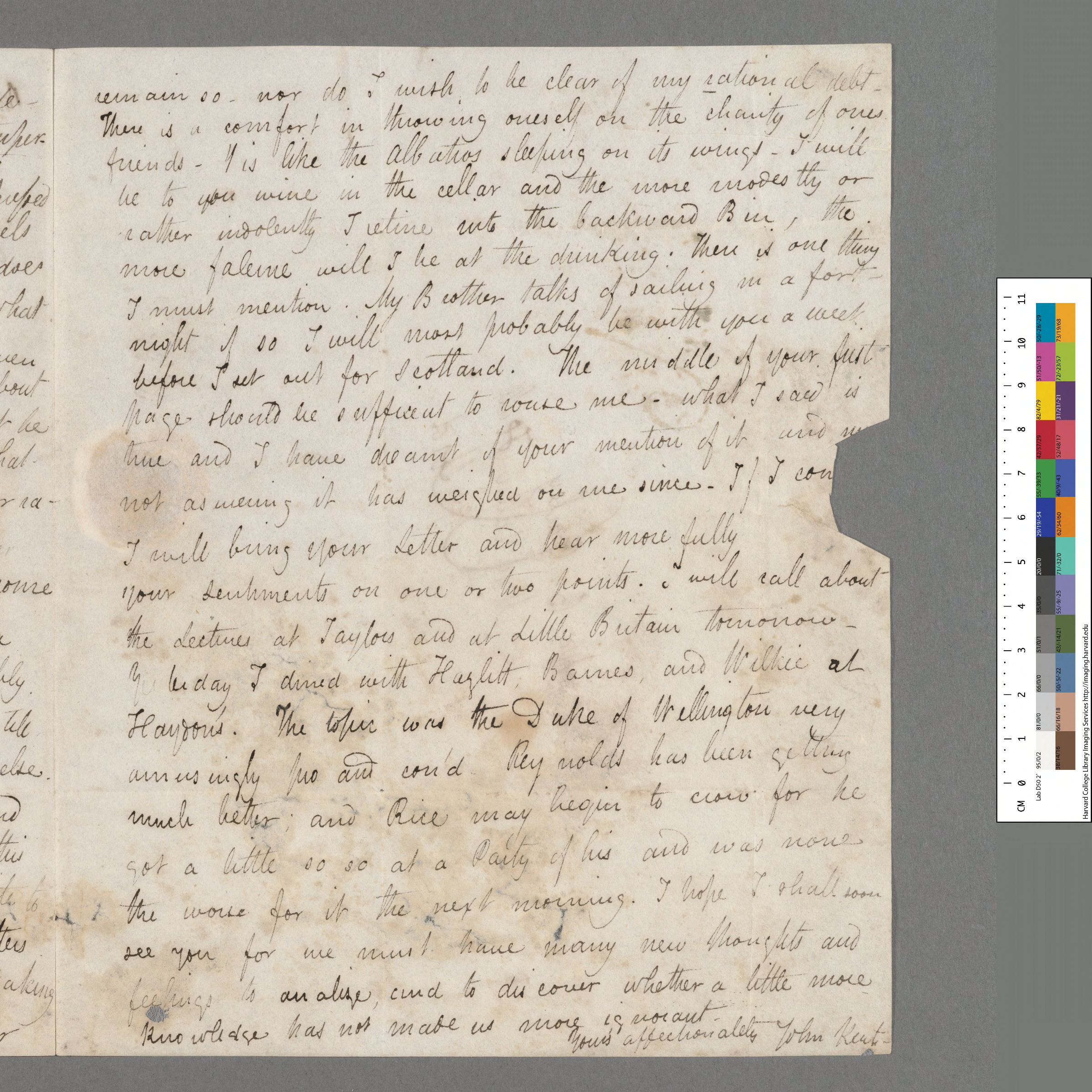
In any case, Keats makes his best effort to write something to Bailey despite his despondence. And in the process he devises a lovely metaphor for how the help of one’s friends buoy the spirit in times of trouble. Here it is: “There is a comfort in throwing oneself on the charity of ones friends–‘t is like the albatros sleeping on its wings.” And we’ll just leave it at that.

Text of the letter can be read in Harry Buxton Forman’s 1895 edition (although beware–his dates are wrong). Images courtesy of Harvard below.

Page 1 of Keats’s 21 and 25 May 1818 letter to Benjamin Bailey. Keats Collection, 1814-1891 (MS Keats 1.28). Houghton Library, Harvard University.

Page 2 of Keats’s 21 and 25 May 1818 letter to Benjamin Bailey. Keats Collection, 1814-1891 (MS Keats 1.28). Houghton Library, Harvard University.

Page 3 of Keats’s 21 and 25 May 1818 letter to Benjamin Bailey. Keats Collection, 1814-1891 (MS Keats 1.28). Houghton Library, Harvard University.

Page 4 of Keats’s 21 and 25 May 1818 letter to Benjamin Bailey. Keats Collection, 1814-1891 (MS Keats 1.28). Houghton Library, Harvard University.

Letter #70: To Margaret Jeffery, 4 or 5 May 1818

After a long stay in Teignmouth (5 months for Tom, 2 for John), the Keats brothers return to Well Walk, Hampstead. The exact date of their departure is uncertain, but it was certainly after 3 May (when Keats sent a letter to Reynolds from Teignmouth–the “Mansion of Many Apartments” letter no less), and it was long enough before 11 May for them to make it back to London, on which date Keats dined with Haydon. Rollins suggests 4 or 5 May, and we won’t quibble with him here.

The letter sent soon after their departure is to Margaret Jeffery, the mother of Marian (or Marianne, or Maryann) and Sarah Jeffery, two young women with whom the Keats brothers became acquainted while staying at Teignmouth. The letter was written at Honiton, some 32 miles, via Exeter, northeast of Teignmouth. (To explore roads and distances via contemporary sources, check out our post from 21 March with relevant links.) Keats, ever the polite young man, sends this letter to Mrs. Jeffery to thank her for her solicitude regarding Tom’s health: “My Brother has borne his Journey thus far remarkably well. I am too sensible of your anxiety for us not to send this by the Chaise back for you.” What a thoughtful guy. Makes certain people, who will not be named (or rather, who will not name themselves), and who still struggle mightily to remember to send thank you notes (sorry, Mom!), look a bit foolish.

Keats’s brief but characteristically thoughtful letter to Mrs. Jeffery.

[**EDITOR’S NOTE: The information in this paragraph is wrong. We’re leaving it to remind ourselves not to blithely trust Rollins in all things. See update below.**] But to return. It seems from this letter that Tom and John were accompanied on the first stage of their trip by Sarah Jeffery. Keats asks Mrs. Jeffery to “Give our goodbyes again to Marrian and Fanny.” (Side note: there really isn’t any consistency in spelling Marian/Marianne/Maryann/Marrian’s name.) Well what about Sarah? No goodbye for her?? Piece of evidence number one that Sarah was with John and Tom when the letter was written at Honiton. That the letter was sent back “by the Chaise” (i.e. in possession of Sarah on her return trip home) is piece of evidence number two, although it’s also plausible that Keats could have sent the letter back by some anonymous chaise passenger who agreed to deliver the letter to Mrs. Jeffery. Piece of evidence number three: in a letter Sarah Jeffery about a year later (31 May 1819), Keats chastises himself, “Why did I not answer your Honiton Letter?” That seems to suggest that after John and Tom continued their journey toward London, Sarah remained in Honiton and sent them a London-bound letter following fast on the brothers’ heels. Piece of evidence number four: in another letter to Sarah Jeffery, sent on 9 Jun 1819, Keats closes it with, “I shall ever remember our leave-taking with you.” That sentiment seems to suggest that their leave-taking with Sarah was separate from their leave-taking from the rest of the Jeffery family.

How do we know of these letters, you ask? Thought you never would! The correspondence with the Jeffery family comes rather late to the Keats story: 1893 to be exact. In that year Albert Forbes Sieveking (mostly remembered now for his history of gardens, The Praise of Gardens) came into possession of four letters by Keats, three by Tom, and a copy of Keats’s “Sonnet on Blue.” These manuscripts had been preserved by Marian Jeffery, who married Isaac Sparke Prowse in 1829, with whom she had a child in 1836, William Jeffery Prowse. Not much is known about the elder Prowse, except that he came from Torquay (just 10 miles or so down the coast from Teignmouth), that he was enrolled as a student in the local school in Torquay in 1805 (see J. T. White’s History of Torquay, published in 1878), that he was a wine merchant, and that he died in 1844. Young William was then adopted by his uncle, John Sparke Prowse, with whom he lived in Greenwich. A year before that, in July 1843, the boy had fallen into the harbor and was rescued by a 12-year-old W. A. Goss, who was awarded £5 and “the Royal Humane Society’s medal for an act of bravery” (J. T. White again). Good work, young man!

William Jeffrery Prowse, having cheated death thanks to the heroism of Goss, grew up to become a celebrated comic writer, though like so many people in this story, he died young, at just 34 years of age in 1870. He was at the peak of his success in the 1860s, when he was one of the contributing writers for Fun, the periodical founded by Tom Hood, son of Thomas Hood and Jane Hood (née Reynolds–the Keats connections abound!). While writing for the magazine Prowse rubbed elbows with Hood, W. S. Gilbert (before he found his more famous career trajectory), Thomas William Robertson, Clement Scott, and Thomas Archer, among others. It was to Archer that Prowse gave the Keats-family manuscripts that had been passed to him by his mother. When Archer died in 1893, the letters were passed on to his son, Launcelot Archer, who then conveyed them to Sieveking.

Sieveking published the four Keats letters, along with significant commentary, in The Fortnightly Review in December 1893. A few things of interest to draw to your attention. Devotees of the history of Keats’s letters may know that the letters to Fanny Brawne (coming starting July 2019–get ready!) were not published until long after Keats’s death (in 1878 to be precise), and when they were published, let’s just say some people (ahem, Matthew Arnold) were not too pleased about it. Arnold, of course, was not the only one, but his comments about those letters are probably the most famous. For just one sample, how about this for a verdict: “one is tempted to say that Keats’s love-letter is the love-letter of a surgeon’s apprentice. It has in its relaxed self-abandonment something underbred and ignoble, as of a youth ill brought up, without the training which teaches us that we must put some constraint upon our feelings and upon the expression of them. It is the sort of love-letter of a surgeon’s apprentice which one might hear read out in a breach of promise case, or in the Divorce Court. The sensuous man speaks in it, and the sensuous man of a badly bred and badly trained sort.”

But that was back in 1878, and by 1893 the debates about the propriety of publishing personal correspondence had been long settled, right? Sieveking, who devotes several pages to the question, shows that it had not. As he was publishing these newly-rediscovered letters, you might imagine that Sieveking was cool with publishing letters, even if they might be embarrassing to an author. And you’d be right. Clearly he felt the need to defend his decision because other writers were still complaining about the Fanny Brawne letters! Sieveking’s main named antagonist is William Watson, a poet himself, and the author of an essay in August 1890 in the National Review titled “The Punishment of Genius.” Watson’s argument is essentially: “ugh, good thing Keats is dead so he doesn’t have to be embarrassed all the time!” Got news for you, Watson, Keats and embarrassment was kind of a thing when he was alive too (just ask Christopher Ricks). Here’s a choice bit, in which Watson sarcastically lists off all the great wishes for fame that Keats had realized by 1890 and would have witnessed if, as Shelley claimed, Adonais “lives, he wakes”: “He will have seen the passionate letters to his somewhat mundane goddess catalogued in sale lists, and knocked down under the auctioneer’s hammer.” The KLP will officially change its Twitter handle to “Somewhat Mundane Goddess Project” in July 2019 when the letters to Fanny Brawne begin. Just so you know.

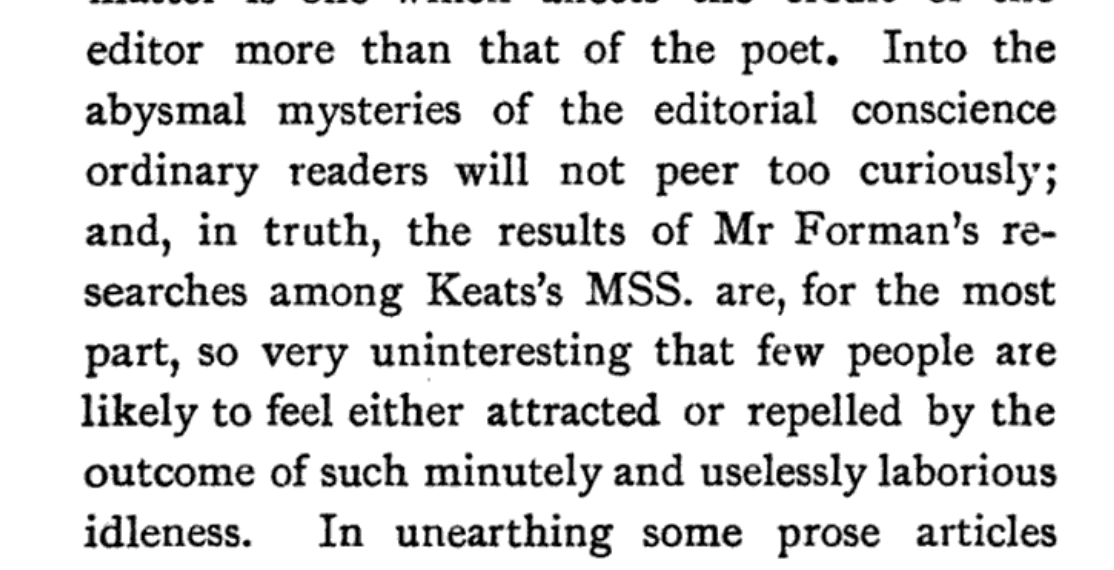
There are some more-than-somewhat mundane matters stuck in Watson’s craw as well, to which we here at the KLP must take exception. Watson has the gall to slag off “the painstaking modern editor!” In this case, Harry Buxton Forman is the one Watson has in mind. What are Forman’s sins? How about this one: “Keats wrote in a letter, ‘I much wait,’ instead of ‘I must wait,’ and Mr Forman carefully preserves the blunder.” Who would ever care about such things?? Only fools and charlatans, for sure. The KLP wholeheartedly agrees with Watson’s assessment below:

“Minutely and uselessly laborious idleness” indeed. Why bother devoting one’s time to the minute particulars of something like Keats’s letters…

But back to Sieveking and his response to Watson. Here’s what he has to say about such matters: “Much has been said by the critics as to the bad taste and indiscretion of publishing over-detailed biographies and letters of a private nature. But there is nothing in these letters which can by any possibility suggest the desirability of suppression. And even had there been, I do not think I should have yielded to the desire. If we are to know anything at all about a great poet after his death, I am of opinion we can hardly know too much.” To which we say, Mr. Sieveking: same.

To read the rest of Sieveking’s commentary, along with his transcripts of the letters, head over to the Fortnightly Review via Hathitrust. We’ll hear more about the Jeffery sisters in early June when Keats writes to Sarah and Marian.

**UPDATE–7 June 2018**
Turns out there are some inaccuracies in Rollins’s reading of the Jeffery family. First, it appears that the spelling of their name was JeffERY, not JeffREY. Confirmation of this fact comes largely from the fairly consistent spelling of William Jeffery Prowse’s name in that manner in publications mentioning or by him from the time. It also appears that Rollins’s supposition about Sarah traveling with John and Tom to Honiton is wrong. The problem that led to Rollins’s mistakes was his assumption that there were three sisters, Marian, Sarah, and Fanny. Alas, Fanny was a nickname for Sarah, whose full name was Sarah Frances Jeffery. So when Keats asks Mrs. Jeffery to give his goodbyes to Marian and Fanny, that means Marian and Sarah.

Because Rollins assumed that Sarah and Fanny were two different people, he also makes a mistake in identifying the recipient of the two letters Keats sends in May and June 1819. The first is addressed simply to “Miss Jeffry.” The second is to the same, although without the surviving manuscript, we don’t know exactly how it was addressed (or how Keats spelled the name). As Robert Gittings pointed out in his 1970 edition of Keats’s selected letters, the “Miss Jeffry” in question would have been Marian (as the eldest daughter, she would have been referred to as Miss Jeffery). Rollins mistake is compounded by Keats asking about “Fanny” in his 31 May 1819 letter, and also offering “my Compts to Mrs–your Sister.” Rollins assumes that the writer must be Sarah, because he assumes that the new “Mrs” was Marian, who did marry Isaac Sparke Prowse, but not until ten years after Keats’s letter. It seems, therefore, that Sarah/Fanny, not Marian, may have wedded sometime between May 1818 and May 1819.

Ok, takeaways: Tom and John traveled alone when they left Teignmouth, “Fanny” and “Sarah” are in fact one person (Sarah Frances), and Keats’s 1819 letters are to Marian, not to Sarah. Keats’s bit in his 9 June 1819 letter, “I shall ever remember our leave-taking with you,” is also cast in a different light knowing the you in question was Marian. That sentiment lends credence to the idea that there was some sort of close attachment, albeit perhaps mostly a one-sided one. For more on Marian and Keats, see our post about the 4 June 1818 letter.

Letter #69: To John Hamilton Reynolds, 3 May 1818

There are many letters that we wish still existed in their original manuscripts–here’s looking at you, negative capability–but today’s letter surely ranks pretty highly on the list. In this case the reason is different that it is with the negative capability letter, which we have only via John Jeffrey’s unreliable transcript (curse you, John Jeffrey! But also, thanks for trying at least). Today’s letter to Reynolds comes to us from a transcript by Richard Woodhouse, whose work can be trusted much more than that of Jeffrey. What we miss out on with this letter is Keats making a visual pun as he crosses his letter! We know it exists because Woodhouse makes a note explaining it. But oh my, it’d be great to see precisely how it looked in that original manuscript.

If you’re new here, you might not know what a “crossed letter” is. So here’s a primer for you. They are “fun” to read. Not the easiest task, that’s for sure. It’s a good thing Woodhouse possessed such a diligent bureaucratic sensibility, which is really put to the test with a letter like this one. And actually, it’s long past time that we recognize the heroic efforts of Woodhouse’s clerks. They actually did the majority of the transcribing, after which Woodhouse would look over their work and offer corrections where he identified them. As far as we know here at the KLP, no one has ever attempted to do any research into who those clerks might have been. But they’re important, too. Woodhouse shouldn’t get to hog all the credit!

But back to Keats. Here’s the bit when he makes his joke with the crossing:

Have you not seen a Gull, an ord, a sea Mew, or any thing to bring this Line to a proper length, and also fill up this clear part; that like the Gull I may ‡ dip–I hope, not out of sight–and also, like a Gull, I hope to be lucky in a good sized fish–This crossing a letter is not without its association–for chequer work leads us naturally to a Milkmaid, a Milkmaid to Hogarth Hogarth to Shakespeare Shakespear to Hazlitt–Hazlitt to Shakespeare and thus by merely pulling as apron string we set a pretty peal of Chimes at work–Let them chime on while, with your patience,–I will return to Wordsworth

Let’s unpack what’s going on here. Again, we only know what’s going on because Woodhouse (and here it is Woodhouse, not his clerk) offers this note of explanation: “(Here the first page of the letter is crossed–and the 2 first lines to this mark ‡ are written in the clear space left as a margin –& the word “dip” is the first word that dips into the former writing–.”

Woodhouse’s note explaining Keats’s crossing of the letter.

Here it’s useful to return again to how crossing works. Keats would have turned back to the first page of his letter, turned the paper 90 degrees, and written perpendicularly in relation to the written text from earlier in the letter. Because there would have been a bit of a margin on the left side (now the top of the page after being turned 90 degrees) which is “this clear part.” It seems possible that the sentence begins (“Have you not seen…”) on the fourth page and concludes there with “bring this Line to a proper length,” at which point the remaining text (“and also fill up this clear part; that like the Gull I may ‡ dip”) would fit in the margin of page one before dipping into the original next. But Woodhouse’s note implies that all of the two sentences appear cross-wise on page one. So who knows. This is why we need to see the original MS!

Another reason we might want to the original MS is to know where underlining actually occurs in Keats’s text and which instances of underlining are added by Woodhouse and clerks. (Regular readers will recall that Keats and underlining is a favorite arcane topic of the KLP’s Brian Rejack.) Is the “dip” underlined by Keats in order to emphasize his play on the dip into the letter’s earlier “sea of prose”? If it is, what about this more famous bit: “We see not the ballance of good and evil. We are in a Mist–We are now in that state–We feel the ‘burden of the Mystery.'” Did Keats underline that third “We” to distinguish between the inclusive “We” of the first two phrases and his shift toward an inclusive we (i.e. Keats and Reynolds)? What if he underlined it because that particular “We” was right in the middle of another word? Remember it’s a crossed letter, so it could certainly be the case that the word We is in a Mist because it can’t be seen very easily (remember earlier, Keats’s words dip “I hope, not out of sight”). Or what if a clerk mistook a stroke of the pen from one of the perpendicular words for an underlining of that third “We“? These are the kinds of questions that we need to have answered! One last thing and then we’ll move on–this is a long letter! Of course, it’s crossed, so there’s that. But still, it’s really long. One wonders if Keats was using larger paper than the typical 23 X 18 cm (approximately) sheets of most of his letter from earlier in 1818. Perhaps he had by this point purchased some of the 33 x 21 cm (approximately) sheets he’d use during his Northern Tour in June and July. Again, crucial questions!

If you’re less interested in the textual details like these, perhaps you’d rather hear about what makes this letter so remarkable. Yes, let’s talk about the “Mansion of Many Apartments.” This is Keats’s “simile of human life,” which begins in “the infant or thoughtless Chamber, in which we remain as long as we do not think–We remain there a long while, and notwithstanding the doors of the second Chamber remain wide open, showing a bright appearance, we care not to hasten to it.” Notice the continuing attention to vision and light, which Keats began with respect to hoping that Reynolds would be able to see the crossed writing. Maybe the idea that Keats would play with the crossing and “We” being in a mist isn’t all that crazy?? But to return, we arrive at the second chamber, or “the Chamber of Maiden-Thought,” where “we become intoxicated with the light and the atmosphere, we see nothing but pleasant wonders, and think of delaying there for ever in delight.” Here think of a youthful Keats writing poems in which he’s in awe of flowers, rolling around in the grass, pining for the moon, etc. That intoxicating “atmosphere” soon produces a different kind of experience of this chamber:

However among the effects this breathing is father of is that tremendous one of sharpening one’s vision into the heart and nature of Man–of convincing ones nerves that the World is full of Misery and Heartbreak, Pain, Sickness and oppression–whereby This Chamber of Maiden Thought becomes gradually darken’d and at the same time on all sides of it many doors are set open–but all dark–all leading to dark passages–We see not the ballance of good and evil. We are in a Mist–We are now in that state–We feel the ‘burden of the Mystery,’ To this point was Wordsworth come, as far as I can conceive when he wrote ‘Tintern Abbey’ and it seems to me that his Genius is explorative of those dark Passages. Now if we live, and go on thinking, we too shall explore them.

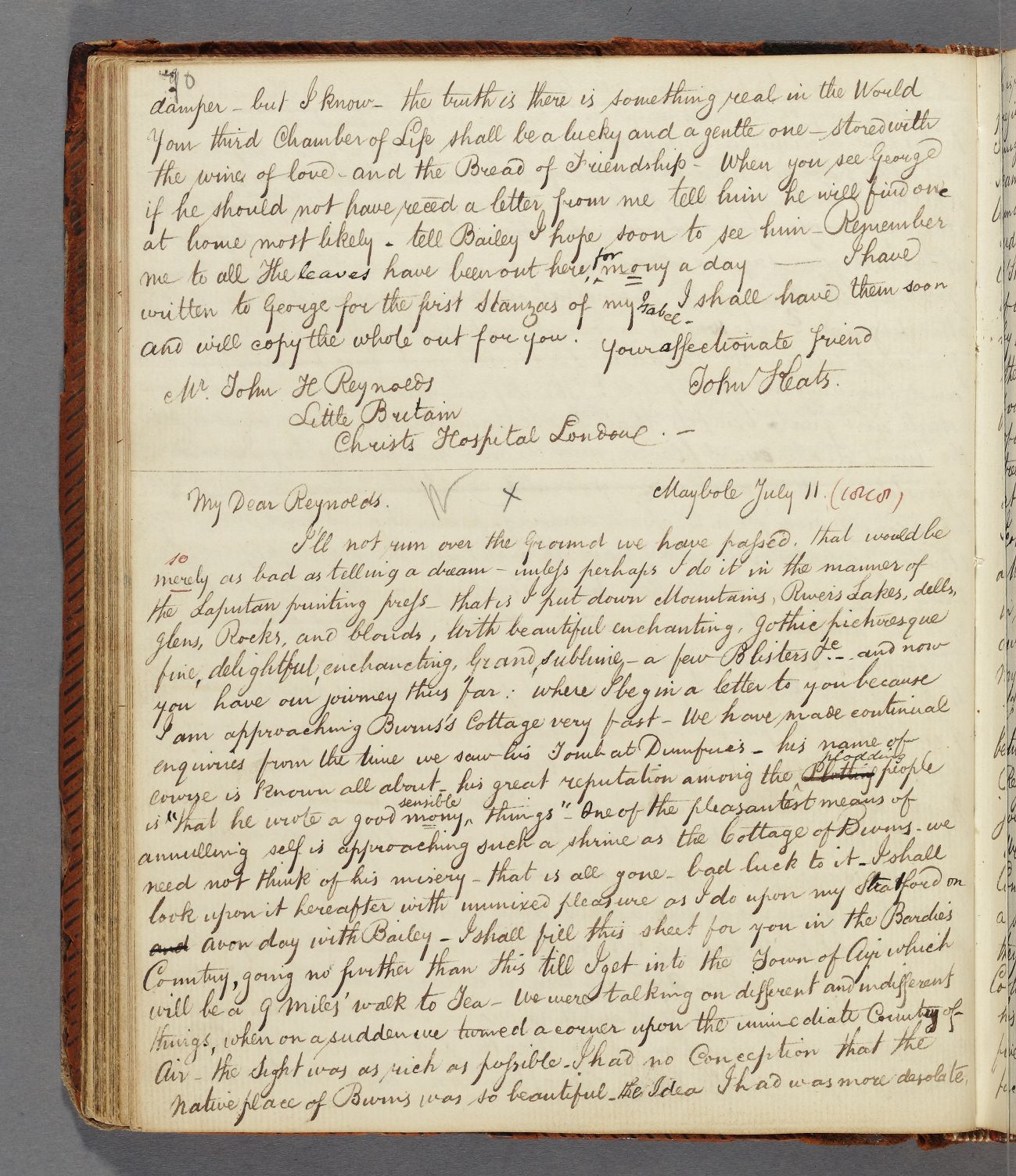
Of course, Keats did live (though only a few more years), and we daresay he did some high quality exploring of those dark passages. Even here, though, at the end of the letter Keats gives a hint of what might be found at the end of those corridors leading to further chambers. It’s a lovely sentiment, and one that we think Keats puts in practice in his life and work: “Tom has spit a leetle blood this afternoon, and that is rather a damper–but I know–the truth is there is something real in the World Your third Chamber of Life shall be a lucky and a gentle one–stored with the wine of love–and the Bread of Friendship.” As Keats himself writes earlier in this same letter, “axioms in philosophy are not axioms until they are proved upon our pulses.” So let’s strive to bring the wine of love and the bread of friendship into this world of “Misery and Heartbreak, Pain, Sickness and oppression.”

To read the rest of this remarkable letter, you can view images from Woodhouse (and clerk) below, courtesy of Harvard. Or read the text from Harry Buxton Forman’s 1895 edition here.

Page 1 of Woodhouse’s transcript of Keats’s 3 May 1818 letter to John Hamilton Reynolds. Keats Collection, 1814-1891 (MS Keats 3.3). Houghton Library, Harvard University.

Page 2 of Woodhouse’s transcript of Keats’s 3 May 1818 letter to John Hamilton Reynolds. Keats Collection, 1814-1891 (MS Keats 3.3). Houghton Library, Harvard University.

Page 3 of Woodhouse’s transcript of Keats’s 3 May 1818 letter to John Hamilton Reynolds. Keats Collection, 1814-1891 (MS Keats 3.3). Houghton Library, Harvard University.

Page 4 of Woodhouse’s transcript of Keats’s 3 May 1818 letter to John Hamilton Reynolds. Keats Collection, 1814-1891 (MS Keats 3.3). Houghton Library, Harvard University.

Page 5 of Woodhouse’s transcript of Keats’s 3 May 1818 letter to John Hamilton Reynolds. Keats Collection, 1814-1891 (MS Keats 3.3). Houghton Library, Harvard University.

Page 6 of Woodhouse’s transcript of Keats’s 3 May 1818 letter to John Hamilton Reynolds. Keats Collection, 1814-1891 (MS Keats 3.3). Houghton Library, Harvard University.

Page 7 of Woodhouse’s transcript of Keats’s 3 May 1818 letter to John Hamilton Reynolds. Keats Collection, 1814-1891 (MS Keats 3.3). Houghton Library, Harvard University.

Letter #68: To John Hamilton Reynolds, 27 April 1818

Keats’s spring stay in Teignmouth is fast coming to an end. Today’s letter is the penultimate one sent during the visit, the last one coming on 3 May, a day or two before he and Tom head back to London. His vacay has been a bit of a mixed bag. Keats put the finishing touches on Endymion during his stay. As we’ve seen again and again, Keats certainly didn’t enjoy being confined indoors thanks to the constant rainy weather since arrival at the beginning of March. But at least that meant he had time to get some writing done! In today’s letter we hear for the first time about one of the three narrative poems that will lend their names to Keats’s final volume of poetry: Isabella, or, as Keats refers to it here, “my ‘Pot of Basil.'” Reynolds and Keats had originally planned to each write poems based on stories from Boccaccio and publish them together. Reynolds, though, urged Keats to forge ahead without him. Reynolds did publish two poems based on Boccaccio in his book The Garden of Florence (1821).

Keats is a bit reluctant to hurry Reynolds along since his friend had been in ill health for much of the spring. He writes today that “you must not think of it [i.e. Reynolds’s Boccaccio poetry] till many months after you are quite well:–then put your passion to it,–and I shall be bound up with you in the shadows of mind, as we are in our matters of human life.” And indeed today they are still bound up in the minds of posterity (though their poems were not bound together in a book as they had intended), with Reynolds’s fame typically being associated with his friendship with Keats.

Also on Keats’s mind is Tom’s health, which has been up and down throughout the spring. In this letter Keats notes that Tom has “taken a fancy to a Physician here, Dr Turton, and I think is getting better.” Alas, the Keats brothers’ days of being nearly almost always all together are coming to an end. John will soon venture out for his Northern tour, George will get married and leave for America, and Tom will be beyond the reach of any physician’s help. Poor Tom.

It’s perhaps with some sense of the impending sufferings he will face that Keats continues his quest in what he called in his letter to Taylor on 24 April, “a love for philosophy.” Today he notes his intention to learn Greek and Italian, and to seek, with the help of William Hazlitt’s advice, “the best metaphysical road I can take.” He would start to learn some Italian with his reading of Dante over the next two years, and one can’t help but think that such study would have offered some insightful “metaphysical roads” to travel. If nothing else it led to the wonderfully strange dream vision that is The Fall of Hyperion. So cheers, Dante!

And one final bit of humor regarding this afterlife with which to conclude (although Keats does so at the letter’s opening). He apologizes to Reynolds for his delinquency in writing, and notes:

I hope I may not be punished, when I see you well, and so anxious as you always are for me, with the remembrance of my so seldom writing when you were so horribly confined–the most unhappy hours in our lives are those in which we recollect times past to our own blushing–If we are immortal that must be the Hell.

The KLP wholeheartedly agrees–embarrassment lingers in the memory pretty darn effectively, and an eternity of reflecting upon one’s failures seems like a pretty good approach to eternal torture! Dante must have come up with that in some circle, no?

Text of today’s letter comes from a transcript by Richard Woodhouse. It can be read in Forman’s 1895 here. Images below come courtesy of Harvard’s Houghton Library.

Page 1 of Woodhouse’s transcript of Keats’s 27 April 1818 letter to John Hamilton Reynolds. Keats Collection, 1814-1891 (MS Keats 3.3). Houghton Library, Harvard University.

Page 2 of Woodhouse’s transcript of Keats’s 27 April 1818 letter to John Hamilton Reynolds. Keats Collection, 1814-1891 (MS Keats 3.3). Houghton Library, Harvard University.

We Who Are Skittish

Sarah Sarai

Re: Keats’s 24 April 1818 letter to Taylor

You know how a person sometimes fails at squirming away discomfort? And so they drink a few beers, or binge on Netflix, or both? Or perform a multitude of other diversionary tasks – scrubbing odd corners of their abode and reorganizing their books, maybe by presenting-gender, geography, and first-name alpha? And all that is performed in order to numb-out. To not feel an anticipated sting of suspected failure or panic at the thought of confronting imperfection, regardless of the odds? The odds being, imperfection unlikely when making a book as John Keats, but whatever.

Because if a person feels pain and discomfort, even a simple sting, she or he or they are most likely not happy in that moment. And what does a person want, especially a person young as John Keats in 1818, but to be happy?

And so, in his letter of 24 April 1818, twenty-three-year-old John Keats thanks “dear Taylor” for the assist. Keats, as he writes, is among those “young men” who, “for some time have had an idea that such a thing as happiness is to be had, and therefore are extremely impatient under any unpleasant restraining.” An idea had anew by youth of all genders and preferences in every generation, of course. In the letter he describes second-guessing his decisions about Endymion. He reveals or at least plays with “revealing” an uneasiness with himself as a writer. “But I could not help it then…” What artist could “help” wanting another eye on the work?

Keats showed the manuscript of Endymion to worthy friend John Taylor who suggested this and that edit. And during that blessed moment when the manuscript was in a sort of conscionable limbo, Keats could catch his breath, which, after creating a classic epic poem of poetic romance and philosophy, he needed, said breath, to catch thereof. His gratitude for Taylor’s help is genuine and dear. His expression of same is playful; his description of one macrocosm of an emotion vivid.

In Endymion, as Ronald A. Sharp points out in his book, Keats, Skepticism, and the Religion of Beauty,

What Keats suggests . . . is that to fully actualize the soul, or potential identity with which each person is born one must not passively tolerate suffering but actively confront it as the Indian Maid does in Endymion:

Come then, Sorrow!
Sweetest Sorrow!
Like an own babe, I nurse thee on my breast! [4. 270-81]

Sharp further elucidates that suffering has value but requires no glorification:

This does not mean that one must seek suffering or that, like Rimbaud, one must search out the most intense and various experiences in order to savor even the gruesome and perverse for their full cargo of ‘life.’

Certainly, there are impulses within most religions to gruelingly treat the flesh in order to prove one’s worth as a devotee of whatever, whoever one has in mind. I think most any deity would be more than satisfied were we to feed and educate our children. At any rate, it’s not that Keats shies away from pain so much as he knows the universal instinct to do so. He has observed the emotional cycles in the laboratory of his being as “habitual sensation.” As one of my favorite American poets wrote, “Sorrow everywhere” (Jack Gilbert).

Another perspective–other than aha-ing Keats’ pain–another or perhaps the most obvious is that John Keats entrusted his work with a friend before chasing it into the world at large. Therefore, the very existence of Keats’s letters is verification that friendship and connection were more than part of Keats’s life. Friendships and navigating the spaces between us are basic to everyone’s life. Friendship was part of Keats’s poetry, part of his life and his poetry.

One summer many years ago I spent six weeks at Kenyon College in Gambier, Ohio with a dozen other high school teachers, courtesy of an NEH Fellowship. By night, we searched out most moist and leafy green grottos, elven-designed, for firefly watching. The only firefly I had seen since my family moved from New York to L.A. when I was eight was in The Golden Book of Elves and Fairies, illustrated by Garth Williams. In the seminar, we discussed writings on the theme “Literature and Friendship.” Professor Ronald A. Sharp (see above) led the seminar, the reading list of which included Books VIII and IX of The Ethics by Aristotle, whose insights into friendships and categorization of types of friends are astoundingly accurate and provoked, in me, many gotcha moments. The ancient philosopher was out of his league in some of his other volumes when it came to describing women’s anatomy, but friendship, which has no country, he got right. We read Shakespeare and other literature the titles which I can no longer remember–this was thirty years ago, and we read selections from Keats’s letters. Prior to that summer my thoughts of Keats’ interests were of beauty and imagination. Friendship added a new room for my little inner castle of thinking about Keats.

In the April 24, 1818 letter, Keats offers his friend a gentlemanly apology (“I think I did wrong to leave to you all the Endymion…”). It’s a statement signifying high politesse as there is no injured party, but the statement is not a meaningless gesture. John Taylor is a friend to whom Keats can admit his path to self-actualization (definitely my phrase, not his). “The road lies through application, study and thought.” And magical fireflies, quixotic to the imagination.

Sarah Sarai is the author of Geographies of Soul and Taffeta (Indolent Books) and The Future Is Happy (BlazeVOX). Her poems are in many journals and anthologies, including Boston Review, Threepenny Review, Say It Loud: Poems About James Brown, and Like a Fat Gold Watch: Meditations on Sylvia Plath and Living. She also writes short stories and has an MFA in Fiction from Sarah Lawrence College.


Works Cited

Ronald A. Sharp. Keats, Skepticism, and the Religion of Beauty. Athens: Georgia. The University of Georgia Press. 1979.

Jane Werner, author. Garth Williams, illustrator. The Giant Golden Book of Elves and Fairies. NY: NY. Golden Books. 1951.

Letter #67: To John Taylor, 24 April 1818

Editor’s Note: As part of the KLP’s ongoing pedagogy initiatives, one of the KLP co-founders, Brian Rejack, has been working with some of the students in his undergraduate romanticism course this semester to have students research individual letters and write introductory posts for the letters. Today’s post is the third of such posts scheduled to appear over the next few weeks. You can read previous ones here and here and here.

Daniel De La Cruz and Denzel Mitchem (Illinois State University)

Keats, in classic fashion, writes out another contemplative letter as he reflects on his newest book finally appearing in print. After having received an advanced copy of Endymion, Keats corresponds with his publisher John Taylor about some minor errata he’s identified in reading over the book. He also expresses his struggle to feel ready for his summer journey to the north, not because he lacks desire, but because he has an insatiable appetite for knowledge and he worries he may not yet be ready to truly benefit from the experience.

The letter begins with Keats apologizing to Taylor for leaving him “all the trouble of Endymion.” One can understand why a publisher might want his author around while putting the final touches on the book. Keats excuses his behavior (i.e. leaving London for Teignmouth) by suggesting that at a young age people are so eager to get happiness that they feel entitled to it,  and treat any “unpleasant restraining” as something to avoid at all costs. Keats now seems to think it is better to greet this difficulties and troubles “as an habitual sensation, a pannier which is to weigh upon them through life.” It would appear that Keats had been “impatient” about the task of correcting his poem for publication, but now he decides to add some edits even though the task has been completed!

Following his thoughts gives a glimpse into how Keats could apply a perfectionist’s care to the publication of his work when he didn’t feel too impatient to do so. Note the precise way he explains what he calls “identical” and “related” speeches in the poem: “If we divide the speeches into identical and related: and to the former put merely one inverted comma at the beginning and another at the end; and to the latter inverted commas before every line, the book will be better understood at the first glance”. While it is slightly confusing to follow, it shows that Keats does take his time and purposely looks through his work to improve upon it, and these seemingly minor edits can nonetheless serve a large purpose in Keats’s delivery. As he mentions, he does carry the reader’s interpretation of his work in mind: “the book will be better understood at the first glance.”

In the following paragraph, Keats explains in vivid detail the fact that he wishes to travel over the summer, but that he worries about his lack of experience before undertaking the trip. He wants to gain knowledge not only for his own sake, but also to help him serve the world better. In the letter Keats writes, “I find there is no worthy pursuit but the idea of doing some good for the world […] there is but one way for me–the road lies though application study and thought.” As much as Keats appreciates “delicious diligent indolence,” we also see his ability to approach a task with determination and an aim to help more than just himself. We thus see a Keats optimistic about the immediate future, and in overall good spirits thanks to his book’s appearance, his brother’s improving health, and his intentions to pursue “a love for Philosophy.”

The MS for today’s letter is at the Morgan Library (no images for us to provide at the moment). You can read text of the letter from Forman’s 1895 edition here. Images below come from Richard Woodhouse’s transcript (courtesy of Harvard). Coming up soon, a response to the letter from Sarah Sarai!

Page 1 of Woodhouse’s transcript of Keats’s 24 April 1818 letter to John Taylor. Keats Collection, 1814-1891 (MS Keats 3.3). Houghton Library, Harvard University.

Page 2 of Woodhouse’s transcript of Keats’s 24 April 1818 letter to John Taylor. Keats Collection, 1814-1891 (MS Keats 3.3). Houghton Library, Harvard University.

Letter #66: To John Hamilton Reynolds, 17 April 1818

Editor’s Note: As part of the KLP’s ongoing pedagogy initiatives, one of the KLP co-founders, Brian Rejack, has been working with some of the students in his undergraduate romanticism course this semester to have students research individual letters and write introductory posts for the letters. Today’s post is the third of such posts scheduled to appear over the next few weeks. You can read previous ones here and here.

Taylor Edwards and Hannah Henley (Illinois State University)

A rather short letter for today, and once again it is to one of Keats’s regular correspondents, John Hamilton Reynolds. As you may recall, in the last letter to Reynolds (9 April), Keats responded to Reynolds’s objections about the preface to Endymion. His submission of the original preface was on 21 March, and now, almost a month later, the debate finally concludes. In today’s letter to Reynolds it is apparent that Keats still feels ambivalent about the preface, even going as far to say that he “had an idea of giving no preface.” But then he reluctantly relents, declaring finally that “one should not be too timid—of committing faults.”

After discussing the topic of the preface, Keats goes on to mention the climate and surroundings of his current locale. At this time Keats is still in Teignmouth as he awaits the publishing of Endymion. The constant wet weather continues to disappoint, leading to Tom being “quite low spirited.” Keats nonetheless offers some humor by unfavorably comparing his native England and its climate to that of Italy: “It is impossible to live in a country which is continually under hatches. Who would live in a region of Mists, Game Laws, indemnity Bills, etc., when there is such a place as Italy?” These sentiments arrive as Keats continues to plan for his Northern Tour, which will not quite match the climate of Italy!

Keats then apologizes to Reynolds by mentioning that he intended to send him “songs written in your favorite Devon.” This demonstrates that he had intended to write more, but thanks to the weather he lacked the impetus to do so. By this point in 1818 it seems Keats is almost required to dwell on the weather, most particularly the “Rain! Rain! Rain!” Ever since his arrival in Teignmouth in early March, his displeasure with the constant rain has been a common topic in his letters to Reynolds. He appears to have enjoyed at least once nice day on 16 April, as he writes: “What a spite it is one cannot get out the like way I went yesterday I found a lane bank’d on each side with store of Primroses.” His pleasure at the rare good weather emphasizes his clear annoyance with the more consistent bad weather, which certainly has a great effect on him.

Notable history of this letter includes that this it was for a long time wrongly dated. The manuscript was a late acquisition of Arthur Houghton, and as such, editions including Rollins’s had relied on a transcript by Richard Woodhouse, which incorrectly dated it to 10 April. So good thing we have the manuscript now!

The text of the letter (based on the Woodhouse transcript) can be found in Forman’s 1895 edition. Images of the manuscript and the transcript are below. A few small discrepancies exist–see if you can spot them all…

Page 1 of Keats’s 17 April 1818 letter to John Hamilton Reynolds. Keats Collection, 1814-1891 (MS Keats 1.27). Houghton Library, Harvard University.

Page 2 of Keats’s 17 April 1818 letter to John Hamilton Reynolds. Keats Collection, 1814-1891 (MS Keats 1.27). Houghton Library, Harvard University.

Woodhouse’s transcript of Keats’s 17 April 1818 letter to John Hamilton Reynolds. Keats Collection, 1814-1891 (MS Keats 3.3). Houghton Library, Harvard University.

Letter #65: To John Hamilton Reynolds, 9 April 1818

Editor’s Note: As part of the KLP’s ongoing pedagogy initiatives, one of the KLP co-founders, Brian Rejack, has been working with some of the students in his undergraduate romanticism course this semester to have students research individual letters and write introductory posts for the letters. Today’s post is the second of such posts scheduled to appear over the next few weeks. You can read the first of them here.

Rachel Adams, Alisa Christensen, & Rachel Mackey (Illinois State University)

For today’s letter, we see Keats writing again to one of his typical correspondents in spring 1818, John Hamilton Reynolds. After delivering his preface to Endymion back on 21 March, we now gain insight into Keats’s thought process about it in response to his friends’ rejection of it. Keats opens the letter by remarking, “Since you all agree that the thing is bad, it must be so.” His publishers and Reynolds concurred that the tone of Keats’s first preface was far too apologetic and self-negating. Keats provides a lengthy explanation as to why it may have come across this way, and he confesses to Reynolds that he views the public as “a thing I cannot help looking upon as an Enemy.” He loathes the idea of being subordinate to the public, and that if he were to “write a Preface in a supple or subdued style, it [would] not be in character with [him] as a public speaker”. In this hostility towards the public, however, Keats’s appreciation for his friends is further highlighted in a rather touching moment. He emphasizes to Reynolds that such hostility and fear of vulnerability does not extend to his closest companions, as he “could not live without the love of [his] friends.” Thus, while Keats feels animosity toward the idea of the public, it’s clear just how much he valued the friendly relationships in his life.

After this moment of vulnerability, Keats further contemplates his attitudes toward the public and how he feels about his own public image. Keats states “I would jump down Ætna for any great Public Good,” a somewhat paradoxical statement when the context behind the phrase is examined. The reference is to the pre-Socratic philosopher, Empedocles, who believed he was a divine being of sorts, and thus (allegedly) leapt into the volcanic crater of Etna hoping to be apotheosized after death. So although Keats claims he is willing to sacrifice himself to do some good in the world, his reference also suggests that he considers himself a divine being above the public, while they are merely his followers. It’s Keats being a bit pretentious even as he’s claiming to not care about an audience.

That tension continues throughout this section. He wants to “daunt and dazzle the thousand jabberers about Pictures and Books” (i.e. the Public), but he “cannot be subdued before them.” His next image suggests that he’s thinking here specifically about reviewers, describing these “jabberers” as “swarms of Porcupines” who await Endymion with “their Quills erect.” Keats wants to “fright ‘em away with a torch” and (presumably) discourage them from even reading Endymion. The torch in this metaphor is his preface, but he acknowledges to Reynolds that perhaps it “is not much of a torch.” He eventually concedes that his original preface may have been too disrespectful towards his audience, but for now he remains indecisive about whether to rewrite it, and even suggests to Reynolds that if he has not reached a decision in four to five days to “tell Taylor to publish it without a preface.” Seemingly ready to leave the topic behind, Keats abruptly changes topics away from the issues with the preface, and towards Reynold’s health (a frequent subject with the two friends). Another regular topic we’ve encountered this spring surfaces next: the near constant rainy weather in Devon. Keats is clearly fed up with it, as he claims the sound of raindrops against his window “give [him] the same sensation as a quart of cold water offered to revive a half drowned devil.”

From this point on, Keats continues to write conversationally to Reynolds and does not return to Endymion again. Instead he tells Reynolds that he hopes “soon to be writing to you about the things of the north, purposing to wayfare all over those parts,” referring to his “Northern Tour” that he will undertake with friend and fellow poet Charles Brown beginning in late June (as Keats mentioned to Haydon in yesterday’s letter). Keats states “I have settled my accoutrements in my own mind,” but goes on to say that he still wants to have some time with Reynolds before he leaves. Keats then lists his many reasons for “going wonder-ways.” The reasons he lists to Reynolds are what you might expect: he wants to “enlarge [his] vision” and “escape disquisitions on Poetry.” These sound like excellent reasons to go on a months-long walking tour! Keats ends the letter with a few optimistic phrases that are actually pretty sad for the modern reader. While still writing about his summer plans, he writes “thus will I take all Europe in turn, and see the Kingdoms of the Earth and the glory of them.” Although Keats seems very excited about travel in this letter, we know that he dies before he is able to visit any more “Kingdoms of the Earth.” In fact, the next (and only) time that Keats travels out of the country is when he travels to Italy in 1820 in the vain hope of recuperating from his illness. Next, Keats writes that “Tom is getting better he hopes you may meet him at the top o’ the hill.” Unfortunately, even if Tom was showing improvement at the time Keats wrote this letter, it would have been short-lived as he died in December 1818. At least on 9 April 1818, though, Keats was feeling hopeful about the future.

As with most letters to Reynolds, the manuscript is lost, so the Woodhouse transcript is our only source for the text. Images of the transcript are included below courtesy of Harvard. Text of the letter from the 1895 Forman edition can be accessed here.

Page 1 of Woodhouse’s transcript of Keats’s 9 April 1818 letter to John Hamilton Reynolds. Keats Collection, 1814-1891 (MS Keats 3.3). Houghton Library, Harvard University.

Page 2 of Woodhouse’s transcript of Keats’s 9 April 1818 letter to John Hamilton Reynolds. Keats Collection, 1814-1891 (MS Keats 3.3). Houghton Library, Harvard University.

Page 3 of Woodhouse’s transcript of Keats’s 9 April 1818 letter to John Hamilton Reynolds. Keats Collection, 1814-1891 (MS Keats 3.3). Houghton Library, Harvard University.

Letter #64: To Benjamin Robert Haydon, 8 April 1818

Today’s letter marks a first that we here at the KLP are very excited about: the first mention of Keats’s summer plans! That’s right, we’re getting close to the Northern Tour of 1818. It was a big deal for Keats in many ways, and, lucky for all of us, it produced some amazing letters. We’ve got these gems to anticipate: the account of Keats’s visit to Stock Ghyll Force in Ambleside, Keats’s thoughts on Wordsworth campaigning for the Tory MP William Lowther (later Earl of Lonsdale), drinking “whuskey” at the birthplace of Robert Burns, going up Ben Nevis (and “N.B. [coming] down again”), other sights like Ailsa Rock and Fingal’s Cave, and LOTS of opinions on “the cursed Oatcake.” So get your walking shoes ready!

Keats gives some idea of his intentions on undertaking the trip as he informs Haydon of the plan. Here’s that passage:

I purpose within a Month to put my knapsack at my back and make a pedestrian tour through the North of England, and part of Scotland–to make a sort of Prologue to the Life I intend to pursue–that is to write, to study and to see all Europe at the lowest expence. I will clamber through the Clouds and exist. I will get such an accumulation of stupendous recollolections that as I walk through the suburbs of London I may not see them–I will stand upon Mont Blanc and remember this coming Summer when I intend to straddle ben Lomond–with my Soul!–galligaskins are out of the Question.

No word on the fate of the galligaskins, but we get a pretty good sense of Keats’s other planning priorities. After the (disappointing) completion of Endymion, Keats felt the need to gain a new set of experiences which could serve as poetic “full-ripened grains” to be stored for later use. Given that the poems most associated with Keats’s legacy are written after summer 1818, it seems like the tour must have done something good!

In the rest of the letter Keats does a fair bit of quoting and referencing Shakespeare, as he so often does when writing Haydon (and because Haydon had mentioned a favorite passage from All’s Well That Ends Well in the previous letter to which Keats was responding–the 10/11 May 1817 letter to Haydon is another Shakespeare-filled bit of their correspondence). We also see a continuation of Keats’s displeasure with Wordsworth, which had been growing since meeting him back in December 1817. Here is what he has to say to Haydon in today’s letter: “I am affraid Wordsworth went rather huff’d out of Town–I am sorry for it. he cannot expect his fireside Divan to be infallible he cannot expect but that every Man of worth is as proud as himself.” This frustration is part of Keats’s broader wariness of literary London at this point, which is another reason he cites for wanting to venture North in the summer. We’ll see more thoughts on Wordsworth once Keats ends up in the elder poet’s backyard!

Text of the letter comes from the MS housed at Harvard (images below). As is our wont, we recommend Forman’s 1895 edition of the letters for a good public domain version of the text.

Page 1 of Keats’s 8 April 1818 letter to Benjamin Robert Haydon. Keats Collection, 1814-1891 (MS Keats 1.26). Houghton Library, Harvard University.

Page 2 of Keats’s 8 April 1818 letter to Benjamin Robert Haydon. Keats Collection, 1814-1891 (MS Keats 1.26). Houghton Library, Harvard University.

Page 3 of Keats’s 8 April 1818 letter to Benjamin Robert Haydon. Keats Collection, 1814-1891 (MS Keats 1.26). Houghton Library, Harvard University.

Page 4 of Keats’s 8 April 1818 letter to Benjamin Robert Haydon. Keats Collection, 1814-1891 (MS Keats 1.26). Houghton Library, Harvard University.